artificial intelligence
The future of artificial intelligence.
AI Just Replaced Another 100,000 Workers — Is Your Job Next?”
AI Just Replaced Another 100,000 Workers — Is Your Job Next? Artificial Intelligence is no longer a futuristic idea — it is a present-day economic force reshaping industries, careers, and livelihoods across the globe. What began as a tool for automation in factories has now evolved into a sophisticated technology capable of performing tasks once thought to be purely human. And the most recent global employment reports reveal a startling fact: AI has replaced over 100,000 workers in the last year alone. This isn’t happening in one country. It’s a global wave. From the United States to India, China to Germany, companies are rapidly adopting AI systems to cut costs, increase efficiency, and outperform competitors. Entire job categories are shrinking. And the workers most affected often come from fields that were once considered secure. Customer service, data entry, banking, transportation, healthcare support, and even creative fields like writing and design are feeling the weight of AI disruption. Chatbots now handle customer complaints. AI software scans millions of documents in minutes. Autonomous vehicles are reducing the need for human drivers. And automated design tools are producing logos, videos, advertisements, and even songs. But the most shocking development is how fast this transformation is accelerating. Tech analysts say that what we are witnessing is the fastest job displacement event in human history. During past industrial revolutions, workers had decades to adapt. Today, the shift is happening in months. As companies adopt AI tools, human employees find themselves competing against systems that work faster, cheaper, and without rest. In the United States, major corporations in tech, finance, and e-commerce have laid off workers, citing "AI restructuring" as the primary reason. In Asia, call centers that once employed millions are now adopting generative AI agents that can speak multiple languages and solve problems in seconds. In Europe, manufacturing giants are replacing assembly workers with intelligent machines capable of precision work. But the most important question remains: Are all jobs at risk? Experts say no. While AI is replacing many jobs, it is also creating new opportunities — but these opportunities require new skills. Roles like AI trainers, data analysts, automation supervisors, cybersecurity specialists, and prompt engineers are seeing massive demand. Workers who adapt quickly may thrive, but the transition will not be easy. The global fear is understandable. A factory worker cannot instantly become an AI technician. A customer service agent cannot immediately transform into a machine learning specialist. Millions of workers lack access to training, resources, and opportunities. Governments worldwide are being urged to prepare safety nets — retraining programs, job assistance, unemployment support, and strict regulations to prevent abuse. Some countries have already begun funding digital literacy programs. Others are considering taxes on AI-driven companies to support displaced workers. Still, the future remains uncertain. Some futurists argue that AI will eventually take over almost all repetitive tasks, forcing humans to shift into more creative and strategic roles. Others warn of massive unemployment if urgent action is not taken. One thing, however, is clear: no job category is completely immune. Even professionals in law, medicine, and education are seeing parts of their tasks automated. AI can now draft legal documents, diagnose illnesses, and even grade school assignments. So what can workers do? Experts recommend three key strategies: 1. Learn new digital skills — even basic digital literacy increases job security. 2. Embrace lifelong learning — the workplace of the future rewards adaptability. 3. Build uniquely human abilities — empathy, creativity, leadership, and emotional intelligence cannot be automated. Artificial Intelligence is not slowing down. It is accelerating. And the decisions workers make today will determine whether they survive — or get swept away — by the wave of automation reshaping the global workforce.
By Gideon Polycarp12 months ago in Futurism
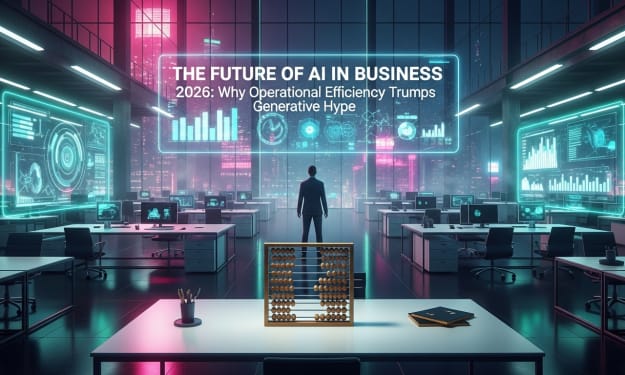
The Future of AI in Business 2026
The Great AI Reckoning Why 2026 is the Year of ROI Not R&D I remember the chaos of 2023. Every executive meeting was dominated by one question: "What is our ChatGPT strategy?" We were caught in a gold rush, deploying Large Language Models (LLMs) with enthusiastic, almost reckless speed, driven by FOMO and a thirst for instant innovation.
By Devin Rosario12 months ago in Futurism
5 Generative AI Breakthroughs That Will Define 2026
Why I Believe the Monolithic Model Is Over If you, like me, spent the last two years wading through the early waters of Generative AI, you know that the focus was on sheer scale. Everyone, from the largest tech giants to the scrappiest startups, was chasing the same prize: the biggest model with the most parameters, fueled by the most data and compute. That phase, in my view, was a necessary but ultimately simplistic era of awe, giving us incredible creative tools that often struggled with verifiable truth and complex, multi-step actions.
By Devin Rosario12 months ago in Futurism
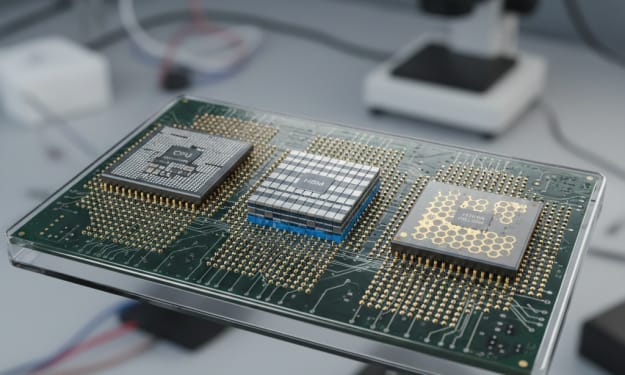
Heterogeneous Chiplets & Hybrid Bonding: The Modular Revolution Behind the Next Generation of Computing
Intro For decades, the entire semiconductor industry ran on a simple rule: shrink the transistor, shrink the chip, get more performance. Moore’s Law wasn’t just a prediction — it was a culture. Engineers believed that if you could just make everything smaller and put more on a single piece of silicon, the computer would keep getting better, faster, cheaper.
By Sebastian De Lima12 months ago in Futurism
The Light-Speed AI Revolution: How Photonic Chips Could Make Smart Devices Faster and Cooler
Intro / Lede Imagine your phone running a powerful AI model without draining battery, or a tiny gadget that recognizes voice, images and learns on the fly — all while consuming a fraction of today’s power. That’s the real promise behind photonic AI chips: using light (photons) instead of electrons to do the heavy math. If industry and labs turn promise into products, the way we build and use AI could flip fast.
By Sebastian De Lima12 months ago in Futurism
The Future of AI: How Artificial Intelligence Will Transform Our World in the Next Decade
In recent years, Artificial Intelligence (AI) has evolved from a futuristic concept to a transformative force influencing nearly every aspect of human life. With major breakthroughs in machine learning, natural language processing, and autonomous systems, AI is no longer just a tool used in laboratories or by tech giants; it's increasingly becoming a part of our everyday lives. But as we stand on the cusp of this technological revolution, one question looms large: How will AI truly reshape the future? The answer isn't simple, and it isn't one-size-fits-all. AI's impact spans a wide spectrum of industries, sectors, and societal domains, bringing with it both tremendous opportunities and significant challenges. The rapid advancements in AI technologies are setting the stage for a new era, but they also force us to ask critical questions about the ethics of automation, the future of employment, and the role of humans in a highly automated world. The Rise of AI: A Brief Overview AI isn't a new concept. For decades, science fiction has fueled imaginations with visions of robots, machines with human-like intellect, and fully automated cities. Yet, only in recent years has the potential for AI to have a true impact on society become clear. From self-driving cars to advanced diagnostic tools in healthcare, AI is becoming an integral part of our future. At its core, AI refers to machines or systems designed to mimic human intelligence and perform tasks that traditionally required human intervention. These tasks range from recognizing images, understanding spoken language, solving complex problems, to even predicting future outcomes based on data patterns. Some AI systems are already widely used in consumer products, like voice assistants (Siri, Alexa), recommendation algorithms (Netflix, YouTube), and customer service bots. But these are just the tip of the iceberg. Opportunities: How AI Will Transform Industries 1. Healthcare Perhaps no industry stands to benefit from AI as much as healthcare. AI-powered tools are revolutionizing diagnostics, making medical practices more efficient and accurate. With the ability to analyze vast amounts of medical data quickly, AI is enabling faster detection of diseases, such as cancer, at earlier stages when treatment is more effective. In fact, AI algorithms are already outperforming human doctors in some diagnostic tasks, such as reading radiology scans and predicting patient outcomes. Additionally, AI is playing a key role in drug discovery, helping researchers identify promising compounds and speed up clinical trials. Personalized medicine, tailored to an individual’s genetic makeup, is also becoming more feasible due to AI’s data-crunching capabilities. 2. Transportation Self-driving cars are one of the most talked-about applications of AI. While fully autonomous vehicles are not yet widespread, the technology is advancing rapidly, with companies like Tesla, Waymo, and Uber investing heavily in AI-powered autonomous vehicles. In the near future, we could see a major reduction in road accidents, a more efficient transportation system, and even reduced congestion, all thanks to AI. Beyond personal vehicles, AI is also transforming logistics and freight industries. Smart routing, predictive maintenance, and autonomous delivery systems are optimizing supply chains and making transportation safer and more efficient. 3. Education AI’s potential to revolutionize education is immense. Personalized learning powered by AI can adapt to each student’s learning pace and style, offering tailored content and assignments that better suit their individual needs. This could be a game-changer, especially for students with learning disabilities or those in under-resourced educational settings. Furthermore, AI can assist educators by automating administrative tasks such as grading and attendance tracking, giving them more time to focus on teaching and engaging with students. Virtual tutors powered by AI could also become commonplace, providing students with round-the-clock assistance and guidance. 4. Finance The financial sector is already benefiting from AI, with algorithms analyzing market trends and customer behavior to make smarter investments, predict financial crises, and offer personalized financial advice. AI is also being used to detect fraudulent activities, improving security in banking transactions. In the future, AI could make financial systems more transparent, efficient, and accessible, potentially democratizing access to financial services in regions where banking infrastructure is lacking. Challenges: The Dark Side of AI Despite the immense promise of AI, there are significant challenges and risks that we must confront. As AI systems become more capable, they could displace millions of jobs, particularly in fields like manufacturing, transportation, and customer service. This could lead to a major shift in the global job market, requiring massive retraining programs and new policies to manage the transition. Moreover, there are critical ethical questions regarding AI’s use. For instance, who is responsible when an autonomous vehicle causes an accident? Can we trust AI to make life-or-death decisions in fields like healthcare or military operations? As AI continues to develop, we will need robust frameworks to ensure these technologies are used ethically and responsibly. There is also the risk of deepening inequalities. While AI has the potential to benefit society as a whole, it could also exacerbate existing inequalities. For example, AI could favor wealthier nations or individuals who have access to the best technology, leaving others behind. This could widen the digital divide, leaving marginalized communities with fewer opportunities. Finally, there is the question of privacy. AI systems require vast amounts of data to function, and much of this data is personal and sensitive. How can we balance the need for data with the need for privacy and security? As AI grows, so too will concerns over surveillance, data breaches, and the misuse of personal information. The Road Ahead: What’s Next for AI? The future of AI is both exciting and uncertain. While it's impossible to predict the full extent of AI’s influence, there are a few trends we can expect to shape the coming years. 1. AI and the Workforce: As AI takes over more routine tasks, workers will need to adapt by developing new skills, particularly those involving creativity, critical thinking, and emotional intelligence—qualities that AI currently cannot replicate. 2. Ethical AI: There will be an increasing focus on creating ethical frameworks for AI. Organizations and governments will need to implement policies that ensure AI systems are transparent, fair, and accountable. 3. AI in Art and Creativity: AI is already being used to create music, paintings, and even literature. While AI’s role in creativity is still evolving, we are likely to see more collaborations between humans and AI in the artistic world. 4. AI-Powered Sustainability: AI could play a pivotal role in addressing global challenges like climate change. From optimizing energy consumption to improving agriculture, AI’s ability to analyze and predict outcomes could significantly contribute to sustainability efforts. Conclusion: Embracing the Future The future of AI is filled with boundless possibilities, from revolutionizing industries to enhancing the quality of life. However, it also presents challenges that must be addressed with care and consideration. As we continue to embrace AI’s potential, it is essential that we also ensure it is developed and implemented in ways that are ethical, inclusive, and beneficial to all. Ultimately, the key to navigating the future of AI will be balance—balancing the immense technological opportunities with thoughtful regulation and consideration of the human impact. As we look to the horizon, one thing is clear: AI is not just a tool; it is the driving force of tomorrow’s world. And as we step into this new era, we must ask ourselves: Are we ready for the AI revolution?
By The Insight Ledger 12 months ago in Futurism
How AI Writing Tools Are Leveling the Playing Field for New Creators in 2025
Five years ago, writing online felt like a game reserved for professionals. People believed you needed perfect grammar, years of experience, or expensive software to create something worth reading.
By Media Curation Team12 months ago in Futurism
10 Key Benefits of Integrating AI and ML in Your Business
The pace of change in the present world is rapid because of the so-called ‘digital’ era, where the demand increases exponentially with each passing day for better performance with increased efficiency and with fewer costs and a much satisfied ‘customer.’ The infusion of ‘AI’ and ‘ML’ is a guiding factor for any enterprise if they have ambitions of staying ‘competitive,’ ‘scalable,’ and ‘futuristic.’ Any enterprise can experience a change ‘revolution’ with the ‘implementation’ of ‘AI’ and ‘ML.’ Here are ten key ‘benefits’ of ‘AI’ and ‘ML.’
By Kiran Moda12 months ago in Futurism
Australia Data Center Market: Cloud Expansion, AI Workloads & the Future of Digital Infrastructure. AI-Generated.
The Australia data center market is experiencing a significant inflection point, driven by surging demand for cloud services, artificial intelligence (AI) workloads, and next-generation digital infrastructure. According to IMARC Group, the market was valued at USD 4.5 billion in 2024, and is projected to reach USD 7.8 billion by 2033, representing a CAGR of 5.7% over the 2025–2033 period. This growth trajectory underscores the increasing importance of data centers as core national digital infrastructure — supporting cloud services, enterprise IT, AI workloads, edge computing and high-performance applications. As cloud adoption deepens and demand for AI and data-intensive workloads rises, Australia’s data-center ecosystem is evolving robustly to meet future computing and storage needs.
By Shrestha Roy12 months ago in Futurism