artificial intelligence
The future of artificial intelligence.
How Will the Demand for AI Services Impact Google Cloud, Amazon AWS, and Microsoft Azure?
Artificial intelligence is reshaping the digital economy, and every enterprise from healthcare providers to global banks is accelerating its move toward AI-powered transformation. But as organizations deploy large language models (LLMs), predictive analytics, and intelligent automation at scale, one underlying trend has become clear: the demand for AI services is redefining the competitive landscape among major cloud providers: Google Cloud, Amazon Web Services (AWS), and Microsoft Azure.
By NextGen Narratives11 months ago in Futurism
The Silent Partner: How AI is Rewriting the Rules of Creativity
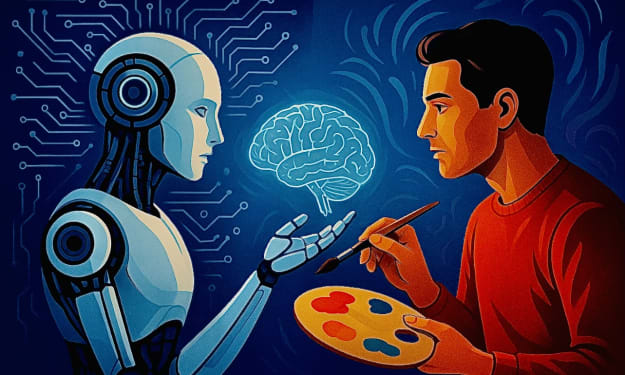
We’ve long believed creativity was the last bastion of humanity, something that algorithms could never truly replicate. Yet quietly, almost imperceptibly, AI has moved from crunching numbers to holding a paintbrush, and it’s producing work that challenges our very definition of art. This isn't about machines replacing artists. It's about something far more interesting: AI as a collaborative partner that can amplify human creativity in ways we're only beginning to understand. The New Creative Toolkit: AI in Action Across creative fields, AI tools are becoming as fundamental as a painter's brush or a writer's notebook: · The Written Word: Tools like ChatGPT and Claude help writers overcome blocks, generate ideas, and even co-write entire chapters. Platforms like Sudowrite offer "brainstorming" functions that suggest metaphors and plot twists. · Visual Arts: Midjourney, DALL-E, and Stable Diffusion have democratized visual creation, allowing anyone with a vivid imagination to create stunning artwork in seconds. These aren't just filters—they're interpretation engines that can blend styles and concepts in novel ways. · Music Composition: AIVA (Artificial Intelligence Virtual Artist) composes emotional soundtrack music, while Google's Magenta project explores how machine learning can create compelling melodies and harmonies. · Game Development: AI now generates entire game worlds, creates dynamic dialogue for non-player characters, and even helps design balanced game mechanics. Beyond the Hype: What Does This Mean for Artists? The emergence of AI creativity raises profound questions: The Inspiration Machine For many creators,AI serves as an infinite source of inspiration. A writer can generate twenty possible opening paragraphs. A concept artist can explore fifty visual directions for a character in an hour. This acceleration of the ideation process is perhaps AI's greatest gift to creativity. The Skill Shift Technical proficiency matters differently now.The ability to craft the perfect prompt—to guide the AI toward a specific vision—is becoming as valuable as traditional technical skills. The artist's role is shifting from executor to curator and director. The Authenticity Question When an AI generates a beautiful poem,who is the artist? The person who wrote the prompt? The programmers who built the model? Or the AI itself? This dilemma strikes at the heart of what we value in art: technical mastery, emotional expression, or simply the final product? Case Study: The AI-Augmented Creative Process Consider a novelist working with AI: 1. Brainstorming: She uses AI to generate character backstories and world-building elements 2. Writing: When stuck on a scene, she asks the AI for dialogue options 3. Editing: AI tools help identify pacing issues and suggest structural improvements 4. Cover Design: She collaborates with an image generator to create the perfect book cover The human remains the visionary, the quality controller, the emotional core—but AI handles much of the heavy lifting. The Dark Side: Ethical Brushstrokes This creative revolution isn't without its shadows: · Training Data Dilemma: Most AI models were trained on copyrighted works without permission or compensation for the original creators · Style Imitation: AI can perfectly mimic living artists' styles, potentially devaluing their unique voice · The Homogenization Risk: If everyone uses the same AI tools, could we lose the quirky, imperfect, uniquely human aspects of art? Looking Ahead: The Future of Human Creativity The most exciting developments will likely be in human-AI collaboration rather than AI replacement. We might see: · Personalized AI creative partners that learn an individual artist's style and preferences · New art forms that could only exist through human-AI interaction · Democratization of creativity where people who lacked technical training can now express their visions The Bottom Line AI isn't making human creativity obsolete—it's making it more accessible and potentially more profound. The artists of tomorrow won't be those who shun these tools, but those who learn to dance with them, who understand how to guide AI to serve human vision. The question is no longer "Can AI be creative?" but "What new forms of creativity can humans and AI discover together?" The canvas is vast, and we've only just begun to paint.
By GadgetGround11 months ago in Futurism
Beyond Voice Assistants: Your Home is About to Get a Whole Lot Smarter
We’ve grown accustomed to asking our speakers for the weather or setting a timer with our phones. But the next wave of domestic AI isn’t about responding to commands; it’s about fading into the background. It’s the shift from interactive AI to ambient AI, and it’s poised to fundamentally change our relationship with our living spaces. Welcome to the era of the truly "smart" home, an environment that senses, learns, and acts on your behalf, often without you uttering a single word. The Invisible Butler: What is Ambient AI? Imagine walking into your kitchen on a chilly morning. The lights have already gently brightened to your preferred morning level, and the thermostat began warming the floor 15 minutes before your alarm went off. Your coffee machine, having learned your schedule, is just finishing a fresh brew. No buttons were pressed. No apps were opened. This is ambient AI. It uses a distributed network of sensors, cameras, and microphones—often embedded in everyday objects—to build a continuous, contextual understanding of a space and its inhabitants. Instead of waiting for a "Hey Google," it's always on, subtly optimizing your environment for comfort, efficiency, and even health. The Gadgets Building Your Intelligent Home This isn't science fiction. The hardware ecosystem is already being built: · Sensing Systems: Devices like the Google Nest Hub with its built-in radar (Project Soli) can sense your presence and gestures. Advanced mmWave sensors in products like the Eve Motion can detect not just motion, but breathing and precise location in a room, all while preserving privacy by not using cameras. · Context-Aware Displays: Imagine a digital photo frame that shows your calendar when you walk up to it in the morning, then switches to recipe instructions when you approach it in the kitchen, and finally displays your relaxation playlist in the evening. The screen itself becomes an ambient interface. · AI-Powered Appliances: Newer refrigerators with internal cameras can track inventory and suggest recipes based on what’s about to expire. Ovens can recognize the food you put inside and automatically set the correct temperature and time. The Double-Edged Sword: Convenience vs. Privacy The promise is undeniable: unparalleled convenience, energy savings, and even safety (e.g., detecting a fall or a water leak). But this intelligence comes with a profound question: How much of our personal data are we willing to exchange for this comfort? An always-listening, always-watching home generates a staggering amount of intimate data: · Your sleep patterns · Your eating habits · Your daily routines and when you are away · Your emotional state (inferred from voice tone or movement) This data is a goldmine, not just for tailoring your experience but also for advertisers and, potentially, malicious actors. The central challenge of the ambient AI home will be trust. Can we trust the companies that build these devices to handle our data ethically and secure it impeccably? The Future: A Home that Cares for You Looking ahead, the potential expands beyond convenience into care. For an aging population, an ambient AI home could be a guardian—noticing changes in gait that might predict a fall, detecting missed medications, and providing companionship. It could monitor air quality for asthmatics or adjust lighting to help regulate circadian rhythms.
By GadgetGround11 months ago in Futurism
Can AI Replace Human Creativity?. AI-Generated.
Artificial Intelligence is evolving at a speed that feels almost unreal. Every few months, a new model arrives—smarter, faster, more capable than the last. It can write essays, compose music, generate images, and even mimic human voices. As AI becomes more deeply woven into our lives, a big question rises again and again:
By Voxwrite ✍️ 11 months ago in Futurism
The Unseen Cost of the AI Boom: Can We Code a Greener Future?. AI-Generated.
We’re living in the midst of an intelligence explosion. Not the sci-fi kind with rogue robots, but a very real, very rapid revolution driven by Artificial Intelligence. From chatbots that craft sonnets to algorithms that predict complex protein folds, the promise of AI is staggering. It’s automating the mundane, supercharging creativity, and solving problems that have baffled us for decades. But as we marvel at the outputs of models like GPT-4 and Midjourney, there’s a critical conversation we’re not having loudly enough: What is the environmental cost of this intelligence? Behind every seemingly effortless AI-generated answer or image is an immense amount of computational power. And that power has a very real, physical footprint. The Engine Room: Why AI is an Energy Guzzler To understand the scale, we need to peek into the engine room. Modern AI, particularly large language models and diffusion models, relies on a process called training. This isn't a one-time event; it’s a colossal undertaking where a model ingests terabytes of data—a significant chunk of the internet—to learn patterns and relationships. This process runs on powerful servers housed in massive data centers. These centers are the factories of the digital age, and they consume electricity on an industrial scale. · The Training Toll: Training a single, state-of-the-art AI model can consume more electricity than 100 homes use in an entire year. The associated carbon emissions can be equivalent to the lifetime emissions of five average American cars. · The Inference Iceberg: But training is just the beginning. The real, continuous energy drain comes from inference—the moment you ask a model a question and it generates a response. With billions of queries processed daily across the globe, this is where the long-term environmental impact truly adds up. The Cloud Isn't Fluffy: Data Centers and Their Thirst We often think of the "cloud" as an ethereal, weightless space. In reality, it’s a global network of data centers that require two things in enormous quantities: 1. Electricity: To power the processors (GPUs) that do the calculations. 2. Water: To cool those processors and prevent them from overheating. A single large data center can use millions of gallons of water per day, drawing on local water resources. This isn't to demonize AI. The technology itself is neutral. The challenge lies in how we power it. Coding a Sustainable Path Forward The solution isn’t to halt progress. It’s to innovate our way toward a more sustainable AI ecosystem. The good news is that this is already becoming a key focus for researchers and tech companies. Here’s where we’re heading: 1. Hardware Innovation: Companies are designing new chips specifically for AI workloads that deliver more computations per watt of energy. Think of it as swapping a gas-guzzling V8 for a highly efficient electric engine. 2. Algorithmic Efficiency: Researchers are creating "smarter" algorithms that achieve the same results with far less computational brute force. Techniques like model pruning and quantization are like teaching the AI to be more concise and less wasteful. 3. Strategic Siting: The carbon footprint of an AI query depends heavily on the energy grid that powers it. A data center running on solar power in Arizona has a fraction of the footprint of one running on coal. There’s a growing push to build and locate data centers near sources of renewable energy. 4. The "Small AI" Movement: Not every task needs a billion-parameter model. The rise of smaller, specialized models that are trained for specific tasks uses significantly less energy while still being highly effective. It’s the difference between using a massive industrial oven to bake a single potato and using a countertop toaster oven. Our Role in the Loop As consumers and professionals, we also have a part to play. We can be more mindful of our AI usage. Do we need to generate 100 images to find the perfect one? Does every simple query need to be handled by the largest, most powerful model? Cultivating a mindset of digital sustainability is crucial. The Bottom Line The AI revolution holds the key to solving some of humanity’s greatest challenges, including climate change itself. It’s being used to optimize energy grids, accelerate material science for better solar panels, and model climate patterns. But to harness its full potential for good, we must first address its own environmental blind spot. The goal is to create a virtuous cycle where AI not only runs on green energy but is also the very tool that helps us build a greener world. The next great innovation in AI won’t just be a more intelligent model—it will be a more efficient one. The future of technology depends not just on what we create, but on how wisely we power it.
By GadgetGround11 months ago in Futurism
The Echo of Tears in Rain: How Blade Runner Still Shapes the Future of Sci-Fi
Blade Runner didn’t just redefine sci-fi aesthetics—it rewrote the philosophical rules of the genre. This Movies of the 80s deep-dive explores how its questions about humanity, AI, and identity continue to shape modern science fiction from Ex Machina to Cyberpunk 2077.
By Movies of the 80s11 months ago in Futurism