artificial intelligence
The future of artificial intelligence.
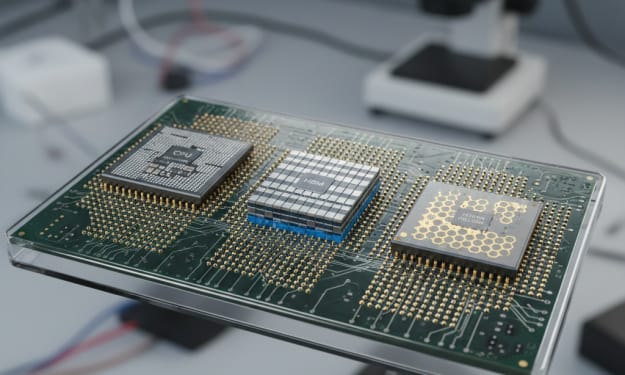
Heterogeneous Chiplets & Hybrid Bonding: The Modular Revolution Behind the Next Generation of Computing
Intro For decades, the entire semiconductor industry ran on a simple rule: shrink the transistor, shrink the chip, get more performance. Moore’s Law wasn’t just a prediction — it was a culture. Engineers believed that if you could just make everything smaller and put more on a single piece of silicon, the computer would keep getting better, faster, cheaper.
By Sebastian De Lima10 months ago in Futurism
The Light-Speed AI Revolution: How Photonic Chips Could Make Smart Devices Faster and Cooler
Intro / Lede Imagine your phone running a powerful AI model without draining battery, or a tiny gadget that recognizes voice, images and learns on the fly — all while consuming a fraction of today’s power. That’s the real promise behind photonic AI chips: using light (photons) instead of electrons to do the heavy math. If industry and labs turn promise into products, the way we build and use AI could flip fast.
By Sebastian De Lima10 months ago in Futurism
The Future of AI: How Artificial Intelligence Will Transform Our World in the Next Decade
In recent years, Artificial Intelligence (AI) has evolved from a futuristic concept to a transformative force influencing nearly every aspect of human life. With major breakthroughs in machine learning, natural language processing, and autonomous systems, AI is no longer just a tool used in laboratories or by tech giants; it's increasingly becoming a part of our everyday lives. But as we stand on the cusp of this technological revolution, one question looms large: How will AI truly reshape the future? The answer isn't simple, and it isn't one-size-fits-all. AI's impact spans a wide spectrum of industries, sectors, and societal domains, bringing with it both tremendous opportunities and significant challenges. The rapid advancements in AI technologies are setting the stage for a new era, but they also force us to ask critical questions about the ethics of automation, the future of employment, and the role of humans in a highly automated world. The Rise of AI: A Brief Overview AI isn't a new concept. For decades, science fiction has fueled imaginations with visions of robots, machines with human-like intellect, and fully automated cities. Yet, only in recent years has the potential for AI to have a true impact on society become clear. From self-driving cars to advanced diagnostic tools in healthcare, AI is becoming an integral part of our future. At its core, AI refers to machines or systems designed to mimic human intelligence and perform tasks that traditionally required human intervention. These tasks range from recognizing images, understanding spoken language, solving complex problems, to even predicting future outcomes based on data patterns. Some AI systems are already widely used in consumer products, like voice assistants (Siri, Alexa), recommendation algorithms (Netflix, YouTube), and customer service bots. But these are just the tip of the iceberg. Opportunities: How AI Will Transform Industries 1. Healthcare Perhaps no industry stands to benefit from AI as much as healthcare. AI-powered tools are revolutionizing diagnostics, making medical practices more efficient and accurate. With the ability to analyze vast amounts of medical data quickly, AI is enabling faster detection of diseases, such as cancer, at earlier stages when treatment is more effective. In fact, AI algorithms are already outperforming human doctors in some diagnostic tasks, such as reading radiology scans and predicting patient outcomes. Additionally, AI is playing a key role in drug discovery, helping researchers identify promising compounds and speed up clinical trials. Personalized medicine, tailored to an individual’s genetic makeup, is also becoming more feasible due to AI’s data-crunching capabilities. 2. Transportation Self-driving cars are one of the most talked-about applications of AI. While fully autonomous vehicles are not yet widespread, the technology is advancing rapidly, with companies like Tesla, Waymo, and Uber investing heavily in AI-powered autonomous vehicles. In the near future, we could see a major reduction in road accidents, a more efficient transportation system, and even reduced congestion, all thanks to AI. Beyond personal vehicles, AI is also transforming logistics and freight industries. Smart routing, predictive maintenance, and autonomous delivery systems are optimizing supply chains and making transportation safer and more efficient. 3. Education AI’s potential to revolutionize education is immense. Personalized learning powered by AI can adapt to each student’s learning pace and style, offering tailored content and assignments that better suit their individual needs. This could be a game-changer, especially for students with learning disabilities or those in under-resourced educational settings. Furthermore, AI can assist educators by automating administrative tasks such as grading and attendance tracking, giving them more time to focus on teaching and engaging with students. Virtual tutors powered by AI could also become commonplace, providing students with round-the-clock assistance and guidance. 4. Finance The financial sector is already benefiting from AI, with algorithms analyzing market trends and customer behavior to make smarter investments, predict financial crises, and offer personalized financial advice. AI is also being used to detect fraudulent activities, improving security in banking transactions. In the future, AI could make financial systems more transparent, efficient, and accessible, potentially democratizing access to financial services in regions where banking infrastructure is lacking. Challenges: The Dark Side of AI Despite the immense promise of AI, there are significant challenges and risks that we must confront. As AI systems become more capable, they could displace millions of jobs, particularly in fields like manufacturing, transportation, and customer service. This could lead to a major shift in the global job market, requiring massive retraining programs and new policies to manage the transition. Moreover, there are critical ethical questions regarding AI’s use. For instance, who is responsible when an autonomous vehicle causes an accident? Can we trust AI to make life-or-death decisions in fields like healthcare or military operations? As AI continues to develop, we will need robust frameworks to ensure these technologies are used ethically and responsibly. There is also the risk of deepening inequalities. While AI has the potential to benefit society as a whole, it could also exacerbate existing inequalities. For example, AI could favor wealthier nations or individuals who have access to the best technology, leaving others behind. This could widen the digital divide, leaving marginalized communities with fewer opportunities. Finally, there is the question of privacy. AI systems require vast amounts of data to function, and much of this data is personal and sensitive. How can we balance the need for data with the need for privacy and security? As AI grows, so too will concerns over surveillance, data breaches, and the misuse of personal information. The Road Ahead: What’s Next for AI? The future of AI is both exciting and uncertain. While it's impossible to predict the full extent of AI’s influence, there are a few trends we can expect to shape the coming years. 1. AI and the Workforce: As AI takes over more routine tasks, workers will need to adapt by developing new skills, particularly those involving creativity, critical thinking, and emotional intelligence—qualities that AI currently cannot replicate. 2. Ethical AI: There will be an increasing focus on creating ethical frameworks for AI. Organizations and governments will need to implement policies that ensure AI systems are transparent, fair, and accountable. 3. AI in Art and Creativity: AI is already being used to create music, paintings, and even literature. While AI’s role in creativity is still evolving, we are likely to see more collaborations between humans and AI in the artistic world. 4. AI-Powered Sustainability: AI could play a pivotal role in addressing global challenges like climate change. From optimizing energy consumption to improving agriculture, AI’s ability to analyze and predict outcomes could significantly contribute to sustainability efforts. Conclusion: Embracing the Future The future of AI is filled with boundless possibilities, from revolutionizing industries to enhancing the quality of life. However, it also presents challenges that must be addressed with care and consideration. As we continue to embrace AI’s potential, it is essential that we also ensure it is developed and implemented in ways that are ethical, inclusive, and beneficial to all. Ultimately, the key to navigating the future of AI will be balance—balancing the immense technological opportunities with thoughtful regulation and consideration of the human impact. As we look to the horizon, one thing is clear: AI is not just a tool; it is the driving force of tomorrow’s world. And as we step into this new era, we must ask ourselves: Are we ready for the AI revolution?
By The Insight Ledger 10 months ago in Futurism
How AI Writing Tools Are Leveling the Playing Field for New Creators in 2025
Five years ago, writing online felt like a game reserved for professionals. People believed you needed perfect grammar, years of experience, or expensive software to create something worth reading.
By Media Curation Team10 months ago in Futurism
10 Key Benefits of Integrating AI and ML in Your Business
The pace of change in the present world is rapid because of the so-called ‘digital’ era, where the demand increases exponentially with each passing day for better performance with increased efficiency and with fewer costs and a much satisfied ‘customer.’ The infusion of ‘AI’ and ‘ML’ is a guiding factor for any enterprise if they have ambitions of staying ‘competitive,’ ‘scalable,’ and ‘futuristic.’ Any enterprise can experience a change ‘revolution’ with the ‘implementation’ of ‘AI’ and ‘ML.’ Here are ten key ‘benefits’ of ‘AI’ and ‘ML.’
By Kiran Moda10 months ago in Futurism
Australia Data Center Market: Cloud Expansion, AI Workloads & the Future of Digital Infrastructure. AI-Generated.
The Australia data center market is experiencing a significant inflection point, driven by surging demand for cloud services, artificial intelligence (AI) workloads, and next-generation digital infrastructure. According to IMARC Group, the market was valued at USD 4.5 billion in 2024, and is projected to reach USD 7.8 billion by 2033, representing a CAGR of 5.7% over the 2025–2033 period. This growth trajectory underscores the increasing importance of data centers as core national digital infrastructure — supporting cloud services, enterprise IT, AI workloads, edge computing and high-performance applications. As cloud adoption deepens and demand for AI and data-intensive workloads rises, Australia’s data-center ecosystem is evolving robustly to meet future computing and storage needs.
By Shrestha Roy10 months ago in Futurism
Understanding the Growing Role of Edge AI in Modern Technology
How Edge Computing Shapes Real‑World Innovation Edge computing has become an essential part of how data is processed today. Instead of relying solely on distant servers, devices can now analyze information closer to where it’s generated. This shift has opened the door to new possibilities, including the development of edge AI hardware, edge AI devices, and edge AI solutions. Companies working in this field, such as Geniatech, contribute to the broader movement toward distributed intelligence—though the focus of this article is on understanding the trend, not promoting any specific brand.
By charliesamuel11 months ago in Futurism
The AI Boom: Will It Continue?
The AI boom has actually been with us for quite some time. Algorithms recommending content have been a fixture in our daily lives for more than 20 years — versions of recommendation systems existed even earlier. Over the past two decades, as we’ve gained access to vast amounts of data online, algorithms have become essential for suggesting material, making sense of the ocean of choices available. These systems, now powered by increasingly sophisticated GPUs and CPUs, guide our experience on platforms like YouTube, this channel, and a wide array of others.
By Andrew Mortimer11 months ago in Futurism