

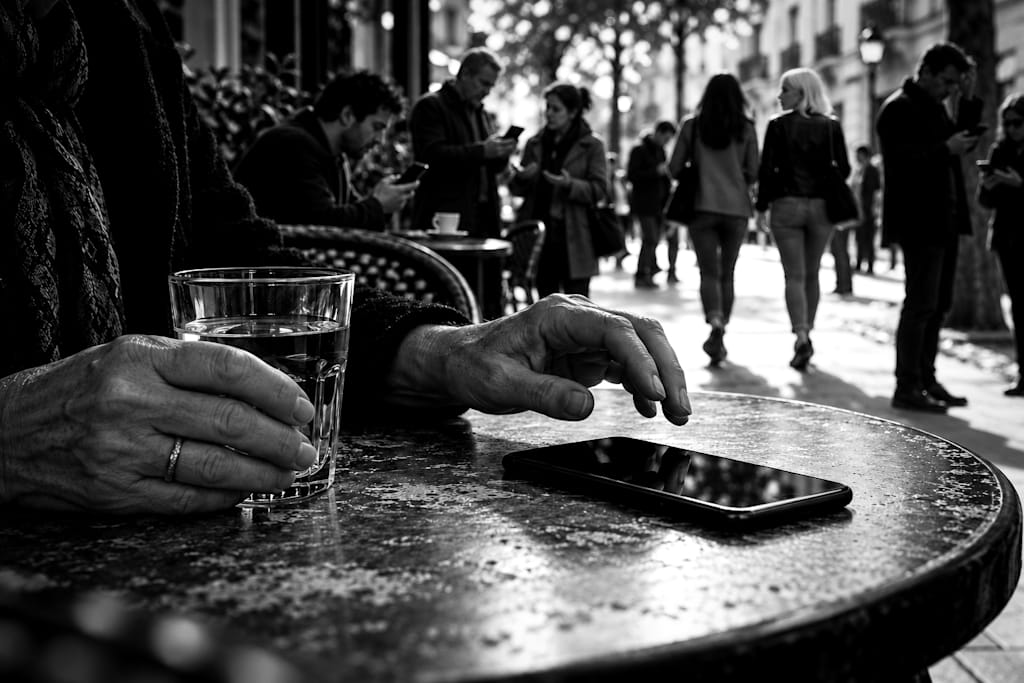
My daughter stopped moving outside a restaurant at 12.17.
I watched the little circle around her face settle over the building. Then my screen went black.
I pressed the side button. Held it down. Pressed both buttons.
Across the café, a man tapped his phone against his palm.
“Yours too?” the waitress asked. She was holding hers by one corner, away from her body.
I said yes.
“Fantastic. I’ve just paid nine hundred dollars for this cunt.”
The coffee machine continued grinding. A tram went past. Outside, a boy in a delivery helmet turned slowly, reading the names above the shops. I tried the button again.
A man near the window opened his laptop. People gathered behind him, bending over his shoulders.
“Not just here,” he said.
“Telstra?”
“No. Other countries.”
A woman asked whether he could get the school website.
The waitress brought my bill handwritten on an order slip. I had fourteen dollars in my purse. Enough for the coffee and a tip I could suddenly no longer afford.
I held the button down while I counted out the coins.
My daughter was twenty-three minutes away on foot. She might have ordered already. She might be getting ready to leave.
As I put my phone away, I felt a small release beneath my ribs. For the moment, there was nothing else I could do to it.
I took the phone out again before I reached the door.
She had come home eleven months earlier, after a man she had been seeing began waiting outside her work.
For six weeks she slept in my spare room. I bought the yoghurt she liked. I learned the sound of a car slowing outside after dark. At night, on my way to the toilet, I checked the strip of light beneath her door. If it was dark, I stood and listened.
Once I found her in the kitchen at two in the morning. We sat on the floor eating toast. She leaned against my shoulder and complained that I had bought the wrong butter. I could have stayed there until my hips seized.
Then she found somewhere else. She showed me how to find her on the map.
“Keep it on for now,” she said. “So you don’t worry.”
At first I looked when she worked late. Then when she went somewhere new.
Eventually I looked with breakfast.
If she was home, I could make tea. If she wasn’t, I checked again after the kettle boiled.
There was a supermarket she preferred, farther from her flat than another supermarket. A house she visited on Thursdays. A stretch of park where she sometimes stopped for so long that I imagined a bench and began to recognise it without ever having seen it.
I did not ask about these things. We had agreed I needed to stop asking so many questions.
Sometimes I woke needing the toilet and checked before I got out of bed. Sometimes I didn’t need the toilet.
I tried leaving the phone in the kitchen. I lasted until 1.40. It seemed a stupid way for something terrible to happen, while I lay in the next room congratulating myself on being sensible.
Lately, if I looked and she was home, I wondered whether she had left the phone there.
There was always one more thing I could think of.
Outside the station, a young woman held a dead phone to her ear while a man beside her said, “We’ll find a landline. We can ring the school.”
The traffic lights worked. I found this reassuring and then felt stupid for requiring the continued existence of red.
An electronics shop had turned a television towards the window. People stood beneath it, their own small black rectangles loose at their sides.
The newsreader was speaking over footage from Tokyo. Men in suits. A woman with a shopping bag. Someone holding a phone up to a camera.
SIMILAR FAILURES REPORTED ACROSS JAPAN.
A woman beside me said her son was there.
“Whereabouts?” somebody asked.
She shook her head. “He sent me pictures this morning.”
I stayed beside her until the report changed. She was trying to remember the name of his hotel. I knew the look on her face. I could have stood there and helped her be frightened for the rest of the afternoon.
Instead I went to find my daughter while I still knew where she was.
A shop was selling bottled water for cash. I bought one. She might be thirsty.
As I walked, people were asking each other things. Which tram went to the hospital. Whether a number needed an area code. If anyone had a pen. A man with a delivery bag stopped me for directions, and I knew the street. I could tell him where to turn.
For several minutes I felt almost competent. I knew telephone numbers. Three dead relatives and a butcher who had closed in 1998, admittedly, but the machinery was there. I could read a street directory. I had once travelled through whole days without anybody knowing where I was.
At seventeen I could find Yeva in a city.
I would ring her house. Her father usually answered, breathing through his nose, furious that his telephone had once again admitted a girl.
“Going into town?”
“Yeah.”
“See you there.”
That was the arrangement. No time. No particular place. I put on my boots and went.
She would be outside the record shop, sitting on the low wall with her knees apart, picking the label off a bottle. Or we would reach the station steps from opposite directions, both already grinning.
Sometimes she had bought my drink. There were days when I looked up and there she was, and we laughed at having done it again.
I remembered her taking my wrist to show me something in a window. The heat of the pavement through my boots. Going into a shop because I wanted to, without first checking anything.
At the next crossing I caught myself smiling. Then I thought of what I had felt outside the café.
I would not have to look tonight. I could wake at two and there would be nothing to look at. Whatever happened, I could not be expected to have checked.
The light changed. Someone behind me said, “You going?” I stepped off the kerb.
For half a street I allowed myself to imagine sleeping. Then I imagined her needing me while I slept.
I walked faster. The bottle knocked against my hip.
My daughter was laughing when I found her.
Her head was tilted back. A woman opposite was speaking, making a shape in the air with both hands. Then my daughter bent over the phone on the table. A white cable ran from it through the open window.
She pressed something and waited.
“Mum.”
She stood so quickly her bag fell off the chair. Her hand closed around my arm.
“Is yours working?”
“No.”
“What are they saying?”
“Japan too.”
“I know. But what are we supposed to do?”
I looked towards the television inside. A presenter was listening to somebody we couldn’t hear.
My daughter let go of my arm and picked up her bag.
“Here. Sit.”
The other woman introduced herself as Jo. We shook hands. Her fingers were warm and a little oily from lunch. Jo. The Thursday house, perhaps. I almost asked.
“What did you try?” my daughter said.
I showed her the buttons. She took my phone, pressed them in a different order and held the last one down. I watched her face while she watched the screen.
Nothing happened.
She kept holding it.
“That’s what mine does.”
She laid them side by side. Mine looked old beside hers, the case rubbed shiny at the corners.
I put the water on the table.
“For you.”
“Oh. Thanks.”
She unscrewed it and drank. I had been right about one thing.
Jo asked the waiter whether they could use the restaurant’s phone.
“You can try. There’s a queue.”
“Does your mum still have a landline?” my daughter asked her.
“No.”
We looked at the waiter. He waited another moment, then went back inside.
“My mother’s on her own,” Jo said. “I’m going to drive over.”
“I’ll come,” my daughter said.
She picked up her phone, remembered the cable and put it down again.
“How did you know we were here, Mum?”
“I saw before mine went off.”
Her hand stayed on the phone.
“Oh.”
“I hadn’t heard from you.”
“I spoke to you on Tuesday.”
“It’s Friday.”
“Yes.”
The waiter squeezed past. I pulled in my knees.
“I just wanted to know you were safe.”
“I am.”
“Of course. I can see that.”
But I kept looking. Her face. Her hands. The little burn near her wrist.
“Oven tray,” she said.
I nodded too quickly.
Inside, the presenter corrected something she had said about the networks. A man at the next table asked someone to write down the number on the screen. He couldn’t find a pen.
My daughter pushed the bread basket towards me.
“I didn’t realise you were looking so much.”
“Only when I’m worried.”
She rubbed her finger along the edge of her plate.
“I thought it helped you sleep.”
“It did.”
The cable crossed her wrist. She moved it away.
“At first.”
She put down the bread she was holding and turned her chair towards me.
“I wake up and...”
Jo reached for the jug.
“Water?”
“Yes, please.”
My daughter waited while I drank. Then she took her phone off the charger and pressed the button again.
“I liked it when I was walking home,” she said.
I set down the glass.
“Knowing you could see.”
Her thumb moved over the black screen.
“Not all the time. Just then.”
On the television, a man in Tokyo was speaking through an interpreter. People stood behind him waiting to speak. My daughter looked from his face to the phone in her hand.
“So if you need someone now...”
I wanted to say she could always call me.
Jo folded her napkin, opened it, folded it again.
“We should go soon.”
“She’ll have the radio on,” my daughter said. “Your mum. She’ll know more than we do.”
She put a hand over Jo’s.
There had been a morning in the spare room when I opened the curtains and found my daughter asleep with her mouth open. One leg outside the sheet. An ugly, thorough sleep. She had begun to leave mugs around again. She wanted to know if I was going to the shops.
I was so happy that week.
I still checked the street before putting the bins out.
She told me about the flat while I was writing the shopping list. I had written two tubs of her yoghurt. I made it three.
The waiter brought the bill. Their terminal was working, he said, if they had a card.
My daughter slid one from the back of her phone case.
“Mine today,” she told Jo.
Jo began to object.
“You paid last time.”
She took the bill inside. I watched her wait beside the counter, card in one hand and dead phone in the other. She spoke to the waiter, who turned the terminal towards her.
A little receipt came out.
When she returned she looked at it before putting it in her pocket.
“At least something works.”
She sat and took another piece of bread. Jo was finishing her water.
“At work, Sandra still writes every appointment in a book,” my daughter said. “She’s going to be unbearable on Monday.”
Jo laughed. I did too, a little late.
My daughter started telling me about a patient who had tried to negotiate the price of a crown with a bag of home-grown lemons. She did his voice, then Sandra’s. Jo began laughing before she finished.
“Whole bloody tree,” Jo said.
“Yes!”
I smiled with them. There were other people who knew when to come in.
My daughter looked down at the phone again. The smile stayed on her mouth a moment after the rest of her had stopped.
“When I was seventeen, Yeva and I used to go into town,” I said. “We’d just say, see you there. No time or anything.”
“Auntie Yeva?”
“She wasn’t anybody’s auntie then.”
“You just found each other?”
“Usually.”
“And if you didn’t?”
I broke the bread in my fingers.
“I went home.”
She looked at me, then down at the two halves of bread.
“What was she like?”
“Filthy laugh. Terrible fringe. She used to cut mine.”
“That explains some of the photos.”
I laughed with bread in my mouth. For a moment she did too.
I wanted to tell her about the drink waiting in Yeva’s hand. I wanted to give her the whole afternoon, the certainty that somebody would be there.
Jo stood up and my daughter reached across to unhook the strap of her bag from the chair.
“I don’t like this,” my daughter said.
She was looking at the phone.
“Neither do I.”
I had not pressed mine once since sitting down. It lay beside my glass.
“Where will you go after?” I asked.
“Jo’s mum’s first. Then I don’t know.”
“You could...”
She looked at me.
I could put sheets on the spare bed. There was bread in the freezer. I was already working out whether I had enough butter.
Jo was waiting with her jacket over her arm.
“I’ll be home after this,” I said. “If you need me.”
My daughter nodded. She put the bottle in her bag and unplugged the charger from the socket inside the window.
“Thanks,” she told the waiter, handing it back.
“I’ll text when we get there.”
“All right.”
She looked at the phone in her hand.
“Sorry. I keep doing that.”
She put it in her pocket and kissed my cheek.
“Have you got your tram card?”
“Yes.”
“Sure?”
I showed her the corner of it in my purse.
She held my arm again. Then she followed Jo.
At the crossing she turned. My hand went up before I knew whether she was looking for me. She waved back.
The light changed. My daughter stepped down beside Jo. Somebody passed between us. I moved to see her again.
On the other side, she turned her head towards Jo.
My feet hurt. I wanted to follow her so badly that I leaned forward.
I wanted her to keep walking.
They passed the pharmacy. For another few seconds I could see the back of her jacket between people. Then I couldn’t.
Inside, somebody asked the waiter to turn up the news. He said it was as loud as it went. A chair scraped behind me.
I sat down.
My glass was half full. There was bread in the basket. I put a piece on my daughter’s plate and brushed the crumbs from my skirt.
The waiter came to clear the table.
“Finished?”
They couldn’t have gone far.
“Not yet,” I said.
I took another drink.
About the Creator
Iris Obscura
I am many women. I am Iris.
Polite, sane, restrained? No. None of that.
Entropy at 3 am. Dead things stirring in your mind’s eye. Raking through your inner beauty to find something it hasn’t prettied up.
Maybe those.
Sometimes tender.
Read on.
Enjoyed the story? Support the Creator.
Subscribe for free to receive all their stories in your feed. You could also become a paid subscriber, letting them know you appreciate their work.
Comments
There are no comments for this story
Be the first to respond and start the conversation.