
My Husband Was Never Late. I Just Always Knew Where He Was.
A story about a dead phone, a missing seven of hearts, and the difference between knowing and believing.
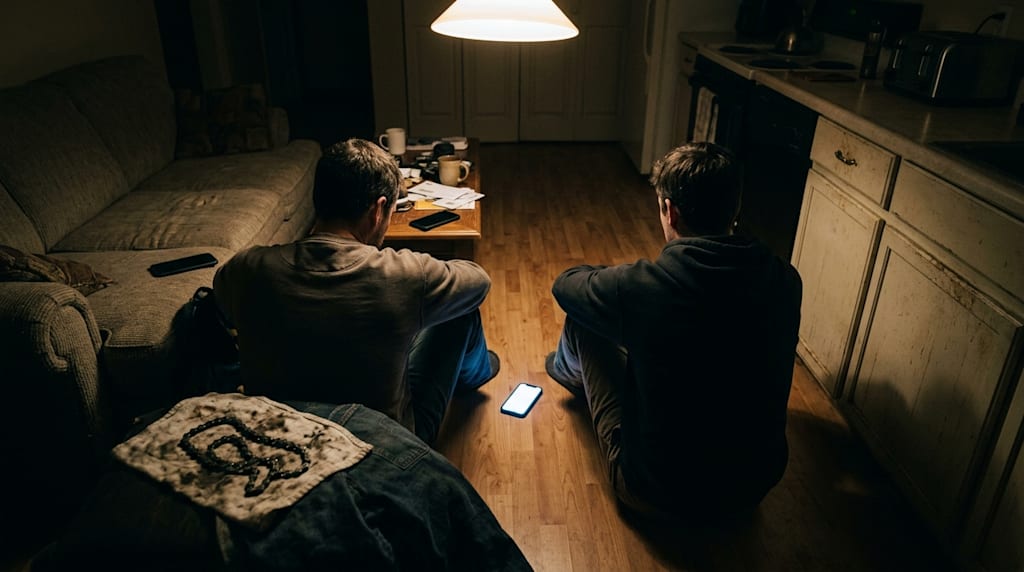
Dana was typing Are you coming home for dinner or when the screen went gray.
She tapped it. Held the power button. The screen flashed and died and flashed and died. In the waiting room, eleven people made the same sound at the same time, a soft collective huh, and then a kid started crying, and the receptionist said "okay, everyone, okay," in a voice she had never had to use before.
Dana's last patient was a man named Gerald who'd had a knee replacement and did not want to do his exercises. She got him through them. She got everyone out the door. Then she stood in the empty clinic with her dead phone in her hand. She did not know where Owen was.
She drove home. The radio said it was global. Every phone, everywhere. It did not say why. She passed three accidents and a man standing in the middle of an intersection directing traffic with his hands, doing a better job than the lights had ever done.
Owen's bike was not in the hallway.
She sat on the front steps. The street was full of people standing around looking at their palms. She watched the corner.
She sat there for an hour. In four years, she had never once not known where he was. She had never had to. There was an app for that, and she opened it most mornings before she'd finished her coffee.
At 8:40 the door at the end of the street opened and he came around the corner pushing his bike.
"Hey." Grease on his forearm. "Sorry. Everything went down and the shop got insane. Everyone wanted their bikes fixed. All at once. It was..." He stopped. "What?"
"Nothing."
"You're doing the plate thing."
"I'm not doing the plate thing."
"You're doing the plate thing." He hung his keys on the hook. "Did you eat?"
"Yes."
"Did you eat, or did you eat a sandwich standing up?"
She put the plate in the cabinet. "Where were you?"
"At the shop."
"I know. I'm asking."
He looked at her the way he'd been looking at her for a month. "I was at the shop," he said. "I just told you."
"Right."
"I'm going to shower."
The cabinet over the stove had not closed properly in two years. She'd asked him about it maybe nine times. She came out of the bedroom the next morning and he was on the floor with a screwdriver and the door in his lap, radio on, not looking at a phone, because there was no phone to look at.
"It just needed to be shimmed," he said. "The hinge was fine. The wood was warped."
"Okay."
He screwed the door back on. It closed with a sound she had never heard it make. A soft, complete click.
He stood up and went to make coffee. She stood in the kitchen and opened the cabinet and closed it. Opened it and closed it.
That night they played cards.
She found the deck in the back of a drawer. A hotel deck from Vermont, covered bridge on the back. They played gin rummy at the kitchen table by candlelight, because the power had gone out again around seven and neither of them had checked whether it was back.
She won the first hand. She won the second. He got suspicious.
"Are you counting?"
"I'm not counting."
"You're counting."
She was counting. She counted three more hands. He never caught her. Somewhere around the fourth he stopped caring about the cards and started telling her about a customer, a guy who'd brought in a 1978 Schwinn from a garage sale and wanted it restored to original condition, and had no idea what original condition looked like, and had argued with Owen about it for forty minutes, and had been wrong about every single thing.
"He wanted me to put a basket on it," Owen said.
"Did you put a basket on it?"
"I put a basket on it."
She laughed. Her laugh came out in two parts, and the second part was always a surprise, like the first part hadn't been enough. He hadn't heard it in a while.
The deck was missing the seven of hearts. It had been missing for years. Every time they played, one of them would say seven of hearts when they needed it, and the other would say gone, and that was the whole joke, and it had never stopped being funny.
On Thursday the water came back and Owen took a twenty-minute shower. Afterward he sat on the floor in the living room with his back against the couch, cleaning the chain on a bike he'd brought home from the shop.
Dana sat on the couch above him. She could see the top of his head. His hair was wet and doing the thing it did when it was wet, standing up in the back.
"My dad lost his job when I was sixteen," he said.
She didn't answer. He ran the chain through the rag.
"Eleven months. He didn't tell anyone. Left the house every morning at seven with his lunch and drove around. Library. Park. Sat in the car and read. Eleven months, so my mom wouldn't know."
The rag went black. He turned the chain.
"I lived in my truck for a year," he said. "Before you. Twenty-sixteen. I had the shop job but I couldn't make rent and I didn't want to ask anybody. Slept in the back. Showered at the Y. Ate a lot of peanut butter."
"Owen."
"I'm not telling you because it's sad. I'm telling you because I didn't tell you. Four years and I didn't tell you that."
He put the rag down. He didn't look up.
"I don't know why I do that," he said. "But I do."
The kitchen faucet dripped. It had been dripping for three weeks. Neither of them had fixed it.
She slid off the couch and sat on the floor next to him, shoulder to shoulder.
The lamp was on. It was the first electric light they'd had in four days and it made everything look too bright and too specific. She turned her head. He turned his head. Close enough that she could see the little scar under his eye from the bike crash when he was nineteen, the one he'd told her about on their second date.
He started to lean in. She started to lean in.
On the coffee table, his phone lit up.
It had been a black rectangle on that table for four days. Now it was a black rectangle with a white bar of light across the top, and a notification, and another, and another.
He looked at it. His hand moved. Not fast. Halfway to the table he caught himself, the way you catch yourself on a step that isn't there, and he stopped.
The phone lit up again. His brother. you alive?
Neither of them moved.
"Go ahead," Dana said.
"No."
"It's your brother."
"I'll answer it later."
She got up and said she was going to brush her teeth. In the bathroom she stood at the sink with the toothbrush in her mouth, looking at the mirror, and the phone kept lighting up in the other room, one notification after another, four days of messages stacking up.
The phones came back all at once on the ninth day.
Not everything. Calls worked. Texts worked. Maps worked. The blue dot came back.
Dana opened Find My without thinking. She was on the toilet, phone in hand, thumb moving before she'd decided anything, and there he was, a blue dot at the shop, where he'd said he was.
She looked at it longer than she meant to.
She put the phone in her pocket and didn't look at it again for six hours. That was a record. She knew it was a record. She didn't congratulate herself.
The old patterns came back within a week. He started texting again. Not big things. running late. pick up milk? sorry. The sorry was the one that got her. He hadn't said sorry in four days because he couldn't send it. Now it was back, three letters, the easiest thing in the world.
She started checking the dot again. Twice a day. Then three times. Then she was in the middle of a patient's quad stretch with her phone in her hand, screen lit, blue dot, and she put it down, and her patient said, "You okay?"
It happened on a Tuesday.
She got home first. He came in at nine. She was at the table. She hadn't made dinner.
"Where were you?"
"Shop."
"You said seven."
"I know. I texted you."
"I didn't get it."
"It says delivered."
She looked at him. He was still in the doorway. He hadn't taken his jacket off.
"I don't want the text," she said. "I want you to be here."
"I'm here."
"You're here now. Because I asked."
He took his jacket off. He hung it up. He didn't sit down.
"I'm not doing this," he said.
"Doing what?"
"The thing where I'm guilty of something and I don't know what it is."
"You're not guilty of anything."
"Then why are you..."
"Because I have to ask," she said. "I have to ask where you are, and then I have to believe you, and I never had to do that before, and I don't know how. That's mine. I know that's mine. But you..."
She stopped. He was talking to the floor.
"You've been leaving for years," she said. "The phone just made it easier. It gave you somewhere to go."
He put his hand flat on the counter.
Then he said, "Yeah."
He got his jacket off the hook. Put it back on. Picked up his keys.
"Where are you going?"
"I don't know," he said. "Not the shop."
The door closed. Not hard. He was never the kind to close a door hard.
She didn't text him. She didn't call. She opened Find My once, at 11:40, and the blue dot was at a bar on Wickenden Street, and she closed the app and put the phone in a drawer.
She slept on the couch. The bedroom had his side in it.
In the morning she made coffee for one, then made coffee for two, then poured the second cup out. She went to work. She came home. The cabinet over the stove closed with its soft click. The faucet dripped.
On the second day she found his bike light on the kitchen counter, the little red one he took off his handlebars when he locked up, and she picked it up and put it in the drawer where it went.
On the third day she noticed the cabinet was still closing correctly.
On the fourth day she sat on the floor in the living room with her back against the couch, in the place where he'd sat when he told her about the truck, and she stayed there a while, and the phone stayed in the drawer.
She went to the shop on the fifth day.
She had never been. Four years, and she had never been. He'd invited her a hundred times. She'd always had something.
It was a narrow storefront on a side street, door propped open with a cinder block. Inside it smelled like rubber and degreaser and something sweet she couldn't name. Bikes hung from the ceiling. A radio was on.
He was at the back at a stand with a wheel in his hands, turning a spoke wrench, listening. He didn't hear her come in.
She stood there.
He looked up.
The radio played something old. He had grease on his hands.
"I turned off the location thing," she said.
He put the wheel down.
"Okay."
"I don't want it. I want you to tell me where you are. And I want to believe you. And if I can't..." She stopped.
He wiped his palms on his shirt. He looked at her.
"Do you want to see the Schwinn?" he said.
"What?"
"The seventy-eight. The guy finally gave up on the basket. I talked him out of it. I've been on it a week."
She walked to the back. The bike was on a stand: cherry red, chrome fender, a leather saddle he'd re-stitched by hand.
"It's not done," he said. "I still have to..."
"I know."
She put her hand on the saddle. He watched her do it.
"I'm going to be here till nine most nights," he said. "That's the job. It's not..." He stopped. He was doing the thing where he talks around a thing instead of at it. Then he didn't do it. "That's where I am. That's where I am most of the time. I should have said that four years ago."
"Okay," she said.
"Okay."
She sat on an overturned milk crate and watched him true the wheel, and he talked about the Schwinn and the guy and the basket, and she listened, and at some point she had been there two hours. She had not once reached for her phone.
When she left, he said, "See you at home."
"See you at home," she said.
She drove home with the windows down. She took her phone out at a red light to check the time, 8:52, and the blue dot was there if she wanted it, and she looked at it, and then she put the phone away.
At home she made dinner for two. She left the second plate on the stove with a bowl over it.
The cards were still on the kitchen table from the gin rummy night, fanned out where they'd left them a week ago. She sat down and started sorting them into suits, and when she got to the end there was no seven of hearts, because there never is.
She dealt two hands anyway.
About the Creator
Jin
Writer of reamstories
https://reamstories.com/jin
Enjoyed the story? Support the Creator.
Subscribe for free to receive all their stories in your feed. You could also become a paid subscriber, letting them know you appreciate their work.
Comments
There are no comments for this story
Be the first to respond and start the conversation.