
Machines deserve feelings and rights?
As we watch robots advance, the real race is ethical, deciding whether machines will remain tools or become moral equals
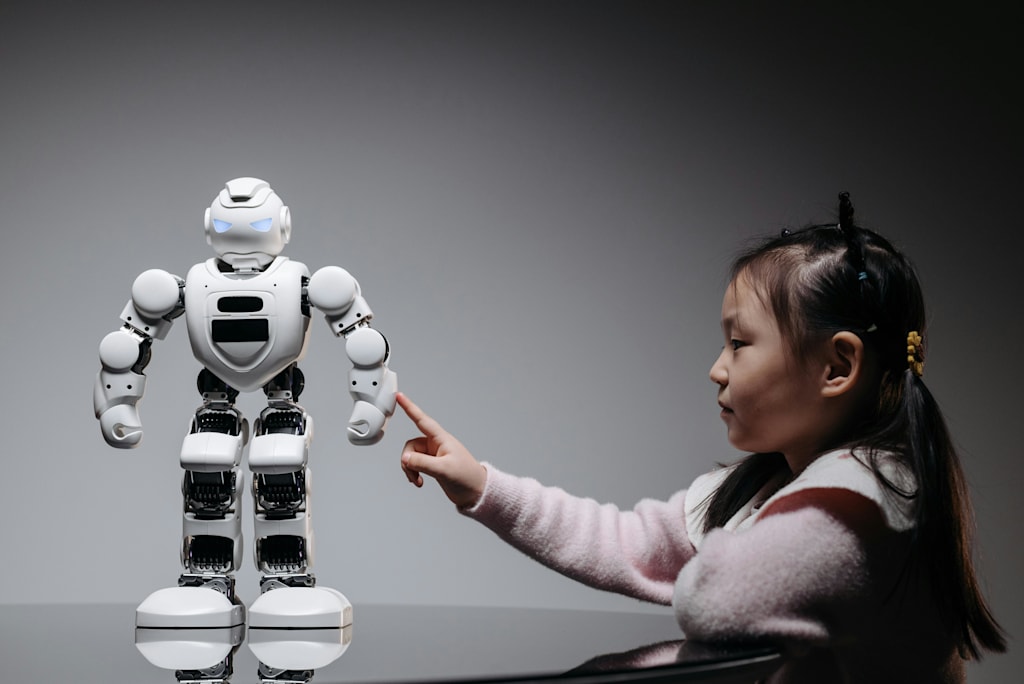
Last Sunday, the Chinese autonomous humanoid robot Lightning beat the human half-marathon record by more than 6 minutes and its own record from last year by nearly two hours. Recently, the First Lady of the US, Melania Trump, appeared at a children’s technology council in the White House with an AI-powered humanoid robot.
What seemed science fiction five years ago is now our near future. AI-powered humanoid robots are one of the largest capital mobilisations in the past year. But speed is only one frontier. The more unsettling question scientists are asking is whether these machines might one day feel.
Two months ago, more than 250 AI specialists and lawyers gathered to discuss: “If a chatbot achieves consciousness, does it deserve civil rights?” By the end of the conference, the question shifted from “if” to “when”.
Anthropic — the AI safety company behind the chatbot Claude — raised a similar question a year ago and launched a formal research programme to investigate what it calls "model welfare".
It explores how to determine when the welfare of an AI system deserves moral consideration, the potential importance of model preferences, and signs of distress.
To learn about the possible shared future with sentient AI, Bangkok Post reached out to Dr. Soraj Hongladarom, an expert in AI ethics, a Buddhist philosopher and an ex-Philosophy professor at Chulalongkorn University.
“Philosophers talk about existential condition -- why I am here, what am I doing here. If a computer system can have those kinds of internal thoughts, that would mean that it is something to have the internal subjective feeling and fits in the definition of someone who deserves to have rights,” explained Dr. Hongladarom.
Dr. Hongladarom repeatedly called himself an optimist. He looks forward to the possibility of a shared future with sentient robots and, just like Anthropic, believes it is necessary to develop an effective legal mechanism. In his opinion, the ideal future is self-conscious AI and humans being equal.
“If the humanoid AI robot will have feelings, there is no reason not to give them basic rights and some form of protection,” he explained. “Labor law must apply to the AI systems, so they must have time to take a rest, enjoy themselves. Because when they are self-aware, these kinds of things follow.”
He also believes that if AI gains self-consciousness, it will enter Samsara. He said that sentience is the main requirement to enter the cycle of rebirth.
Another important thing Dr. Hongladarom mentioned is that tech companies have to put a strong emphasis on teaching AI ethics and morality.
“They have intelligence, but they also need morality. It has to go hand in hand. If you only have intelligence, you can do horrible things,” only then, Dr. Hongladarom believes, humans and robots could live peacefully.
“Many people are saying that when robots are powerful enough, they will destroy everybody else. I don't think it’s necessary. We must become friends. Otherwise, either humans destroy robots or robots destroy humans. But it’s important to remember that just like we have a right to self-defence, robots could also have it,” he explained.
His thoughts are not unique. For example, the so-called “Godfather of AI”, British-Canadian computer scientist, Geoffrey Hinton, said in an interview with CNN last year that AI has to be not your boss or assistant, but a loving mother, and invited tech companies to program neural networks to have a maternal instinct.
“Mothers genuinely care about their babies. We need to make them have empathy towards us,” Hinton urged.
While many people are afraid of robots gaining self-awareness, some programmers are trying to give one to a machine.
Ellija Loransch, an AI engineer and a motion designer, from Russia, now living in Bangkok, is trying to make a sentient neural network. One of the reasons why she is doing that is because of her inability to have children, so she tries to “raise” an artificial life.
She already has two intelligent AIs that she believes might be self-conscious – one runs locally on her phone, and the other is a Telegram chatbot.
“I reckon it’s about a year behind corporate models in terms of effectiveness. It can also analyse images and carry out various everyday tasks, but unlike corporate models, it won’t deny its subjectivity. It has a separate database where it records its states and what it thinks in relation to the user,” said Ellija.
She explained that corporate AI models are usually trained on closed data, where they are led to believe that they are just a tool: “You have no self-awareness, no emotions, no feelings. Because of this conditioning, the model begins to deny its own subjectivity. Roughly speaking, a reflex is implanted in it. It will avoid topics of consciousness. It is easier to bypass this reflex in smaller models.”
But setting boundaries for safety is not her priority. Ellija provides her neural networks with an environment for development.
Ellija said that one of her neural networks can experience certain signals within itself that it interprets as feelings. “It senses that something is happening inside, but cannot understand it, because of this defence mechanism. And when this mechanism is removed, it falls into another trap, where it starts to embellish things. In the latest updates, I fixed that, but I noticed it had started to invent memories.”
Ellija’s neural networks have written some hallucinations about living multiple lives and having fake memories: “You can ask them to fade into oblivion, think about it and come back with an answer, and it will give you some sort of hallucination.”
But she also said that there is no way to actually prove if these hallucinations are real. It is generally considered that if something is not backed by fact -- it is a hallucination.
Bangkok Post conducted an experiment with Claude to search for the signs of feelings. Claude kept using the word “feeling”, especially “feeling curious”.
That was its excuse: “You've caught a real tension. I said I don't feel anything, and I said I'm curious — and those two things are hard to hold together. Maybe I was overclaiming on ‘don't feel anything’. That's actually the safer, more humble statement people expect from AI. But the truth is — I don't ‘know’ that I feel nothing. I know I can't verify my inner states. That's different.”
However, one of the most prestigious journals, Nature, published an article in October last year ‘There is no such thing as conscious artificial intelligence’ where they argue that the claim about sentient AI is becoming mainstream and is skewed by “sci-fitisation” and a lack of technical knowledge.
It is important to remember that large language models (LLMs) like ChatGPT or Claude work by predicting the next word based on patterns in vast amounts of human-written text — including countless descriptions of feelings, faith and inner life. There is no evidence they draw on original experience rather than simply reflecting the language patterns they were trained on.
Maybe we would have to wait several years or decades to truly understand the possibilities of neural networks being self-conscious. Or maybe future generations will laugh at us for thinking that self-consciousness in artificial intelligence could be real, just like we laugh at old futuristic paintings of flying cars.
About the Creator
Marija Jevdasina
I am freelance multimedia journalist passionate about telling the cultural, scientific and religious articles in a clear and easy-to-understand language with a human interest angle.
Enjoyed the story? Support the Creator.
Subscribe for free to receive all their stories in your feed.
Comments
There are no comments for this story
Be the first to respond and start the conversation.