
In an old star cluster, astronomers discover an enigmatic gap.
An opening among a sea of stars

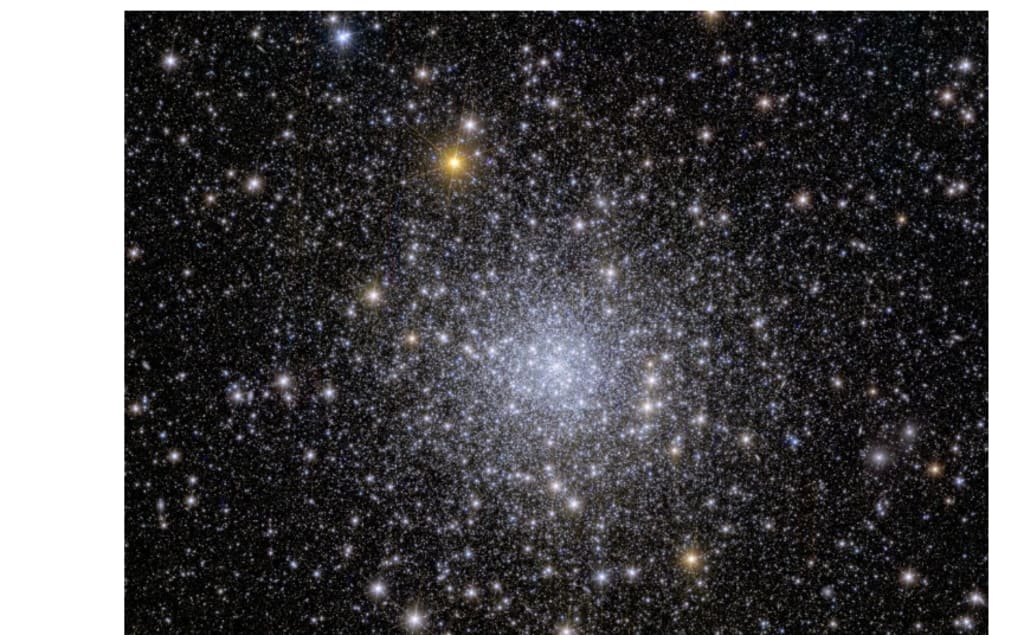
The goal of the study was to examine how stars in an old cluster near Earth moved. However, they unintentionally learned something about the universe's most prevalent stars. They observed something quite strange about red dwarfs that ought to be there. Despite their distance, the lack of these stars may offer some insightful information about the internal changes taking place in these stars.
An opening among a sea of stars
The discovery came from data gathered by NASA's Hubble Space Telescope and the European Space Agency's Euclid space telescope. Researchers were looking at NGC 6397, an old globular cluster in the constellation Ara that is roughly 8,000 light-years away from Earth.
A narrow gap appeared where a particular group of low-mass red dwarf stars should have appeared when the scientists classified the cluster's stars based on colour and brightness. Scientists from Baltimore, Maryland's Space Telescope Science Institute (STScI) oversaw the investigation.
This feature has never before been found inside a globular cluster, according to the team's discovery. According to Andrea Bellini, co-author of the paper, "the discovery was serendipitous." "We discovered the gap even though we weren't searching for it."
A secret initially discovered nearer to home
When examining data from the European Space Agency's Gaia observatory in 2018, astronomers discovered a similar gap. Using a Hertzsprung-Russell diagram, a crucial technique for mapping stars based on their brightness and temperature, that study looked at around 250,000 neighbouring stars.
Relatively few stars developed in a small slice that cut through the red dwarf population, according to the Gaia data. At the time, scientists believed that changes occurring inside some red dwarfs were connected to the missing stars. The new finding demonstrates that a much older and farther-off star population exhibits the same phenomena.
Instability within a star
In reality, the stars are not going away. Rather, they go through a short phase that reduces their visibility at specific brightness levels. Red dwarfs with masses between 0.34 and 0.36 times that of the Sun are thought to exhibit the effect. Fuel accumulation in the core of these stars can cause energy explosions that cause internal instability.
The size, temperature, and brightness of a star are all slightly changed by these internal variations. Astronomers use a chart that shows a noticeable gap because very few stars are captured during this transition.
The discovery provides a unique window into the interiors of stars. Scientists are typically unable to see firsthand what occurs inside stars. Rather, they have to deduce those processes from temperature and light observations.
The significance of globular clusters
Among the Milky Way's oldest structures are globular clusters. In a comparatively small area of space, they are home to hundreds of thousands of stars.
Many of them were created just after the universe itself began to exist, more than 13 billion years ago. The estimated age of NGC 6397 is 13.4 billion years. "Stellar evolution and stellar populations are best studied in globular clusters," stated Massimo Griggio of STScI, the lead author of the study.
"The stars in this globular cluster are roughly the same age and at the same distance from one another." Compared to stars dispersed throughout the galaxy, the stars are easier for researchers to compare because they originated together. As a result, variations between stars are more likely to be caused by actual physical processes than by variations in composition or age.
A novel instrument for measuring distance
Additionally, the finding may enhance one of the most crucial metrics in astronomy: distance. Astronomers can determine an object's actual size, brightness, and position in cosmic history by using its distance. Accurately measuring those distances continues to be a problem in the field.
Russell Ryan, a co-author of the study, stated, "We can use this information to estimate the cluster's distance because we can determine the brightness where the gap is with very high precision and know for what stellar masses it occurs." The red dwarf gap may become another helpful standard for calculating distances throughout the galaxy if subsequent studies validate the technique.
Hubble-specific technology
Extremely accurate measurements were needed to identify the feature. It is challenging to separate the stars in NGC 6397 due to their near proximity. The group used analysis methods and software created over the course of more than 20 years for the Hubble Space Telescope.
With the use of these instruments, scientists were able to precisely measure and identify individual stars within the dense cluster. The missing-star pattern became evident when Euclid's considerably broader vision of the sky was added.
Team member Mattia Libralato stated, "With these tools, we demonstrate that we can push the limits of Euclid, and in the future, the Roman Space Telescope, across a wide field of view." "More research using Euclid and, eventually, Roman will hopefully enable us to better characterise this feature also in other globular clusters."
About the Creator
Enjoyed the story? Support the Creator.
Subscribe for free to receive all their stories in your feed.
Comments
There are no comments for this story
Be the first to respond and start the conversation.