
Genius "Unpaid Labor": How Clicking Traffic Lights Built Today's AI Powerhouse 🌐
How billions of internet users accidentally became the world's largest AI training army. 🌍

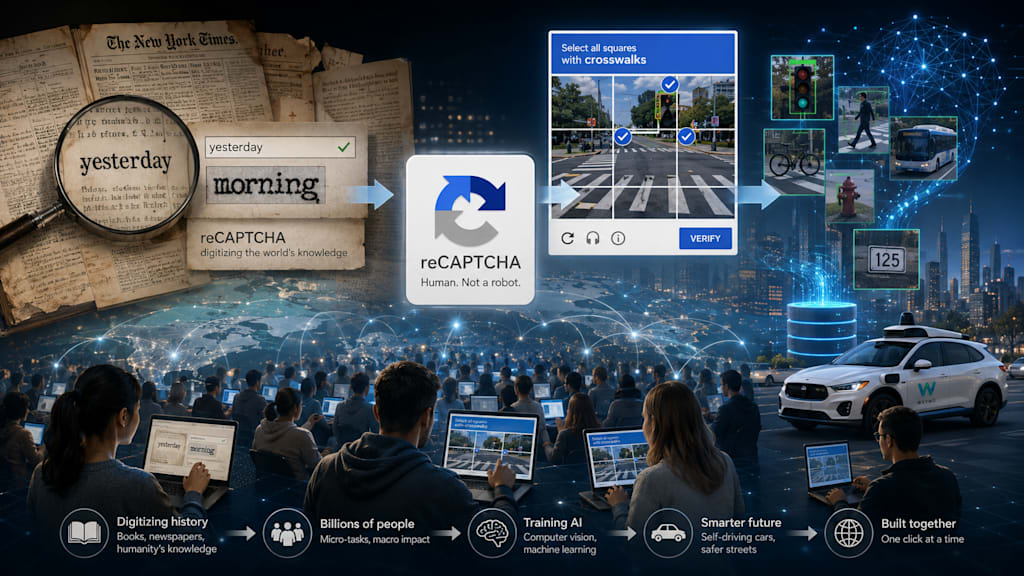
We all know that moment of frustration. You want to quickly buy a concert ticket 🎫, log into your bank, or download a file, when suddenly a digital wall blocks your path. Distorted, twisted letters that look like they were written by a toddler, or a grid of nine photos with the instruction: “Select all squares with crosswalks” 🚶♂️.
Muttering under your breath, you squint and click. You wonder: “Is that one millimeter of the pole part of the traffic light, or not?”. The verification passes. You have proven to the system that you are human.
Think you just wasted five seconds of your life on a useless security procedure? Think again. You actually just finished a free shift in the largest and most efficient data "factory" in human history.
This is the story of how billions of people, completely unknowingly, built the foundations of modern artificial intelligence.
A Brilliant Idea by a Young Scientist 🧠
It all started in the early 2000s at Carnegie Mellon University. A young scientist from Guatemala, Luis von Ahn, co-created the CAPTCHA system (an automated test to tell computers and humans apart). The idea was simple – bots were great with code, but they couldn't "see" the way humans do. Showing them distorted text blocked internet scammers and spammers.
The system became a massive hit. Soon, however, von Ahn had a realization that changed the course of digital history. He noticed that every day, millions of people spent a few seconds typing these meaningless words. When he added up those microseconds, it turned out that humanity was wasting hundreds of thousands of hours every day.
“What if we could harness this giant collective energy to do something useful?” he thought. That is how reCAPTCHA was born.
The core difference was brilliant: while the old method generated random, useless squiggles, the new solution started feeding people real-world textual and visual problems that machines couldn't figure out on their own.
Phase 1: How We Saved Literary History 📚
In the first version of reCAPTCHA, instead of random letters, the system started showing us... cropped words from old books and newspapers 📰.
Google (which quickly smelled an opportunity and bought von Ahn’s company in 2009) had an ambitious plan back then: to digitize all the world's literature. They scanned millions of pages, including the entire archive of The New York Times dating back to the 19th century. But there was a catch. The old paper had yellowed, the ink was smudged, and the fonts were archaic. Traditional Optical Character Recognition (OCR) software gave up on about one out of every ten words. To a computer, it was just an inkblot; to a human, it was obviously a word.
The reCAPTCHA mechanism worked through a genius two-word system:
The Control Word: One word was already known to the system. If you typed it correctly, the system knew you were a human and weren't cheating.
The Puzzle Word: The second word came from a damaged archive that the computer couldn't decipher.
If ten different people from all over the world independently typed the same puzzle word as "yesterday," Google gained 100% certainty that this was the correct word. In this way, by typing crooked letters during logins, humanity digitized decades of The New York Times issues and millions of books for Google Books. For free. In just a few years.
Phase 2: Shifting Gears to Self-Driving Cars 🚗
Over time, algorithms learned to read text better than we can. The books were rewritten, and reCAPTCHA evolved. The text disappeared, and its place was taken by photos divided into a grid.
We started clicking on fire hydrants, buses, bicycles, storefronts, and traffic lights 🚦. The official reason? Detecting next-generation bots. The real secondary goal? Training Computer Vision for autonomous vehicles.
Imagine you are building a self-driving car. For it to navigate streets safely, its artificial intelligence needs to differentiate a pedestrian from a tree shadow, or a "Stop" sign from a restaurant advertisement, all in a fraction of a second. For the AI to learn this, it needs millions of examples. Someone has to describe, or "tag," those images. In the tech world, this kind of data annotation costs a fortune and takes thousands of hours.
Google solved this on a global scale:
Instead of paying an army of workers, they created a free army out of all of us.
By pointing out crosswalks or motorcycles, we were building a massive database for projects like Waymo (Google's self-driving taxis) and improving Google Street View maps, where reCAPTCHA was used to read house numbers and street signs.
The Global Anthill 🐜
The anthill metaphor fits perfectly here. A single ant means very little and carries just a tiny twig. But millions of ants working within a single system can build impressive structures.
reCAPTCHA is a textbook example of crowdsourcing—tapping into the wisdom and labor of the crowd. It is a micro-time-tax we pay for using a secure internet. Instead of money, we pay with our unique, human capacity for perception.
Today, security systems have changed significantly. The latest versions of reCAPTCHA mostly run quietly in the background 💻—analyzing how you move your mouse, how fast you type, and your browser cookies, rarely bothering us with images anymore.
Yet, the foundation for the AI revolution we are witnessing today was poured back when you were impatiently clicking on storefronts. The next time you see a prompt asking you to find traffic lights on your screen, smile to yourself. You are putting another brick into the framework of our digital future.
About the Creator
Piotr Nowak
Pole in Italy ✈️ | AI | Crypto | Online Earning | Book writer | Every read supports my work on Vocal
Enjoyed the story? Support the Creator.
Subscribe for free to receive all their stories in your feed.
Comments
There are no comments for this story
Be the first to respond and start the conversation.