
AI Agents vs Employees: The Entry-Level Job Crisis Nobody Is Talking About
How artificial intelligence is quietly reshaping the first rung of the career ladder before most people realize what's happening.

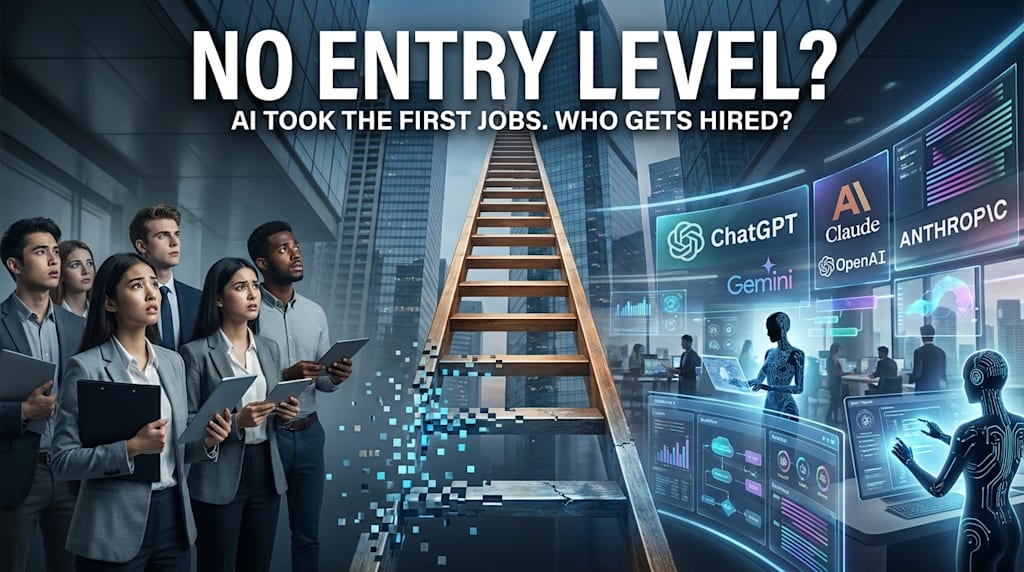
AI Agents vs Employees: The Entry-Level Job Crisis Nobody Is Talking About
A few months ago, I noticed something strange while browsing job boards.
The usual flood of entry-level positions seemed thinner than before. Companies were still hiring senior specialists, managers, and experienced professionals, but many of the beginner roles that traditionally helped people get their foot in the door appeared to be disappearing.
At first, it seemed like a temporary hiring slowdown. Then I started seeing another pattern.
The same companies were talking openly about AI assistants, AI agents, and workflow automation.
That may not be a coincidence.
For years, discussions about artificial intelligence focused on a dramatic question: Will AI replace human workers?
What is actually happening looks far less dramatic and potentially far more disruptive.
AI is not replacing entire careers overnight. Instead, it is quietly taking over the kinds of tasks that have historically belonged to entry-level employees.
Think about the first job many people have in an office. It often involves organizing information, preparing reports, responding to routine emails, scheduling meetings, researching basic questions, or updating spreadsheets. These tasks may not be glamorous, but they serve an important purpose. They allow new workers to learn how an industry functions.
Today, many of those responsibilities can be completed by AI systems in seconds.
That creates a challenge that receives surprisingly little attention.
If companies need fewer people to perform beginner-level work, where will the next generation gain experience?
The issue is not that AI can do everything. It clearly cannot.
Most businesses still rely heavily on human judgment. A manager handling a difficult client conversation cannot simply hand the situation to an algorithm. A business leader making a major strategic decision cannot avoid responsibility by pointing to an AI-generated recommendation. Trust, leadership, negotiation, and creativity remain deeply human skills.
Yet businesses are not looking for places where AI can replace their best employees.
They are looking for places where AI can reduce costs.
And entry-level tasks often sit at the top of that list.
This helps explain why the current moment feels different from previous waves of automation. Earlier technologies often replaced physical labor. Modern AI is targeting information work, especially the repetitive digital tasks that occur entirely on a computer screen.
Ironically, some of the people who spent years preparing for knowledge-based careers may now face more disruption than workers in trades that require physical presence and hands-on expertise.
An electrician, plumber, or technician still has to show up and solve real-world problems. An AI agent cannot repair a broken electrical system in a family home.
A junior analyst who spends most of the day gathering information, however, faces a different reality.
The long-term consequences could be significant.
Many professions depend on a pipeline. Beginners become experienced workers, experienced workers become leaders, and leaders train the next generation. If fewer people enter that pipeline, organizations may eventually face talent shortages at higher levels.
That possibility rarely appears in discussions about AI, yet it may become one of the technology's most important economic effects.
History suggests that technological change creates new opportunities even as it removes old ones. The internet eliminated certain jobs while creating entire industries that previously did not exist. AI will likely follow a similar path.
The difference is speed.
Changes that once unfolded over decades can now happen within a few years.
That is why the most valuable skill today may not be coding, writing, designing, or even prompting AI systems.
It may be adaptability.
People who learn how to work alongside intelligent tools will probably remain valuable. People who assume their profession will remain untouched may face a far more difficult adjustment.
The conversation about AI often focuses on whether machines will replace humans.
A more important question may be this:
If AI handles the work that used to teach people how to build a career, what does the first step of that career look like now?
About the Creator
Future Lens
Exploring AI, technology, and the future of work through research-driven insights.
Enjoyed the story? Support the Creator.
Subscribe for free to receive all their stories in your feed.
Comments
There are no comments for this story
Be the first to respond and start the conversation.