
A LIFEBOAT HANGING IN THE UNIVERSE": THE ARTEMIS II CREW DELIVERS AN EMOTIONAL RETURN TO HOUSTON
They flew further into the blackness of space than any humans in history. But when the four astronauts of the Artemis II mission finally took the stage in Texas this weekend, they didn’t want to talk about rockets or distance records. They wanted to talk about the terrifying, beautiful fragility of Earth.

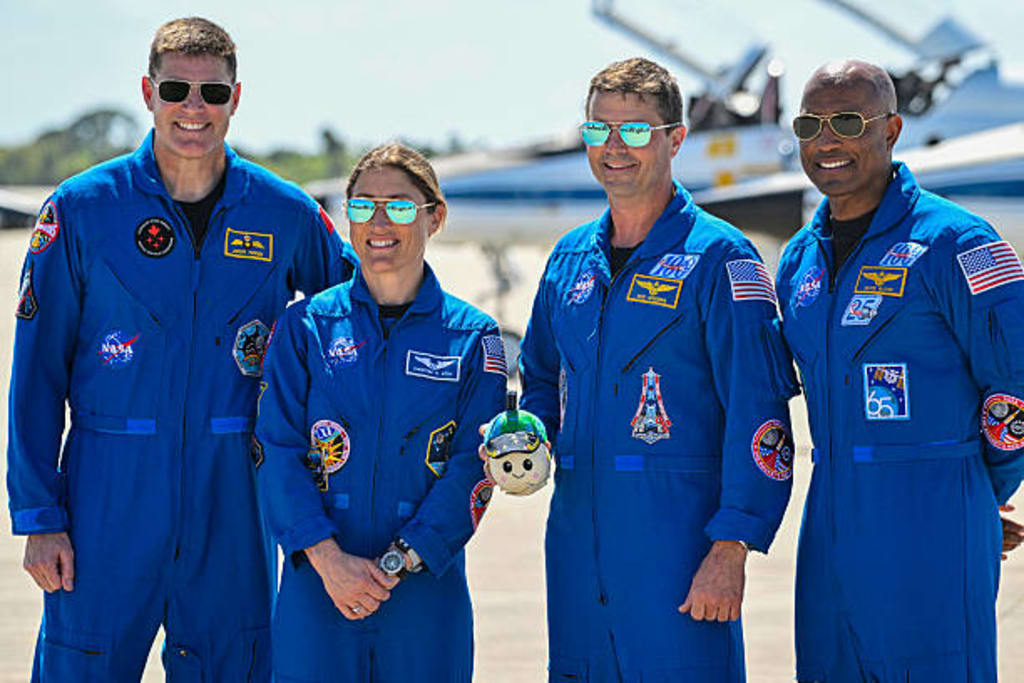
The hangar at Ellington Field was absolutely deafening. After spending ten days surrounded by the kind of profound, crushing silence that only exists in the deep vacuum of space, the noise inside that Houston facility on Saturday must have felt like a physical blow. Hundreds of people—engineers, flight directors, retired astronauts, and military brass—were on their feet, screaming themselves hoarse. NASA Administrator Jared Isaacman grabbed the microphone, looking out at the roaring crowd, and gave the introduction everyone had been waiting over half a century to hear: "Ladies and gentlemen, your Artemis II crew." Reid Wiseman, Victor Glover, Christina Koch, and Jeremy Hansen walked out onto the stage. They had just flown in from San Diego after a flawless ocean splashdown the night before. They had spent a few rushed, private minutes hugging their spouses and kids away from the cameras. Now, they were standing in front of the world. If you expected a group of chest-thumping conquerors, you were looking at the wrong crew. The people standing on that stage looked completely overwhelmed. They had just traveled 252,756 miles from home, pushing past the legendary distance record set by the crippled Apollo 13 mission. They saw things no human eyes had processed since 1972. And the weight of that isolation was written all over their faces. Commander Reid Wiseman grabbed the mic first, his voice thick with emotion. He stripped away all the glossy PR language that usually surrounds these missions and just told the raw truth. "This was not easy," Wiseman told the silent hangar. "Before you launch, it feels like it’s the greatest dream on Earth. And when you’re out there, you just want to get back to your families and your friends." He paused, looking out at the crowd of blue flight suits. "It’s a special thing to be a human, and it’s a special thing to be on planet Earth." Pilot Victor Glover was even more blunt about the mental toll of the journey. When asked to summarize the flight, Glover shook his head. "I have not processed what we just did, and I’m afraid to start even trying." You can't really blame him. During their flyby, the crew managed to capture an image that is already burning itself into the history books. We all know the famous "Earthrise" photo from Apollo 8 in 1968. But this crew captured an Earthset. They watched our bright blue marble physically sink and disappear behind the dead, heavily pockmarked gray horizon of the Moon's far side. Christina Koch tried to explain what that specific moment felt like. Because when you are 250,000 miles away. The math doesn't matter anymore. Only the terrifying scale of the void does. "Honestly, what struck me wasn’t necessarily just Earth, it was all the blackness around it," Koch said, her voice echoing in the massive room. "Earth was just this lifeboat hanging undisturbedly in the universe." She looked directly at the cameras. "Planet Earth, you are a crew." The timing of this entire homecoming felt almost scripted by a Hollywood writer. The crew walked into that Houston base on the exact 56th anniversary of the Apollo 13 launch. The mission that made "Houston, we've had a problem" a permanent part of our vocabulary. In a moment that brought tears to the eyes of veteran space workers in the room, it was revealed that the Artemis II crew actually received a pre-recorded wake-up message while they were out in the black. It was from Apollo 13 Commander Jim Lovell, recorded just before he passed away the previous summer. The ghosts of the Apollo era were literally cheering them on from the grave. Canadian astronaut Jeremy Hansen put his arm around his crewmates, pulling them into a tight line on the stage. He told the audience that surviving the trip required an immense amount of love, and making a conscious choice to extract joy from a highly stressful environment. Because yes, they had the breathtaking views and the solar eclipse. But they also had to survive a highly publicized, deeply frustrating space toilet malfunction that NASA is now scrambling to redesign before the next launch. "When you look up here, you’re not looking at us," Hansen said, staring into the crowd. "We are a mirror reflecting you. And if you like what you see, then just look a little deeper. This is you." So, the test is over. The hardware worked. The lifeboat kept them alive. Now, the pressure shifts completely to the next phase. NASA is already deep into preparations for Artemis III next year, which will force a new crew to practice docking with a lunar lander in Earth orbit. And all of that leads directly to Artemis IV in 2028, where two humans will finally attempt a terrifying, high-stakes touchdown near the shadowed craters of the lunar south pole. Wiseman refused to call the mission fully complete until he had hugged his two daughters. But before he walked off that stage on Saturday, the Commander turned his attention to the rows of active NASA astronauts sitting in the audience. The men and women who are next in line. He pointed a finger directly at the sea of blue flight suits. "It is time to go and be ready," Wiseman yelled, his voice suddenly sharp and commanding. "Because it takes courage. It takes determination. And you all are freaking going, and we are going to be standing there supporting you every single step of the way in every possible way possible." The silence is broken. The lifeboat is home. Now, we go back to the surface.
About the Creator
Wellova
I am [Wellova], a horror writer who finds fear in silence and shadows. My stories reveal unseen presences, whispers in the dark, and secrets buried deep—reminding readers that fear is never far, sometimes just behind a door left unopened.
Enjoyed the story? Support the Creator.
Subscribe for free to receive all their stories in your feed.
Comments
There are no comments for this story
Be the first to respond and start the conversation.