advice
Find advice on relationships, sex, what to buy, how to try new fetishes, how to interpret fantasies, and more.
The Psychology Behind Falling in Love with Your Best Friend
Often, falling in love with your best friend is unpredictable. Emotional closeness is the bonding that occurs due to the memories made together, constant support, and time spent together. Such emotional closeness eventually leads to romantic feelings even without initial physical attraction. The brain links comfort, safety, and trust with positive emotional reactions.
By Steve Waughabout a year ago in Filthy
Falling in Love with Your Best Friend: From Friendship to Forever
Falling in love with your best friend is evolution that’s soft and unexpected. What starts as playful banter and a certain level of trust develops into something much deeper, more complex, and near impossible to overlook.
By Steve Waughabout a year ago in Filthy
Fun Ways to Strengthen Your Parent-Teen Relationship
The emotional, social, and psychological changes teenagers experience often leads to strain in their relationships with parents. A connection is what teens need most during this stage of life, yet it often fades away in the chaos of daily routines, school-related stress, and miscommunications.
By Steve Waughabout a year ago in Filthy
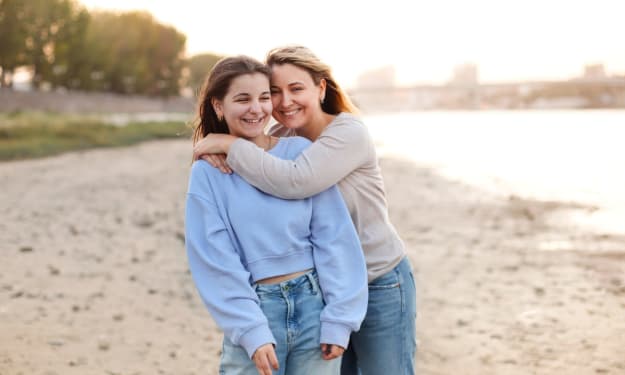
How to Fix a Broken Relationship With Your Teenage Kid
The separation of a parent and teenager can be very painful. What was once an affectionate bond could transform into a relationship fraught with cold indifference, distance, and simmering hostility. There might be harsh phrases, persistent conflicts, or even silence that quietly lingers.
By Steve Waughabout a year ago in Filthy
The Key to a Strong Parent-Teen Relationship
The moving from childhood into adolescence initiates a period of immense change into the parent-child relationship. Affectionate and simple interactions can devolve into strained, unresolved conflicts, or emotionally cold distances. An adolescent’s desire for independence, coupled with imposing opinions and boundary-testing will vex even the most well-intentioned parent.
By Steve Waughabout a year ago in Filthy
The Lazy Girl
Once upon a time, in the quiet village of Elmswood, lived a girl named Mira who was known far and wide as “the lazy girl.” She would sleep late, avoid chores, and daydream endlessly under the shade of the old oak tree behind her house. While others worked the fields, tended shops, or studied hard, Mira preferred watching the clouds and listening to the birds. Her mother, a hardworking seamstress, often sighed, “Mira, life won’t wait for you to get up.” But Mira would yawn and say, “Why rush when the sky looks so peaceful today?” The villagers shook their heads. “She’s a lost cause,” they’d whisper. “She’ll never do anything worthwhile.” One summer, Elmswood faced an unusual challenge. A sudden landslide blocked the only path that connected their village to the rest of the valley. With roads buried under rock and trees, no food or supplies could get through. The villagers were forced to ration what little they had. Desperation hung in the air. The mayor called for volunteers to help clear the path. Everyone came forward—except Mira. She remained seated under her tree, as usual. “Don’t bother asking her,” muttered one farmer. “She doesn’t lift a finger for anything.” But something was different that day. Mira’s eyes followed the frantic movement of the people. She saw children hungry, elders tired, and her mother stitching by candlelight with trembling hands. That night, Mira couldn’t sleep. For the first time, guilt crept in. She wasn’t tired from work—she was tired from doing nothing. The next morning, she rose with the sun, surprising her mother. “I’m going to the forest,” she said quietly. “To nap?” her mother asked, puzzled. “To help,” Mira replied. Mira didn’t have the strength to lift boulders or chop down trees, but she remembered the trails she used to wander as a child, looking for berries and wildflowers. While others hacked through the main road, Mira ventured deep into the woods. She climbed hills, crossed streams, and studied the land. By midday, she stumbled upon a forgotten animal path that led around the landslide and reconnected with the trade route beyond the village. Excited, she rushed back to the village. “I found another way!” she shouted. No one believed her. The mayor chuckled. “That trail hasn’t been used in decades.” “Come see for yourself,” she urged. Reluctantly, the mayor and a few villagers followed her. When they reached the path and saw that it bypassed the blocked road entirely, their jaws dropped. “Mira, how did you find this?” “I’ve walked these woods for years,” she said. “I guess doing nothing taught me something after all.” With Mira’s path, traders returned, food and supplies flowed in, and the village was saved from hardship. The villagers, once full of scorn, now looked at her with new eyes. The mayor declared, “Today, Mira showed us that strength isn’t just in muscles or sweat. It’s also in curiosity, observation, and knowing the world in quiet ways.” Mira didn’t return to being lazy—not entirely. She still loved sitting under her oak tree, but now she also explored the forest with purpose. She mapped hidden paths, helped travelers find their way, and became the village’s first guide. No longer “the lazy girl,” Mira was now known as “the clever pathfinder.” When someone asked her what changed, she smiled and said, “I just woke up one day and realized doing nothing felt worse than trying something—even if I failed.” --- Moral: Everyone has their own strength—even those who seem the least likely. Sometimes, the quietest paths lead to the greatest impact.
By IRSHAD MUHAMMADabout a year ago in Filthy