Short Story
TUS NUA - ch 9
TUS NUA – ch 9 New Beginnings – Mia and Midnight (*)(*)(*) When Mia declared her witchy status, Nora Green’s excitement came to a screeching halt. Shock was an understatement as she stood as still as a stone monument, even to the point, she wasn’t sure if she was still breathing.
By Margaret Brennanabout a year ago in Fiction
The Micro Machine
Simple rules led to a difference in what Grayden Lute wanted to say. He stood at six feet two inches and possessed the color of a Franklin stove. The prompt seemed easy enough to understand: “Write flash fiction in fifty words exactly and submit in twelve hours from opening this link and win fifty- thousand dollars.” At exactly six pm, the clock started. From his home in Wilmington, Delaware, he could only think of how agonizing the feeling of writer’s block existed in his mind. Nothing could soothe his brain or tame the raging fire going on in his thoughts. He paced the room and looked at the scraps of paper he had jotted down ideas and sketched outlines. None of that mattered.
By Skyler Saundersabout a year ago in Fiction
Small Town USA #22
Eddy and I trailed slowly behind Jesse as we approached the militant’s compound of a house on the corner of Lefevre and Idaho Street. We moved through the alley behind my parents’ house, guiding ourselves through the shadows, toward our unsuspecting victim of the infamous “Knock and Run.”
By Clifford Kincaidabout a year ago in Fiction
Lila and The Talisman of Ultimate Authority . Top Story - July 2025.
When I was little, I thought that the past was in black and white. The world depicted in old movies seemed no less lively than the one I lived in, but was devoid of the vibrancy which I took for granted. Whenever the TV was tuned to some classic film or historical news footage, I’d wonder what it was like for people living in that drab place, and pity the incompleteness of their existence.
By J. Otis Haasabout a year ago in Fiction
The Clock That Ticked Backwards: A Short Tale of Time and Regret
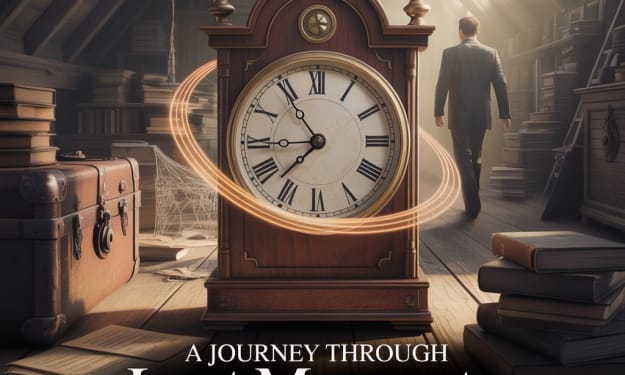
In the quiet corner of an old attic, hidden beneath dusty boxes and forgotten keepsakes, sat a clock unlike any other. It wasn’t ornate or grand. In fact, it was plain—wooden, square-faced, with faded Roman numerals. But it held a secret far more valuable than gold. This was the clock that ticked backwards. Tom Ellison, a man who had lost more than he cared to remember, discovered it on a gray Tuesday afternoon. Life hadn’t been kind to Tom. Once full of dreams and ambition, he had let opportunities slip through his fingers like sand. Regret had become his shadow. His days were long, his nights longer. The attic, part of the house he inherited from his grandmother, was a place he avoided—until that day. He hadn’t expected to find anything of interest, but the ticking caught his ear. A gentle, deliberate tick... tick... tick... yet something was off. When he looked closely, he saw the hands of the clock moving in reverse. Curious, he wound the key. The clock responded by glowing faintly, and then—something incredible happened. Tom found himself standing outside his old college dorm, the year was 2008. His phone, now a flip model, buzzed in his pocket. He saw himself in the reflection of a glass door—youthful, determined, full of life. Time hadn’t just moved backward. It had taken him with it. At first, Tom thought he was dreaming. But the longer he stood there, the more he realized this was no illusion. The clock had granted him a second chance. --- The Temptation of Time What would you do if you could relive the moments you regret the most? Would you fix old mistakes, rekindle lost love, or take a leap you once feared? For Tom, the answer was clear: he would right the wrongs. He made different choices this time. He attended the job interview he skipped out of fear. He apologized to the father he hadn’t spoken to in years. He chose courage where once he chose comfort. And slowly, life began to blossom in ways he never thought possible. But time, like life, demands balance. Each backward tick of the clock had a cost. Each change he made in the past altered something else—something he hadn’t foreseen. A friend he had saved from heartbreak never pursued the music career she once had. A colleague he helped get a job turned corrupt, affecting hundreds. In saving one regret, Tom unintentionally created another. --- The Price of Playing with Time Tom realized too late that the clock wasn’t a gift—it was a test. Regret, while painful, shapes us. It teaches. It humbles. Trying to erase it risks unraveling the very thread of growth. One night, he returned to the attic, holding the clock in his hands. It had begun ticking faster, more erratically. He knew he had to make a choice: keep rewriting the past, or accept the lessons it left behind. With a deep breath, he wound it one last time. The world shimmered around him like a fading dream. When he awoke, he was back in the attic—older, wiser, but changed. Tom no longer feared his past. Instead, he honored it. --- Embracing Regret as a Teacher We all carry moments we wish we could change. Words left unsaid. Paths not taken. But perhaps the true power lies not in going back, but in moving forward with intention. Regret doesn’t mean failure. It means you’ve grown. It means your heart knows better now. Tom began writing, sharing his story with others who felt trapped by their yesterdays. His tale of the backward clock became a viral sensation, resonating with thousands who longed for a second chance. But the message wasn’t about time travel—it was about perspective. About learning to forgive yourself. About using the weight of regret not as a chain, but as wings. --- Final Ticks of the Tale Whether the clock was real or symbolic, only Tom knew. But its lesson remains timeless: We cannot change the past, but we can change how we live because of it. So the next time you feel the sting of a missed opportunity or the ache of a memory you wish you could erase, remember: you don’t need a magic clock to begin again. All you need is today.
By Wasif islamabout a year ago in Fiction
The Last Call at Sparrow’s Café
Lena walked into Sparrow’s Café at exactly 7:45 PM. The little bell above the door rang softly as she stepped inside. She stopped for a moment and took a deep breath. The warm smell of coffee and cinnamon filled the air. The café was just like she remembered — quiet music playing softly, the soft clinking of cups, and low voices of people chatting.
By Muhammad Adilabout a year ago in Fiction
when the town stopped dreaming
There was a time when the people of Windmere dreamed in color. They dreamed of dragons soaring over the hills, of bridges made of stardust and oceans that whispered secrets. The butcher once confessed he'd dreamed of baking cinnamon rolls in the shape of galaxies. The schoolteacher wrote poems based on visions she saw while asleep—poems that made even the mayor cry. Children giggled in their sleep, mumbling about magical creatures and kingdoms hidden beneath their beds. But one day, the dreams stopped. No one noticed it at first. One person waking without a dream is hardly newsworthy. But then, another. And another. And within a week, the entire town of Windmere woke up to silence—not just in the world, but in their minds. No more surreal landscapes. No more flying. No more unexpected reunions with long-gone loved ones. The canvas of sleep had gone blank. At first, people shrugged it off. "Maybe it’s the weather," someone said. "Probably just stress," another offered. The town physician checked for pollutants, sleeping disorders, even mass psychosis. But everything came back normal. Perfectly, frustratingly normal. The town's color began to fade—not literally, but in spirit. Conversations dulled. Laughter lost its luster. The bakery stopped experimenting with whimsical recipes and returned to plain white bread. The library, once filled with eager readers chasing fantasies, stood dusty and quiet. Even the birds seemed to sing less. Children stopped drawing. And that was when people really began to worry. --- Ten-year-old Elsie Maddox was the first to ask the question everyone had been avoiding: “Where do dreams go when they disappear?” Her parents, like most grown-ups, gave her a soft smile and changed the subject. But Elsie was not like most children. She noticed things. She noticed the silence. She noticed her goldfish no longer danced in its bowl at night, the way it used to when she had adventure dreams. She noticed that her dog, Patches, whined in his sleep now, instead of chasing imaginary squirrels. And so Elsie, determined and brave in a way that only children can be, decided to find the answer herself. She packed a notebook, a flashlight, and two peanut butter sandwiches. After everyone had gone to bed, she tiptoed out into the foggy streets of Windmere. She visited the wishing well in the town square, where people once threw coins and asked for dreams to come true. She looked down into its depths and whispered, “Bring them back. Please.” Nothing. Then she visited old Mrs. Dellarose, who was known for reading tea leaves and once claimed she dreamed in languages no one had heard of. Mrs. Dellarose hadn’t spoken in days, her eyes distant. But when Elsie held her hand and whispered her question again—“Where did the dreams go?”—the old woman blinked and murmured, “They were stolen.” Stolen. The word echoed in Elsie’s mind. --- She spent the next week asking everyone if they remembered their last dream. Most didn’t. A few remembered fleeting flashes: a tree made of mirrors, a song they couldn’t hum, a face they almost recognized. Each time, Elsie drew what they described in her notebook. Patterns emerged. The same tree. The same melody. The same face. She followed those clues to the edge of Windmere, to a long-forgotten shack covered in ivy and moss. Inside, she found journals stacked high—every one full of dream fragments. Thousands of them. Torn from sleep, stolen, collected. And sitting in the center, hunched over a book, was a figure wrapped in shadows. “I didn’t mean to take them all,” it whispered. “But I was lonely. And dreams… dreams are company.” Elsie stepped forward. “But they’re not yours to keep.” “I know,” the figure said, its voice trembling. “But I couldn’t help it. The world forgot me. I thought if I held their dreams, I’d be remembered.” Elsie sat beside it. “Maybe we can remember you another way.” She took the figure’s hand. “Come back to the town. Tell us your story. Let us dream with you.” The figure, once feared and forgotten, nodded. --- That night, Windmere dreamed again. First it was a baby who smiled in her sleep. Then a teenager who woke up sketching impossible machines. The librarian dreamed of a flying whale that lived in a cloud library. The mayor dreamed of dancing on a rooftop with his childhood dog. And Elsie? Elsie dreamed of a girl with a notebook, walking hand-in-hand with a shadow that no longer felt alone. The color returned. The laughter bloomed again. And Windmere learned that dreams aren’t just about sleep—they’re about connection, about remembering even the forgotten, about hope lighting up the dark corners of our minds. Because when a town stops dreaming, it starts to fade. But when it dreams again—oh, how brightly it shines.
By Mati Henry about a year ago in Fiction