Short Story
The Silence Beneath the Clocktower
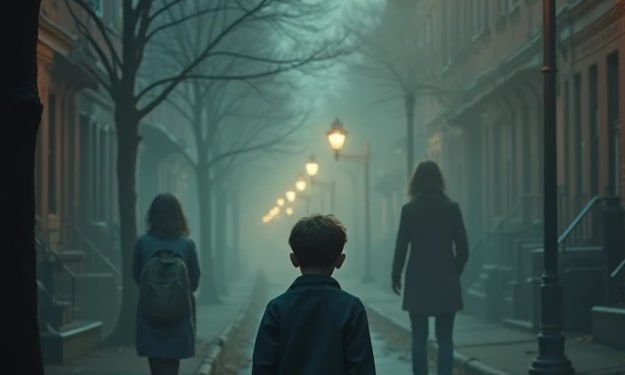
In the fog-wrapped town of Eldhollow, a clocktower stood at the center like a solemn monument. Its hands hadn’t moved in seventy-three years. The bells hadn’t rung. Not since the fire. Not since the disappearances. People avoided it like a shadow that stretched too far.
By Awais Khaliqabout a year ago in Fiction
From Dust to Diamonds
In a narrow, dust-covered street of an old village called Bahari, nestled between dry hills and forgotten dreams, lived a boy named Ayaan. His house was barely more than a patchwork of mud walls and a rusted tin roof that groaned with every passing breeze. His father, once a promising mason, had become paralyzed after a fall from a scaffold. His mother did odd jobs—washing clothes, sweeping houses, and sometimes fasting to ensure Ayaan had enough to eat.
By NIAZ Muhammadabout a year ago in Fiction
Lurking in the Depths of You
“Mr. Elliot Blackwood,” calls a rustic voice. I fumble my keys and wallet as I stand, timidly walking toward the small room, which is composed of only a couple of chairs and a small rectangular table that looks like it belongs in a campervan.
By Chelsea Kateabout a year ago in Fiction
In Between. Content Warning.
Marcus let out a low groan as his quiet, relaxing morning was shattered by the deafening ringtone of his phone. He took another sip of his black coffee before picking up the device. A frown slowly emerged on Marcus' face as he stared at the name on the screen: Jake.
By Sophie Garciaabout a year ago in Fiction
Shadows of the Same Star
In the quiet town of Elmsridge, nestled between the rolling hills and whispering forests, lived two boys—Eli and Marcus—who had been friends since the age of five. From the moment they built their first fort out of sticks and leaves in the woods behind their houses, the world seemed to exist only for the two of them.
By NIAZ Muhammadabout a year ago in Fiction
The Diamond That was Glass
Long ago, in the dusty village of Rampur where fields stretched like patchwork quilts under the sun, lived a farmer named Mohit. His hands were calloused from dawn-to-dusk labor, tilling the stubborn earth alongside his devoted wife, Bhavna. Their greatest sorrow was their son, Lokesh—a young man whose bones seemed woven with idleness. While Mohit’s back bent beneath the weight of grain sacks, Lokesh sprawled in the shade, dreaming of riches without sweat. "Look at Raju!" he’d complain, "A government job without cracking a book! Why must *I* wallow in cow dung?" One mist-laced morning, Lokesh slipped away unseen. Mohit returned from the fields at noon, his brow furrowed like plowed soil. "Where is that boy?" he demanded of Bhavna. "Roaming again! He’ll crumble beneath life’s burdens!" Bhavna wiped flour from her hands, defending softly, "Let him see the world. One day he’ll make us proud." Unbeknownst to them, Lokesh was trudging back from the nearby city, his mind buzzing with fantasies. On the dirt path, a saffron-robed sadhu materialized like a mirage. "Young man!" the holy man’s voice rasped, eyes piercing. "Raj Yog blazes in your destiny! Richer than all in Rampur—give but one rupee, and I’ll unveil your future." Heart drumming against his ribs, Lokesh surrendered his only coin. At home, Bhavna met him anxiously. "Your father’s fury simmers like hot oil! Where were you?" Lokesh’s declaration burst forth: "I can’t suffocate in this village! A holy man says I’m born for business—get Father to give me 500 rupees!" Bhavna’s eyes glistened. After a tense silence, she unlocked a small wooden box hidden beneath saris, revealing her painstakingly saved coins. "Take it," she whispered, pressing the cold metal into his palm. "But tread wisely, my son." At first light, Lokesh set off, the 500 rupees a heavy secret in his pocket. By midday, exhaustion pinned him to the roadside. He stumbled into a ramshackle inn, its air thick with woodsmoke and mildew. As he collapsed onto a cot, angry voices sliced through the thin wall: "—won’t sell for 400, you cheat! The diamond’s worth 2,000!" "Greed blinds you," snarled another. "My new buyer pays double!" A door slammed. Pulse racing, Lokesh crept to the adjoining room. A scar-faced man held up a stone that caught the light like captured starlight. "Diamond?" Lokesh breathed. The man’s grin was jagged. "Yours for 500—now." Without hesitation, Lokesh traded Bhavna’s savings for the glittering prize. He raced back to Rampur, bursting into the moneylender’s shadowy stall. "How much for this treasure?" The moneylender’s magnifying lens hovered, then his laughter cracked like whip. "Glass, you fool! Worthless!" The world tilted. Lokesh fled to Bhavna, whose face crumpled as he confessed. "Years of saving… gone," she wept, clutching her sari’s edge. "Your father mustn’t know." Weeks later, the rhythmic thud of grain sacks hitting the cart announced harvest’s end. Mohit counted silver coins at their wooden table. Lokesh tugged Bhavna’s sleeve. "The grain money—ask him for 500 more!" Mohit’s voice cut through their whispers: "Secrets? Out with it." Bhavna stammered, "Lokesh… needs capital for business." Mohit’s knuckles whitened. "Business? He couldn’t sell rainwater in a desert!" Yet Lokesh pleaded, spinning tales of city partners and guaranteed profits. Finally, Mohit leaned forward, eyes flinty. "Earn five rupees daily—like my field hands—and I’ll fund you." The next dawn, Lokesh sought shortcuts. He approached the moneylender’s sneering son, Shiv. "Lend me five rupees? Father pays tomorrow." Shiv’s laugh was cruel. "Still peddling glass diamonds? Get lost!" Humiliated, Lokesh visited his uncle, who pressed ten rupees into his hand with pity. Each evening, Mohit examined the coins. "Throw them in the well," he’d order. With a shrug, Lokesh obeyed, watching silver vanish into the dark water without a ripple of regret. On the third day, despair hung heavy as storm clouds. Rain lashed suddenly, turning lanes to rivers. An elderly man struggled under leaking sacks of rice. "Lad! Help me save these—two rupees yours!" Lokesh heaved the sodden burdens, muscles screaming, mud sucking at his sandals. Water streamed down his neck as he stacked the last sack inside the dry storehouse. The old man pressed two warm coins into his blistered palm. "Bless you, son." At home, dripping and aching, Lokesh offered the coins. Mohit’s command came: "To the well with them." Fire surged in Lokesh’s chest. "No!" he shouted, clutching the rupees. "I carried half a ton in the downpour for this!" Mohit’s stern facade finally softened. He took the coins, then gently returned them. "Feel that anger? That’s the worth of *earned* sweat. You didn’t flinch losing your mother’s savings or your uncle’s charity. But *this*—" he tapped the two rupees, "—this you fought for. Raj Yog isn’t handed out by sadhus or thieves. It’s built by hands that honor their own labor." The truth crashed over Lokesh like a monsoon wave. At dawn, he stood beside Mohit in the fields, the raw handle of a plow blistering his palms anew. Season after season, he learned the language of soil and seed. When the harvest came, golden heaps overflowed their carts—yields doubled by diligence. Mohit’s rare smile was sun breaking through clouds. Bhavna sang as she cooked. And Lokesh, once chasing glass illusions, now measured wealth in the weight of honest grain and the quiet pride in his father’s eyes. The village whispered of the lazy boy reborn—proof that true fortune is reaped not by stolen diamonds or holy predictions, but by the relentless, sacred toil of one’s own hands.
By Alice Talesabout a year ago in Fiction
The Things I Never Said to My Father
The Things I Never Said to My Father There are conversations we rehearse in our heads a hundred times but never let pass our lips. Words that sit in the back of the throat like stones, too heavy to lift, too sharp to swallow. This is for all the things I never said to my father — and probably never will.
By Kine Willimesabout a year ago in Fiction
Small Town USA #4
Ok, let me back up and explain why I’m so passionate about lighting off my own fireworks. And no, I don’t think every Tom, Dick, and Sally should be allowed to light their own. Let’s be honest — fireworks are dangerous. And they’re even more dangerous when they fall into the wrong hands, especially adults with alcohol. Sometimes even the “good kids” do stupid shit when left unsupervised. Especially a group of prepubescent boys growing up in a small Eastern Washington town in the late 1980s.
By Clifford Kincaidabout a year ago in Fiction
Whispers of the Dead
In the old quarters of Philadelphia, autumn had wrapped the city in a blanket of sorrow. The yellow leaves, fallen from trees, lay scattered on the roads like symbols of a mysterious dream. Within this melancholic atmosphere lived a nine-year-old boy, Cole Sear — his life entangled in secrets no one could see.
By Ameer Gullabout a year ago in Fiction