Short Story
The Whispering Blade
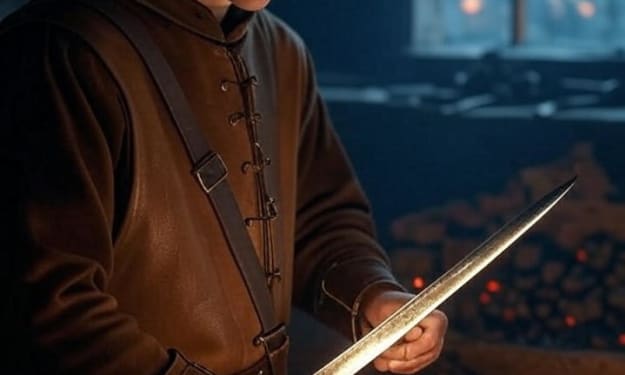
In the quiet village of Emberhollow, nestled between the Shadowridge mountains and endless whispering woods, lived a seventeen-year-old blacksmith named Eldon Vale. Orphaned as a child and raised by his aging mentor, Master Darnic, Eldon had known nothing but fire, steel, and the comforting clang of the hammer upon anvil. Life was simple. Predictable. Safe. Until the night the sword appeared. It was a crisp autumn evening. Eldon had been working late, shaping horseshoes and fixing old plows when a sudden gust of wind blew through the forge—though all the windows were shut. The fire flared blue, and the anvil sparked violently. There, resting atop the anvil as if it had always belonged, lay a sword. Its hilt was obsidian black, carved with ancient runes that shimmered faintly. The blade itself was unlike anything Eldon had ever seen—metal that seemed to absorb light, yet shimmer with an inner glow. And when he touched it, it hummed—not with vibration, but with voice. That night, long after the forge had gone cold, Eldon lay awake with the sword beside him. As the moon rose high, a soft whisper began to drift from the blade. > "The crown sleeps beneath roots of ash. One heart beats where none should be. The flame forgets, the steel remembers— What once was lost, shall rise in thee." Eldon jolted up, eyes wide. "Who’s there?" he asked, but only the sword answered—silent again. Night after night, the sword whispered more riddles, more cryptic verses that hinted at a lost kingdom, a sleeping king, a terrible war. Eldon scribbled them down, studying them by candlelight. Something ancient was speaking to him—something that knew him. Then came the fire. One evening, as villagers gathered for the harvest celebration, riders emerged from the forest, faces hidden behind iron masks. Bandits. Raiders. No warning. No mercy. Flames rose. Screams echoed through the square. Eldon ran toward the forge, heart pounding, unsure what he could do. Then he saw it—the sword, glowing like molten silver. It sang to him. > "Blood will burn, and truth will bleed, But only flame can plant the seed. Take the blade, or all shall fall— The forge has called, now heed the call." His hands trembled. He had never wielded a real weapon before. He was a smith, not a warrior. But something deep inside awakened. He grabbed the sword. The moment his fingers closed around the hilt, a surge of energy roared through him. His vision blurred. The whispers became a chorus—chanting, crying, calling. He stepped into the street. The nearest raider charged at him. With no training, Eldon should have been cut down in seconds. But the sword moved with him. Or perhaps, it moved for him. It parried, it struck, it burned. Every blow left trails of glowing light. The raiders, startled by the young blacksmith’s fury—and by the magic pulsing from the blade—began to flee. But not before one of them spoke. > "The Blade of Velmir has returned," the masked leader hissed. "The Flameborn has awakened. The Kingdom stirs…" Then he vanished into the smoke. The village smoldered behind Eldon. Ash drifted through the air like snow. People stared in awe—some in fear. He dropped the sword. It stopped glowing, now cool and still. But it still watched him. Later that night, as he sat alone in the forge, the sword whispered again. > "You are not only of Emberhollow. You are the last ember of Velmir, Forged in fire, born to reign. Seek the roots beneath the ash. The kingdom remembers you." Eldon looked at the blade. He thought of the kingdom in the riddles, of the magic in his blood he never knew existed. The sword had saved his village. But at what cost? If he kept it, he would no longer be just a blacksmith. He would become a flame in a war that had long burned out—until now. The blade pulsed gently, waiting. Eldon exhaled. The world had changed, and so had he. With trembling hands, he lifted the sword once more. This time, he did not fear it. He listened.
By NIAZ Muhammadabout a year ago in Fiction
CHEL'a
Is it so hard to believe that there are worlds beyond our own planets? Inhabited worlds, lost worlds, worlds of water with different life. worlds just born and worlds at their end. How many have precipitated their own demise through hubris or belief in infallibility of Gods or Goddesses.
By Victor Mendezabout a year ago in Fiction
The Garden That Ate the Sun
There was a time when the village of Veradale basked in golden sunlight. It stretched across the hills like honey, warming the fields, blooming the tulips, and drying the linens hung from every humble porch. But that was before the garden came. It started as nothing—just a patch of earth behind the long-abandoned Garrison estate. Locals had always whispered about the estate, calling it cursed. No one dared to live there. But in early spring, dark green sprouts pushed through the ground like veins on skin. They were thick, pulsing, almost breathing. A few boys tried to poke at the vines with sticks, only to come home the next day with strange rashes on their arms. The very next morning, the sun didn’t rise. The sky was not overcast, nor stormy. It was simply... dark. A gray, endless twilight hung over Veradale. The townspeople waited for the clouds to break, but they never did. Days turned into weeks. Crops began to fail. Animals grew restless. The birds stopped singing. And yet, behind the Garrison estate, the garden bloomed. No sunlight touched Veradale anymore, but the garden didn’t need it. It grew wildly—roses the size of dinner plates, vines thick as tree trunks, flowers with petals that shimmered like moonlight. Some said the plants whispered if you stood too close. Others said they heard crying. The town council sent a few men to cut the garden down. They never returned. One of them, old Mr. Remy, was found three days later—his body wrapped in roots, his face twisted in terror, his eyes... burned. Not gouged, not scratched. Burned. As if he had looked directly into the sun—but no sun had shone for nearly a month. It was 14-year-old Lyra who discovered the truth. Her younger brother, Jacob, had disappeared chasing his dog into the garden. The townspeople begged Lyra not to go after him, but she refused. “If no one else will,” she said, tying a red scarf around her neck, “then I will.” She stepped into the garden at twilight. The moment she passed its edge, warmth pressed against her skin. It was humid. Alive. The air shimmered with golden motes, like dust floating in liquid amber. She called for Jacob, but only the rustle of leaves answered. The plants turned as she moved. She could feel their attention. She wandered deeper. Time felt strange—stretched. Twisted. A vine brushed her cheek like a lover’s touch. In its reflection, she saw something horrifying: herself, aged by decades, her face weathered, eyes hollow. She stepped back. Then she heard it—a soft, familiar giggle. Jacob. She followed the sound to a clearing where the sun still shone. Bright. Brilliant. Blinding. And in the center, sat Jacob—laughing, playing, bathed in golden light. She ran to him, but the ground shifted. Roots rose like snakes, wrapping around her ankles. “You should not be here,” whispered a voice from the trees. It wasn’t a person. It was the garden. “The sun,” Lyra gasped, staring into the radiance. “Why is it here?” “It is mine now,” said the garden. “It feeds me. It loves me. The world beyond starves, but I bloom.” “You’re killing us,” she cried. “You stole our light!” “The sun was wasted on you,” it said. “You grew crops. I grow eternity.” She looked at Jacob, smiling blankly, unmoving. “Let him go.” “I cannot,” the garden replied. “He is part of the bloom now. He chose the light.” “No,” Lyra said, pulling a matchstick from her pocket. She had brought it for warmth—maybe for protection. She struck it. Fire bloomed. The garden screamed. The roots recoiled. The trees trembled. Jacob blinked, his eyes clearing. “Lyra?” he whispered. She grabbed him, dragging him away as vines snapped and leaves turned black. The golden sun flared, then dimmed. As they ran, the light faded behind them, shrinking, curling in on itself like a dying star. They emerged back into Veradale. The sky was still dark—but less so. A crack of sunlight pierced the horizon. The next morning, the sun rose again. The garden, now a patch of smoldering ash, never returned. But on quiet nights, if you walked past the Garrison estate, you could still smell flowers, and hear leaves rustling in the dark, as if waiting. Waiting for the next one brave—or foolish—enough to bring them light.
By Ubaid Khanabout a year ago in Fiction