Short Story
The Odyssey
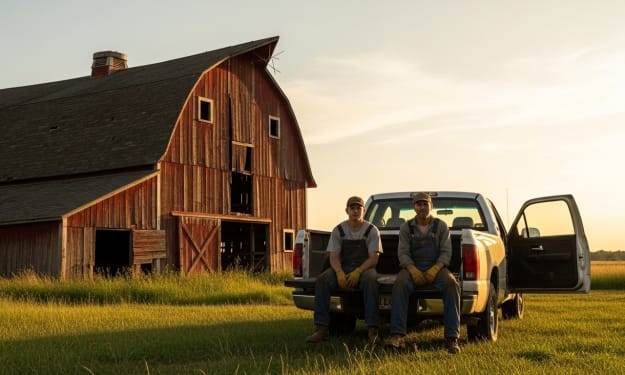
Rain blurred the windshield as the old pickup truck crawled along the cracked highway. Elijah North gripped the steering wheel like it was the only thing keeping him tethered to the Earth. A duffel bag sat in the passenger seat—his only luggage after five years away. Home. He hadn’t said that word out loud in years. Not since the argument. Not since the slamming door. Not since his father's voice, rough and angry, echoed behind him—If you walk out that door, don't come back. He did. And now, he was. The town sign for Maple Hollow passed by, half-covered in rust and moss. Pop. 2,108. It hadn’t changed much, he thought. But he had. A beard where a boy’s stubble once was. Hands calloused from oil rigs and rail yards. Eyes that had seen too much. His stomach twisted as the house came into view—white paint peeling, the swing on the porch swaying gently in the wind, like it was still waiting for someone to come sit. He parked by the mailbox. The same dent on the side from when he’d crashed his bike at twelve. No one was outside, but the lights were on. He stood at the edge of the gravel path for a long time, heart pounding, staring at the front door. Five years was a long time for silence. He climbed the steps. Knocked. Footsteps on the other side. A pause. The door creaked open. His mother stood there. “Elijah,” she whispered. “Hey, Ma.” Her eyes filled with tears before she pulled him into a hug. She didn’t ask questions, didn’t lecture, didn’t cry out. She just held him. And in that embrace, he wasn’t a runaway. He wasn’t a disappointment. He was her son. “He’s in the barn,” she said softly when they finally pulled apart. Of course he was. His father’s refuge. Elijah didn’t hesitate. He crossed the muddy yard and pushed open the barn doors. The smell of hay, old tools, and memories flooded him. His father was there, wrench in hand, fixing the engine of an old red tractor. He looked up. Their eyes locked. The silence cracked with tension. “I heard you were back,” his father said at last. “I am,” Elijah replied. Another pause. “You fixing the old Massey?” “She still runs. Needs coaxing.” Elijah walked forward, hands in his jacket pockets. “You kept her running all these years?” His father gave a grunt, somewhere between agreement and dismissal. “Someone had to.” Another silence. Elijah looked down. “I… I didn’t come back to fight.” “No?” his father said, a challenge in his voice. “I came back because I couldn’t carry the weight anymore. I thought leaving would make me a man. But it just made me lost.” His father’s jaw tightened. “You left without looking back.” “I know. And I was wrong.” He stepped closer. “I’m not the same kid who ran off. I thought I had to prove something. That I could survive without you. But all I learned was how much I needed to come home.” The wrench dropped to the floor with a clank. “I was hard on you,” his father said. “Too hard. My father raised me that way, and I thought it was right. But when you left… I realized I’d pushed too far.” Elijah’s throat tightened. “I just wanted you to be proud of me.” “I always was,” his father said quietly. “I just didn’t know how to say it.” The silence this time wasn’t heavy. It was healing. “I can help with the tractor,” Elijah offered. His father nodded. “Go grab a wrench.” For the next hour, they worked side by side—two men who had once been strangers, now finding their rhythm again in the language of machines, grease, and quiet understanding. Later, they sat on the tailgate, watching the sky shift to twilight. A few stars blinked awake. “Ma’s making pot roast,” his father said. Elijah smiled. “She always said pot roast fixes everything.” “Maybe it does,” his father replied, then added, “You staying a while?” Elijah looked up at the stars. “Yeah. I think I am.”
By Shah Nawazabout a year ago in Fiction
PARASITIC RELATIONSHIPS
Picking up my purse, I prepared to leave the strange flat. Looking around at my unfamiliar surroundings, I soon found something untraceable that I wanted. I grabbed the stones I saw inside a bowl on the side table, and then noticed last night's Fling’s wallet beside the bowl.
By Mother Combsabout a year ago in Fiction
Episode 7: Silver Like Mercy
So Ant woke up chained to a radiator in a room that didn't remember what heat felt like. That's how it started. The floor was concrete. The walls were insulted - by water damage. A single bulb hung like it had been sentenced to watch. His mouth tasted like copper and forgetting. His chest ached where someone had written pain in fists. And his arm - his arm had teeth in it. Two rows. Familiar ones.
By Paper Lanternabout a year ago in Fiction
Tails from Juniper Lake
Beau was a happy-go-lucky Golden Retriever with a slobbery grin and a backpack full of snacks. His owners insisted he carry his own food and treats. Tilly, a sleek gray cat with a taste for adventure (and a profound disdain for Beau’s drool), assisted her owner in packing her bag with sardine tins, catnip, and her favorite cat hammock to relax in.
By Sam Hudginsabout a year ago in Fiction
“At Twenty-Five, Dad Caught Me in My Strange Midnight Ritual”
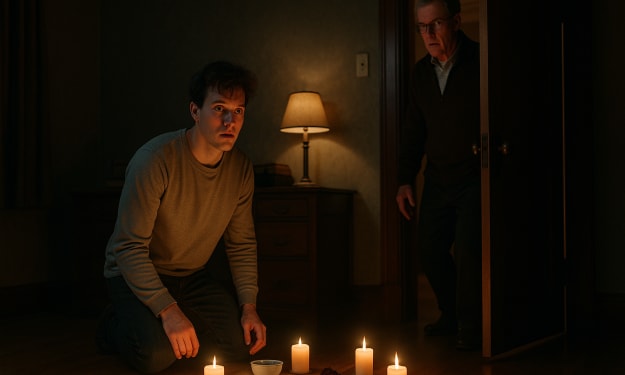
Even at twenty-five, I hadn’t let go of my odd habits. Some people grew out of theirs in their teenage years—mine only got more intense, more personal, and, honestly, a little weirder. While others my age were getting promoted, engaged, or planning trips to Bali, I found myself in my grandfather’s old study every night at 11:07 PM sharp, surrounded by dim candlelight and strange, broken relics that only made sense to me. It wasn’t something I ever talked about. I kept it hidden, the way most people hide shame or grief. On the desk, I’d carefully arrange a chipped teacup, a rusted pocket watch, a dried rose petal, and a strip of old velvet ribbon. I didn’t know why I chose those objects—they just felt… right. Then, as the candlelight flickered against the wallpaper, I’d close my eyes and whisper a name into the stillness. “Mara.” She was the name I held onto. Sometimes I wasn’t sure who Mara even was anymore—my grandmother, a lost friend, a part of myself that had slipped through the cracks. All I knew was that whispering her name made me feel less alone. It became a ritual of comfort, of memory, of meaning—strange to everyone else, but grounding to me. This went on for years. No one knew. I lived a relatively normal life during the day—meetings, emails, coffee breaks, small talk—but the nights were mine, private and peculiar. My father, who I still lived with at the time, probably chalked up the late nights to work stress or insomnia. He never asked. I never told. Until one Tuesday night. I came home later than usual, exhausted and barely hanging on to the rhythm of my life. Still, the ritual called to me. I walked quietly down the hall, slipped into the study, lit the candles one by one, and began arranging my objects. The soft glow wrapped around me like a blanket, familiar and still. I closed my eyes, took a breath, and whispered the name. “Mara…” And that’s when I heard it—the unmistakable sound of keys jingling in the lock. The door creaked open, spilling hallway light into the room like a spotlight on a stage I wasn’t ready to perform on. I froze. My father stood in the doorway, his face a mix of confusion and concern, eyes scanning the circle of candles, the strange objects, and me—kneeling in the center like some lonely monk performing a forgotten rite. “What… are you doing?” he asked quietly, stepping inside. I stared at him, caught mid-ritual like a child with their hand in the cookie jar. My heart pounded in my chest. I couldn’t lie—it was too bizarre to explain away. “It’s… hard to say,” I muttered, looking down at the teacup. “I’ve been doing this for years. It helps me feel connected… to things I’ve lost. To people. To parts of myself.” He didn’t speak at first. He just walked slowly to the desk and picked up the pocket watch, turning it in his fingers. Then, almost too softly to hear, he said, “This was your grandfather’s.” I nodded. “And the cup was Grandma’s. The rose was from the day she died.” He sat down beside me on the floor, the candlelight soft on his weathered face. I braced for a lecture, or a laugh, or maybe even anger—but it never came. “You know,” he said after a moment, “I used to come in here late at night too. After your mom passed. I didn’t light candles, but… I’d sit in his old chair. Just sit. It helped.” I looked at him, surprised. He smiled faintly, eyes still on the flickering flames. “We all grieve differently,” he continued. “Sometimes we need to hold onto strange little things just to stay standing. But you don’t have to do it alone.” And just like that, something shifted. The candles didn’t seem so eerie anymore. The ritual didn’t feel so heavy. For the first time, I wasn’t just the boy whispering into the dark—I was someone seen. That night, we didn’t blow out the candles right away. We sat together, sharing stories, memories, silences. And in those hours between midnight and morning, I realized that even the weirdest habits can be beautiful, as long as there’s someone willing to understand them. Since then, I’ve changed the ritual. I still light a candle sometimes, still whisper a name when the silence gets too loud—but I don’t hide it. I let others in. Because healing, I’ve learned, isn’t just about keeping the memory alive. It’s about letting love in, even in the strangest places. And it took being caught by my father, mid-whisper, to finally understand that.
By cheaper collectionabout a year ago in Fiction