Short Story
Wings and Walls
1. A New Dawn It was the summer of 2025. In a quiet suburb of Columbus, Ohio, the Adams family—John, Maria, and their two kids, Liam and Emma—were waking up with renewed hope. For the past two years, John, a high school teacher, and Maria, a nurse, had been diligently saving every dollar to buy their first home. It wasn’t just about bricks and mortar—it was about security, memories, and a place to call their own.
By The voice of the heartabout a year ago in Fiction
The Sparrow and the Silence
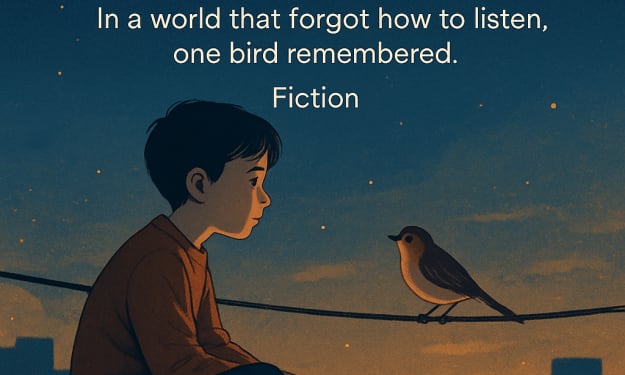
In a city where car horns screamed louder than thoughts, and footsteps echoed without purpose, silence had become a stranger. Streets buzzed, shops roared with music, and people buried themselves in phones, unaware of the world around them. Even the birds — once singers of morning joy — had stopped singing. Except for one. A sparrow, small and brown like dust, sat on a power line each dawn. It sang not for attention, but because it remembered a time when listening mattered. When songs could stir a soul, and silence was sacred. Down below, a boy named Eli lived in a narrow apartment tucked between two grey buildings. He had no friends. His parents worked too much. His teachers barely noticed him. He felt like a whisper in a world shouting over itself. Every morning, while brushing his teeth, Eli heard something no one else did — the sparrow’s song. Faint, pure, and lonely. At first, he thought it was his imagination. But it happened every day, always at the same time. A note here, a pause there, like the bird was telling a secret no one else could understand. He started listening. --- One morning, Eli skipped the bus and climbed up the stairs to the rooftop. There, perched above the chaos, was the sparrow. It didn’t fly away. It looked at him. And then… it sang. Eli didn’t speak. He didn’t take a picture. He just sat and listened, his heart slowing, his breath softening. For the first time in months, the noise inside his head grew quiet. The next day, he returned. And the next. He began writing what he felt. Words poured from him like water breaking a dam: "Your wings cut through the noise. A single note becomes a door. I walked through, into peace." His poems weren't perfect. But they were real. --- In school, Eli shared his first poem. His classmates laughed at first. But then they heard the honesty in his voice. A teacher asked him to read more. A girl who always sat alone began sitting beside him. Eli didn’t change overnight. But something did. The sparrow kept singing. And now, Eli sang back — in words, in kindness, in stillness. One weekend, he asked his teacher if he could paint a mural on the back wall of the school. It was usually covered in graffiti, ignored like a forgotten thought. With permission and a few brushes, he painted the sparrow. Wings spread. Eyes closed. Singing. At the bottom, he wrote: > “In a world full of noise, I listened. Now I hear everything.” --- People began to notice. A neighbor who hadn’t spoken to anyone in years stood quietly before the wall every morning. A teenager with headphones always on removed them for the first time and just stood in silence. The mural became more than art. It became a message. One day, Eli returned to the rooftop. The sparrow wasn’t there. Days passed. Still no bird. He was heartbroken, but something inside him whispered: “It was never just about the bird. It was about the listening.” He picked up his notebook and began writing again. --- Years later, Eli became a poet. He traveled to schools, libraries, and parks, telling children about the sparrow who sang when no one else did. He told them the truth: That sound is not always noise, and silence is not always empty. Sometimes, silence carries the message you’ve been needing to hear. His message reached thousands. His mural stayed untouched. His poems were translated. His voice — once ignored — was now a soft power of change. --- But whenever he sat quietly in nature, on a rooftop or by a tree, Eli still listened. Sometimes, faintly in the distance, he swore he heard a single note — not loud, not demanding. Just present. The voice of a sparrow. The voice of a world remembering how to feel. ---
By The Pen of Farooq about a year ago in Fiction
Cupcakes and Sunshine
It was one of those easy, quiet afternoons when the sun was warm but not too hot, and the sidewalk seemed to stretch out like a gentle path to nowhere in particular. I wasn’t rushing, wasn’t on any schedule. I was just enjoying the day — something that doesn’t happen often enough in our busy lives.
By ibrahim khanabout a year ago in Fiction
The Man Who Collected Goodbyes
The Man Who Collected Goodbyes He sat in the farthest corner of the café, where the sunlight met the shadows, sipping lukewarm coffee like it was sacred. Every day, at exactly 4 p.m., he arrived—never early, never late. Always alone.
By Wings of Time about a year ago in Fiction
When the Rain Fell Softly. AI-Generated.
The first time I saw her, it was raining—not the wild, stormy kind, but the soft, gentle drizzle that makes everything feel like a dream. I was sitting outside a quiet bookstore in Lahore, under a small awning, sipping hot chai from a paper cup. The smell of wet earth, old books, and street samosas lingered in the air. That’s when she appeared—running, laughing, drenched but not bothered at all. Her dupatta clung to her, her hair wet and tangled, and her smile… it was the kind that didn’t ask for attention but captured it anyway. She looked at me, a stranger, and said, “Do you mind if I stand here for a while? My umbrella broke halfway down the street.” I moved slightly, making space under the already crowded shade. “Of course not.” She stood beside me, brushing water from her sleeves. There was a kind of quiet comfort in the moment—two strangers sharing shelter from the rain. I offered her some chai. She took it with a soft laugh and thanked me. That’s how it began. Her name was Areeba. She was a literature student, studying Urdu classics, and had a soft spot for rainy days and old poetry. That first conversation went from Faiz to Ghalib, from chai stalls to childhood stories. She told me how marigolds reminded her of her grandmother’s garden—how they were simple but lasted longer than roses. I remember thinking, This girl sees beauty in things most people forget to notice. We parted ways that day without exchanging numbers, just a smile and a soft “maybe I’ll see you again.” I didn’t expect to. But the city, in its strange way, kept bringing us back together. We met again a week later at the same bookstore. Then again in a chai shop nearby. After that, it became a pattern. We never made plans—we just kept running into each other like the universe was writing us into the same chapter. We talked about everything. She told me how her dream was to pursue her Master’s in Karachi. I told her how I loved photography but never had the courage to chase it seriously. She encouraged me, saying, “If something brings you peace, it’s worth following.” One day, I brought her a bunch of marigolds, tied in a simple white thread. She looked at them, then at me. “You remembered.” “I remember everything about you,” I replied. We sat on that bookstore bench for hours, not caring about time or the noise around us. She read me poems from her notebook. I took pictures of her holding those marigolds, the sunlight catching her smile. But not every love story ends with forever. Some just leave you with moments that never fade. One evening, as we sat under our favorite tree, Areeba told me she’d gotten her admission in Karachi. She was leaving in two weeks. “I’m happy for you,” I said, though my chest ached. “I don’t want to go,” she whispered. “But you have to,” I replied. “For yourself. And I’ll still be here. Always.” We didn’t make promises we couldn’t keep. We exchanged letters instead of big words. And when she left, I stood at the station with another bunch of marigolds, watching her train disappear into the horizon. We kept in touch for a while—calls, texts, voice notes filled with poetry and silly jokes. But life has its way of testing distances. Slowly, the messages grew shorter. The calls became less frequent. And yet… not a day goes by when I don’t think of her. Every time it rains, I look out the window and remember that day—her laugh, the broken umbrella, and the warmth of her hand brushing mine as she took the chai. I still visit that bookstore. I still sit on that same bench. And yes, I still buy marigolds. Because sometimes, a moment is enough. One walk in the rain. One poem. One girl who saw beauty in forgotten things. And honestly, even if love doesn’t last a lifetime, it can still change one. Forever.
By Sherooz khanabout a year ago in Fiction
The Letter Arrived 20 Years Late. AI-Generated.
The mail came at 3:16 PM. Same as always. But that day, something was different. Tucked between a water bill and a supermarket coupon booklet was a yellowed envelope—creased, brittle, and stamped with a date: March 12, 2005.
By Muhammad Riazabout a year ago in Fiction
Rediscovering the Wholeness Within: Embracing Consciousness as the Source and Letting Go of the Illusion of the Ego
Over the past twenty years, the word “holistic,” like the word “organic,” has moved from the fringes to the center stage. It is a buzzword with positive connotations and yet remains hard to define. The main reason for this, I believe, is that wholeness is caught in a seeming contradiction. Do you aim, as millions do, to become whole, taking this as a spiritual goal?
By Julie Smithabout a year ago in Fiction
The Tree
Deep in the forest was a large, old tree. Not just large, but vast, and not just old, but ancient. This tree was so wide and tall that you might think it would blot out the sun, darkening the forest floor. Yet somehow it allowed just the right amount of light to filter through its leaves, so that the ground was not left wanting of warmth. Instead of darkness and damp at its feet, there was colour and life. Soft green moss crept over the earth and climbed its trunk. Small white flowers, like tiny fallen stars, were sprinkled around the base, and the delicate tendrils of a vine slowly made their way over and around the roots of the ancient tree.
By Victoria Roseabout a year ago in Fiction
Whatever Happened To Home
Today was the day — The day where I left it all behind. Why I would do such a thing? Well, I have yet to come up with a simple answer for that. It’s far more complicated than just one thing. It’s a buildup of pressure that has slowly been pushing for an escape. And the only escape I ever knew — was to run away.
By John Henryabout a year ago in Fiction
Hamlet
The neon skyline of Elsinor City pulsed red against the smoggy night as Hamlet pressed his hand to the bulletproof glass of the penthouse window. Below, the city lived and died on rhythm and betrayal—just like the stories whispered through the halls of the CrownCorp towers. Hamlet Sinclair III had it all: power, privilege, and a family legacy carved from steel and secrets. But tonight, it all felt hollow. “Your father was murdered.” The words still echoed from the encrypted message he’d received just hours ago. Anonymous. Precise. Cruel. He had believed the official report: heart failure. But the whisper of doubt had never quite gone silent. And now, it screamed. --- “Are you sure about this?” Ophelia asked, perched on the leather armchair in his office, eyes full of worry. “No,” Hamlet admitted, pouring a drink. “But if there’s even a chance it’s true, I can’t let it go.” “They’ll call you paranoid.” “They already do.” Ophelia rose and took the glass from his hand, setting it aside. “Then don’t do this alone.” Hamlet looked at her—the only one who saw through the crown and chaos. He wanted to believe she’d still be there when it all collapsed. “I don’t trust anyone else,” he said. “Not even my mother.” --- His investigation began with silence. Then came surveillance footage from the night of his father’s death—altered. Then a financial paper trail—buried transactions between Claudius Sinclair and shadow brokers. Claudius, his uncle. Now CEO. Now married to his mother. Now suspect. The betrayal tasted metallic. Hamlet stood before the family portrait in the grand atrium, staring into his father’s painted eyes. “I’ll make them pay,” he whispered. --- At a shareholder gala, under the guise of toasts and tailored suits, Hamlet cornered Claudius near the private bar. “I’ve been thinking about Father a lot lately,” Hamlet said, swirling his drink. Claudius’s smile didn’t waver. “We all miss him.” “Do we?” A flicker of something passed over Claudius’s face. Hamlet leaned in. “Funny how your fortune doubled the week after his death.” “You sound accusatory, nephew.” “And you sound guilty.” A beat of silence. Claudius smiled again. But it was colder this time. “Careful, Hamlet. Grief can make you see ghosts where there are none.” Hamlet downed his drink, eyes locked. “And guilt buries bodies in boardrooms.” --- Later that night, Hamlet found Ophelia waiting in his penthouse. Her hands trembled as she handed him a flash drive. “I hacked the servers,” she said. “I didn’t want to. But you need to see this.” On the screen: an audio file. Claudius’s voice. “…take him out. If the old man finds out, we lose everything. Make it look natural. Heart failure. Clean.” Hamlet sat in stunned silence. Then he stood. “This is it. This is the truth.” Ophelia caught his wrist. “Don’t do what I think you’re about to do.” “He took everything from me.” “And if you kill him, you’ll lose yourself, too.” --- The confrontation came not with bullets or board votes, but in the family chapel, lit only by a stained-glass moon. Claudius stood before the altar, alone. “I know what you did,” Hamlet said, voice echoing. Claudius turned. “Do you?” “I have the recording. You killed him.” Claudius stepped closer, unafraid. “What will you do with it? Expose me? Ruin the empire your father built? Or will you bury the truth, like we buried him?” Hamlet’s hand hovered near the gun in his coat. “You want me to pull the trigger,” Hamlet said bitterly. “I want you to choose,” Claudius replied. “Are you a son… or a prince?” --- He didn’t shoot. Instead, he played the recording for the board. And the press. And the world. Claudius was arrested. His mother left the city. The empire cracked under scandal. Hamlet watched it all unfold from a hotel room far from Elsinor. Ophelia called. He didn’t answer. He’d won—but he felt empty. Like a ghost. Because in destroying Claudius… he’d buried something of himself. Not just a prince. Not just a son. But a man who believed justice could restore what revenge never could.
By Shah Nawazabout a year ago in Fiction