Series
Escape from the Cooinda Cycle: Part Three
I was surprised when I looked at my watch, and rekindled with energy to make it through the last time here, I quickly left the area and used the staff code to exit the back door towards the bins. I enjoyed the small amount of time in relative calm while doing the bins and did not rush back, but slowly made my way back down to The Gypsy’s room.
By Savannah K. Wilson4 years ago in Fiction
Escape from the Cooinda Cycle: Part One
“I've been looking for freedom, Since I left my home town, I've been looking for freedom,” I was singing along as loud as I could clapping where I could without losing control of the vehicle. As the song came to its crescendo, I belted out the final line in time with The Hoff.
By Savannah K. Wilson4 years ago in Fiction
LONDON SHARK: CHAPTER FOUR
you can find the prologue and all previous chapters here C h a p t e r F o u r THE MAN WALKS WITH PURPOSE, his hair (slightly shaggy, definitely auburn dashed with peroxide tips, I see now) lightly bouncing on an exposed white shirt collar that’s peeping out from his peacoat. The purpose in his gait is one of freedom, of vigour. This is because he . . . he has the remnants of Hannah’s fingerprints still wrapped around his own digits, while the loveless clamminess I feel balled up in my fist is probably sweat, although, with the pressure I’ve been squeezing my fingernails into my palms, it’s quite possibly blood.
By jamie harding4 years ago in Fiction
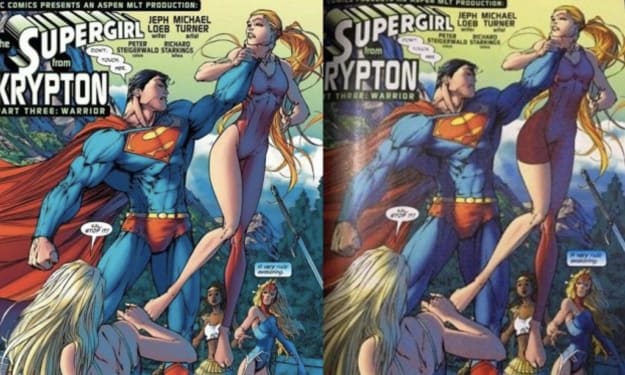
10 Comic Books Deemed Too Hot to Handle
10 Comic Books Deemed Too Hot to Handle The name of the 1954 book by psychologist Fredric Wertham's Seduction of the Innocent. It wasn't a love story or an erotic thriller, either. He argued that it was an exposé of a product harmful to young people's mental health worldwide. Those violent and suggestive comic comics were his preferred target audience. He asserted that by exposing their young readers to violence and sex, these scandalous journals fostered misbehaviour. He bent facts and other data to match his idea when they contradicted it. Although his accusations were absurd, his assertions concerned parents, educators, and politicians. Publishers started to filter their titles so that the contents would be deemed acceptable by the Comics Code Authority (CCA), which was established in 1954 by the Comics Magazine Association of America, and they also contributed to the comic book industry's voluntary self-policing. Surprisingly, some publishers, including the biggest and best-known in the business—Marvel Comics and DC Comics—continued to censor their own works even after publishers voluntarily withdrew from the censorship programme. These 10 comics were thought to be too hot to handle. They were consequently censored by their own publishers.
By Paul Smith4 years ago in Fiction