Mystery
If You Go Into the Woods Today. Honorable Mention in They Shouldn’t Have Come Here Challenge.
Calvin looked at the remnants of the campfire and took one final bite of his cold s’more. The wind started to bite with cold and he leaned forward to douse the glowing embers from a bucket.
By Amos Glade5 months ago in Fiction
The Night the Beds Learned to Fly
The Night the Beds Learned to Fly A Secret Above the Clouds That No One Was Meant to Discover In the town of Hollow Pines, beds were never considered interesting. People bought them for comfort, complained when they creaked, replaced them when they sagged, and slept without giving them another thought. Beds stayed where beds belonged—on floors, against walls, under windows, carrying dreams like quiet containers. At least, that was the rule. Until the night the beds disappeared. It began with a sound. Not thunder. Not wind. A soft humming. At first, only Mrs. Bell thought she heard it. She woke in the middle of the night and sat upright. Her bedroom felt strangely empty. Her bed was vibrating. “Impossible,” she whispered. Then the humming grew louder. The bed lifted. Slowly. The legs left the floor. Mrs. Bell stared. Her blanket slid toward her feet. Her heart climbed into her throat. And before she could scream— the bed floated upward and drifted through the open window. Mrs. Bell grabbed the headboard. The bed did not stop. Outside, moonlight painted the streets silver. One by one, windows opened. Beds rose into the air. Mattresses glided. Wooden frames turned gently like ships catching invisible currents. Across Hollow Pines, beds began taking flight. Nobody understood why. Nobody knew where they were going. Except one boy. Eli Warren. Eli had never slept much. He stayed awake late reading stories about impossible places and inventing explanations for things other people ignored. So when his own bed began humming at midnight— he was already watching. His eyes widened. His first thought was: Finally. His second thought was: Don’t let this be a dream. Eli leapt onto the mattress before it left the floor. The bed rose. His stomach dropped. His house shrank. His neighborhood became a pattern of rooftops. The air rushed around him. His bed moved higher. Higher. Above chimneys. Above clouds. Above everything familiar. Eli laughed. Then immediately regretted laughing because flying beds did not appear to come with instructions. “Where are we going?” he shouted. The bed answered. Not with words. But with a turn. Then another. Then a sudden acceleration. They joined a river of hundreds of glowing beds heading toward the horizon. Some carried sleeping adults. Some carried children. Some were empty. Some had pillows bouncing behind them. Above the clouds, something impossible appeared. A city. Not made of stone. Not made of metal. Made entirely of beds. There were towers stacked from wooden frames. Bridges woven from headboards. Roads made of blankets stretched tight. Windows glowing from lamps inside enormous mattresses. Beds moved through the sky like living creatures. Eli’s jaw dropped. A voice came from beside him. “New arrival.” He turned. A girl sat cross-legged on a floating bed. Her hair moved upward slightly in the wind. She looked about his age. She smiled. “You’re staying upright. Impressive.” Eli blinked. “You knew this existed?” She nodded. “My family’s been coming here for generations.” Eli stared harder. “…Why?” The girl shrugged. “People forget beds aren’t only for sleeping.” Her bed drifted beside his. “I’m Mira.” “Eli.” Mira pointed ahead. At the center of the city stood the largest bed ever built. So enormous it touched the underside of the clouds. Golden sheets shimmered around it. Thousands of smaller beds circled it. “What is that?” Mira’s expression changed. Nobody laughed. Nobody spoke loudly. “That’s the Dreamframe.” Eli frowned. “The what?” Mira lowered her voice. “It keeps flight possible.” Eli looked around. Beds everywhere. Floating. Moving. Alive. He laughed nervously. “This can’t be real.” Mira smiled. “That’s what everyone says.” They landed near a wide staircase made from polished bed slats. A crowd gathered. An elderly figure stepped forward. His coat looked stitched from old quilts. His eyes were bright. He looked at Eli. Then smiled. “First flight?” Eli nodded. The old man bowed slightly. “Welcome.” Eli pointed around. “What is this place?” The old man looked upward. For a long moment. Then said— “Every bed remembers.” Eli blinked. The old man continued. “People think beds only collect sleep.” He touched the wooden railing. “They collect stories.” Dreams. Secrets. Late-night thoughts. Hope. Fear. Regret. Longing. Wonder. Everything people carry before they close their eyes. And long ago— someone discovered enough of those memories could become wings. Eli looked at the city. The idea sounded impossible. But everything here already was. The old man turned. “Come.” They entered a chamber beneath the Dreamframe. Inside— walls pulsed softly. Thousands of tiny lights moved through wooden beams. Floating images appeared. Children laughing. Families reunited. People whispering impossible wishes into pillows. Someone writing letters they never sent. Someone deciding not to give up. Eli stared. The old man said quietly— “Beds remember who people were when nobody watched.” Eli felt strangely quiet. Then asked: “So why don’t beds fly all the time?” The old man’s expression darkened. Because not every dream rises. Some become too heavy. Some become forgotten. Some become fear. The Dreamframe had rules. Only beds with enough wonder could remain airborne. Otherwise— they returned. And Hollow Pines had been selected for a rare migration. Eli looked around. “So people don’t know?” The old man smiled sadly. “No.” Mira nudged him. “Come on. There’s one more thing.” She led him to the edge of the city. Far below— clouds parted. The world stretched endlessly. Thousands of flying beds moved outward. Like stars drifting across the sky. Mira looked at him. “You know the strange thing?” Eli waited. She smiled. “People think dreams happen inside beds.” Her bed floated slightly. “But sometimes…” She pointed upward. “…dreams become the reason beds move.” Eli looked at the horizon. For the first time in years— he didn’t want answers. He wanted to fly. He stepped onto Mira’s bed. She grinned. The city behind them glowed. The wind opened. And together— they soared into the night. Not toward adventure. Not toward treasure. Not toward escape. Just upward. Where beds carried forgotten stories. Where pillows became sails. Where impossible things happened quietly above sleeping towns. And somewhere far below— people slept without knowing that above their roofs— their beds were learning how to dream. By sunrise, every bed returned. No scratches. No missing blankets. No one believed the stories. Except Eli. Because when he opened his bedroom door— his bed was exactly where he left it. But there was something different. A single pillow rested at an odd angle. And carved faintly into the wooden frame— almost impossible to see— were three words: NEXT FLIGHT SOON.
By Samson E. Gifted5 months ago in Fiction
The Last Letter
The letter arrived on a Tuesday, which was strange, because Marcus had been dead for three years. Lena stood at the door of her apartment, the envelope trembling between her fingers. Her name was written in his handwriting — that unmistakable slant, the way he always looped the L like a small wave. She had spent years trying to forget that handwriting. She had burned his notes, deleted his messages, given away the books he had annotated in the margins just to stop herself from reading his thoughts.
By Elarix Dreson5 months ago in Fiction
A Man For All Seasons
''By Robert Bolt'' Early Childhood Robert Bolt was born in 1924 in Manchester. He was the son of a small shopkeeper; his father kept a furniture shop. He had one elder brother. He was brought up as a Methodist. He says that he still has a rather Puritan outlook on enjoyment, needing a moral reason for it to obtain peace of mind.
By M Uzair Khan (UK)5 months ago in Fiction
The Forgotten Lighthouse Keeper’s Island
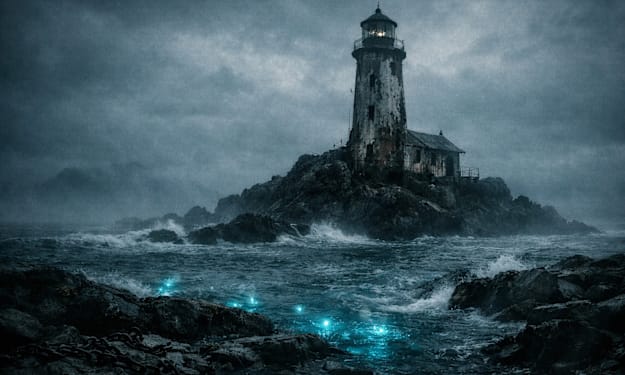
. We were four friends looking for an adventure during our island-hopping trip along the eastern coast of Sulawesi. Me (Raka), my best friend since school Dimas, his sister Nadia, and our friend Tara. Someone in the last port had told us about a tiny, forgotten island with an old Dutch lighthouse that hadn’t been visited in decades. “No one goes there anymore,” the old fisherman said. We thought it would make for incredible photos and stories. We hired a small boat and left early in the morning. The sea was calm. After three hours we saw it — a rocky island no bigger than two football fields, dominated by a tall, white lighthouse standing against the gray sky. No other buildings. No trees. Just rocks, waves, and that lonely tower. The boatman refused to wait. He dropped us off and said he would return in two days. We waved him off, excited. The lighthouse door was unlocked. Inside, the ground floor was surprisingly clean. A table with four chairs. A pot still sitting on an old stove. Upstairs, the keeper’s living quarters had beds with sheets that looked recently changed. In the basement, accessed by a narrow spiral staircase, we found metal doors and what looked like old storage rooms. That first night we cooked noodles and laughed around a small fire outside. The stars were beautiful. The waves crashed steadily against the rocks. Everything felt peaceful. Until 1:47 a.m. I woke up to a soft, pulsing blue light coming from the basement stairs. I thought one of us had left a flashlight on. When I went to check, the light disappeared. But I heard something — a low, wet clicking sound, like a tongue against teeth, followed by a soft humming. The next morning we explored the basement properly. It was much larger than it looked from above. Damp concrete walls covered in dark mold. Old metal barrels. And at the far end, a heavy iron door leading deeper down into the rock. The door was slightly open. Behind it, stone steps went further down into darkness. Dimas wanted to go deeper. We followed with our flashlights. That’s when we saw the first lure. A small, glowing blue orb floating in the darkness ahead. It swayed gently, like a fishing lure. Then another appeared. Then three more. They were attached to long, thin stalks coming from the heads of pale, humanoid shapes crouched in the water that flooded the lowest chamber. The creatures were horrifying. Their bodies were thin and elongated, almost skeletal, with translucent skin showing dark organs underneath. Their heads were bulbous and hairless. From the top of each head grew a long, fleshy stalk ending in a glowing lure — blue and white, pulsing softly. Their faces had no eyes, only wide slits for nostrils and large, tooth-filled mouths that opened sideways. Their fingers were extremely long and webbed, perfect for gripping wet stone. They didn’t attack immediately. They watched us. The lures swayed hypnotically. We ran back upstairs and barricaded the basement door with heavy barrels. We told ourselves they couldn’t climb up. We were wrong. On the second night they started coming. The lures appeared first — glowing softly under the door gaps. Then long fingers reached through, feeling around. They made that constant wet clicking sound. One of them pressed its face against the bottom of the door and began whispering in a voice that sounded like bubbles popping underwater. It called Nadia’s name. It knew her name. Tara was the first to break. On the third night she woke up screaming. One creature had managed to squeeze its thin arm through a crack and was holding her ankle. The glowing lure on its head was inches from her face. She stared into it, frozen. When we pulled her away, her eyes were glassy. She kept repeating, “It showed me the bottom of the sea… it’s beautiful.” She walked downstairs the next morning while we slept. We heard her scream once, then the wet dragging sound. When we reached the basement, she was gone. Only her shoes remained, neatly placed beside the water. Dimas tried to be strong for his sister. He made spears from broken wood and metal. We stayed on the top floor of the lighthouse, the lantern room, where we could see everything. But the creatures were patient. They began climbing the outside walls at night. We could hear their long fingers scraping against the concrete as they pulled themselves up. Nadia was taken on the fifth night. She had gone to the edge of the platform to get fresh air. One moment she was there. The next, a pale arm reached over the railing, wrapped around her waist, and pulled her down silently. We heard her scream as she fell. When we looked over, we saw multiple glowing lures underwater, surrounding her sinking body. She was still struggling. Dimas never recovered after that. He stopped speaking. He just sat in the corner staring at the floor. On the sixth night he walked straight down the stairs without a word. We heard him talking to someone down there — laughing, then crying, then silence. The creatures had learned his voice perfectly. Now I am completely alone. I have been in the lantern room for two days. The creatures have filled the lower floors. Their glowing lures light up the entire staircase like underwater stars. Sometimes they call my name in the voices of my dead friends. They sound so real. They beg me to come down. They say the water is warm. They say I won’t feel pain for long. My phone still has some battery. The boatman is not coming back. I think he knew. The creatures are patient. They wait. One of them is climbing the outside wall right now. I can see its glowing lure rising slowly past the window. Its mouth is open. It is smiling. If you ever hear about a forgotten lighthouse on a small rocky island, do not go there. The keeper did not leave. He is still down there. And he is no longer human. The door to the lantern room just moved. Long wet fingers are sliding underneath it. The lure is glowing brighter now. It is very close.
By Esmat Zafari5 months ago in Fiction
Shops, Shops, Shops, Shops, Shops, Shops, Shops
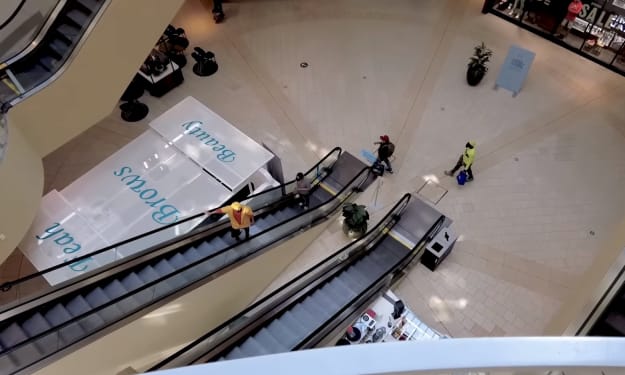
Introduction. The title of this was influenced by the name of the band "Pigs, Pigs, Pigs, Pigs, Pigs, Pigs, Pigs" and the Buchanan Shopping Mall in Glasgow, though virtually any Shopping Mall makes me feel like this.
By Mike Singleton 💜 Mikeydred 5 months ago in Fiction
Last Ride on Route 11
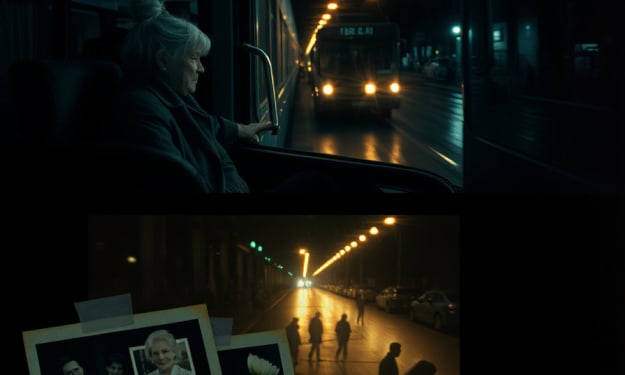
Last Ride on Route 11 by [ uzair hadi] The final run of Route 11 was always quiet. The bus rolled through the sleeping city like an old dog on its nightly patrol, its headlights brushing across shuttered storefronts, cracked sidewalks, and the glint of bottles left on curbs. Harold, the driver, had been doing this route for seventeen years, and the pattern had become familiar. Familiar enough that, when the woman first stepped onto the bus at Maple and 14th three weeks ago, he knew something was different.
By uzair hadi5 months ago in Fiction
True Story
It was not aliens. I know saying that first does me no favours. But once a man says aliens, the story is over. People stop listening to the parts that are true. They stop asking what season it was, what the house smelled like, what the dog did, whether the porch light was on, whether there was a June bug dead in the glass or still alive, knocking itself stupid against the bulb.
By Patrick Gadoury5 months ago in Fiction
The Forgotten Prison in the Forest
We were six friends on a hiking trip in the dense forests of East Kalimantan. Me (Fikri), my brother Toni, our cousins Rina and Dika, and our friends Lena and Marco. We had heard rumors about an old forgotten prison built by the Dutch colonial government in the 1930s that was abandoned after Indonesia’s independence. Locals said it was deep in the jungle and completely swallowed by trees. It sounded like the ultimate exploration story for our group chat. After two days of hard trekking, we found it. The prison emerged from the jungle like a broken concrete monster. Tall walls covered in thick vines. Rusty iron gates hanging open. Watchtowers tilted at dangerous angles. The main building was a long, ugly block with rows of tiny windows. The air around it felt heavier, damper, and smelled of old rust and wet stone. “This place is massive,” Marco said, his voice echoing. “Let’s check it out quickly before it gets dark.” We should have turned back. Inside the main gate, the courtyard was overgrown with weeds. Old metal shackles still lay on the ground. We entered the main cell block through a heavy door that creaked loudly. The corridor stretched long and dark. Tiny cells lined both sides — each one barely wider than a person’s outstretched arms. The ceilings were low. The walls were covered in scratches. That’s when we first felt watched. On the second day we decided to spend the night. We set up camp in the old guard room near the entrance because it had a solid roof. We built a fire and laughed about how creepy the place was. None of us wanted to admit we were already uncomfortable. The creatures revealed themselves on the third night. They were former prisoners. Or at least, something that used to be human. Their bodies were horribly stretched and twisted from decades of being forced into those tiny cells. Their spines were curved unnaturally. Their arms and legs were elongated, joints bent in wrong directions. Their skin was pale gray and hung loosely, like it had been stretched too many times. Their heads were elongated from pressing against the low ceilings. They had no eyes — just dark hollows — but they moved with terrifying awareness. We first saw one at 2:17 a.m. It was standing at the end of the cell corridor, perfectly still, its long arms hanging down past its knees. Its head was tilted sideways, as if listening. When our flashlight hit it, it slowly opened its mouth too wide and made a sound like cracking bones. Then it crawled up the wall and disappeared into the ceiling. We panicked and tried to leave at first light. But the jungle had changed. The path we had used to arrive was gone, replaced by thick, tangled vines that hadn’t been there before. We were trapped. The creatures began hunting us slowly. They never rushed. They enjoyed watching us break. They would stand outside the cells where we hid, breathing heavily, their long fingers scratching the walls in rhythm. Sometimes they whispered in broken voices — names of our family members, things we had never told each other. Dika was the first to go. On the fourth night, he woke up screaming. One of the creatures was inside our guard room, crouched over him. Its long fingers were pressing into his shoulders, slowly pulling his body longer. We could hear his bones cracking as it stretched him. When we finally drove it away with fire, Dika was already changed. His arms were longer. His back was bent. He kept whispering, “The cell feels smaller now,” before walking into the darkness. We never saw him alive again. Lena lasted until the fifth night. She started hearing her dead mother’s voice coming from one of the isolation cells. The creature had learned it perfectly. It kept calling her name softly, crying like a mother. Lena broke down and ran toward the sound. We heard her screaming for almost an hour as they stretched her into their shape. When we found her body the next morning, she was sitting neatly inside a tiny cell, her limbs folded at impossible angles, still breathing but no longer human. Marco tried to be the hero. He made torches and went deeper into the prison to find another exit. We waited for hours. Eventually we heard him screaming our names — but it wasn’t really him. The creatures had learned his voice. They used it to call us, begging us to come help him. Toni and Rina died together on the sixth night. They tried to climb the watchtower to signal for help. Two creatures followed them up the stairs, moving on all fours like broken spiders. We heard the sounds of bones breaking and their final screams. When I found what remained, their bodies had been carefully placed in two small guard posts — folded to fit the tiny spaces. Now only I remain. I have been hiding in the same guard room for two days. The creatures no longer hide. They stand outside the door, five or six of them, their long bodies bent, hollow faces turned toward me. They breathe together in rhythm. Sometimes they stretch their arms under the door, fingers reaching, scraping the floor. They have brought me food. Old prison rations that appear fresh every morning. They want me alive. They want me strong enough to last longer so they can enjoy breaking me slowly. I am typing this with shaking hands. My phone battery is at 9%. The scratching on the walls is getting louder. They are widening the cracks, trying to reach me. I can hear Toni’s voice now, calling from the corridor: “Fikri… come out. The cell is ready for you.” It sounds exactly like him. I miss my friends. If you ever hear about an old prison deep in the Indonesian jungle, do not look for it. Do not enter the gates. Do not listen to the voices that know your name. The prisoners never left. They are still serving their sentences. And they want new cellmates. The door just moved. Long fingers are reaching underneath it right now.
By Esmat Zafari5 months ago in Fiction
Something in Your Light
Aquaria missed the artistic engineer, who breathed life into his designs, singing his poetry, and giving her a lighthouse soul. She still missed her original clockwork gears from the 1890’s that rotated the beacon light inside the crystalline, multi-faceted, glass Fresnel lens. Like a giant diamond, it reflected light from all the sharp cuts. Sometimes for fun she made the light pulse against the night sky, bright as a sun then like a dim star in the distance. One night local boy Ray Olson was lurking around the lighthouse. Aquaria did her pulsing light display, catching him in a brilliant burst. He ran all the way home. "You've got some imagination. Serves you right," said his mother. But the stories grew and people wondered. "There is something strange about our Aquaria Lighthouse," people in the village would say. "It's haunted." Because she was more than stone and mortar, she missed the personal human element from the times when the lightkeepers wrote by hand in her logbook. When she felt an intuitive connection with people, she warmed the air and floor around them. But only her beloved singing engineer had been intuitive enough to sense the connections. Through the decades, mystical tales about her became part of the local village lore. Aquaria enjoyed hearing the whispered stories. She felt a connection, and she sent warmth into the air around the storytellers. Aquaria’s flashing lighthouse beacon was updated from oil wicks to electricity in the 1930s. Then in the 1980’s she was automated further. Even her logbooks were kept on a computer instead of handwritten. She was decommissioned in 2020, but on her ground floor sat the old computer from back in the 1980s used for the keepers’ daily logbook entries. It was still plugged in and sometimes the old processors made whirring noises during the night when there was no one around to hear it. No one else knew Aquaria had gained access to this technology. Now the lighthouse with a soul even wrote stories on it that no one read. Ghost stories and myths surrounded the slender tower topped by a glass lantern, sitting on a bluff hundreds of feet above the sea. Aquaria's beacon was no longer used, but her fame as a beautiful lady of the sea continued. One night a local person driving along the coastline pulled off the road to watch the stars and the moonlit waves. He swore he saw Aquaria shine her beacon and sweep it across the sea and rocky headlands. The villagers shook their heads and looked at him with sideways eyes when he told them his story. They shared secret glances with each other, raising their eyebrows. Another time someone visited the ground floor of the lighthouse after dark. They thought they saw flickers of amber on the monitor screen when they came into the ground floor room. More rumors of a ghost began to circulate. One hundred and thirty years after Aquaria’s light first shined, tourists often said, “It is almost as if Aquaria is alive with her own personality.” She became a legend. The stories grew. One night a group of teenagers sneaked along the trails to her tower at night. They wanted to find out if there really was a ghost. Their skin tingled when they got close. “Did you hear something?” “No, silly, it is only a wild animal in the bushes.” The clever nerd of the group found a way to open the door to the ground floor of the lighthouse tower. Inside, they looked around. It was like time traveling to the past. “Wow, I bet that’s the same stove they had in the 1890s,” said a young girl’s voice. In one corner sat a black, wood-fired Franklin warming stove. Nearby was a table with a wooden box holding antique books. They spotted the boxy old computer from the 1980s sitting next to the old books. "Old stuff next to the computer. But the computer is at least 40 years old too. Wow." The group felt the impact of the passage of decades and different eras. They paused to process the feelings evoked by this “This is so cool.” “Let me see.” “Get out of my way.” The kids elbowed each other to get a closer look. “Let’s fire this up,” said one of the boys. He pushed the computer’s Power button. They found a 5 ½ inch floppy disk under the dusty computer. “I can’t believe this,” said a girl wearing a baseball cap backward. The squat monitor on top of the CPU box lit up with amber-colored text and numbers rolling and blinking. The group's computer nerd read the scrolling text. "It is a 246. Mid-1980s. Classic." The group stared at this historic machine from about 40 years ago. The girl in the baseball cap found the old plastic mouse and plugged it in. Then she pushed the huge floppy disc into the port. A document appeared on the screen. The air and floor around them started to warm up, but they didn’t notice. At the top, the title said, “The Legend of Aquaria Lighthouse.” The teenagers clustered around the monitor, reading the amber-toned letters that contrasted with the black background. "Who wrote this?" The computer nerd wrinkled his forehead and lifted one eyebrow. The others giggled at his comical face. Then they began reading. Aquaria was created with love by a lonely, artistic engineer, who had the heart of a poet. He imagined infusing her graceful white tower and lantern with life in his passion for her beauty. To him, she was a graceful lady in white, ready to dance with the ocean breezes. When he was nearly finished building her, he sat in the lantern room, high above the sea, like a lover with his beloved, writing poetry about her and singing this song to her. Through the ocean mist, Shining and sun-kissed, Flashing lighted tower, At the midnight hour. Perfumed by salty air, Foggy cloaks you wear, You almost seem alive Each time that I arrive. Something in your light Technology at night Has personality Beyond what I can see.
By M Uzair Khan (UK)5 months ago in Fiction