
The Forgotten Prison in the Forest
the prison from 1930s that was abandoned after Indonesia’s independence.

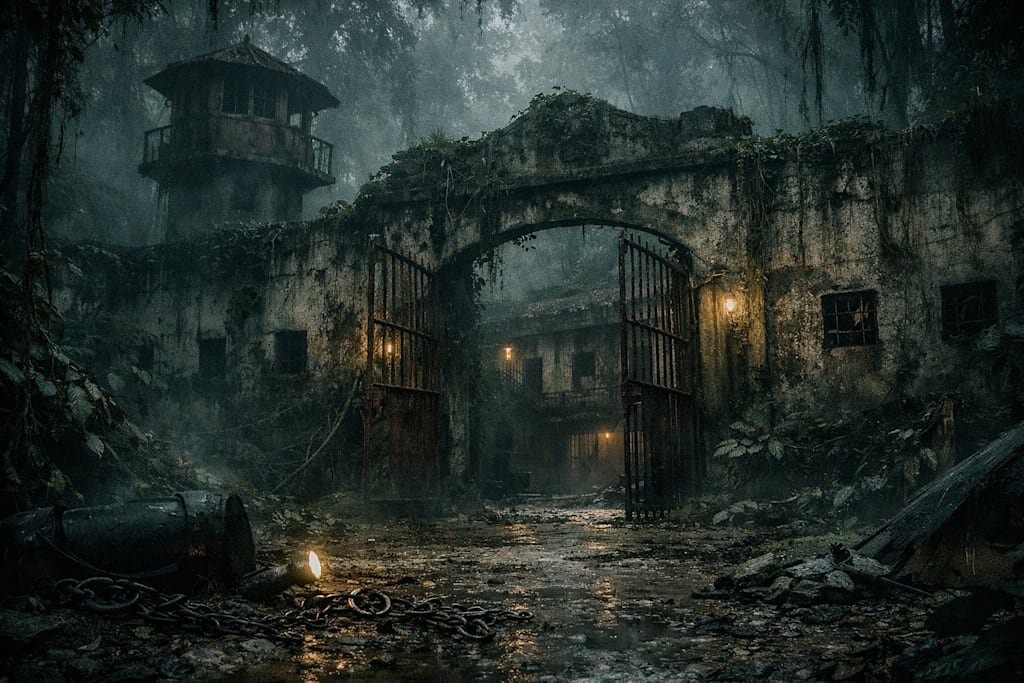
We were six friends on a hiking trip in the dense forests of East Kalimantan. Me (Fikri), my brother Toni, our cousins Rina and Dika, and our friends Lena and Marco. We had heard rumors about an old forgotten prison built by the Dutch colonial government in the 1930s that was abandoned after Indonesia’s independence. Locals said it was deep in the jungle and completely swallowed by trees. It sounded like the ultimate exploration story for our group chat. After two days of hard trekking, we found it. The prison emerged from the jungle like a broken concrete monster. Tall walls covered in thick vines. Rusty iron gates hanging open. Watchtowers tilted at dangerous angles. The main building was a long, ugly block with rows of tiny windows. The air around it felt heavier, damper, and smelled of old rust and wet stone. “This place is massive,” Marco said, his voice echoing. “Let’s check it out quickly before it gets dark.” We should have turned back. Inside the main gate, the courtyard was overgrown with weeds. Old metal shackles still lay on the ground. We entered the main cell block through a heavy door that creaked loudly. The corridor stretched long and dark. Tiny cells lined both sides — each one barely wider than a person’s outstretched arms. The ceilings were low. The walls were covered in scratches. That’s when we first felt watched. On the second day we decided to spend the night. We set up camp in the old guard room near the entrance because it had a solid roof. We built a fire and laughed about how creepy the place was. None of us wanted to admit we were already uncomfortable. The creatures revealed themselves on the third night. They were former prisoners. Or at least, something that used to be human. Their bodies were horribly stretched and twisted from decades of being forced into those tiny cells. Their spines were curved unnaturally. Their arms and legs were elongated, joints bent in wrong directions. Their skin was pale gray and hung loosely, like it had been stretched too many times. Their heads were elongated from pressing against the low ceilings. They had no eyes — just dark hollows — but they moved with terrifying awareness. We first saw one at 2:17 a.m. It was standing at the end of the cell corridor, perfectly still, its long arms hanging down past its knees. Its head was tilted sideways, as if listening. When our flashlight hit it, it slowly opened its mouth too wide and made a sound like cracking bones. Then it crawled up the wall and disappeared into the ceiling. We panicked and tried to leave at first light. But the jungle had changed. The path we had used to arrive was gone, replaced by thick, tangled vines that hadn’t been there before. We were trapped. The creatures began hunting us slowly. They never rushed. They enjoyed watching us break. They would stand outside the cells where we hid, breathing heavily, their long fingers scratching the walls in rhythm. Sometimes they whispered in broken voices — names of our family members, things we had never told each other. Dika was the first to go. On the fourth night, he woke up screaming. One of the creatures was inside our guard room, crouched over him. Its long fingers were pressing into his shoulders, slowly pulling his body longer. We could hear his bones cracking as it stretched him. When we finally drove it away with fire, Dika was already changed. His arms were longer. His back was bent. He kept whispering, “The cell feels smaller now,” before walking into the darkness. We never saw him alive again. Lena lasted until the fifth night. She started hearing her dead mother’s voice coming from one of the isolation cells. The creature had learned it perfectly. It kept calling her name softly, crying like a mother. Lena broke down and ran toward the sound. We heard her screaming for almost an hour as they stretched her into their shape. When we found her body the next morning, she was sitting neatly inside a tiny cell, her limbs folded at impossible angles, still breathing but no longer human. Marco tried to be the hero. He made torches and went deeper into the prison to find another exit. We waited for hours. Eventually we heard him screaming our names — but it wasn’t really him. The creatures had learned his voice. They used it to call us, begging us to come help him. Toni and Rina died together on the sixth night. They tried to climb the watchtower to signal for help. Two creatures followed them up the stairs, moving on all fours like broken spiders. We heard the sounds of bones breaking and their final screams. When I found what remained, their bodies had been carefully placed in two small guard posts — folded to fit the tiny spaces. Now only I remain. I have been hiding in the same guard room for two days. The creatures no longer hide. They stand outside the door, five or six of them, their long bodies bent, hollow faces turned toward me. They breathe together in rhythm. Sometimes they stretch their arms under the door, fingers reaching, scraping the floor. They have brought me food. Old prison rations that appear fresh every morning. They want me alive. They want me strong enough to last longer so they can enjoy breaking me slowly. I am typing this with shaking hands. My phone battery is at 9%. The scratching on the walls is getting louder. They are widening the cracks, trying to reach me. I can hear Toni’s voice now, calling from the corridor: “Fikri… come out. The cell is ready for you.” It sounds exactly like him. I miss my friends. If you ever hear about an old prison deep in the Indonesian jungle, do not look for it. Do not enter the gates. Do not listen to the voices that know your name. The prisoners never left. They are still serving their sentences. And they want new cellmates. The door just moved. Long fingers are reaching underneath it right now.
About the Creator
Esmat Zafari
hey i am esmat Zafari,i post stories about horror and scary psychological facts, scenarios and more,i post constantly so consider following and subscribing me so you get what i post
Enjoyed the story? Support the Creator.
Subscribe for free to receive all their stories in your feed.
Comments
There are no comments for this story
Be the first to respond and start the conversation.