Mystery
The Roar and the Whisper
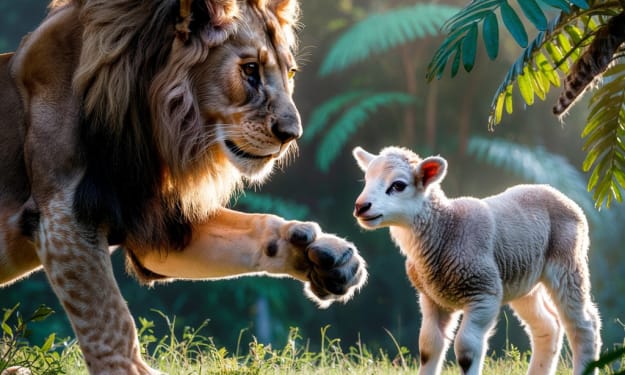
The Roar That Ruled "eep in the heart of the forest where sunlight cracked through tangled canopies and shadows held secrets, ruled the mighty lion, Ragnar. His mane was like flame, his roar like thunder, and no creature dared question his rule. He hunted when he pleased, roamed where he chose, and took what he wanted. The law of the wild was simple: “The strong survive, and the weak obey.” And no creature was considered weaker than the lambs of the northern meadow. Their soft bleats and peaceful grazing made them easy prey. They never ran far. They never fought back. And they always feared Ragnar. But the lion was growing tired. No hunt thrilled him anymore. No roar echoed long enough. A gnawing emptiness followed every victory, though he didn’t know why. The Lamb Who Didn't Run One overcast morning, Ragnar padded through the forest and came upon a stream near the meadow. There, alone and humming a strange little tune, stood a lamb—Lyra—her snow-white wool glowing against the gray sky. She was far from her flock, vulnerable, unaware. Or so Ragnar thought. He stepped forward, ready to pounce, but Lyra didn’t flinch. She looked up, locking eyes with the predator of her kind. "You’re the lion they all whisper about," she said. Her voice was calm. Almost... curious. Ragnar paused mid-step. No creature had ever spoken to him without trembling. "You should run," he growled. "I know," she replied. "But I won’t." "Why not?" Lyra smiled faintly. "Because I don’t believe you want to eat me. Not today. A Strange Curiosity Instead of devouring her, Ragnar sat down. For the next hour, they talked. Or rather—she talked, and he listened. She told him about the wind and how it carried the scent of wildflowers from the southern hills. She told him about a mother bird building her nest in a crooked tree. She even sang him a lullaby her grandmother used to hum during storms. When the sky darkened, Ragnar rose. “You’re strange for a lamb.” "And you’re quiet for a lion," Lyra said, unbothered. He left without a word, but that night, Ragnar didn’t sleep. He kept hearing her voice—soft and steady like a whisper brushing against thunde- Return to the Meadow The next day, Ragnar returned. And the next. And the next. They never talked about fear. Or death. Or what might happen if one day his hunger outweighed his curiosity. They spoke of stories instead. The myths of the forest. The colors of the moon. The dreams Lyra sometimes had where lions and lambs danced together without fear. “You’re ridiculous,” Ragnar said once, but he found himself wondering—what would that world look like The Challenge But the jungle noticed. And the pride grew restless. “You’ve gone soft,” snarled Drax, Ragnar’s younger rival. “You sit with prey while your strength withers.” “I’m still king,” Ragnar growled. “Then prove it. Hunt her. Bring her back as your prize.” Ragnar said nothing. But inside, something cracked. That night, he stood at the edge of the meadow. Lyra was waiting. She always waited. But this time, he didn’t sit. He stared at her as if seeing her for the first time—as a lamb, as prey, as the weakness he had once vowed to destroy. "Is today the day you eat me?" she asked gently. "I might have to." Lyra nodded. “Then at least let me tell you one more story.” He listened. It was a story about a lion and a lamb who were born into war but dreamed of peace. Who were told they could never be friends but still shared shade under the same tree. A story that never had an ending—because no one dared imagine one. “You can write it,” Lyra said. “You’re the lion. You decide how the story ends.” The Roar That Changed Everything The next morning, Ragnar returned to the pride. He roared—not a roar of dominance or hunger, but something new. A roar that echoed with choice, not instinct. “I will not hunt the lamb,” he declared. “Nor any creature who offers no harm.” The pride erupted. "You’ve betrayed your nature!" Drax roared. “No,” Ragnar said. “I’ve rewritten it.” A battle followed. Fierce, brutal, primal. But in the end, Ragnar stood over Drax, bloodied but unbowed. “This is our law now: strength with mercy, power with restraint.” Some lions left. Others stayed. But the jungle heard. And the whisper began to spread. A New Meadow Months passed. The forest changed. Predators and prey still lived by instinct, but not by fear. A fragile truce was born—not perfect, not without setbacks—but real. And sometimes, in the quietest part of the meadow, Ragnar would sit beside Lyra, listening to her stories as the sun dipped low. “Do you miss being feared?” she asked once. “Sometimes,” he admitted. “But I’ve found something better.” “What’s that?” He smiled. “Peace.” The Final Story Years later, when Lyra grew old and her steps slowed, she asked Ragnar for one last favor. “Tell the story,” she whispered. “Even when I’m gone. Tell it like it mattered.” Ragnar, now grayed and gentler, nodded. And he did. He told the cubs and the calves, the foxes and the fawns. He told them of a time when the jungle was ruled by fear, and how a lamb changed a lion with nothing but her voice. He ended each tale the same way: > “Strength isn’t in how loud you roar, But in how quietly you can listen.”
By Arshad khanabout a year ago in Fiction
The Echo That Wore My Name
I first heard it on a Tuesday, somewhere between sleep and sunrise—the unmistakable sound of my name echoing from the woods behind my childhood home. “Lena…” It was soft, stretched, almost reverent, like the trees were remembering something I had forgotten. I hadn’t planned to return to Maple Hollow. But when my mother passed, the house became mine, along with its secrets, creaking floorboards, and a history that refused to stay buried. I arrived with suitcases full of city clothes and an empty heart, expecting dust and grief. What I didn’t expect was the voice. It didn’t scare me at first. Ghosts, after all, weren’t real—only metaphors for guilt and longing. But the voice was neither guilt nor longing. It was familiar. Not like my mother’s or my father’s. No, it was like my own—except aged, deeper, as though it had lived longer than me. The second time it came was during the rain. I stood under the eaves of the porch, sipping tea, watching droplets slice through the dusk. Then it came again—closer, more insistent. “Lena…” I dropped the mug. The sound of porcelain shattering should’ve jolted me back to logic. Instead, I stepped off the porch and into the mud, following the sound. The woods behind the house had grown thick in the years since I’d played in them. Vines clung to old oaks like forgotten promises. Every step felt like a memory unearthing itself. Here was where I built my first fort. There, the stump where I pretended to be queen of the forest. But it was deeper—much deeper—where I found the clearing. It wasn’t large. A circle of bare earth, perfectly round, where no plants grew. In its center stood a tree I didn’t recognize. Silver bark, smooth as glass. And carved into it, deep and old, was my name. Not the full one—Lena Marie Holt—but just “Lena,” etched in the kind of cursive I hadn’t used since the fourth grade. I ran. But running from a voice is like trying to outrun your reflection. Back at the house, I locked the doors, buried the memory, and convinced myself it was a dream. People see strange things in grief, I told myself. The mind is clever. It can recreate your voice, twist it in the silence until it sounds like someone else. But it wasn’t just the voice. Days passed. Then a week. And things began to shift. Mirrors fogged when I hadn’t showered. Lights flickered at 2:13 a.m. every night. And the birds—those sweet, chattering songbirds I once loved—fell silent each morning at dawn, like they too were listening. The final straw came when I opened the attic. Boxes of old toys. A trunk of my mother’s scarves. And one box, taped shut, labeled in handwriting I didn’t recognize: FOR LENA — WHEN SHE REMEMBERS. Inside was a cassette tape. A pink one, the kind I hadn’t seen since the '90s. Alongside it, a note: > “This is the part of you you buried. Let it echo. Let it live again.” I didn’t own a cassette player. But the next day, as if summoned by fate or something more intelligent, I found one at the local thrift store. A dusty Walkman, with batteries still inside. I pressed play. The voice that came out was mine. But younger. Softer. Laughing. Then it shifted. “You found the tree, didn’t you?” the tape said. “Good. That means the time loop worked. I knew you’d forget. That’s what growing up does. But I buried the memory there—along with everything we promised not to forget.” There was silence, then a whisper: “You are not just Lena. You are the echo of every version of her who came before. And now, she needs you.” The tape ended. It didn’t make sense. Or maybe it did in a way only the forest, the fog, and a forgotten childhood could explain. That night, I returned to the clearing. The tree was still there. Silver and tall, humming softly like it was alive. I placed my hand on the bark and said the only thing I could: “I remember now.” The tree shuddered. Light bloomed from its base, crawling up its spine like veins of stars. And then I saw her—me—but not quite. She was older. Wiser. Wearing a smile I hadn’t known in years. She didn’t speak. She didn’t need to. She simply nodded. Then faded. From that day on, the woods never whispered again. The birds sang at dawn. The lights behaved. And I—Lena—finally understood. The echo wasn’t haunting me. It was calling me back. To become whole again. ---
By Jane Smith about a year ago in Fiction
Secondhand Childhood
Alex woke to the sound of birdsong, soft and distant and impossibly familiar. The ceiling above was an off-white swirl of plaster, the kind they hadn’t seen in years, and the window to the right glowed with filtered morning light through yellow curtains. They sat up slowly, muscles aching like they’d slept too long, and looked around. The bedspread was pale blue. The wooden dresser had a chip in the corner. And the floor creaked in the exact same way it had when they were eight. Except, of course, they hadn’t lived here when they were eight. They had never been in this house before. And yet… they knew it.
By Dakota Hyderabout a year ago in Fiction
Vanished on Hollow Street
The town of Elmsford had many streets, but none whispered like Hollow Street. Tucked behind the main square, it curved like a question mark—quiet, shaded by skeletal trees, with old houses that hadn't changed since the 1940s. Most people avoided it. Some said it was cursed. But for 16-year-old Mara Bennett, it was just the fastest way home from school.
By Sana Ullahabout a year ago in Fiction