Mystery
Metamorphosis. Content Warning.
You murdered me with your axe, and then you slowly skinned me and started to cut up my body into the thinnest of possible slices. You gave me no warning, and I saw the less precious parts of my anatomy smouldering on your open fire.That hurt a lot, but you were not finished. you then got out your tools and started to decorate my skin slivers with the blackest of your inks.Then you sewed the bits back together, bound them, and that's what I am now to the world.I was a tree. Now I am your book.
By Mike Singleton 💜 Mikeydred about a year ago in Fiction
The Day People Could Hear Each Other's Inner Monologues. AI-Generated.
It began on a Tuesday. The morning was unremarkable. The air smelled faintly of rain, and city pigeons cooed with their usual arrogance. But at exactly 6:43 AM, a woman named Lila Fisher heard the barista at the coffee shop think:
By Ahmet Kıvanç Demirkıranabout a year ago in Fiction
The Man Who Knew Too Much
Chapter 1: The Notebook That Shouldn't Exist It started with a $3 purchase at a dusty thrift store in Sedona. I was there to kill time, not uncover secrets that would unravel my reality. The leather-bound notebook caught my eye because of the strange symbol on its cover—a triangle with an eye inside, drawn in fading silver ink.
By Naveed Khanabout a year ago in Fiction
The Man Who Sat at Table Seven
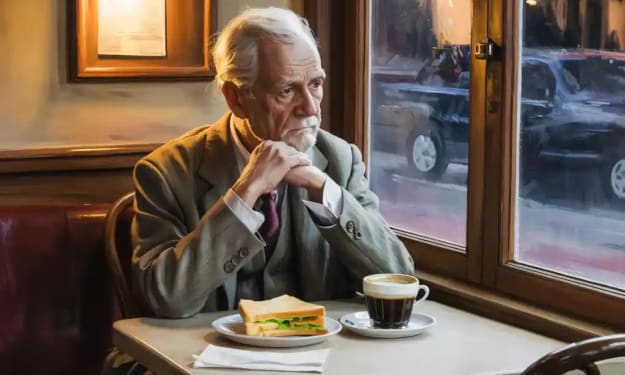
There’s a quiet little café on East 41st Street, nestled unceremoniously between a secondhand bookstore and a flower shop that always smells of jasmine and damp stems. Blink, and you might miss it. No neon signs. No whimsical chalkboard menus boasting fancy lattes or turmeric infusions. The awning just reads “Mira’s Café” in fading gold letters. Inside, it smells like toasted bread, warm milk, and stories too old to tell.
By Arshad khanabout a year ago in Fiction
The Town That Erased My Memory
I arrived in the town of Alder Creek on a rainy Thursday evening, not entirely sure why I was there. The drive had been unplanned. I had set out for a weekend getaway from the noise of city life, hoping to clear my mind. My GPS had glitched an hour out, rerouting me off the main highway onto a winding forest road. By the time I realized I was off course, I saw the wooden sign: Welcome to Alder Creek - Est. 1834. The lettering was faded, the wood half-rotted, but something about it pulled me in.
By Harley Morrisabout a year ago in Fiction
The Echoes of the Yellow Scarf
When Mira stepped off the subway at 14th Street, the crowd swept around her like waves. It was the same platform, same train, same morning routine—but today, something was different. Clutched in her hand was a yellow scarf. Not hers. She had found it on the park bench she always sat on before heading to work. It was soft, handmade, and slightly frayed at the edges, with initials stitched in the corner: S.H. She hesitated before picking it up earlier that morning. Normally, she'd ignore lost items, let someone else deal with them. But something about this scarf felt… personal. Like it was meant for her to find. By the time she reached her office on the 22nd floor of a glass-paneled building, she couldn’t stop thinking about the initials. Who was S.H.? Why did it feel like more than just a lost scarf? She Googled the initials with “yellow scarf” and “New York”—of course, nothing. A thousand meaningless results. But then came the dreams. That night, Mira dreamt of a girl in a yellow scarf standing under a streetlamp, eyes full of sorrow. She said nothing. Just stood. Watching. Silent. The next night, she returned. This time, Mira spoke. “Who are you?” The girl looked up. “Help me find home.” Mira jolted awake. The scarf was on the chair beside her bed—right where she’d left it. But it looked newer. Less worn. As if time had reversed. In the days that followed, the dreams grew more vivid. The girl—always in that yellow scarf—stood by a bench, her back to Mira, facing a lake Mira had never seen before. And every time, she'd whisper, “Almost there.” Mira started drawing the scenes. She was no artist, but the urge was uncontrollable. She filled pages with images of the girl, the lake, the scarf fluttering like a whisper caught in wind. Her friends thought she was spiraling. “You need sleep,” they said. “You’re obsessing over nothing.” But she couldn't stop. One rainy Sunday, Mira walked aimlessly through Central Park, the scarf wrapped around her neck, the dreams echoing in her thoughts. And then—she saw it. The bench. Not just any bench. The bench. The one from her dreams. It faced a small, quiet lake. Willow trees bowed along the edges. A streetlamp flickered nearby. It was all real. She sat. A soft breeze passed. Leaves rustled. The scarf lifted slightly. And then, across the lake, stood the girl. Real. Flesh and bone. Same yellow scarf. Same solemn eyes. Mira stood. “Who are you?” The girl smiled faintly. “You found me.” Mira stepped forward, breath caught in her throat. But before she could speak again, the girl turned and walked toward the trees—fading like mist in morning light. Gone. Mira looked down. The scarf had vanished. In its place, on the bench, was a note. “Thank you. I’m home now. – S.H.” That was three years ago. Since then, Mira walks the park every Sunday. She never saw the girl again, but sometimes, when the breeze picks up just right, she feels a soft warmth on her neck—as if a scarf, unseen, still lingers. She doesn’t tell many people the story. Who would believe her? But if you ever find a yellow scarf where it shouldn't be… Hold on to it. Someone might be waiting.
By Arshad khanabout a year ago in Fiction
The House That Remembers.
The old Victorian house on Chestnut Street was our dream, or at least the skeleton of it. It was a fixer-upper, with peeling paint and floors that groaned like a sleeping old man, but my husband, Ben, and I saw its potential. We were young, in love, and naively optimistic about how far a few coats of paint and a lot of hard work could go. We bought it for a steal, blissfully unaware that the house came with a feature not listed in the realtor’s description.
By MUHAMMAD FARHANabout a year ago in Fiction
The Letter from Jallianwala
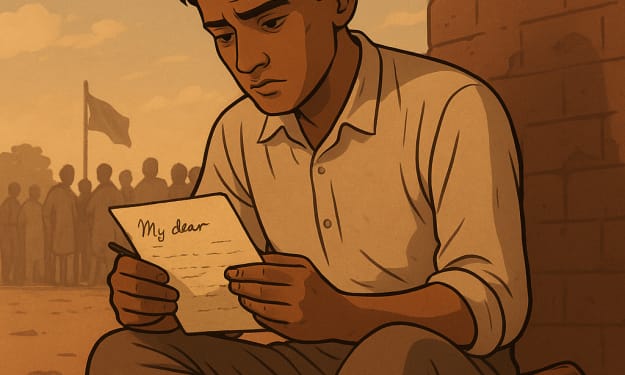
April 13, 1919 — Amritsar, Punjab The sun was unforgiving that afternoon, but it was Baisakhi — the harvest festival. Thousands had gathered in Jallianwala Bagh to celebrate, to protest peacefully against the Rowlatt Act, to listen, to breathe freely for a moment in their own country.
By Waqif Khanabout a year ago in Fiction
The Quiet Theft
It started, as these things always do, with a perfect mistake. He found her through a friend’s story — not tagged, just visible in the background. A flash of her face, caught mid-laugh, her hands covering her mouth like she was trying to keep something beautiful from escaping. She wore a threadbare sweatshirt and no jewelry, and something about her made him sit up straighter.
By Paper Lanternabout a year ago in Fiction