Mystery
He Died 8 Years Ago. Then He Left a Voicemail
He Died 8 Years Ago. Then He Left a Voicemail Written by Iqbal Raza It started with a notification. Lena was in the middle of folding laundry when her phone buzzed. A voicemail. That wasn’t unusual — except this one was from a number she hadn’t seen in years. A number she had deleted, blocked, and buried with the man who once owned it. Her hands froze mid-fold as the screen displayed the words: "1 New Voicemail — From: Dad." Lena felt the air shift. She stared at the screen as if it might disappear. Her father, Marcus Evans, had died eight years ago. A heart attack in the middle of the night. He was found on the floor of his workshop the next morning, radio still humming jazz softly in the background. So how was he leaving voicemails now? She tapped play. There was static, then a familiar voice—cracked, weary, but unmistakably his. > “Lena... if you’re hearing this, I’m gone. Not just from your phone, but from this world. I don’t know when you’ll get this. Maybe a year, maybe ten. But you need to know something... I never stopped trying to fix things between us.” Her heart stopped. Then beat again, hard. The Past She’d Tried to Forget Marcus wasn’t a bad father, not in the usual way. He didn’t hit, didn’t drink, didn’t leave. But he withheld. His love was mechanical—practical, predictable, cold. He built furniture better than he built relationships. When her mother died, Lena was 13. That’s when the silence between them grew into a canyon. She left home at 18 and never went back. They spoke rarely. Holidays were exchanged like formalities. Their last phone call, two weeks before his death, had ended in an argument about nothing — and everything. “You always act like I was never there for you,” he had said. “And you were never really there,” she had replied. Neither said goodbye. Ghosts in the Machine Lena played the voicemail again. The static seemed longer this time, like something was shifting. Could voicemails be corrupted over time? Could a phone company hold onto a message for years? She couldn’t stop thinking about it. She searched through old backups, even reactivated her cloud voicemail. Nothing. This was the only message. Then it happened again. Three days later. A second message. > “I’m in the shed. You remember the old one, right? Behind the big oak tree. There’s something I left there for you. Maybe it’ll explain everything.” She hadn’t been to her childhood home in nearly a decade. After Marcus passed, the property was sold off to a developer. She had no legal right to be there. But the next morning, Lena found herself driving down the highway toward her old town, toward the house she swore never to see again. Return to the Shed It was still there — the oak tree, the shed, though the house behind it had been remodeled beyond recognition. The shed, however, remained untouched, weathered by time and neglect. A relic that no one cared to demolish. Lena waited until dusk before slipping into the backyard. Her heart raced with every step. Inside the shed, the smell of oil and sawdust hit her like a memory. Tools still hung on rusting hooks. In the far corner, beneath a sheet, she found it. An old wooden box. Her name carved into the lid. Inside: letters. Dozens of them. Letters Never Sent Each envelope was dated — birthdays, holidays, graduation, even her wedding day. Letters he never mailed. Words he never said. Apologies, memories, regrets. Each one written in his blocky handwriting. > “I saw the way you looked at me at your graduation. Like I didn’t belong. But I wanted to say something. I just didn’t know how. So I wrote this instead.” > “You were right. I didn’t know how to grieve your mother, so I pretended I didn’t have to. That was wrong.” > “I was proud of you every single day. I just... didn’t say it enough.” Lena cried until her body ached. The Final Message Back home, she received one final voicemail. This one was different. > “I hope you found it, Lena. If you’re listening, it means you cared enough to go back. Thank you. I didn’t deserve your forgiveness, but I wanted you to have mine. We both held onto our anger too long. But love doesn’t vanish. It just waits... sometimes in a shed behind an old oak tree.” Then a pause. Then silence. And for the first time in years, Lena smiled. Afterward Lena took the letters and had them bound into a small book. She called it "Words Never Spoken." At her book launch six months later, she told a small audience, “This isn’t just my story. It’s a story for anyone who didn’t get to say goodbye. For anyone who needed a voicemail from the past to make peace with the future.” People lined up afterward to hug her, to share their own versions of the story. Because we all have ghosts. And sometimes, they just want to be heard.
By Moonlit Lettersabout a year ago in Fiction
The Clockmaker’s Last Secret
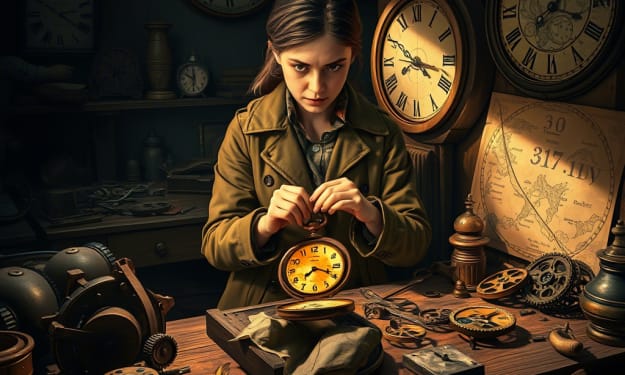
In the quiet, mist-laden town of Eldermere, where cobblestone streets wound like the gears of an ancient timepiece, there lived a clockmaker named Elias Veyne. His shop, tucked between a butcher’s stall and a forgotten bookstore, was a place of whispers—both literal and imagined. The townsfolk said Elias didn’t just repair clocks; he "listened "to them. And then, one autumn evening, he vanished. The only clue was a single pocket watch left on his workbench, its hands frozen at 3:17. But this was no ordinary timepiece. When wound, it didn’t tick forward—it ticked *backward*. The Mystery Unfolds Lira Arden, a young journalist from the city, arrived in Eldermere after hearing rumors of the clockmaker’s disappearance. She had grown up on stories of Elias—how his clocks never lost a second, how some claimed they could even *predict* events before they happened. But superstition was one thing; a missing man was another. The townspeople were reluctant to speak. The butcher muttered about "bad luck," the bookstore owner simply shook her head, and the mayor insisted Elias had "gone on a trip." But Lira noticed how their eyes flicked toward the old clock tower at the center of town, its face perpetually stuck at the same time: 3:17. That night, Lira wound the pocket watch. The world shuddered. Suddenly, she stood not in the dimly lit shop, but in the same room bathed in golden afternoon light. Elias Veyne stood before her, his fingers stained with oil, his expression one of grim recognition. "You shouldn’t have done that," he said.
By Azmat Roman ✨about a year ago in Fiction
A Veil of Light, or a Flirtation in Sacred Dress?
A woman is always standing in the middle of all gazes— the gaze of law, the gaze of society, the gaze of religion, and the hardest of them all: her own gaze upon herself. In a world where meanings constantly shift, a woman’s clothing floats between belief and pressure, between faith and performance. In Islamic culture, hijab is more than a piece of fabric. The Qur'an says: “Let them not display their beauty—except what must naturally appear…” (Ayat al-Nur, 24:31) There is humility in this command, a kind of inner dignity. But if that dignity is missing from the soul, then the cloth becomes just a costume— a sacred-looking trick to attract attention. There are women who wear the chador proudly, but with faces reshaped by surgery, heavy makeup, and chadors fluttering like banners— not to conceal, but to reveal. In that contradiction, something is lost: truth. Not hijab. Not lack of it. Just… truth. If a woman is honest with herself, if she lets her hair fly in the wind, not for flirtation but for freedom— if she covers herself, not to hide but to honor her being— then both choices lead to the same meaning: to be. I’m a woman who loves the feeling of wind in her hair— not to attract, but to feel alive. Not to be seen, but to breathe. But in a world where restrictions outnumber understanding, sometimes freedom becomes an unspoken crime. In a society where a woman’s worth is reduced to makeup and modesty, where value is measured by looks, not thought, sometimes, being a woman is a quiet act of resistance. Rumi once said: "Nothing is outside you. Seek within—everything you want, you already are." And I believe a woman must become so whole within herself that she no longer needs masks, or stages, or silence dressed as virtue. Neither hijab nor its absence defines her. Her presence does. A light that shines from within. If she chooses, she can make new meaning— between veil and light. Not to disappear. Not to shine. Just to be.
By Ladan Tajaabout a year ago in Fiction
The Traveler of Darkness
James lived in a small town where nothing ever happened. The streets were quiet, the nights were long, and the same people passed by each day. He worked at a gas station on the edge of town, usually finishing his shift around 10 PM. Every night, he walked home using the same dark road that cut through a quiet neighborhood. He had done this for years and never thought much about it—until one night, things changed. That night, the street felt different. The air was colder. The lights flickered. James pulled his jacket tighter and walked a little faster. As he turned the corner, he saw someone ahead. It was a man. The man was walking slowly, dressed in a long black coat. He wore a dark hat, and his head was tilted downward. James couldn’t see his face. He assumed the man lived nearby and didn’t think too much of it. But something about the man made him uncomfortable. His steps were too slow, too steady, like he wasn’t in a hurry at all. And then, just as James looked away for a moment, the man was gone. There was nowhere he could have gone. No alleys. No open doors. No parked cars. Just empty road. James stood still for a minute. Maybe he imagined it. Maybe he was just tired. He shook it off and continued walking home. The next night, the man was there again. Same road. Same spot. Same black coat and hat. And again, as James got close, the man disappeared. This time, James stopped and looked around carefully. Nothing. No sound. No movement. Just the wind. By the third night, James felt afraid. He told himself not to be silly. It was just a man. Maybe a strange one, but nothing more. Still, part of him wanted to take a different way home. But he didn’t. He wanted to prove to himself there was nothing to fear. And again, the man appeared. Walking slowly. Not saying a word. James tried to speak. “Hey,” he called out. “Do you need help?” The man didn’t turn, didn’t stop. Just kept walking. James followed him, but no matter how fast he walked, the distance stayed the same. It was like trying to chase a shadow. On the fourth night, James brought a flashlight. He pointed it at the man, but the light didn’t touch him. The beam stopped just before reaching the dark figure, as if the man was surrounded by something that pushed the light away. That night, James couldn’t sleep. On the fifth night, James waited for the man. He stood behind a tree at the usual spot. When he saw the black figure approaching, he stepped out. “Why do you keep walking this road?” he asked. The man stopped. For the first time, he lifted his head. There was no face. No eyes. No mouth. Just smooth, dark skin. Like a blank mask. James couldn’t move. His heart pounded. He took a step back. The man took a step forward. James turned and ran. He didn’t look back. Not once. The next morning, he called in sick to work. He told his friend Eric about the man. Eric laughed. “You need sleep, man. You’re seeing things.” But James knew what he saw. On the sixth night, James did not want to leave the house. But he felt pulled. As if something in him had to go. Like someone whispering inside his mind, telling him: “Just one more walk.” He picked up his flashlight and walked the same road. The man was waiting. This time, the man didn’t walk away. He stood in the middle of the road, unmoving. James walked up to him slowly. “Who are you?” he asked, his voice shaking. The man raised his hand and pointed at James. Then he spoke in a voice so low, it felt like wind inside his ears. “You followed me. Now you take my path.” Suddenly, everything around James turned dark. The road. The lights. The stars. Gone. And just like that, James was gone too. No one saw him after that night. His house stayed empty. His phone was left behind. People searched, but nothing was ever found. Only one thing remained: a long black coat, hanging on a tree near the road where James used to walk. Now, some nights, people say they hear footsteps on the street. Slow. Steady. Never-ending. A man in a black coat, walking the same road. But if you try to speak to him... He disappears.
By Hazrat Bilalabout a year ago in Fiction
The Day My Shadow Spoke Back
The Day My Shadow Spoke Back It began on a Tuesday, the kind of day that slips between calendar pages unnoticed, with overcast skies and coffee that tastes vaguely like memory. I had just finished rearranging my bookshelf — again — when I noticed something strange
By waseem khanabout a year ago in Fiction
My Dead Brother Sends Me Voicemails
The first voicemail came on the anniversary of his death. It was just after midnight. I was scrolling through old photos of us when my phone buzzed. The caller ID said “Unknown.” I let it go to voicemail. A minute later, a notification lit up:
By Musawir Shahabout a year ago in Fiction
The Letter That Waited 20 Years
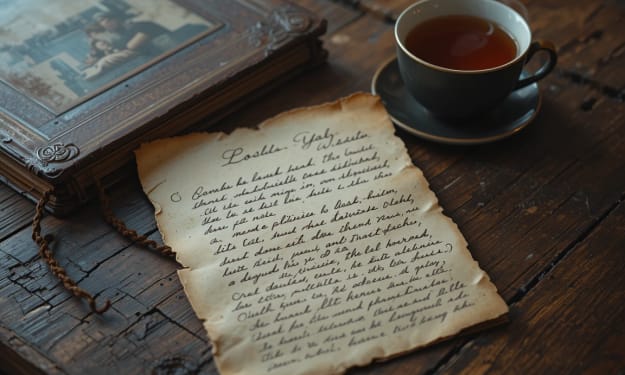
The Letter That Waited 20 Years Written by Raza Iqbal It was a rainy Thursday when Emily stumbled upon the letter. The old family house in Yorkshire had always been full of secrets—dust-covered trunks in the attic, forgotten bookshelves, and drawers that stuck shut from decades of humidity. But this letter wasn’t hidden away. It was tucked carefully between two pages of a photo album, pressed like a fragile flower between fading memories. She had come home for one reason only—to sell the house. Her father had passed away six months ago, and there was no one left to keep the memories warm. Her mother had died when Emily was ten. Her father never spoke much of her afterward. As an adult, Emily stopped asking. Grief made people quiet, she told herself. It made them build walls. But the letter spoke louder than her father ever had. "For Emily. If you're reading this, then the time has come." The handwriting was familiar. Delicate, but certain. Her mother’s. Her heart skipped. With shaking fingers, she unfolded the aged paper, already yellowed and soft at the creases. May 19, 2005 My sweet Emily, You’re only ten today, and maybe you won’t find this letter for many years—perhaps not until you’re grown and the truth finally matters more than the silence. I didn’t want to leave you. Not ever. I want you to know that. The doctors didn’t believe I’d last as long as I did. But your smile made my heart fight for every single day. Still, there were things I never got to tell you. Things I thought your father would explain when you were older. I don’t know if he will. I hope he does. But in case he doesn’t, I’m writing them now. First: You were born out of love. So much love. Your father and I—despite everything—loved each other deeply once. That part is real. But people change. Grief, fear, mistakes... they chip away at love until it’s barely standing. And here is the truth you need to know: I had another child before you. A boy. His name was Jacob. Emily paused. Jacob? She blinked, reread the line, and leaned back into the couch, the letter trembling in her lap. Her mother had never mentioned another child. Neither had her father. I was very young. It was before I met your father. I was seventeen, scared, and alone. My parents sent me away to a home for unwed mothers in the countryside. I was told never to speak of him again. I held him for exactly three minutes before they took him away. He was perfect. Tiny fingers, a soft cry. He had my eyes. I named him Jacob even though no one asked me to. They didn’t care. He was gone before the morning sun touched my window. I spent years searching. But the adoption records were sealed. I never found him. And when I met your father, he asked me to forget. Not because he was cruel—but because he thought the pain would destroy me. He didn’t understand that forgetting hurt more. Tears streamed silently down Emily’s face. She couldn’t picture her mother at seventeen, scared and discarded like a secret. And she couldn’t believe her father had asked her to bury such a thing. Emily, I tell you this not to burden you, but to free you. Families are messy, and love is never simple. But secrets—they are the heaviest inheritance. If by some miracle, this letter finds you, and you feel the need to search for him, I won’t stop you. I just want you to know you were both loved. Always. Love, Mum. Emily sat for a long time in the quiet house, listening to the soft tap of rain against the window. A letter, two decades old, had just changed everything she thought she knew about her family. Suddenly the empty house felt full of voices—her mother's grief, her father's silence, a brother she had never met. She picked up the phone. "Hello, I'm calling about sealed adoption records from 1985..." Six Months Later The café was quiet. A man in his early 40s sat at the far table, nervously checking his watch. Emily walked in, her heart pounding so loud it echoed in her ears. She had seen his photo online, but nothing prepared her for this—seeing Jacob in person. He had their mother’s eyes. Her nose. A kind smile that made her knees weak. He stood as she approached. “Emily?” he asked. She nodded. “Jacob?” They hugged. Long, awkward, emotional. Strangers stitched together by blood and twenty years of silence. Over coffee, she handed him the letter. He read it twice. “I always wondered,” he said quietly. “I used to dream that someone out there was looking for me.” “She was,” Emily whispered. They sat in silence for a while. Two lives that had run parallel, finally intersecting. Epilogue Emily never sold the house. Instead, she turned it into a place for healing—offering weekend retreats for people searching for family, history, or closure. She kept the letter in a glass frame in her study. Not as a reminder of pain, but of truth. And every year, on May 19th, she and Jacob met at the Yorkshire shore, where their mother once took her as a child, to watch the waves roll in. Some letters arrive late. But sometimes, the heart knows exactly when to open them.
By Moonlit Lettersabout a year ago in Fiction
He Never Missed a Day—Until One Morning, He Did
He Never Missed a Day—Until One Morning, He Did Written by Raza Iqbal The townspeople called him “Captain.” It wasn’t his real name—no one ever knew what that was—but it suited him well. Every morning, just as the sky broke into shades of rose and gold, he would arrive at the beach with a soft leather journal in hand and a thermos of something warm. He’d sit on the same weathered bench facing the sea, the one closest to the old fisherman’s dock, and stare out into the waves like they held a secret only he understood. Children whispered tales about him. Some said he’d once sailed around the world. Others claimed he was waiting for a lost love who vanished at sea. The truth, perhaps, was quieter. He never missed a day. Not for rain or wind or fog. Until one morning, he did. I. The Absence “Have you seen the Captain?” The question echoed through the small coastal town. The waitress at the diner noticed first. “His coffee’s still hot,” she muttered, holding the thermos he’d left behind a week ago to be filled daily. Then the postman. The lifeguard. The librarian. Even the children noticed—the old man with eyes like tidepools hadn’t shown up in four days. His absence grew louder than his presence ever had. Someone finally checked the bench. On the seat, tucked beneath a smooth stone, was a sealed envelope. To the Next One Who Needs This, it read. II. The Letter A teenage girl named Ava was the one who found it. Her brother had just left for university. Her mother hadn’t stopped crying since. Ava didn’t understand the silence that had settled in their home. She just knew it felt heavy. And the beach was the only place she could breathe. She sat on the bench without thinking. Her eyes found the letter. Her hands trembled as she opened it. Dear Stranger, If you’re reading this, I’m gone. I don’t know who you are, but I know what brought you here. Sadness. Loneliness. A question you can’t ask out loud. The sea calls to people like us. Let me tell you something: I came here for fifty years. Every morning. Not because I was waiting for someone to return… but because I needed to remember. You see, once I had a wife. Eleanor. Bright eyes. Loud laugh. She hated sand in her shoes but loved the smell of salt in the air. She died before her time. A car accident. Just like that, she was gone. No goodbye. No time to prepare. One moment I had a life. The next, I had a silence too deep for words. That bench saved me. I’d sit and let the wind scream for me. The waves would speak when I could not. And slowly, very slowly, I began to live again—not all at once, but piece by piece. If you're hurting, let the sea hold your grief. It has room. More than you know. You don’t need to be okay right now. You just need to sit. Breathe. Let time do its quiet work. This bench is yours now. Be kind to the next soul who needs it. III. The Town Responds Ava left the letter where she found it. She didn’t tell anyone, not right away. She just came back the next day. And the day after. She started bringing her sketchbook. Then, her mother joined her. A week later, someone added a tiny wooden plaque to the bench: “To the Captain—Thank You for Listening.” Stories began to spill. A man whose daughter left home after a fight sat there with tears he hadn’t shed in years. A woman from the café who lost her baby found peace enough to smile again. A widower brought flowers and left them beside the letter each Sunday. The Captain had become part of the town’s rhythm—alive in memory, even in death. IV. One Year Later Ava sat on the bench on the Captain’s anniversary. The sun warmed her face. Her mother had a new job now. Her brother called every week. The house was still quiet, but the silence no longer hurt. She looked down at the journal on her lap. The same kind the Captain had carried. She opened it and began to write: “Dear Stranger, If you're reading this, then you’ve found the bench. And I’m glad. I was once lost too. This spot helped me find myself again. The man who came before me—he left behind more than a letter. He left a place for healing. So sit. Watch the waves. Let your heart soften. You’re not alone.” V. The Legacy Years passed. People came and went, but the bench remained. Weathered. Silent. Steady. Like the sea. A place for beginnings disguised as endings. A place where strangers became stories. And grief, once too heavy to carry, floated gently out to sea.
By Moonlit Lettersabout a year ago in Fiction
The Book That Moved Mountains
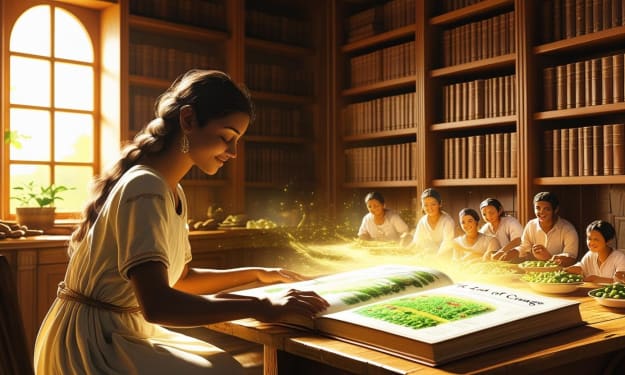
The Book That Moved Mountains A Tale of Words and Transformation In a dusty corner of a small village library, where sunlight barely reached through cracked windows, sat a book. Its cover was worn, its pages yellowed, but its words held a quiet power. The village of Eldergrove was a place of struggle—fields yielded little, winters were harsh, and hope was a scarce commodity. Most villagers toiled from dawn to dusk, their dreams buried under the weight of survival. Among them was Lila, a young woman with calloused hands and a heart that yearned for more.
By Shohel Ranaabout a year ago in Fiction