Mystery
The Night the Wolf Rode With Me
It was the kind of rain that doesn’t care about your plans — steady, soaking, and endless. The kind that makes silence louder and headlights look like ghosts. I hadn’t meant to be out driving that late, but everything about my apartment felt heavier than usual. The walls, the bed, even the air — it all pressed down on me. So I grabbed my keys and drove.
By Writes by Babarabout a year ago in Fiction
She Danced Every Morning at 6 AM
She Danced Every Morning at 6 AM Written by Raza Iqbal At precisely 6:00 AM every morning, just as the first golden strands of sunlight broke through the tall windows of apartment 4B, she danced. To the casual observer, it was nothing out of the ordinary — an elderly woman moving gracefully to music only she could hear. But to those who paid attention, it was something else entirely. Something sacred. Something that made you stop whatever you were doing and just… watch. She lived in a corner unit of the old brick building on Montclair Street. A neighborhood that had seen its share of change — coffee shops replacing bookstores, condos where gardens used to grow — but she remained unchanged. A relic in a modern world. Her name was Eleanor Hart. But the neighbors just called her Miss Ellie. Some mornings, she danced in a flowing white nightgown. Other times, she wore a silk robe that caught the light like moonbeams on water. Her movements were soft, but deliberate. Her face calm, but filled with something deeper — remembrance, maybe. Or longing. She never opened her windows. Never looked down at the street. She simply danced in silence, as though honoring a promise made long ago. My name is Jonah. I moved into the building two years ago — third floor, apartment 3A, just below Miss Ellie. I first noticed her on a Sunday morning while drinking coffee on my fire escape. The world was quiet except for the low hum of the city, and then, there she was. Arms lifted toward the sky, bare feet on worn hardwood, twirling slowly with eyes closed. It became my ritual. Wake up early. Watch Miss Ellie dance. At first, it felt like spying, but there was nothing invasive about it. Watching her felt like a privilege — like being let into a secret world. I never told anyone. It was mine to witness and mine alone. Until one morning, she didn’t dance. I waited, mug in hand, staring up at her dark window. No movement. No light. No silhouette. I assumed she had overslept. Or maybe she was away. But when the second day came and her apartment remained still, an unease crept in. On the third day, I asked the building manager if she was okay. “Miss Ellie?” he said, eyes softening. “She passed away… three nights ago. Peacefully. In her sleep.” It felt like someone had pulled the ground from under me. I never spoke to her, never heard her voice, yet her absence struck like a blow to the chest. The street felt quieter. The mornings colder. A week later, I found an envelope taped to my door. It was handwritten in delicate cursive: “To Jonah, the boy on the fire escape.” My hands trembled as I opened it. > Dear Jonah, > You didn’t think I didn’t notice you, did you? > Every morning for the last two years, there you were — sitting with your coffee, watching me dance like a ghost. I almost laughed the first time I saw you. But then I grew fond of it. Your quiet presence. The way you never interrupted the moment. > I was dancing for someone. His name was Harold. My husband. He died 20 years ago to the day I started dancing. > We were dancers once, in our youth. We met at a jazz club in Paris in 1958. He twirled me under strings of golden lights, and I fell in love before the song ended. Every morning, we danced in our living room before work. Always at 6:00 AM. It was our way of saying: “I choose you again today.” > When he passed, I thought I would break. But then, on a whim, I danced. Alone. At 6:00 AM. And somehow, I felt him there with me. So I did it the next day. And the next. > Some might say it’s silly. But love doesn’t vanish just because a body does. > You watched me without judgment. Without pity. That meant more than you’ll ever know. > So I want to ask you for a favor. > Dance. Not for me. Not for Harold. But for yourself. Dance when you’re lost. Dance when you’re full of joy. Dance when the world makes no sense. > Life is too short to keep your feet still. > Thank you, Jonah. > With love, > Miss Ellie I cried. Not the kind of tears that fall in silence, but the kind that erupt from somewhere deep and long-buried. I never knew what she meant to me until that letter. And I never knew how much I needed to hear those words. So I danced. The next morning, at 6:00 AM, I moved the furniture in my living room and let the music play. Old jazz from the 1950s. The kind she would’ve loved. I didn’t know the steps. Didn’t need to. I just moved — arms open, heart wide. And maybe it was my imagination, or maybe it was something else… but for a fleeting second, I felt her there. Smiling. Watching.
By Moonlit Lettersabout a year ago in Fiction
A Lesson in Nobility and Betrayal
Once upon a time, in a vast and scorching desert, the chief of a noble tribe rode alone on his majestic horse. The sun beat down relentlessly, and the silence of the desert was broken only by the sound of hooves crunching on sand. This was a journey the chief had undertaken many times, a silent meditation in the heart of the wilderness. But on this day, fate had a lesson in store—one that would test not only his strength, but his wisdom and character.
By Ahmad shahabout a year ago in Fiction
The Summer the Lake Dried Up
That summer was supposed to be the last perfect one. The one before college, before scatterings and jobs and becoming different people in different cities. It was supposed to be days at the lake, bonfires with marshmallows that never fully melted, and laughter that echoed across the still water long after midnight.
By Junaid Shahid about a year ago in Fiction
Betrayal of a Best Friend
Betrayal of a Best Friend By [Alexander Arnold] I should have known something was wrong when Ava didn’t text back. It wasn’t like her. We’d been best friends since freshman year—inseparable, really. We shared playlists, secrets, breakups, and dreams under late-night stars. So when she missed our regular Sunday coffee at Café Umbra, I knew it wasn’t forgetfulness. It was something more.
By Alexander Arnoldabout a year ago in Fiction
How Books Rewire Minds and Shape Lives
The Alchemy of Reading: Science and Change How Books Rewire Minds and Shape Lives In a world of fleeting notifications and endless scrolls, opening a book is an act of defiance—a choice to dive deep into the wellspring of human thought. Science has begun to unravel the magic of reading, revealing its power to reshape our brains, nurture wisdom, and spark profound personal change. But what happens when the love for books consumes us? Can reading too much tip into obsession, and can it truly make us wiser or transform who we are? This article explores the science behind reading, its transformative potential, and the delicate balance between passion and excess, painting a vivid picture of how books can change lives.
By Shohel Ranaabout a year ago in Fiction
How Books Shape Minds and Lives
The Magic of Reading: Science and Transformation How Books Shape Minds and Lives In a world awash with screens and fleeting distractions, the act of reading a book feels like a quiet rebellion—a deliberate choice to engage deeply with ideas, stories, and wisdom. Science has begun to unravel the profound effects of reading, revealing its power to reshape our brains, enhance our lives, and even spark personal transformation. Yet, as with any passion, there’s a question of balance: Can reading too much become an addiction? Can it truly make us wiser? This article dives into the science of reading, exploring its benefits, potential pitfalls, and its remarkable ability to change who we are.
By Shohel Ranaabout a year ago in Fiction
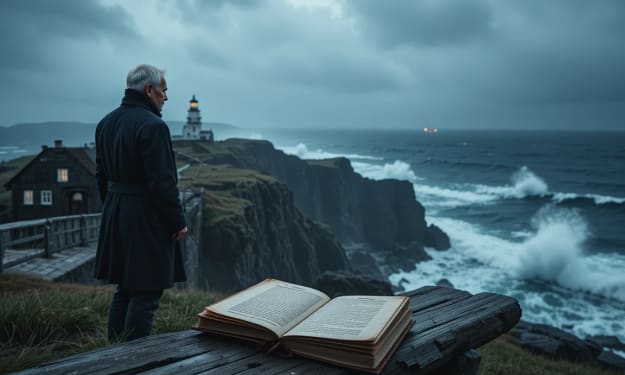
The Lighthouse Keeper’s Journal
The Lighthouse Keeper’s Journal Written by Shah Zeb The lighthouse stood like a forgotten relic at the edge of the world. Perched high on the weather-beaten cliffs of the Scottish coast, it had long ceased to guide ships. Satellite navigation and modern systems had made it obsolete. Yet inside its stone shell, the light still turned, maintained by one man whose presence was as old and steady as the sea spray. Ewan Fraser, seventy-three, had been the lighthouse keeper for nearly five decades. He refused to leave even when the government decommissioned the facility. He argued, perhaps foolishly, that the ocean still remembered the light—and so did the souls of those who had once passed beneath it. Every morning, he brewed tea in a dented kettle and wrote in his journal—a thick, leather-bound book with a broken spine and pages yellowing like sea maps. The entries were rarely about the weather or lighthouse mechanics. They were letters, unsent, written to a woman named Isla. June 6, 1995 The light flickered last night. I thought of you again, of course. I always do when storms come. Remember how we stood in the lantern room and watched the sea fight the sky? You were never afraid. You said storms made you feel alive. It was the calm that frightened you. Isla had been Ewan’s wife—if only for six months. They were married under a gray sky, with seagulls as their choir and waves as their witness. She was an artist, with fire in her voice and salt in her spirit. She painted the sea not as it was, but as it felt. Six months after their wedding, Isla vanished in a boating accident. No body. No goodbye. Just her paint-streaked scarf found on a washed-up piece of driftwood. He had no one else. No children. No close family. The town slowly forgot about Ewan, except the postmaster who still delivered parcels once a month. Inside were canned goods, paper, pens, and batteries. Always the same. And a small, quiet hope that maybe one day something else would come. Then, one October evening, as the fog thickened like wool and the waves slapped rocks like angry fists, Ewan heard it—a knock. Not the wind. Not the groan of old wood. But a knock. Heart pounding, he opened the iron door. A girl stood there. Soaked. Pale. No older than seventeen. "I'm looking for my mother," she said. “She used to live here.” Ewan blinked. “What’s her name?” "Isla." Her name was Cora. Her voice shook when she spoke, not from cold, but from hesitation. She carried an old photo—one of Isla, covered in paint, laughing on the lighthouse steps. The same photo Ewan had tucked into his journal. Except this one had writing on the back. To my daughter, should you ever find this. Start with the light. They sat by the fire, a pot of stew between them. She told him her story in pieces, like a broken bottle being slowly glued back together. Isla had survived the accident. Rescued by a passing trawler. But a head injury had taken her memory. She was taken in by a woman on the Isle of Skye, where she worked as a seamstress, never knowing who she truly was. Until her final days, when fragments returned. Names. Places. A face she had once loved. She died two years ago, Cora said. “But before she passed,” Cora added, eyes bright with pain and wonder, “she told me: 'If you ever want to know where you come from, go to the place where the sea meets the light.' So I did.” Ewan didn’t speak. His hands shook too hard to hold his cup. Instead, he opened the journal. Flipped to the first page. Handed it to her. Each word, each entry, was a letter to Isla. Cora read until morning. She stayed three days. Helped him oil the light. Took photos of the cliffs. They didn’t talk much, but when they did, it was as if silence had become a language of its own—passed down between those who have lost and those who remain. On the last day, she asked, “Why did you stay?” He looked toward the horizon, where the sea kissed the sky. “Because she might come back. And someone had to keep the light on.” January 14, 2020 She came, Isla. Our daughter. She’s kind. Brave. Just like you. I told her everything. The light, the cliffs, the stories. She carries your fire. I think... I think you sent her. When Cora left, she took a small canvas with her—one of Isla’s old sea paintings, faded but still beautiful. She promised to return every year on the same day. Ewan didn’t ask for it, but it filled something in him that had been hollow for twenty years. Three years later, Cora came back with a son. His name was Fraser. He ran up the stairs of the lighthouse as if the place had always belonged to him. April 2, 2024 I am tired, Isla. But I’m not lonely anymore. The light’s still turning. And I think... when it stops, it won’t matter. Because you sent me one last message, through her. And it reached me. That night, as the wind howled and the tide rose, the light blinked its steady rhythm—one last heartbeat for the ships and souls it guided. By morning, Ewan was gone. The journal sat on the desk, closed, a final message on the last page: Keep the light turning. Cora did. Every year. And now her son does. Because some lights never truly go out.
By Moonlit Lettersabout a year ago in Fiction
The Library of Forgotten Names
The Library of Forgotten Names Written by Raza Iqbal The building had no sign. Tucked between a shuttered bakery and an abandoned tailor shop in a quiet corner of Bruges, the heavy oak door didn’t creak when opened—it sighed, like someone waking up from a long sleep. Emilia Laurent stood on the cobblestone threshold, a letter trembling in her hand. The letter had come without return address, sealed with wax bearing the insignia of an hourglass wrapped in ivy.
By Moonlit Lettersabout a year ago in Fiction