Humor
The Second First Time Again Revisited
"This will be the second time you have invented a new genre of writing?" Sean asked skeptically of his close friend Tom as they drove slowly down Main Street. It was a gorgeous spring day, traffic was light, and they had the windows rolled down. "Not exactly my doubting Thomas." Sean was quite pleased with himself for having thought up that reply, which managed to use his friends name in a way which he thought quite clever and he laughed softly to himself before continuing. "I have invented many more genre than two, however, this is the second one I have invented specifically in response to a writing challenge. And, ironically, or perhaps not, they are both what I would call meta genre. The first I called meta-magical satironical realism." Tom looked at Sean and rolled his eyes, snorted loudly then said "Satironical is not a word dude." "It is a word I invented, exactly like the genre which it describes. You will note, if you are paying attention, that an invented word to describe an invented genre is also very meta which is perfect since the entire genre is meta, meta-magical at least. And of course, realistic. Thus the name." Tom laughed out loud at that. His friend Sean was a nice guy, and he really did like him, but he was certifiably insane and often said things that made sense to no one but himself, and sometimes not even that much sense. "Buddy, you are one strange dude. OK. So, you have me interested. What is this second new meta genre you have invented?" "I call it meta meta satironical realism for reasons you will understand if you pay attention closely. "Wait a second buddy, slow down. I need to make sure I understand what you just said. You said meta meta satironical realism? So it has an extra layer of meta and is without any magical elements, but is still satironical, whatever that means? "Don't let anyone ever say you are not capable of paying attention my youthful ward Thomas, for clearly you are. You are correct. Meta meta satironical realism. And satironical simply means it is both satirical and ironic at the same time, or it can mean that it is satirical about being ironic or that it is a satire of an ironic story or ironically it can also mean it is irony that feels like satire or which has a satirical tone. Get it?" "Gheezus Mary and Joseph Sean you are friggin insane. But sure, I'll play along. I get it." They had stopped at a red light, so Sean took a deep breath and composed himself while he waited for the light to turn green before continuing. "I call this genre meta meta satironical realism because the particular challenge for which it is being written is asking the writer to tell a story about doing something again,which feels like the first time. My story, is about how this particular story I am telling right now feels almost exactly like a previous meta story I submitted for a different writing challenge for which the prompt was to write a story in the genre of magical realism. That was the inspiration for the birth of the aforementioned never before seen genre of meta magical satironical realism." "OK Sean. So go ahead. Tell the story. How does it feel almost exactly like that time?" "First, that story failed to win or place in the challenge or receive even an ounce of recognition nor praise, even though it was a work of genius likely unparalleled in the history of writing. This story, is almost certainly destined to the same fate and it is almost as genius. Second that story was intended to be satironical and so is this one. Third and finally, that story was intended to be meta, whereas this one is intended to have one extra layer of meta." Sean paused there, appearing deep in thought for a moment, then spoke again. "My apologies, I suppose that would not actually be a similarity between the two stories, but rather a difference. Oh well. Even I sometimes make mistakes." Both Sean and Tom laughed out loud at that as they continued driving slowly down Main Street feeling like it was the first time they had even done so, even though in actuality it was the second.
By Everyday Junglistabout a year ago in Fiction
The Library That Only Appeared at Midnight
It was almost by accident that I found the library that only appeared at midnight. I had never heard anyone speak of it before—not in stories, not in rumors, not even in the strange local legends old towns like mine tend to cling to. It simply... existed. Or rather, it existed only after the clock struck twelve, and only if you weren’t really looking for it.
By Muhammad Asimabout a year ago in Fiction
When My Shadow Walked Away
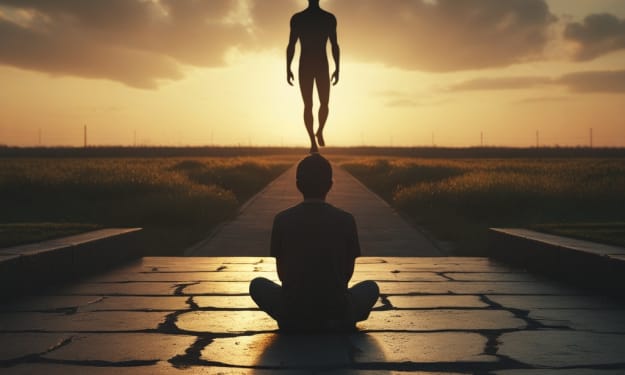
When My Shadow Walked Away By [Rehan khan] I always thought your shadow was something that followed you. That it had no choice. That it belonged to you. But I was wrong. The day my shadow walked away, the sun was soft in the sky—its light tired, not golden. I remember the warmth on my skin. I remember the coolness beneath me as I sat on the cracked concrete steps behind my apartment. And I remember the moment I noticed: I was alone. No outline stretched behind me. No shape mirrored my movements. Just me. And absence. It took me a while to realize what was missing. I lifted my hand, waved it in front of the sun. Nothing. No silhouette. No dark double. Just the air. I turned slowly. Looked behind me. And there it was—my shadow. Standing a few feet away. Still shaped like me. Still connected to me somehow, but no longer bound to follow. It had moved, deliberately, and now it stood still. Watching. I opened my mouth to speak, but no words came. What do you say to your shadow? Instead, I stared. It stared back. Then, it turned and began to walk. I stood quickly, stumbling over my own thoughts. “Wait,” I whispered. It didn’t. It walked—not with menace, not with malice, but with decision. Like someone who has stayed too long at a party they hated, finally leaving the noise behind. And I let it go. --- The days that followed were strange. People didn’t notice. They still smiled at me in the street, still nodded politely, but no one said, “Where’s your shadow?” Not even children. It was as though the world refused to acknowledge it. As though it had been invisible to them all along. But I noticed. Every moment. I walked lighter, somehow. And heavier, too. The mornings were the worst. I used to dread waking up—there was a specific kind of ache that came before the alarm: a quiet, bone-deep sadness that lived under my skin. I had worn it like a second soul. My shadow had always been there in those moments, curled on the bedroom wall, sinking with me beneath the covers. Its weight pressed into mine. But now, the mornings were hollow. My bed felt too wide, the silence too clean. I didn’t cry anymore. But I didn’t laugh either. I simply… existed. Friends noticed that part. “You seem better,” they said. “You’re glowing,” they said. “You’ve changed,” they said. And maybe I had. Without my shadow, there were no sharp dips into despair. No sudden black waves pulling me under. I slept. I ate. I answered texts. But I also felt unreal. I couldn’t write. I couldn’t draw. I couldn’t listen to music without feeling like an imposter. As if the melodies had once belonged to someone else—someone heavier, messier, sadder. Someone real. --- One night, I found myself walking in the same direction I’d last seen my shadow take. I don’t know why. Maybe I missed it. Maybe I was trying to prove I didn’t. The streetlights flickered above me, casting no outline from my feet. I turned a corner, and there it was. Sitting beneath a tree in the park. Still shaped like me. Legs crossed, head bowed. It looked tired. I stepped closer. It didn’t run. I sat beside it. My shadow didn’t move, but somehow, I felt it breathe. “I thought I’d feel better without you,” I said softly. “I thought you were the thing holding me down.” It didn’t answer. But I knew it was listening. “I hated you,” I admitted. “You were always there. In every mirror, every corner. Every time I tried to escape myself… there you were.” And still, it said nothing. “But I think I get it now,” I whispered. “You were never trying to hurt me. You were just showing me the parts of myself I didn’t want to see.” The wind rustled above us. A branch creaked. I watched as my shadow shifted, turning toward me. Slowly, it leaned forward… and merged into mine. Like returning home. --- Now, I wake up and my shadow is there again. It follows me. Sometimes it lingers. Sometimes it stretches long and dark behind me like an echo. But I don’t flinch from it anymore. I’ve made peace with the weight it carries. The sorrow it reflects. I know now that my shadow doesn’t mean I’m broken. It means I’m human. And sometimes, just sometimes—when the light hits me right—I swear I see it smile.
By Rehan khanabout a year ago in Fiction
10 Years of Marriage Equality
A Decade of Love and Progress Where were you on June 26, 2015? For me, it was a normal day at work. But that day changed history—it was the day same-sex marriage became legal across all 50 states in the U.S. We celebrated love, equality, and a hard-won victory for the LGBTQ+ community, activists, and everyone who believes in justice.
By Shafi Ullah Darweshabout a year ago in Fiction
The mirror of the second chances
A cold breeze danced through the cracks of the abandoned cottage as Maya brushed dust from the old mirror. It had been years since anyone had set foot inside. The house belonged to her grandmother, a woman known in the village for strange tales and stranger antiques. Now, after her passing, Maya had returned—not to reclaim her inheritance, but to find a part of herself that she'd lost along the way. Life in the city had hardened Maya. A decade spent chasing corporate success left her emotionally numb. Promotions, parties, paychecks—none of it filled the hollowness she carried. Worse, she had cut ties with her parents and abandoned her younger brother after a family feud. She never forgave them. Or herself. The mirror stood taller than Maya, with a bronze frame curled in vines and mythical beasts. Its glass shimmered unnaturally, even in shadow. Her grandmother once told her, “This mirror doesn’t just reflect what you are. It shows what you could be—if you dare to look deeper.” Maya scoffed then. Now, her skepticism was tinged with curiosity. She looked into the mirror… and blinked. The reflection wasn’t right. The woman staring back had the same face, same brown eyes, same tired expression—but something was different. Behind the mirrored version of Maya stood a boy. Her brother, Arman. He was twelve again, standing in the doorway of her old bedroom, holding a paper boat they made together before things fell apart. Maya gasped and stepped back. The reflection remained unchanged. She turned to check behind her. Nothing. No boy. Just silence. “Great. I’m hallucinating now,” she muttered. But something inside her stirred—a memory long buried. That paper boat was the last gift she ever gave him, before the fight, before the slamming doors and bitter silence. She stared at the mirror again. This time, she saw her younger self and her brother laughing in the backyard, making snow angels. The image faded, and a new one appeared: her mother crying in the kitchen, the day Maya left without saying goodbye. Tears welled up in her eyes. “I didn’t mean to leave forever,” she whispered to no one. A soft whisper echoed from the mirror. “Then go back.” Maya stumbled backward, her heart pounding. The room seemed to shift, the air thick with emotion. The mirror pulsed faintly like a heartbeat. Her hands trembled. “I can’t,” she said aloud. “It’s been too long. They’ve probably moved on.” But deep down, she knew that was just an excuse. The truth was simpler and scarier: she was ashamed. Ashamed of the words she said. Ashamed of the years she stayed silent. Ashamed that she waited until her grandmother died to come back. The mirror flickered again. Now it showed an older Maya, sitting in a sunny garden surrounded by children. Her brother was there too—grown up, smiling, forgiving. “Is this… possible?” she whispered. The mirror said nothing. --- The Next Morning Maya awoke on the dusty couch, the memory of the mirror vivid in her mind. She made a decision. She drove straight to the village where her parents still lived. Her hands shook on the steering wheel. She rehearsed apologies in her head—each one sounding too small for the years they had lost. As she neared the gate, she saw her mother outside, watering the plants. Time had aged her gracefully, but sorrow clung to her shoulders. “Mama?” Maya called softly. Her mother turned. The watering can dropped. “Maya…” she whispered. For a moment, neither moved. Then her mother ran, and Maya found herself wrapped in the kind of hug that melted ten years of pain in a single breath. “I thought we lost you,” her mother sobbed. “I was lost,” Maya replied, “but I want to come home. If you’ll have me.” Inside, her father sat stunned. Arman, now twenty-five, leaned against the wall, arms folded, unsure how to react. “You left,” he said bluntly. “For ten years.” Maya nodded. “I know. And I was wrong.” Silence hung heavy. Then he walked over and hugged her. Tight. “I kept the boat,” he whispered. That night, they sat together over tea, laughing through tears, sharing stories of the years they missed. It wasn’t perfect, but it was a start. --- Months Later Maya moved back to the village, renovated her grandmother’s cottage, and turned it into a small counseling center. People from nearby towns visited, drawn by the warmth she radiated—a warmth she rediscovered through healing. And the mirror? It remained in her room. Every so often, she’d stand before it, and see versions of herself—some joyful, some broken. But she no longer feared them. She understood now: the mirror never showed what was, only what could be. And for Maya, that made all the difference.
By Shehzad khanabout a year ago in Fiction