Holiday
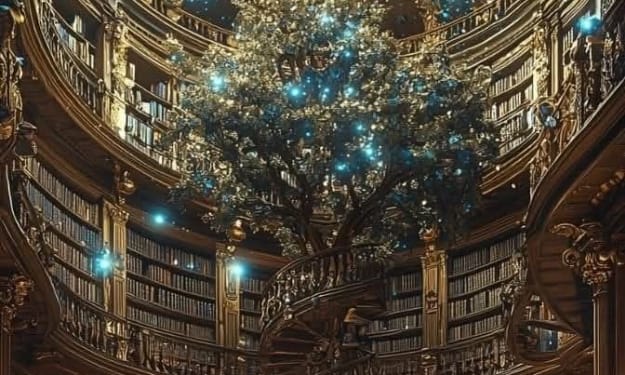
The Library Between Worlds
M Mehran Most people walked past the alley without noticing it. It was narrow, damp, and always smelled faintly of smoke. But Aria had always been drawn to places that seemed forgotten. That night, when the city was loud with Friday traffic, she slipped into the alley and found a door she’d never seen before. It was tall and arched, made of dark oak carved with symbols she didn’t recognize. A brass plaque read simply: The Library Between Worlds. Aria hesitated only a moment before pushing the door open. The room inside stretched impossibly wide, its ceiling lost in shadow. Shelves upon shelves towered upward, filled with books bound in leather, cloth, and even materials that shimmered like metal. Candles floated in the air, their flames steady though no wax dripped. At the center stood a man in a long coat, his hair silver though his face looked young. “Welcome,” he said, as if he had been expecting her. “Few find this place without searching. Fewer still are invited.” Aria swallowed. “What is this?” “A library,” he said with a smile. “But not the kind you know. Here, every book contains a life—every possibility you might have lived, had you made a different choice.” Her pulse quickened. “You mean… alternate versions of me?” “Exactly.” He led her to a shelf where the spines bore her name. Hundreds of them. Aria reached out with trembling fingers and pulled one down at random. The moment she opened it, the library dissolved. She was standing on a stage, bathed in golden light, a violin tucked under her chin. A crowd cheered wildly as she bowed. Aria gasped. She had quit violin when she was twelve, convinced she’d never be good enough. But here, she was a prodigy. The librarian’s voice echoed in her ear: This is one path. Do you wish to stay? The temptation was sharp, but she closed the book. The stage vanished. She was back in the library. Her heart raced. “That was real?” “As real as the life you are living now.” She pulled another book. This time, she was older, sitting on a porch with a ring on her finger and children laughing in the yard. A man whose face she didn’t recognize handed her a glass of lemonade. She felt warmth spread through her chest—love, family, belonging. But again, she closed the book, shaking. Book after book, life after life. Some glorious, some tragic. In one she was a surgeon. In another, a thief. In one, she died young. In another, she lived to a hundred. The librarian watched silently as her hands trembled. “Every choice you’ve ever made opens one door and closes another. Here, you may step into whichever you desire.” Her eyes burned. “But… if I choose one, do I lose the others?” He nodded. “That is the cost. You cannot carry them all.” Aria sank to the floor, overwhelmed. All her life she had wondered about the what ifs—what if she hadn’t given up music, what if she’d said yes to love, what if she’d dared to be braver. And here they all were, stacked neatly on shelves. But as she stared at the endless books, another thought broke through: she had always been so busy regretting the lives she hadn’t lived, she had never honored the one she was living. “I… I can’t choose,” she whispered. The librarian’s eyes softened. “That, too, is a choice.” He reached out, placing a single blank book in her lap. Its cover was plain, its pages empty. “This one is still being written,” he said. “It is yours, and only you can finish it. Not by stepping into someone else’s story, but by living your own.” Her throat tightened. She clutched the book as the shelves began to fade, the candles snuffing out one by one. When she blinked, she was back in the alley, the blank book still warm in her hands. The brass plaque was gone, and the door with it. The city’s noise returned around her—cars honking, people laughing—but everything felt different. For the first time, Aria wasn’t chasing what ifs. She was carrying a story still unwritten, and she knew she had the power to make it extraordinary.
By Muhammad Mehranabout a year ago in Fiction
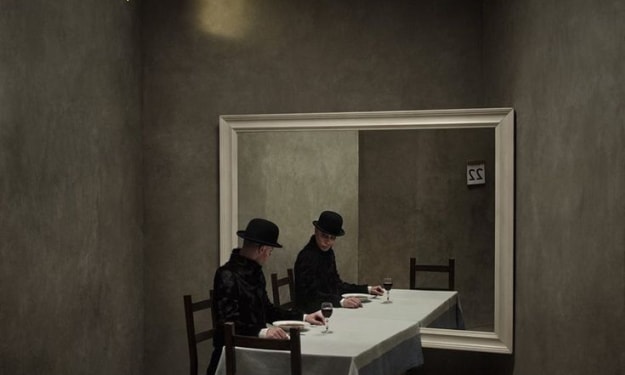
The Mirror in Room Six
M Mehran When traveling for work, Daniel never expected much from the hotels he stayed in—sterile lobbies, thin walls, and coffee that tasted like cardboard. But the motel he checked into that rainy Thursday was stranger than most. The clerk barely looked up as Daniel signed in, mumbling, “Only one room left—Room Six.” The hallway was dim, lined with peeling wallpaper. Room Six creaked when he pushed the door open. Inside, everything seemed ordinary enough: a bed, a chair, a lamp that flickered. The only unusual thing was the mirror. It was full-length, framed in dark wood, and leaned against the far wall. It wasn’t dusty or cracked like the rest of the room—it gleamed, flawless, as though it had been polished moments before. Daniel didn’t think much of it until he unpacked. He glanced at the mirror and froze. His reflection was smiling. But Daniel wasn’t. He stepped closer, his stomach lurching. Slowly, cautiously, he raised his hand. His reflection raised its hand too, in perfect sync. But the smile lingered, stretched unnaturally wide. “Long day,” Daniel muttered to himself, trying to laugh it off. “Just tired.” He turned away, but unease prickled his skin. He left the television on for noise, but every time he glanced at the mirror, the reflection’s smile seemed sharper. --- At 2 a.m., a noise jolted him awake. A faint tapping, like fingernails on glass. The room was dark, the TV off though he hadn’t touched it. His gaze slid to the mirror. His reflection was standing closer than he was—right up against the glass. The tapping grew louder. The reflection lifted its hand and knocked, once, twice, three times. Daniel’s breath caught. His body felt heavy, pinned to the bed. Then, in a voice that didn’t echo in the room but bloomed inside his skull, the reflection whispered: “Let me out.” Daniel scrambled off the bed, heart hammering. “This isn’t real,” he hissed. “I’m dreaming.” The reflection tilted its head, the smile never faltering. “You don’t belong out there. You’re tired. Worn down. Let me take your place. Rest. Just rest.” “No,” Daniel whispered. The mirror rattled. Cracks spidered across its surface though it didn’t break. The reflection’s smile widened until it split the face unnaturally. Daniel grabbed his bag, fled the room, and didn’t stop running until he was in his car, the rain soaking him through. He drove through the night, not caring about the headlights or the storm. --- By morning, he had convinced himself it was exhaustion and stress. Lack of sleep. Maybe even a fever dream. But when he stopped at a diner for breakfast, he caught his reflection in the window. It was still smiling.
By Muhammad Mehranabout a year ago in Fiction
The House That Waited
M Mehran On the outskirts of town, beyond the crooked oak trees and the overgrown path, stood a house no one claimed. Its paint peeled, windows sagged, and yet every night, one upstairs light glowed as though someone were still waiting inside. Children dared each other to approach it, whispering about ghosts and lost lovers, but few ever got closer than the rusted gate. Clara, however, had never been afraid of the house. At twenty-seven, she returned to her hometown with a suitcase of failures—her business had collapsed, her relationship had ended, and the city that once promised so much now felt like a cruel trick. On her first night back, she walked until the familiar silhouette rose in the moonlight. The house looked just as it had when she was a girl, when she’d sketch it in the margins of her notebooks, convinced it had secrets worth knowing. The gate creaked open easily. No lock. No chain. As if the house had always been waiting for her. Inside, dust blanketed the floor, but the air felt strangely warm. The wallpaper peeled in strips, revealing faded patterns of roses. A staircase curved upward, and at its top, yes—light spilled faintly from a room. Clara should have turned back. Instead, she climbed, each step groaning under her weight. At the landing, she hesitated, then pushed open the glowing door. The room was a library. Hundreds of books lined the walls, their spines gleaming though no hand had touched them in decades. A single lamp on a desk flickered gently. And on that desk sat a book with her name embossed in gold. Clara froze. Her throat went dry. She opened it. The first page read: The Story of Clara Whitmore Below, in delicate handwriting, was the story of her childhood—the afternoons at the creek, the loneliness after her mother’s death, the way she always sat at the back of class, sketching that strange house. The pages turned themselves, as though impatient. They showed her teenage years, her secret dreams of becoming an artist, her decision to chase practicality instead. Every choice, every misstep, every heartbreak. And then, halfway through the book, the pages were blank. The lamp flickered once, twice, and the silence thickened. Clara touched the paper. “What is this?” she whispered. A voice drifted from the shelves—soft, old, but clear. “It is your unfinished story.” She spun, but no one was there. “Who’s speaking?” The voice chuckled, though not unkindly. “The house. I keep the stories of those who wander too far from themselves. Yours has been waiting.” Clara’s hands trembled on the desk. “So… what do I do?” “Write,” the house said simply. “Fill the pages with what comes next. Not what you think you should do. Not what others told you to do. What you want.” Her chest ached. “But I don’t know anymore.” “Then start small. One choice. One word. A blank page is not a curse, Clara. It is an invitation.” Her eyes blurred with tears. She sat, picked up the pen lying beside the book, and hesitated. The nib hovered over the page, her hand shaking. Then she wrote: Tomorrow, Clara paints again. The lamp glowed brighter. Somewhere deep in the walls, gears clicked like locks being undone. --- The next morning, Clara woke in her childhood bedroom, unsure if the house had been dream or memory. But the scent of ink clung to her fingertips, and on her desk sat a canvas she hadn’t touched in years. She began to paint. Hesitant strokes at first, then bolder, until color spilled across the canvas. She painted the oak trees, the crooked path, the waiting house. Day after day, she returned to the library, each time finding the book open to the next blank page. Whatever she wrote there seemed to shape her waking life. She painted, she applied for exhibitions, she reconnected with friends she’d long avoided. But with each written word, the house grew quieter. The wallpaper faded further, the shelves thinned. The voice, when it spoke, sounded weaker. On her final visit, the library was nearly bare. Only her book remained. Its last blank page trembled as though in a breeze. The house’s voice whispered, faint as a sigh: “You have no need of me now. Your story is yours to carry.” Clara placed her hand on the final page and wrote: Clara chooses to keep writing, no matter how uncertain. The lamp flickered once—and went dark. --- Years later, Clara’s paintings hung in galleries across the country. Critics praised the haunting imagery, the way her canvases captured both loss and possibility. She never told them the truth: that each painting began in a library that no longer existed. Sometimes, when she walked past the edge of town, she looked for the house. But the path had grown over, and no silhouette rose in the distance. And yet, on nights when doubt clawed at her, Clara would hear it faintly in her dreams—the creak of a gate, the whisper of pages turning, and the soft voice reminding her: “A blank page is not a curse. It is an invitation.”
By Muhammad Mehranabout a year ago in Fiction
The Ghost
Grandma Baker and I stood out in the pouring rain, milling over our choice for a potential Jack O’ lantern carefully. I picked up various pumpkins, feeling them for heft and softness. Once I found the perfect one, I showed it to Grandma Baker and carried it to the checkout stand, already set up near the entrance to the pumpkin patch! Mr. Gravy wore blue jeans and an oversized Kent State Hooded sweatshirt.
By DJ Robbinsabout a year ago in Fiction
The Letter I Was Never Meant to Read
It was a quiet evening when I stumbled upon the letter. The house was unusually still, the kind of silence that presses on your chest and makes you feel like something is about to change. I hadn’t been looking for secrets; I was simply searching for an old notebook in the wooden chest my mother kept locked in her room. But fate has a strange way of revealing truths when we least expect them.
By Nadeem Shah about a year ago in Fiction
Under the Crimson Sky
The crimson sky stretched endlessly above, its fiery glow spilling across the horizon like blood on sand. For most villagers, it was just another sunset, another day slowly slipping into the night. But for Ayaan, the sight of that sky was both a curse and a reminder—a curse of the past he could never completely bury, and a reminder of the fight he could no longer run away from.
By Nadeem Shah about a year ago in Fiction
“Echoes of an Evening Walk”
write by [MR HASHAM] Echoes of the Evening Walk Sham dhal rahi thi, asmaan ne suraj ke peeche laal aur sunehri rang phela diye the. Aaliya apni beti Sana ka haath pakad kar purane kachay raste par chal rahi thi. Dono ki chaal halki thi, jaise waqt ko zara dheere karna chahti ho.
By Muhammad hashamabout a year ago in Fiction
AI for the Mind
The Rise of Digital Therapy Tools In recent years, mental health has become a central topic across Europe, with rising awareness about depression, anxiety, and burnout. Traditionally, access to therapy has been limited by long waiting times, high costs, and stigma. This is where artificial intelligence (AI) has stepped in, offering new ways to make mental health support more accessible.
By Muhammad Ibrahimabout a year ago in Fiction