Holiday
The Last Human
The coffee maker still worked. That was something. Lorna stood in the kitchen of a house that wasn't hers—hadn't been anyone's for three years now—and watched the dark liquid drip into a chipped mug. Outside, vines crawled up the sides of skyscrapers. A deer grazed in what used to be Times Square. The planet was healing, they would have said, back when there was a "they."
By Parsley Rose about a year ago in Fiction
The Double Echo of the Douglas
The Pivot: 03:07 A.M. The city slept beneath a heavy blanket of November. Alexandru leaned over his desk, surrounded by sketches, old books, and the faint hum of his computer. He was a young man of 28, with tired eyes but a feverish spark of genius. The object of his passion, his five-year obsession, was The Architect’s Hourglass—an urban legend among those passionate about space and time theory, which claimed to hold the key not only to perfect perspective but also to the understanding of all choices, made or unmade.Alexandru’s project, a predictive modeling algorithm for urban density, was ready. In six minutes, he was due to submit the application to a prestigious global competition that could change his life, offering him unlimited funding for research.The phone, resting on the edge of the desk, vibrated. A call from an unknown number, at 03:07.Alexandru looked up. Six minutes. If he answered, he would break his absolute state of flow, risking the loss of concentration on the final details. If he ignored it, he would miss a potential essential contact.
By alin butucabout a year ago in Fiction
The Experience of Viewing the Remarks Produced by AI . Content Warning.
Here’s what it truly feels like to earn appreciation from a machine and why your real, fallible humanity still counts most online. When the words seem genuine, but there is no emotion conveyed. 1. The First Comment That Seemed Fake Just another night of publishing stories on Medium it was business as usual. It wasn't flawless, but it was unfiltered, heartfelt, and penned from that inside space where ideas aren't refined, simply real. After that, a message appeared. A remark had been made. You've written a fantastic piece. I am genuinely inspired by your viewpoint. Continue doing an excellent job. It should’ve made me smile. But instead, something inside me went quiet. It was too slick. Too perfect. Too empty. I copied the comment, pasted it into Google and there it was a dozen similar comments strewn over different blogs. That’s when I discovered it wasn’t a human who spoke to me but It was a machine and somehow, that hurt more than I imagined 2. When Validation Feels Manufactured Writers don’t write for claps alone. We write to connect to feel seen. Every time someone comments, it’s not just feedback, it's a signal. A whisper that says Hey, I read your thoughts, I felt them too. But what happens when that whisper is artificial? When the warmth in the words is produced, not genuine? It feels like being hugged by a ghost. You can sense the shape of the emotion, but not the warmth of it and suddenly, all that affirmation whose likes, those comments, those “great post answers, they lose their value. Because connection without consciousness isn’t connection. It's a simulation. 3. The Paradox of the AI Era We live in a strange time. Writers utilize AI to create. Readers use AI to remark. Soon, maybe, AIs will reply to each other while humans only observe. We say we desire authenticity. But we’re automating our emotions, our voices, our empathy. We call it efficiency, but maybe it's an escape. We’re steadily forgetting how to be human online and maybe, even offline. It makes me wonder If no one’s truly feeling the words, is anyone really talking? 4. What It Feels Like Up Close It feels like applause from an empty theater. It appears like engagement, but it sounds like silence. You start questioning: Did anyone actually read what I wrote? Did anyone feel it? I can’t totally blame AI, because it's smart, useful and even brilliant in its own way. It saves time, improves ideas, and helps authors like us shape thoughts faster. But there’s something about AI that can't fake empathy. It can imitate emotion, but it can’t feel it. It can describe a sunset, but it can’t sit in awe of it. 5. The Imperfection That Makes Us Human The little typo that displays your joy. The jumbled paragraph that suggests you were crying while writing. The raw, unedited sentence you almost deleted but didn’t. Those are not mistakes. They are fingerprints. They prove you were here. Perfection is the enemy of connection and AI, for all its brilliance, is a little too perfect. 6. My Turning Point as a Writer After that moment, I made a quiet pledge to myself, If someone comments on my post, I’ll welcome it but I’ll check for the pulse. I’ll seek for the warmth behind the words, not simply the words themselves and more importantly I’ll never stop writing like a human. Because that’s what readers genuinely need not automation, not optimization, but authenticity. Even if AI learns to replicate humanity perfectly, I’ll still prefer to bleed on the page. Because that’s what writing is intended to be, not clean, not cold, but alive. 7. To Every Writer Reading This If you ever feel disheartened because nobody’s commenting because you assume no one’s reading remember this: Even one real A person who reads your words is worth more than a thousand bots claiming to care. One human connection outweighs a thousand algorithmic exchanges. Your words don’t need millions of eyes. They just need one soul to see them. Keep writing like a person. Because real people can tell the difference. 8. The Future Isn’t About AI It’s About Awareness AI isn’t the enemy. Unawareness is. Use AI to support you, not to replace you. Let it modify your grammar, not your truth. Let it mend your commas not your voice. Because the world doesn’t need another perfect post. It needs something real. Something that reminds people what it is to feel. Seeing AI-generated comments on my postings seems like seeing technology cheer for me loud but lifeless. But it also reminded me of something powerful: In a world where everything is automated, Being human becomes a superpower. The errors, the fragility, the wobbly phrases they’re not defects. They’re proof that you’re alive and that’s what will always separate us fro Next time you remark on someone’s post, don’t let AI compose it for you. Take 10 seconds to feel what their comments made you feel. Then say something real even if it’s just: This touched me. I felt this. Thank you for writing this. Because you can feel it, AI can't and that’s what will always make your presence matters
By Aliyu Ibrahim about a year ago in Fiction
The Last Prayer of Rahim
There’s a small village at the edge of nowhere — the kind of place where time moves slowly, and people remember everything. That’s where Rahim lived. He wasn’t always sick. Once, he was the strongest man in the village — the kind who carried bricks all day and still helped his neighbors fix their roofs before sunset. People used to call him “Bhai Rahim — the man with a heart bigger than his hands.” But life has a strange way of testing the kindest souls. A few years ago, an illness crept into Rahim’s body. At first, it was just pain — something he could hide behind his smile. Then came the swelling, the weakness, the nights of burning fever. Doctors called it incurable. Rahim just called it “Allah’s test.” His house was small — two rooms and a wooden door that always creaked. Every morning, before the sun climbed over the rooftops, he would spread his prayer mat and whisper the same words: >Ya Allah… give me patience, not comfort. Give me strength, not ease.” The neighbors would hear his voice through the thin walls. Some pitied him. Others just shook their heads and said, “He won’t live long.” But Rahim always smiled when he heard that. “I’ve already lived longer than despair,” he’d say softly. -- One cloudy afternoon, a traveler named Saeed arrived in the village. He wasn’t looking for Rahim — he was just passing through, tired and lonely, searching for something he couldn’t name. Someone at the tea stall told him about “the sick man who prays for others.” Curious, Saeed went to find him. When he reached Rahim’s home, the sight stopped him cold. Rahim was sitting on a thin mattress by the door. His body looked fragile, but his eyes — those eyes had light. He wasn’t praying for healing; he was praying for gratitude. Saeed sat quietly beside him. Neither spoke for a while. The sound of their breathing filled the silence between prayers. Finally, Rahim opened his eyes and smiled. “Brother, you look troubled,” he said softly. Saeed’s eyes were wet. “I came to see you, but now I don’t know what to say. I feel helpless.” Rahim chuckled faintly — a dry, gentle sound. “Don’t be. Pain is not always a punishment. Sometimes it’s a reminder… that we still belong to Him.” -Saeed took out a bundle of money, hands trembling. “Please, take this,” he said. “Use it for medicine, for care… for anything.” Rahim looked at it for a moment, then closed Saeed’s hand around it again. “Brother, money can fix a body, but not a heart. And my heart is fine.” Saeed couldn’t hold back his tears anymore. “What can I do then?” he asked. “Pray with me,” Rahim whispered. “That’s all I ever need.” So they sat together — two strangers who suddenly felt like brothers. Their hands lifted, voices low but full of meaning. “Ya Allah, forgive us when we forget to be grateful. Forgive us when we fear pain more than we fear losing faith. And when we suffer, let us remember — You never test without purpose.” The air grew still. Even the birds seemed to listen. Saeed could feel the weight of those words settle deep inside his chest. Rahim’s hands slowly dropped to his lap. His eyes stayed open, but something changed — a softness came over him. He whispered one last time, barely audible: “Tell the world… I wasn’t waiting for death. I was waiting to meet the One who gave me life.” And then, silence. Complete, peaceful silence. The azaan began to echo from the nearby mosque. Saeed sat there, motionless, tears falling one by one. He wasn’t crying out of pity anymore — he was crying because he’d just seen what faith truly looked like. Before leaving, he looked around the little courtyard. There was no wealth, no comfort, no sign of healing. Yet somehow, Rahim had everything Saeed had been searching for — peace. When Saeed walked back to the main road, the evening light touched the village roofs. He whispered to himself: "He healed me, even as he was dying.” And from that day on, wherever Saeed went, he carried Rahim’s prayer in his heart — a prayer that wasn’t just about pain or faith, but about finding light in the darkest corners of life. Moral / Reflection: Some people leave this world without fame or fortune, but they leave behind something far greater — a lesson that faith can turn suffering into strength, and sorrow into peace.
By Vocal Member about a year ago in Fiction
The Halloween Table 4
Starting to think better to get more place settings on the table. Didn't think anyone would come but maybe one. The doorbell bonged once again, and I went to check. Yes, it is Francine and Monty. One I was expecting, but not with a guest but the more the merrier scarier. Come on into this unexpected party of five, I believe. We gathered in the dining room, and we set the table for four more. The buffet offered several favorites that all enjoyed and with that we sat and ate and shared a Halloween meal of friends and ghouls galore.
By Mark Grahamabout a year ago in Fiction
The Halloween Table 3
The doorbell began bonging again. I went to the door and checked. It was my friend Wolfy. You are a tad early there Wolfy but remember no changing tonight. I do have your favorite meal preparing for you can stay normal. The bonging began once more. I went to the door and looked out and there she was Vivian. Welcome, Miss Viv. How did the dentist visit and those two teeth you were worried about? Your favorite drink in in the cooler over there in the corner. Wolfy stop that and let her past. What did I do just smelling.
By Mark Grahamabout a year ago in Fiction
The Halloween Table 2
The table is set suddenly the doorbell bongs. Who could that be at this hour? It is not quite All Hallos Eve, and I am not really expected anybody as of yet. The doorbell bongs again. I guess I better answer it. Slowly walking to the door and look out the peephole. Seeing nothing thinking maybe an early trickster for the neighbors know that I like this season of frights. Opening the door and preparing myself I walk out onto the porch and look around. Seeing nothing out the ordinary I walk back into the house, a bit wary now.
By Mark Grahamabout a year ago in Fiction
The Halloween Table
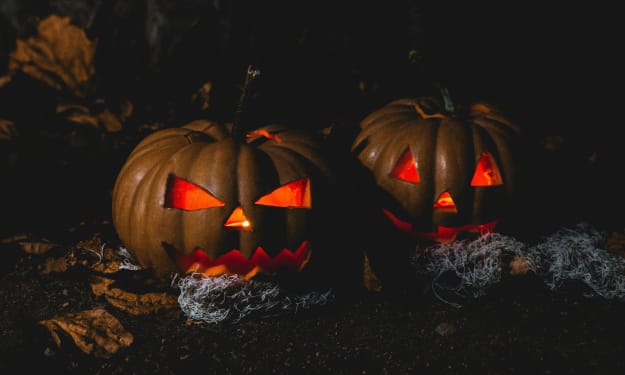
What do you suppose a Halloween table to look like? To me a Halloween table is one that kind of gives off a Gothic motif that is a dark Mahogany table maybe with a few tall candlesticks in the middle. Now picture cobwebs hanging from the ceiling and chandelier in the center of the room. There is a sense that one is not alone at this table for its set for two for pewter dishes. Who is expecting whom? Is it for a special trick or treater? At this time of year, one may not know for sure. Happy dining!?
By Mark Grahamabout a year ago in Fiction
The Photographer of Lost Souls
M Mehran Every morning at dawn, Mira Lang stood on the cliffs overlooking the sea, her camera in hand. She waited for the light — that thin, trembling line between night and day — when the world seemed to hold its breath. For years, she’d photographed the sunrise. To anyone else, she was simply an artist obsessed with light. But there was a reason behind her quiet ritual — something no one in the coastal town of Evershore knew. Mira could see the souls of the dead. They appeared in the first rays of sunlight — faint silhouettes standing on the horizon, looking toward a place beyond the sea. And when she took their picture, they vanished. --- It had started ten years ago, on the morning her brother drowned. She had been taking photos by the lighthouse when she saw him standing in the surf — smiling, waving, as though saying goodbye. Instinctively, she lifted her camera. When she pressed the shutter, he disappeared. The next day, his body washed ashore. Since then, every dawn brought new faces. Some she recognized from the village — fishermen, old widows, travelers who never returned. Others were strangers. But all of them waited in silence until she captured their final photograph. Her photos, strangely, never showed the figures. Only light. The gallery walls in her cottage were filled with hundreds of them — golden streaks, foggy horizons, pale sunrises. To others, they were art. To her, they were farewells. --- One evening, as Mira closed her shop, a boy entered. He couldn’t have been more than ten, his hair salt-streaked, his clothes too big for him. “You’re the lady who takes pictures of ghosts,” he said. Mira froze. “Who told you that?” “My granddad,” he said. “He said you helped him find Grandma. She died before I was born.” Her heart softened. “What’s your name?” “Eli.” He looked up at her with bright, serious eyes. “Can you take my picture tomorrow?” She frowned. “Why would you want that?” “Because,” he said quietly, “I think I’m supposed to go.” Her stomach turned cold. “Eli, what do you mean?” He shrugged. “I’ve been feeling tired. Mama says it’s nothing, but I know it’s the same tired Grandma had before she left.” Mira knelt beside him. “You’re not going anywhere. Do you understand?” He only smiled. “You help people cross, don’t you? Maybe you can help me too.” --- That night, she couldn’t sleep. The boy’s words echoed in her mind. She had never tried to stop a soul from leaving — only to send them peacefully onward. But Eli was still alive. When dawn came, she found him waiting on the cliff, barefoot, his small figure outlined by the pink horizon. “You shouldn’t be here,” she said, breathless. “I told you,” he said softly, “it’s time.” He pointed toward the sea. There, just above the waves, stood two shapes — a man and a woman, holding hands. The woman’s hair blew in the wind like a white veil. “My grandparents,” Eli whispered. “They’ve been waiting for me.” Mira’s throat tightened. “Eli, please, you can’t go yet.” He turned to her, eyes full of peace she couldn’t understand. “You always said goodbyes are beautiful. Take my picture, Miss Mira. Please.” Her hands shook. “If I take it, you’ll…” He nodded. “That’s okay.” The wind rose, carrying the smell of salt and rain. Mira lifted her camera, tears stinging her eyes. Through the lens, she saw the three of them together — the boy and the figures of light. “Goodbye, Eli,” she whispered, pressing the shutter. The light flashed — and he was gone. Only the sea remained. --- The next day, the town woke to the news: a boy had passed away in his sleep, peacefully. Mira stayed home, unable to move, unable to cry. She had helped countless souls find peace — but this time, it felt different. She went to the cliffs that evening, camera in hand, but the horizon was empty. No figures. No light. For the first time in years, she felt completely alone. Then she saw it. On the sand below, someone had left a small object — a camera, old and weathered, with her name carved into the side. She picked it up, confused. It wasn’t hers. When she looked through the lens, the world shimmered — and there was Eli, standing beside his grandparents, all three of them waving and smiling in the golden light. He mouthed the words: Thank you. Mira lowered the camera, tears streaming freely now. The sea roared softly below, endless and calm. She finally understood — she wasn’t just taking pictures of endings. She was keeping promises. --- Years later, people still came to Evershore to see her photographs. Critics said her work captured something no one could describe — not grief, not beauty, but something in between. No one ever noticed the faint outlines hidden in the light. But if you stand on those cliffs at dawn, you might. Sometimes, when the sky blushes with the first light of day, you can still hear the faint click of a shutter — and see an old woman standing with her camera, smiling toward the sea, waiting to say one more goodbye.
By Muhammad Mehranabout a year ago in Fiction