Holiday
The hotel laundry has been running itself after midnight
I work laundry for a mid-range chain hotel — the kind with fake marble floors, “continental breakfast,” and carpets that smell faintly like wet dog no matter how often they’re shampooed. My shift’s usually 4 p.m. to 1 a.m., but I’m often the last one here. Nobody wants to be the person closing down the laundry room at night.
By V-Ink Storiesabout a year ago in Fiction
[UPDATE] I was the only one working the night shift… so who checked in Room 409?
Hey everyone, I didn’t expect my last post to blow up the way it did. I just needed to vent about something weird that happened at work, but apparently, it freaked a lot of people out.
By V-Ink Storiesabout a year ago in Fiction
The Coffee Cup. AI-Generated.
Every morning at exactly 7:10, Elias Mwangi opened the doors to his tiny café on River Street in Nairobi. The brass bell above the door jingled softly, echoing through the narrow shop that smelled of roasted beans, cinnamon, and rain-soaked wood.
By shakir hamidabout a year ago in Fiction
The Light Switch
The door slammed shut behind me, and the darkness swallowed everything whole. I hadn't meant to come inside. The old Caldwell house had been abandoned for thirty years, its windows like hollow eyes watching the neighborhood. But my phone had died mid-walk, and when the October rain started sheeting down, the partially open front door seemed like an invitation rather than a warning.
By Parsley Rose about a year ago in Fiction
Title: Modern Technology in Today’s Refrigerators: Smart Features, Efficiency, and Innovation
Refrigerators have come a long way since their invention in the early 20th century. What once was a simple insulated box with a basic cooling mechanism has evolved into a high-tech, energy-efficient, and intelligent kitchen centerpiece. Today’s refrigerators are not just about keeping food cold—they’re about enhancing convenience, preserving freshness longer, reducing energy consumption, and even connecting to your digital life. Thanks to rapid advancements in technology, modern refrigerators now integrate smart systems, advanced materials, AI-driven features, and sustainable engineering. Let’s explore the cutting-edge technologies shaping the refrigerators of today.
By handy maneshonabout a year ago in Fiction
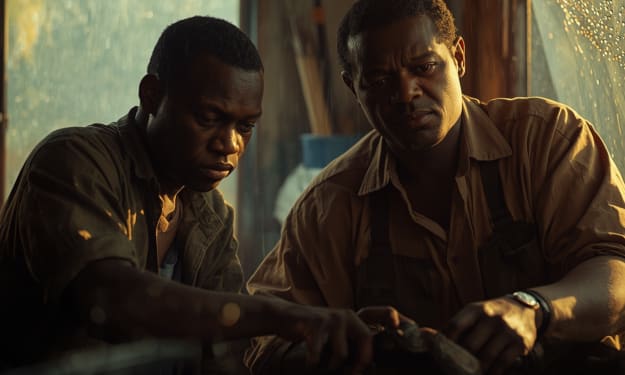
The Last Rain in Bulawayo. AI-Generated.
Bulawayo, 1998 — a city of sunburned streets and restless winds, where the scent of dust and diesel hung heavy in the air. In the township of Mzilikazi, two brothers grew up chasing the same dream but running from different ghosts.
By shakir hamidabout a year ago in Fiction
The Lantern Beyond the Dust
The old village slept beneath a veil of dust and silence. Houses made of clay stood shoulder to shoulder, breathing out the weight of years. The scent of earth and forgotten dreams floated in the still air. Every evening, as the sun sank behind the hills and shadows stretched across the narrow road, a single lantern came alive — hanging by the door of a small, crumbling house. That light belonged to Rahim, an old shoemaker who had long ago stopped fixing shoes and started fixing hearts. The villagers called him “Lantern Baba.” To the children, he was a mystery — a man who never let his lantern die, no matter how harsh the wind or how heavy the rain. Some said he was waiting for someone. Others believed he was just afraid of the dark. But Rahim knew why. That small flame was the last piece of promise he had left. One cold night, a stranger walked into the village. He was young but carried the posture of someone who had wrestled with life for far too long. Dust clung to his boots and sadness to his eyes. His name was Riaz Hamkar — a traveler who had not only lost his way but also the reason to keep walking. He had left the city behind, chasing silence. His dreams had been torn apart by disappointment, his ambitions drowned in the noise of survival. He had once believed he could light his own path — but life, with its cruel humor, had blown out every candle. When he saw the glow of Rahim’s lantern from a distance, something stirred inside him. It wasn’t hope, not yet — just curiosity. Why would someone keep a light burning in such emptiness? He knocked on the door. The old man opened it slowly, his face half-lit, half-shadowed. “Looking for a place to rest, son?” Rahim asked. Riaz nodded. Inside, the small room smelled of oil, leather, and quiet patience. Broken shoes were piled in one corner. On the wall, a faded photograph showed a young boy standing beside a proud father holding the same lantern that now burned on the table. “Your son?” Riaz asked softly. Rahim’s wrinkled lips curved into a painful smile. “Yes. He left for the city years ago. Said he wanted to become someone important. I told him I’d keep the light on, just in case he ever lost his way home.” The two men sat in silence. The wind whispered through the cracks in the walls, like the voice of memory itself. Rahim polished the lantern’s glass again and again, even though it was already clean. “Why do you keep it burning every night?” Riaz finally asked. Rahim looked up, his eyes glimmering like the flame itself. “Because sometimes, people need to see that even a small light can survive the storm.” Riaz didn’t reply. But that night, he couldn’t take his eyes off the lantern. The flame trembled, danced, and steadied again — like a heartbeat refusing to stop. When sleep finally came, Riaz dreamed of his father — of promises unkept and paths untaken. He dreamed of his younger self, still brave enough to believe in small lights. At dawn, when the first rays of sunlight slipped through the cracks, Rahim was gone. Only the lantern remained — burning, warm, alive. Riaz stood for a long time, staring at it. He thought of all the people who lose their light and never find it again. Then, without saying a word, he picked up the lantern, held it to his chest, and stepped out into the morning air. He walked for hours, following no road in particular, only the rhythm of his heartbeat and the whisper of the flame beside him. When he reached the next village, people saw a young man walking through the mist, carrying a glowing lantern. No one knew his story, but everyone felt something inside them — a quiet pull, a reason to look beyond their own darkness. That night, for the first time in years, laughter returned to one of the village homes. A mother hummed a lullaby to her child, and the old baker decided to reopen his shop early the next morning. All because a stranger had passed by with a light that refused to die. Years passed. The story of Lantern Baba spread like the wind — changing from whispers to legend. Some said the old man still lived inside that light, guiding those who had lost their way. Others said the traveler, Riaz Hamkar, had become the new keeper of the flame, carrying it from village to village. No one really knew the truth. But one evening, in another dusty town far away, as darkness fell and the wind howled, a soft light appeared again at the edge of the road. A small child tugged at his mother’s sleeve and pointed. “Look, Mama,” he whispered. “The Lantern Baba is here.” And somewhere, beyond the dust, the light flickered — steady and alive — just like the human heart.
By Riaz Hamkarabout a year ago in Fiction