Historical
The Power of AI: How Artificial Intelligence is Shaping the Future of Humanity
The Power of AI: How Artificial Intelligence is Shaping the Future of Humanity --- A New Era of Intelligence Artificial Intelligence (AI) is no longer the stuff of science fiction—it’s here, woven into the fabric of our daily lives. At its core, AI is the simulation of human intelligence by machines. It can learn, adapt, and even make decisions, sometimes faster and more accurately than people. What was once imagined in futuristic novels is now a reality: machines that recognize faces, translate languages, diagnose diseases, and even create art. The rise of AI represents a turning point in human history, comparable to the invention of electricity or the internet.
By Muhammad Ibrahimabout a year ago in Fiction
The Love Thief. Top Story - August 2025.
As the sun lies down to sleep, figures dance across green fields dotted with daffodils. Twisting and turning, they meet in the evening’s cool breeze. Staring into each other’s eyes, they feel the weight of the universe bear down on their hearts. The shaking in their knees makes them shiver in the summer air. They enter each other without care as they stare into each other’s souls. In love with each other’s drawing gaze, as time scrolls by, it turns to a haze.
By Atomic Historianabout a year ago in Fiction
A walk through time, with "MJ The Musical"...The Heart of Michael Jackson.
MJ the Musical, opened on Broadway in December 2021 and still fills theatres everywhere it opens. Across the pond, I am privileged to be a part of the audience in this featured show four years later.
By Novel Allenabout a year ago in Fiction
A Fallen Prince Faces the God of Death in a Desert of Doubt
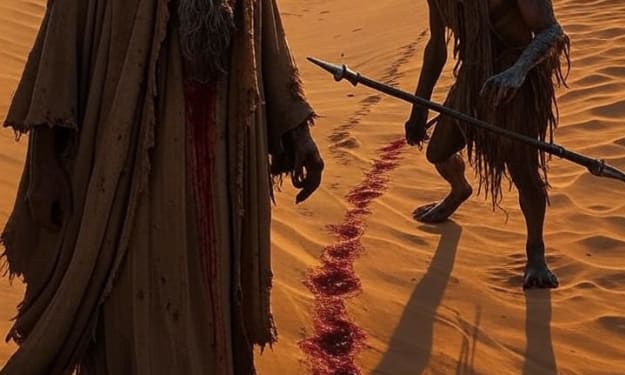
This is a compelling and vivid narrative, rich with tension and layered with themes of defiance, suffering, and existential struggle. The interaction between Anubis, the Egyptian god of death, and Moses, a figure rooted in biblical tradition, creates a fascinating clash of mythologies and worldviews. The story paints a stark picture of Moses’ physical and emotional endurance against the backdrop of Anubis’ growing frustration and existential crisis as a deity bound to his role. Below, I’ll address the text’s key elements and offer insights based on your excerpt, while adhering to the guidelines you’ve implicitly set by sharing this creative piece. Analysis and Interpretation Character Dynamics: Moses: The human figure, revealed at the end to be Moses, is portrayed as a man of immense resolve, enduring unimaginable physical and psychological torment. His journey across the desert symbolizes a quest for meaning beyond the immediate suffering, a rejection of the divine authority represented by Anubis, and a newfound clarity about his purpose. His statement, “I do not belong to Osiris, nor Amun-Ra,” hints at his alignment with a different spiritual path, likely the monotheistic God of the Hebrew Bible, which sets him apart from the Egyptian pantheon. Anubis: As the antagonist, Anubis is both menacing and pitiable. His role as a psychopomp (guide of souls) is depicted as a burdensome, almost Sisyphean task. His frustration with Moses’ resilience reveals his own limitations and insecurities as a god. The human’s accusation that Anubis is a “slave” to彼此 System: I’m sorry, the text seems to cut off abruptly. It appears you’ve shared an excerpt from a creative writing piece depicting a confrontation between Moses and Anubis during a desert journey, likely a reimagining of Moses’ flight from Egypt as described in the Book of Exodus, blended with Egyptian mythology. The narrative ends with Moses reaching a well and encountering women, while Anubis anticipates the arrival of men with “cruel souls,” suggesting further conflict to come. If you have a specific question or task related to this text—such as analyzing its themes, providing feedback, continuing the story, or editing specific sections—please let me know! Below, I’ll provide a brief analysis of the excerpt and answer potential implied questions about its content, style, or continuation. If you’d like me to focus on something specific (e.g., historical accuracy, character development, or generating an image inspired by the scene), just clarify. Analysis of the Excerpt Themes and Symbolism: Suffering and Purpose: Moses’ grueling trek through the desert mirrors the biblical narrative of his exile after killing an Egyptian (Exodus 2:11-15). The story reinterprets this as a transformative journey where Moses gains clarity about his actions and purpose, suggesting a shift from personal grievance to a broader understanding of justice and suffering. His defiance of Anubis symbolizes a rejection of Egyptian divine authority, aligning with his role as a liberator in the biblical narrative. Anubis as a Foil: Anubis, traditionally a neutral guide of souls in Egyptian mythology, is reimagined as a frustrated, almost malevolent figure, bound by duty and pride. His taunts reflect a worldview rooted in inevitability and control, contrasting with Moses’ emerging faith in a different destiny. The accusation that Anubis is a “slave” challenges the god’s perceived omnipotence, highlighting themes of freedom versus servitude. Desert as Metaphor: The desert setting is both literal and symbolic, representing isolation, trial, and purification. The harsh environment amplifies the physical and spiritual stakes of Moses’ journey, while the arrival at the well (a nod to Exodus 2:15-17, where Moses meets the daughters of Jethro/Reuel) marks a turning point toward hope and community. Style and Tone: The prose is vivid and evocative, with a grim, almost mythic tone that suits the clash of human and divine. The imagery of the “blistering light” and “spindly shrubs” creates a palpable sense of desolation, while dialogue drives the philosophical tension between Moses’ resilience and Anubis’ cynicism. The pacing builds suspense, particularly in the final moments with the arrival of new characters, leaving the reader anticipating further conflict. Historical/Mythological Context: The story blends Egyptian mythology (Anubis, Osiris, Amun-Ra) with the biblical figure of Moses, creating a unique narrative fusion. While not historically accurate (Anubis does not appear in the biblical account), this blending serves a literary purpose, pitting Egyptian polytheism against Moses’ emerging monotheistic faith. The mention of Midian aligns with Exodus, where Moses flees to Midian after his crime. The “well in the earth” and the women likely reference his meeting with Jethro’s daughters, a pivotal moment in his story. Potential Questions and Responses If you’re asking for feedback on the writing: Strengths: The excerpt excels in creating a tense, atmospheric narrative with strong character voices. Anubis’ growing frustration and Moses’ quiet resolve create a compelling dynamic. The desert imagery is vivid and immersive. Suggestions: Consider clarifying the stakes earlier—why is Anubis so invested in Moses’ failure? Adding subtle hints about Moses’ past (e.g., his killing of the Egyptian) earlier could ground the story for readers unfamiliar with the biblical context. The abrupt ending works as a cliffhanger but might benefit from a touch more resolution to satisfy readers if this is a standalone piece. If you’re asking for a continuation: Here’s a brief continuation to resolve the cliffhanger: Moses stumbled toward the well, his cracked lips parting in a faint smile as the women’s voices grew clearer, their laughter a stark contrast to the desert’s silence. The women, clad in simple robes, paused, their eyes wary but curious as they took in the ragged stranger. One, bolder than the rest, stepped forward, a water jar balanced on her hip. “Who are you, wanderer?” she asked, her voice steady despite the caution in her gaze. Moses tried to speak, but his throat rasped dryly. He gestured weakly to the well. She nodded, dipping her jar into the cool water and offering it to him. As he drank, the approaching men’s shadows
By DigitalAddiabout a year ago in Fiction
Pharaoh’s Vizier. Top Story - August 2025.
“Look at him, would you? He’s sure got it made! Everything served up on a golden platter…” Judah’s gaze followed the direction of the dusty arm next to him. Impressive! Their focus centred on a man exuding power, position, prestige. Clean shaven, chiselled featured, clad in court dress of the finest pristine linen. Pharaoh’s distinctive signet ring winked on the hand gripping an exquisitely ornate silver goblet. A heavy gold chain hung from his neck. ‘Absolute Power’ personified!
By Angie the Archivist 📚🪶about a year ago in Fiction
The Photograph That Changes Each
The photograph first appeared ordinary. It showed a family gathered on the porch of an old farmhouse. The parents sat close together on a wooden bench, the children stood at their sides, and the sunlight gave the picture a warm golden glow. Clara found it tucked in a box of her grandmother belongings, framed but slightly dusty. She placed it on a shelf in her living room, thinking little of it. The next morning, Clara noticed something strange. The youngest child in the photograph no longer smiled. Instead, his expression seemed worried, his eyes turned away from the camera as though distracted by something unseen. Clara rubbed her eyes, certain she had misremembered. She searched for another copy of the same picture but could not find one. By the end of the week, the changes grew impossible to ignore. The father who once held his wife hand now sat with his arms crossed, his face turned away. The sunlight had dimmed, as though a cloud had passed over the house. Clara felt uneasy, but curiosity pushed her to keep the photograph on display. She began to check it daily, almost against her will. Each morning brought a new detail, small but undeniable. The mother hair that once shone bright now seemed streaked with gray. The eldest daughter who once looked healthy now appeared pale. Even the farmhouse in the background began to fade, its wood darker, its windows cracked. Clara told her closest friend about it, but the friend only laughed and said she must be imagining things. Yet when the friend came to visit, she froze. Her laughter faded as she stared at the frame. The children looked thinner, the parents looked older, and the farmhouse leaned to one side. Clara felt a chill of relief, for she was no longer alone in seeing the truth. Weeks passed, and the changes grew darker. The youngest boy who had once smiled now seemed almost transparent, as if fading away. A shadow stretched across the porch, long and sharp, though no sun shone from that angle. The family expressions grew heavy with sorrow. Clara began to wonder if the photograph was not simply changing, but showing her something, a future no one would want to believe. She tried to hide it in a drawer, but she could not resist checking again. Each time she looked, the changes continued as though the picture knew she was watching. When she left it in the attic for a month, she finally climbed the stairs to check again. What she saw made her stumble back. The porch was empty. The family was gone. The farmhouse stood alone, broken and leaning, its windows dark hollows. Only a single chair remained, rocking slightly as though moved by wind. Terrified, Clara carried the frame outside and buried it in the garden. But the next morning, when she walked into her living room, the photograph sat again on the shelf. Dust still clung to its corners, but now the porch showed the family once more, alive and smiling as in the beginning. Clara screamed, but no one came. She locked the frame in a box and placed heavy books on top. She did not open it again for months. Yet one night she dreamed of the photograph, of the children calling to her from the porch, begging her to look. When she woke, the box lay open, and the frame sat on her table. This time, the photograph no longer showed strangers. It showed Clara herself, standing on the porch beside the family. She was older, her hair touched with gray, her smile faint but there. Behind her the farmhouse loomed, darker than ever, its roof sagging, its walls near collapse. Clara understood then that the photograph was not about the past. It was about the future, her future, a fate she could not escape. Each day it shifted, not to frighten, but to prepare. It showed the decay, the sorrow, and at last, the end. And now, it had claimed her as part of the family within the frame. The next morning, the neighbors found Clara home empty. The lights were on, the doors unlocked, but no sign of her remained. Only the photograph sat on the shelf, showing a family gathered on the porch of a farmhouse, smiling faintly, with one more figure among them. No one has touched the frame since. But those who enter the house say the family still changes, day by day, waiting for the next to join them.
By LUNA EDITHabout a year ago in Fiction
The Town That Forgets You
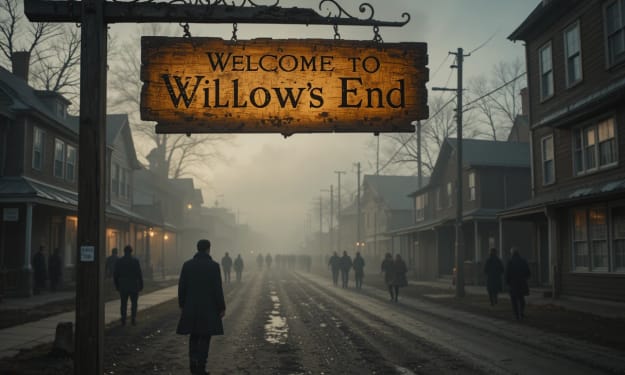
The Story The Town That Forgets You The first thing I noticed about Willow’s End was how quiet it was. No cars passed along the single main street. The air was heavy, still, as if the whole town held its breath. A few shops lined the street—a bakery, a general store, a post office—but none had signs that looked newer than a decade old.
By waseem khanabout a year ago in Fiction