Historical
The Town Where No One Remembers Yesterday
The Town Where No One Remembers Yesterday When time resets, trust no one. The first thing that struck Ethan Cross when he arrived in Bellwick was the silence. Not the peaceful kind, but a hollow quiet that seemed to swallow every sound. The quaint town, with its cobblestone streets and perfectly trimmed hedges, looked like a picture frozen in time. Yet something was off. The people smiled too easily, their eyes too vacant, as if the spark of recognition had been snuffed out long ago.
By Farooq Hashmiabout a year ago in Fiction
Memory
All he had in his life was memory. The house sagged beneath the weight of years, timber groaning under rain and neglect. He moved through its narrow halls like a ghost, brushing dust from the shelves, touching remnants of lives once lived. Each object held her imprint, every shadow whispered her name.
By Vincent Otiriabout a year ago in Fiction
Duty
All he had in his life was duty. The armor leaned against the wall, dented and scratched by decades of war. Each mark was a story, a memory of battles fought under scorching suns and storm-filled skies. His hands trembled as he polished the breastplate, tracing the gouges like a map of every life he had taken, every friend he had lost.
By Vincent Otiriabout a year ago in Fiction
The Silent Billionaire: How Bernard Arnault Quietly Took Over the Luxury World
The Silent Billionaire: How Bernard Arnault Quietly Took Over the Luxury World In the glittering world of fashion, where bold designers and flamboyant icons often steal the spotlight, one man built the most powerful luxury empire on Earth with a demeanor that is almost the opposite of the industry he dominates: quiet, meticulous, and calculated. His name is Bernard Arnault, the chairman and CEO of LVMH Moët Hennessy Louis Vuitton, and his story is a masterclass in subtlety, strategy, and the art of transforming heritage into global power.
By waseem khanabout a year ago in Fiction
Coffee Shop at the End of the World
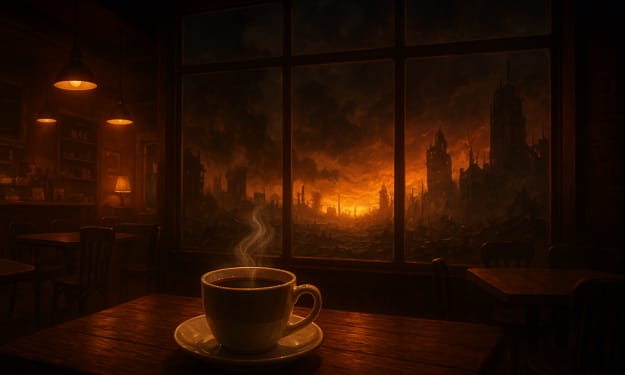
Maya had always believed that the world would end with fire or ice, maybe a bang or a whimper—anything but the gentle hum of an espresso machine and the soft jazz playing from speakers that had seen better days. Yet here she was, wiping down tables at Brew & Beyond while the sky outside painted itself in shades of amber and crimson that had nothing to do with sunset.
By Fazal Ur Rahmanabout a year ago in Fiction
When the Call Came at Midnight: Chapter Four
My name is Elena. For a moment, hearing it in my own head felt strange, as if I had forgotten it ever mattered. But standing between two men bound by secrets, with rain slashing at my skin and the sea roaring below, I clung to it like an anchor. Elena. I was still me, even if nothing else felt steady.
By Saba Writesabout a year ago in Fiction
The Day I Lost My Family. AI-Generated.
It was a Sunday morning when the world I knew shattered into pieces. I still remember the sunlight sneaking in through the curtains, warm on my face, and the faint smell of tea drifting from the kitchen. For a moment, everything felt normal. My mother humming an old tune, my father tapping his newspaper, and my younger sister chasing our old cat around the living room—it was a picture of peace I never thought could disappear so suddenly. I had no idea that within hours, that very picture would only live in my memory. --- The Last Breakfast That morning, I joined them at the table. My mother served parathas the way she always did, slipping the crispy ones to my plate because she knew they were my favorite. My father reminded me to check the car’s oil later, while my sister teased me about how badly I drove. We laughed. We ate. And I didn’t realize I was experiencing my last breakfast with them. There’s a strange cruelty in life—it doesn’t tell you when a moment will be the last. --- The Call I was running late for work, so I left before everyone else. My parents and sister had plans to visit my grandmother in the nearby town. I promised I would join them in the evening. An hour later, I was sitting at my desk when my phone rang. It was an unknown number. I answered, expecting it to be a client, but instead, a shaky voice said: “Are you related to Mr. Rahman?” “Yes… he’s my father. Why?” “There has been an accident. Please come to the General Hospital immediately.” I froze. For a second, I couldn’t breathe. The words didn’t make sense. Accident? What accident? My heart pounded so hard I thought it would rip out of my chest. --- The Hospital When I arrived, the smell of antiseptic hit me first. The waiting area buzzed with cries, hurried footsteps, and whispers. A doctor walked toward me, his eyes heavy with pity. He didn’t even need to speak. My knees went weak, and the world blurred. “They didn’t survive,” he finally said. “I’m so sorry.” Those four words broke me. My family—my mother, father, and little sister—were gone. Just like that. A truck had lost control on the highway and slammed into their car. Instant. Final. Irreversible. --- The Funeral The days that followed were a haze. I don’t remember much except standing by three graves, the soil freshly turned, and my hands trembling as I tried to throw a fistful of dirt over each coffin. People came and went, offering condolences, touching my shoulder, whispering words I couldn’t hear. My ears rang with silence, the kind of silence that screams louder than any sound. At night, I lay in bed, staring at the ceiling, waiting for my mother’s call to dinner, my father’s voice discussing the news, or my sister’s laughter echoing down the hall. Nothing came. Only darkness. --- The Empty House Returning home was the hardest. The walls still smelled of my mother’s cooking, my father’s slippers were by the door, my sister’s books scattered on the floor. Everything was frozen in time, untouched, waiting for them to return. But they never would. The first night, I couldn’t bear it. I sat in the living room and cried until my body gave up. I thought about packing up everything, moving away, running from the pain. But how do you run from memories that live inside your chest? --- Guilt and Questions The days turned into weeks, but the pain didn’t ease. Instead, it changed shape. At first, it was raw grief, then it became guilt. Why didn’t I go with them? Why wasn’t I there? Could I have done something? Saved them? Taken their place? People told me it wasn’t my fault, but grief doesn’t listen to reason. Every mirror showed me the face of a survivor, and every night I asked myself: Why me? Why am I the one still breathing? --- Learning to Live Again It took months before I realized something: my family wouldn’t want me to waste the life I still had. My father always said, “Life is not in our hands, but how we live it is.” My mother wanted me to be strong, no matter what. My sister dreamed of traveling the world, and she used to say, “Don’t sit in one place too long, bhai. Life is bigger than this town.” Those memories became my strength. I started writing letters to them, pouring my pain on paper. I began volunteering at an orphanage, telling stories to children who also knew the sting of loss. And slowly, I discovered a truth: grief never really leaves you, but it teaches you how to carry it. --- The New Me Years have passed since that day, but it still feels like yesterday. I haven’t “moved on,” because you never move on from losing your family—you move forward, carrying their love with you. Their absence is a wound that never fully heals, but their memory is the reason I keep walking. Every time I cook parathas, I hear my mother’s humming. Every time I read the newspaper, I see my father’s glasses sliding down his nose. Every time I laugh a little too loudly, I know my sister is laughing with me. They may be gone, but they live in me. And that is how I survive. --- Closing Thought The day I lost my family was the darkest day of my life. But it also became the day I learned what love truly means—that it doesn’t end with death, that it remains alive in the heart of the one left behind. I am that one. The survivor. The carrier of their memory. And though my house may be empty, my heart is still full of them. ---
By Hazrat Bilalabout a year ago in Fiction