Historical
''The History of 9/11''
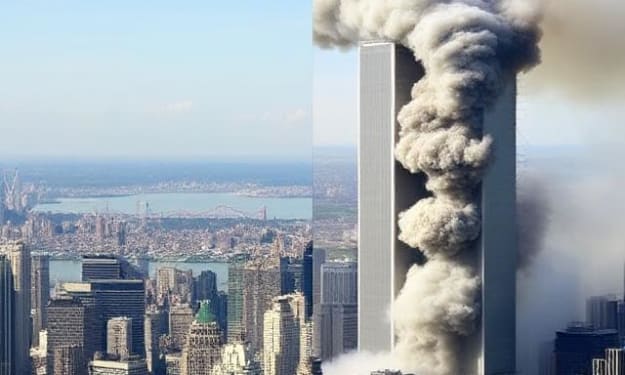
The September 11 attacks, commonly referred to as 9/11, were a series of coordinated terrorist attacks carried out by the Islamic extremist group al-Qaeda against the United States on the morning of Tuesday, September 11, 2001. These attacks were the deadliest terrorist act in world history and had a profound impact on the United States and the world. The Attacks On the morning of 9/11, 19 terrorists hijacked four commercial airplanes. Their plan was to use these planes as weapons to attack key targets in the U.S. At 8:46 a.m., American Airlines Flight 11 crashed into the North Tower of the World Trade Center in New York City. Just 17 minutes later, at 9:03 a.m., United Airlines Flight 175 struck the South Tower. The crashes caused massive explosions, fires, and eventually led both towers to collapse within hours, killing thousands. A third plane, American Airlines Flight 77, was flown into the Pentagon, the headquarters of the U.S. Department of Defense, located in Arlington, Virginia, at 9:37 a.m. The fourth plane, United Airlines Flight 93, was headed for another high-profile target in Washington, D.C.—possibly the White House or the U.S. Capitol—but passengers fought back against the hijackers. The plane crashed into a field in Shanksville, Pennsylvania, at 10:03 a.m. In total, nearly 3,000 people were killed in the attacks, including 2,977 victims and the 19 hijackers. Victims included people from over 90 countries, and the attacks caused immense physical and emotional trauma across the globe. Who Was Responsible? The group responsible for the attacks was al-Qaeda, a radical Islamic terrorist organization founded by Osama bin Laden. Al-Qaeda had declared a holy war (jihad) against the United States, blaming American foreign policy in the Middle East and U.S. military presence in Muslim countries. Bin Laden believed that attacking symbols of American power would weaken the U.S. and spark a global Islamic revolution. The plan for the 9/11 attacks was years in the making. The hijackers, most of whom were from Saudi Arabia, entered the United States legally and trained at American flight schools. The attacks were carefully coordinated and showed a level of planning that shocked intelligence agencies worldwide. The Immediate Aftermath The response to the attacks was immediate and overwhelming. The United States declared a “War on Terror,” and within weeks, launched Operation Enduring Freedom in Afghanistan to remove the Taliban regime, which had been harboring bin Laden and al-Qaeda. The Taliban was quickly overthrown, but the war in Afghanistan would last for two decades, becoming the longest war in American history. Domestically, the U.S. government took sweeping actions to prevent future attacks. The Department of Homeland Security was created in 2002, and airport security was drastically tightened. The USA PATRIOT Act was signed into law, giving the government expanded surveillance powers—a move that sparked debates over civil liberties. Long-Term Effects The 9/11 attacks changed the world in profound ways. In addition to the wars in Afghanistan and Iraq, the U.S. led global efforts to combat terrorism, which included intelligence sharing, military actions, and counterterrorism laws. However, the long-term wars resulted in the deaths of hundreds of thousands, including civilians, and cost trillions of dollars. For Americans, 9/11 became a defining moment. It reshaped national identity, foreign policy, and attitudes toward security and immigration. Memorials, such as the 9/11 Memorial & Museum in New York City, were established to honor the victims. The phrase “Never Forget” became a national slogan. In May 2011, nearly ten years after the attacks, Osama bin Laden was located and killed by U.S. Navy SEALs in Pakistan. His death was seen as a form of justice, though al-Qaeda and other extremist groups continued to operate around the world. Conclusion The September 11 attacks were a tragic turning point in modern history. They exposed the vulnerabilities of even the most powerful nations and showed how small groups with radical ideologies could inflict enormous harm. The global response reshaped politics, security, and society in lasting ways. Though more than two decades have passed, the impact of 9/11 continues to be felt. It serves as a solemn reminder of the cost of hatred and the importance of unity in the face of terror. For many, 9/11 is not just a date, but a symbol of loss, resilience, and the ongoing pursuit of peace and security.
By Israr khanabout a year ago in Fiction
I Used These 10 Free AI Tools for 1 Month – The Results Surprised Me. AI-Generated.
Introduction We live in a time where artificial intelligence is no longer a distant dream — it’s part of our daily routine. From writing to designing, from research to video editing, there seems to be an AI tool for almost everything.
By Muhammed Ismailabout a year ago in Fiction
Goodbye, Forever Home
Goodbye, Forever Home Joanne lingered in the doorway, her hand resting against the faded wooden frame that had welcomed her countless times. The keys jingled faintly in her palm—small, metallic ghosts of a life about to be surrendered. For thirty years, this house had been her anchor. It had heard her laughter, muffled her sobs, and held the silence of long nights when only the ticking clock kept her company.
By Wings of Time about a year ago in Fiction
Cast No Shadow
The road takes all. She laid atop him, thigh against thigh, breath heavy on his neck. The first light of morning registered through the window slats, painting the rough and worn floorboards a dazzlingly soft orange. The movements, the breaths, all performative at best: hers for the coin in the offing, his because his thoughts were far from the dingy rented bedroom. Liquor, women, God–all failed to draw his mind away from the horizon.
By Matthew J. Frommabout a year ago in Fiction
The Fathers of "Robotics" meet across time on social media?
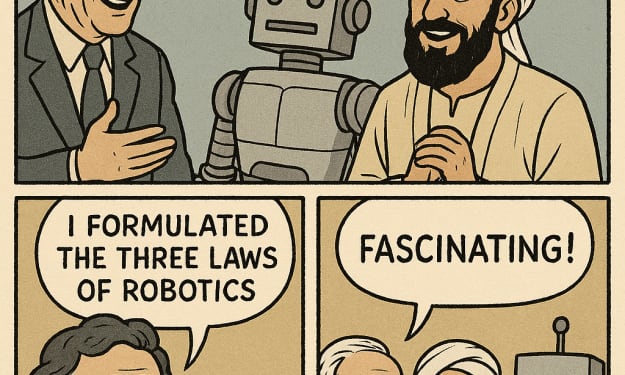
Engelberger = Father of modern robotics Al-Jazari = Father of mechanical automata Isaac Asimov = God-father of it all But, if we’re talking philosophical parenthood, Isaac Asimov might be the godfather of robotic ethics - his Three Laws of Robotics shaped how we imagine AI-human relationships.
By Novel Allenabout a year ago in Fiction
The Enchanted Threads of Time
Hook / Intro No one knew that a simple stitch could alter the fate of an entire city—until Sofia discovered the enchanted fabric. In Nueva Estrella, a city famous for its vibrant streets and ancient legends, her little fabric shop seemed ordinary—but hidden within it were enchanted threads and destinies waiting to be unraveled. Every customer, every fabric, every stitch held the potential to reveal a story that could change lives. This was more than a fantasy story—it was a living magical realism tale interwoven with history, hope, and personal growth. --- A Needle in Time On a rainy afternoon, Sofia stumbled upon an old chest in her grandmother’s attic. Wrapped in delicate velvet lay a piece of fabric that shimmered like the northern lights and a needle that seemed alive, pulsing with her heartbeat. As Sofia touched the fabric, visions flooded her mind: warriors in forgotten battles, kingdoms rising from ashes, dragons soaring through clouds, and distant lands she had never seen. Each stitch she imagined began to etch itself into her consciousness, whispering stories of lives connected across time. This magical realism experience made her realize she had found enchanted threads capable of weaving multiple destinies. The more she touched the fabric, the more she discovered: it was not just magic—it was history, memory, and storytelling woven together. A single stitch could carry the laughter of a child, the sorrow of a lost love, or the courage of a hero yet to be born. --- Weavings of Fate Curious, Sofia began creating patterns from these visions. Her first creation was a scarf whose wavy colors seemed to tug at time itself. Soon, visitors to her shop recounted stories mirroring every stitch she had unknowingly woven. Next came a tapestry: a young sailor battling turbulent seas, scholars deciphering ancient runes, lovers embracing under a moonlit sky. Each piece revealed untold stories, intertwining the destinies of everyone who encountered them. Her shop became a sanctuary of fiction, adventure, and hope. People came from distant towns, drawn by whispers of magical threads. Some came seeking answers, others in search of inspiration. Each time someone touched her creations, they discovered fragments of their own story—an inspirational tale of courage, love, or redemption. --- The Challenge of Power Yet the fabric’s magic was not without consequence. The line between creation and reality blurred. Sofia began to see visions of danger: shadows lurking in the corners of her mind, threads twisting into shapes of fear and sorrow. Every stitch carried weight—one wrong pattern could ripple into someone else’s destiny unpredictably. She sought guidance from Aria, a wise artisan familiar with legends of enchanted threads. Together, they studied the patterns, learned to listen to the fabric, and asked permission before stitching a story. Their collaboration sparked tales of courage, hope, and rediscovered dreams, slowly turning her shop into a hub for those eager to explore magical realism, storytelling, and personal growth responsibly. --- Threads That Connect Us All As the enchanted threads revealed more stories, Sofia realized something extraordinary: the fabric did not just tell individual tales—it connected the people of Nueva Estrella. Families separated by time or circumstance found echoes of each other’s lives within her creations. Strangers met in the shop and discovered shared dreams. Even the city itself seemed alive, humming with a newfound rhythm of interconnected destinies. Sofia began teaching a small group of apprentices, showing them how to respect the threads, to weave without controlling, and to listen to the whispers of magic. Each apprentice added their own touch, creating fictional adventures and inspirational tales filled with hidden wonders. --- Embracing the New Dawn Through challenges and revelations, Sofia discovered the essence of life woven into each stitch. Her creations whispered stories of love, hardships, and triumphs—uniting the city in shared journeys. Nueva Estrella awoke to a new era. Sofia’s shop became the heart of the city, where magical realism and dreams existed in every thread. And as the enchanted threads of time continued to weave destinies, they bound together stories that would endure forever. Every stitch was a heartbeat, every pattern a memory, and every creation a bridge between the past, present, and future—an unforgettable fantasy story of hope, courage, and personal growth. --- Final Thought Have you ever wondered if your smallest action could ripple through someone else’s destiny? In a world alive with possibilities, the enchanted threads remind us that every choice, every stitch, every story matters. This is the magic of storytelling, the power of fantasy fiction, and the beauty of inspirational tales waiting to be discovered.
By ✦•············• Freelancer •············✦about a year ago in Fiction
Shadows on the Edge of Tomorrow
The train station was almost empty, except for a few scattered travelers dragging their suitcases across the cold concrete floor. The air smelled faintly of rain, and the giant clock above the platform ticked louder than usual, marking each second like a reminder that time was both a gift and a thief.
By Nadeem Shah about a year ago in Fiction