Historical
The Young Girl
The Young Girl The mountain had already turned dark when the soup was ready. The cold wind of the night and the insect noise makes the environment evermore rural. The strange lady has not yet come to the hut. I hope to have everything in order by the time she arrives. I taste the soup: It really was good, although I did not have all the necessary condiments. Furthermore, I step outside the hut for a little and contemplate the heavens: The stars are witnesses of my efforts. I went up the mountain, found its guardian, completed two challenges (one more difficult than the other), met a ghost, and I am still standing. “The poor strive more for their dreams.” I look at the arrangement of the stars and their luminosity. Each has its importance in the great universe that we live in. People are also important in the same way. They are white, black, rich, poor, of religion A, or religion B or of any belief system. They are all children with the same father. I also want to take my place in this universe. I am a thinking being without limits. Furthermore, I think that a dream is priceless, but I am willing to pay for it to enter the cave of despair. I contemplate the heavens once more and then go back to the hut. I wasn't surprised to find guardian there.
By Aldivan Teixeira Torres2 years ago in Fiction
5 Worst Fighter Jets
What a mess: Although fighter jets are significant military assets and iconic aviation symbols, not all have been successful. This article examines five of history's worst fighters. Due to its VTOL design flaws, the Soviet Yakovlev Yak-38 had poor handling and was prone to engine failure, limiting its effectiveness.
By Shaeen Sarker2 years ago in Fiction
Three questions ?
The king has become old. He is very old. His eyes cannot see well these days. He can barely hear. He has no strength in his body. In this condition, it is not possible for him to rule the kingdom. The king decided in his heart which of his sons he will give the responsibility of the kingdom to. Then he will spend the rest of his life in quiet punishment.
By Md Ariful Islam2 years ago in Fiction
The Ghost of the Mountain
The Ghost of the Mountain Night falls over the mountain. I light a fire and its crackle soothes my heart. It's been two days since I climbed the mountain, and it still seems like such a stranger to me. My thoughts wander and land in my childhood: The jokes, the fears, the tragedies. I remember well the day I dressed up as an Indian: With bow, arrow, and tomahawk. Now, I was on a sacred mountain, precisely because of the death of a mysterious indigenous man (the Medicine Man of the tribe). I have to think of something else, for the fear is freezing my soul. Deafening noises surround my hut, and I have no idea what or who they are. How does one overcome his fear on an occasion like this? Answer me, reader because I don't know. The mountain is still unknown to me.
By Aldivan Teixeira Torres2 years ago in Fiction
The Second Challenge
The Second Challenge Arriving at my hut, I find the guardian of the mountain who appears more brilliant than ever. Her eyes never stray from my own. I think that I am exceptional to God. I feel his presence at all times. He resurrects me in every way. When I was unemployed, He opened a door; when I didn't have any opportunities to grow professionally, He gave me new paths; when in times of crisis, He freed me from the bonds of Satan. Anyway, that look of approval from the strange woman reminded me of the man I was up until recently. My current goal was to win, regardless of the obstacles that I had to overcome.
By Aldivan Teixeira Torres2 years ago in Fiction
Fair Play: Finding Clarity in the Clues
Even when very little does make sense, we humans use narratives to make sense of the world around us. We tell ourselves stories to relax and amuse ourselves. In tumultuous times, people frequently turn to escapist forms of entertainment as a means of disengaging from the broader world. We also find that we frequently turn to detective fiction. People became increasingly interested in bridge, mahjong, and crossword puzzles after the First World War, and this "play fever" quickly spread to detective novels. Murder mystery writers began to write books that were puzzles to be solved and that complied with the fair play doctrine – the concept that the reader should have a fair chance to solve the mystery before the grand reveal. The trick was to give the reader enough clues to have "a sporting chance to solve the mystery," as TS Eliot put it. The authors of Golden Age detective novels were concerned about fairness that does not exist in the real world. In a whodunnit, where everyone knows their part and the story is new and exciting, but ultimately familiar and comforting, life is so much easier. There are solutions, conclusions, and a person you can blame in detective novels. Someone will always be to blame. Someone to haul off to the scaffold. “Once the murderer leaves, the world of the novel begins to approach its former peacefulness...cleansed of guilt, free of complication and obstacles, recreated anew from the shambles of a temporary disorder...the happy and orderly end toward which the detective has been working,” George Grella writes in his essay Murder and Manners: The Formal Detective Novel. However, reality is clearly not like that. It may be tempting to view life as a mystery that must be resolved. And indeed, tempting to believe that everything has a clear and single explanation. Because there is always a solution, we enjoy solving puzzles. We enjoy detective tales because we are aware that there will ultimately be a satisfying reveal—a straightforward narrative that makes everything make sense. Party games based on murder mysteries like Wink Murder and Murder in the Dark gained a lot of popularity during the Golden Age. This gamification of death took the power, the sting, out of a terrible tragedy and emphasised that of course none of this was actually real – it was in fact just a game. the ideal remedy for dealing with the public aftermath of World War I. The popularity of escape rooms, the rise in sales of jigsaw puzzles during the pandemic, and crime logic gamebooks like GT Karber's Murdle series have all occurred more recently, during our own turbulent times. A piece titled "Why do People Read Detective Stories?" was published in The New Yorker in 1944 by American literary critic Edmund Wilson. He came to the conclusion that the "all-pervasive feeling of guilt and by a fear of impending disaster which it seemed hopeless to try to avert because it never seemed conclusively possible to pin down the responsibility" was the reason for the popularity of detective fiction in the years between the two world wars. Who was responsible for the first crime and who would be responsible for the subsequent one? The murderer is suddenly discovered, and relief! He is not, after all, a person like you or me. Nobody appears innocent or safe. He is a bad guy who is known as George Gruesome in the industry. He has been caught by an invincible Power, the egotistical and omniscient detective who knows exactly how to get rid of the guilt. In more recent times, detective fiction, particularly those written in the Golden Age style, has once more attracted readers. The Guardian reported in July 2020, as UK bookshops reopened, that nearly 120,000 more crime and thriller books were purchased in the final two weeks of June 2020 than at the same time the previous year. Crime was, during this period, the UK’s most popular book genre. Another indication of their growing popularity was the Crime Writers' Association's announcement in 2023 that their awards for classic or "cosy crime" novels would now include a Whodunnit Dagger. With Mystery in White by J, The British Library's Crime Classics series has continued to sell well. Jefferson Farjeon became a number one bestseller for Waterstone’s.In my novel Fair Play, I use the fair play rules together with the familiar structure of a Golden Age detective novel – with its murder, its suspects, its Watson and its reveal – to explore the emotions around grief. Abigail, the main character, alternates between the real world and the fictional world of the detective novel following the sudden death of her brother. She is looking for clues—answers—in both worlds to comprehend her circumstances. In the midst of the unpredictability of real life, the murder mystery provides her with a familiar path and much-needed comfort during her grief. In a detective novel, we are aware that we are getting closer and closer to a conclusion—the answer we have been looking for—within each chapter. At least, that's what Abigail hopes for. "We are lost and unhappy in a universe that seems to make no sense, and cling to science, machines, and detective fiction, just because, within their limited fields, the problems do work out, and the end corresponds to the intention," Dorothy L. Sayers writes in her book "Begin Here," which was published during the Second World War.
By Mahafuj Alam2 years ago in Fiction
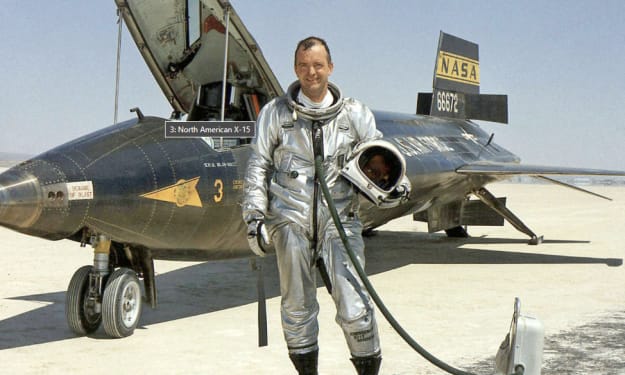
Top Ten: remarkable experimental aircraft
The spectacular North American X-15 was the pinnacle of the US series of ever-faster X-planes. Despite the fact that the previous record was set in 1967, this unparalleled aircraft continues to be the fastest aircraft ever built with a human pilot. It was carried to a high altitude beneath the wing of its NB-52 mothership before being released at 45,000 feet at a speed of about 500 miles per hour. At that point, the aircraft's rocket propulsion would propel it to speeds exceeding Mach 6 and altitudes exceeding 100 kilometers.
By Shaeen Sarker2 years ago in Fiction
The Untold Story of a Man and His Dog
James Carter was a man of few words. He had lived 72 years in the same small town where he was born, worked as a school teacher for over four decades, and quietly retired into a life of solitude after his wife passed away. The house they had shared for over 40 years was now quiet—too quiet. Every morning, James walked to the park at sunrise, sat on the same wooden bench beneath the tall oak tree, and watched the world wake up. It was his routine, and it gave him some sense of purpose. That was until he met Max. Max was a stray—a golden retriever with kind eyes and a limp in his back leg. He first appeared in the park one rainy morning, wet, shivering, and alone. James noticed the dog from a distance, keeping to himself, but something about the animal’s sad eyes struck him. The next day, James brought a sandwich. He ate half and left the other half near the tree. Max returned, sniffed it, and ate it slowly, keeping a cautious distance. Day by day, the distance between them shrank. Within two weeks, Max was sitting right beside James on the bench, resting his head on the old man’s knee. James never spoke much, but with Max, words weren’t needed. They shared sunrises, silent afternoons, and evening strolls. Max listened patiently as James mumbled memories of his wife, his regrets, and his stories of the past. The dog simply stayed—still and loyal. Seasons changed. Winter brought snow, and Max would curl up by James's feet, sharing his warmth. Spring brought blossoms, and they’d walk among the flowers. With Max, James rediscovered life—quiet, but full. He smiled more. He talked a little louder. The neighbors noticed. So did the town. One day, as they walked through the park, a young boy ran up to them and hugged Max tightly. "His name is Buddy!" the boy shouted. "We lost him a year ago! We thought he was gone forever!" James stood still. The boy’s mother approached, tears in her eyes. "Sir, that dog… he used to be ours." James looked down at Max—Buddy—who wagged his tail gently but didn’t move. The woman explained that they had moved away, and during the move, Buddy had run off. They searched, but never found him. Now they were back visiting relatives and happened to spot him in the park. There was a long silence. James knelt down, looking into Max’s eyes. "You have a choice, old friend," he whispered. Max looked between the boy and James, his eyes soft, his body still. Then, he walked back to James and sat beside him. The woman smiled, though her voice trembled. "He chose you." James nodded, holding back tears. “He saved me,” he said quietly. “Or maybe we saved each other.” From that day on, Max was no longer just a stray, or someone’s old pet—he was family. Years passed. Max grew older, slower. His golden fur turned grey. His legs trembled more often, and the walks became shorter. But the bench under the oak tree remained their spot. Every day, they sat together, watching the world move on. Then, one chilly autumn morning, Max didn’t wake up. James found him lying peacefully by his side, head resting on his lap, as if he had just fallen asleep under the orange-leaved sky. James didn’t cry right away. He just sat there, stroking Max’s fur, whispering, “Thank you.” A small stone now sits under that oak tree, with words carved simply: “Max – A loyal friend. He listened, he stayed, and he loved.” People still see James at the park. He walks slower now, carrying a cane, but he still visits the bench every day. Sometimes, he talks softly as if someone’s still beside him. Maybe he believes Max is still there. Maybe he is. In a world that never stopped making noise, the silent bond between a man and his dog spoke louder than words.
By Eisa durane2 years ago in Fiction