Fan Fiction
The Apartment that Rents You
The Apartment that Rents You Written by: Salah Uddin They told you not to get attached. That buildings didn’t love, that walls don’t whisper, and doors don’t remember. But Tower 97 wasn’t like other places. In the City of Drought and Dust, where every breath cost credits and apartments outlived politicians, housing didn’t just house—it chose.
By Salah Uddinabout a year ago in Fiction
Stuck With Mr. Billionaire
“You seriously expect me to sleep in a cabin with him?” Harper’s voice echoed off the pine walls of the snowbound lodge. Her suitcase hit the floor with a thud, narrowly missing the foot of the man leaning against the fireplace, smug grin firmly in place.
By USAMA KHANabout a year ago in Fiction
The Weaver’s Song
The morning sun spilled over the rooftops of Sylhet, casting golden streaks across Arif’s tiny apartment. At twenty-eight, he was a math teacher at a local school, known for his quiet demeanor and knack for making numbers feel like stories. But today, his mind wasn’t on equations. A letter lay open on his table, its edges creased from being read too many times. It was from his aunt in a village near Moulvibazar, a place he hadn’t visited since he was a boy.
By Shohel Ranaabout a year ago in Fiction
My Grandmother’s Mirror Only Reflects the Dead
The Mirror’s First Secret I almost sold the mirror the day after Grandma Lillian’s funeral. It was an ugly thing—a heavy oak frame carved with twisting vines, the glass smoky with age. But Mom insisted: "She wanted you to have it. Said it was special."
By MUHAMMAD Abbasabout a year ago in Fiction
The Sound of His Boots
BY SHAFI ULHAQ At exactly 2:17 a.m., Mira woke to the sound of boots. Heavy. Slow. Familiar. Thump. Drag. Thump. She held her breath, eyes fixed on the ceiling of her childhood bedroom. Her phone screen glowed: no calls, no notifications. Just the time.
By Shafi ulhaqabout a year ago in Fiction
Yesterday's Future
The last time I stood on the rooftop of our old apartment building, the city looked different. Back then, we were seventeen. The skyline shimmered with possibility, every blinking light a promise waiting to be kept. We called it “the edge of tomorrow”—that crumbling rooftop with graffiti on the walls, where dreams felt like they might leap straight into the sky. “I’m going to build something that matters,” you told me once, your breath visible in the winter air. “Not just make money or survive. I want to build something people remember.” I nodded. “And I’ll write. About us. About this.” You laughed. “Who’s going to read a book about two kids staring at airplanes?” I smiled back. “You. When we’re old.” That was twelve years ago. Now I stood there alone, the wind colder than I remembered, the rooftop smaller. The building next to ours had grown taller—steel and glass climbing higher than any dream we ever sketched on notebook margins. Progress. Time’s monument. I took the old Polaroid out of my pocket. Us, blurry and half-smiling. You had written in the white space below: "This is what yesterday’s future looks like." Back then, it felt poetic. Now it felt like a question I didn’t know how to answer. --- We had it all planned. You’d go to college for engineering. I’d major in literature. We’d move to the city, share an apartment, chase our dreams until they caught us or killed us. But the thing no one tells you about futures is how fragile they are. Your scholarship fell through. Mine didn’t. You stayed behind to help your mother after her accident. I left. I told myself it was temporary. We called. We wrote. For a while. Then time got in the way. I published my first book at twenty-six. It was about us, thinly veiled behind fiction. It sold decently. You messaged me congratulations. I said thank you. You said you liked chapter seven. I never asked which part. You stopped replying after that. I stopped writing about you. --- Until last week, when your sister called. She found my number buried in an old phone, still saved under "Skyline." She said the accident was sudden. A drunk driver. A rainy road. You didn’t make it. I hadn’t seen you in ten years. I didn’t even know you still lived here. I asked if I could come to the funeral. She said yes. And now I was back on the roof, holding the photograph you never threw away. I imagined you standing beside me again, eyes squinting against the sun, hair tousled by wind. Would you recognize me now? Would I recognize you? In the distance, I saw a plane cut through the clouds—just like we used to watch. You once said they looked like punctuation marks in the sky. I never understood what you meant. Maybe I do now. Maybe you were telling me that life is a sentence we write one word at a time, and sometimes we don’t realize we’ve reached the end of a chapter until it’s already behind us. --- As I turned to leave, I heard laughter. Two teenagers had climbed onto the rooftop. A boy and girl, backpacks slung low, their conversation light and fast, filled with the same dreams we once whispered into the wind. They didn't notice me. Why would they? I was yesterday now. But as I passed them, the girl asked, “Do you ever wonder what the future looks like?” The boy shrugged. “Probably like this. Just... older.” I smiled. Maybe they were right. Maybe yesterday’s future isn't some grand revelation or perfect destination. Maybe it's just this—returning to where we once began, older, quieter, but still reaching for the sky. Before I stepped through the rooftop door, I left the Polaroid wedged in the metal railing, fluttering slightly in the wind. A memory. A reminder. A punctuation mark in someone else’s story.
By Azmat Roman ✨about a year ago in Fiction
The Mirror Remember
The mirror had been in our family for generations. Tall, framed in dark oak, with curling patterns carved along the edge like vines frozen in time. It stood in my grandmother's room, pressed between her wardrobe and window, half-covered by a faded velvet cloth. She used to say, “Some mirrors reflect. Others remember.” As a child, I never understood what she meant. I’d press my nose to the cold glass and make faces, giggling when it mimicked me back. But sometimes, when I wasn’t looking directly at it—when I glanced at it from the corner of my eye—it seemed to shimmer. Like the mirror was breathing. After Grandma died, I inherited the house. Dust had settled thickly on every surface, and the rooms echoed with silence. But the mirror remained—untouched, upright, waiting. I didn’t intend to keep it. I had grown up, moved on. Old things didn’t belong in modern apartments. But something about it—its weight, its presence—dared me to ignore it. On my third night in the house, I saw her. I had just brushed my teeth and walked past the mirror when a flicker caught my eye. I turned—and there she was. Not my reflection, but hers. My grandmother, standing where I should have been, in the same nightgown she always wore, her eyes soft but solemn. I gasped, stumbled back, and when I looked again, she was gone. I told myself I was tired. Dreaming. The mind plays tricks in old houses filled with memories. But the next night, I saw her again. She didn’t move. Didn’t speak. Just watched me. Not with fear. Not with menace. With something else—urgency. Like she was trying to say something she no longer could. I started staying longer in front of the mirror, staring, waiting. And then, it changed. Not her. The room behind her. In the mirror’s reflection, the room was different—like a version from the past. The curtains were floral, not plain. A porcelain lamp sat on the nightstand that no longer existed. And on the bed… a little girl. Me. The mirror wasn’t just remembering her—it was remembering us. Each night, a new memory surfaced. My fifth birthday. Grandma teaching me to braid my hair. The time I cried because my mother had left again, and Grandma held me so tight I thought I’d break and heal all at once. The mirror, somehow, was showing me everything I had buried. Every joy. Every wound. But one memory stood out. It was raining. I was twelve, standing in that very room, shouting at Grandma. She had forbidden me from going to a party. I was cruel. I called her a bitter old woman who didn’t understand anything. In the mirror’s version of that night, I saw her cry after I slammed the door. I never knew she cried. I sat in front of the mirror that night, whispering apologies to the glass, hoping somehow she heard me. Then, for the first time, the mirror changed again. She appeared—older, paler—but this time, she smiled. Not the tight, sorrowful smile from before. A full, forgiving smile. Her lips moved silently. “I remember. And I forgive.” Tears spilled down my cheeks. I touched the glass. It was warm. The next morning, the mirror was empty. Just my reflection, tired and red-eyed, staring back. I kept the mirror. I placed it in my hallway, uncovered. Not as a decoration, but as a memory keeper. Sometimes, on quiet nights, I see flickers in the glass. Not just of Grandma, but others. My father, who died when I was young. An old friend I lost touch with. Even parts of myself I thought I’d forgotten. It doesn’t frighten me anymore. Because now I understand. Some mirrors don’t just reflect who we are. They remember who we were— And remind us of who we can still be.
By Azmat Roman ✨about a year ago in Fiction
The Last Voice Message
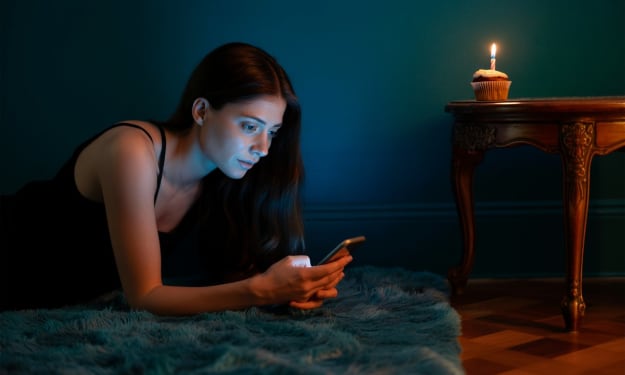
The first one came on a cold October morning. Maya had just turned 28. She was standing in her kitchen with a mug of bitter coffee, watching the steam rise like it was trying to escape. The phone buzzed. No caller ID. Just a voicemail.
By Muhammad Ahmadabout a year ago in Fiction
Borrowed Dreams
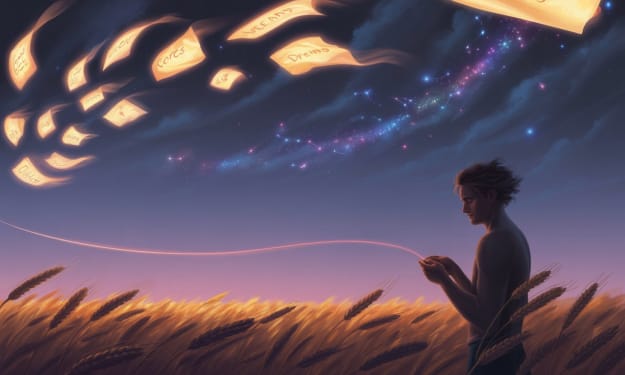
In the city of Lysoria, dreams were currency. Not just metaphors for ambition—but real, vivid dreams you could rent, download, and live in like a midnight theater. Wealthy clients paid thousands to relive the perfect kiss, the thrill of flying, or the comfort of a lost loved one’s voice. Those who couldn’t afford the high price of hope? They rented secondhand dreams—cheap, blurry, and half-wilted.
By Muhammad Ahmadabout a year ago in Fiction
Exit Sign
He woke up in a hospital bed again. The beeping monitors, the antiseptic smell, the sterile white walls—it was all different from yesterday’s dusty motel room, but one thing was exactly the same: the glowing green exit sign, mounted just above the door.
By Muhammad Ahmadabout a year ago in Fiction