Fan Fiction
Where the Sky Held Its Breath
The clouds sat heavy on the horizon, glowing gold and bruised violet in the falling light. The wind had gone still. Even the insects had quieted. Martha stood near the back of the wagon, hands resting on the worn wooden frame. Her arms ached, not just from the day’s travel, but from the child wrapped tight against her chest, dozing, as if the miles had never touched him. They had made camp late. The wheel had cracked on one of the wagons ahead, and half the train had waited while the men repaired it with rope and borrowed wood. The tents were pitched quickly, the fires lit in silence. No one laughed tonight. Martha didn’t speak much anymore. There was no one left to talk to. Her husband had died on the second week of the journey—fever, they said. She had buried him in a shallow grave off the side of the trail, covered the spot with stones, and walked on. Two nights later, she found the baby. Or rather, heard him. The crying came from a canvas bundle near the remains of an abandoned cart, left half-burned at the edge of the grasslands. The others had passed it by without stopping. Martha had not. The child was wrapped in linen, bloodied and wailing, his mother lying cold beside him. No one knew how long they had been there. The wolves hadn’t come yet. So Martha had picked him up. No one argued. The wagon behind her creaked as the wind shifted. She turned toward the hills and watched the storm build, far off in the distance. The trail would be mud by morning. “Hungry again, are you?” she murmured, feeling the child stir. She had no milk. That had stopped days ago. Her body had long since stopped bleeding, long since stopped preparing for the child she lost two winters past. But other women still had enough to spare. She would walk, every night, from fire to fire. Always the same question, asked with quiet resolve. “Will you nurse him?” And they always did. Without hesitation. Tired women, sore and sunburnt, still opened their arms. Not for her. For him. He was growing. Thighs thickening. Eyes sharpening. He watched things now — the flapping of canvas, the flicker of flame, the motion of passing wagons. And sometimes he smiled. Martha hadn’t known it was possible for a smile to wound. She stepped away from the wagon and walked slowly toward one of the nearer tents. Smoke drifted up from a small fire. A woman sat beside it, rocking gently, feeding a child of her own. Martha hesitated, just a moment. Then: “Ma’am… mine hasn’t eaten since morning.” The woman looked up, eyes weary but warm. She shifted, freeing one arm. “Come sit.” Martha lowered herself carefully to the earth. Her knees cracked as she moved, her skirts brushing the grass. The stranger took the boy without question, cradling him to her breast like he belonged there. Silence passed between them as the baby latched, as the sun bled away behind the wagon line. “You his kin?” the woman asked quietly. “No,” Martha said. Then, after a pause: “But I’m all he’s got.” The woman nodded. “Then that’s enough.” For a moment, the weight of everything fell away. The trail. The dust. The graves left behind. There was only this: the sound of nursing. The whisper of wind in the grass. Two women, and a child who did not yet know what it meant to be alone. Martha stared into the fire and let herself breathe. Tomorrow, there would be more walking. More hunger. More sky pressing down on their backs. But tonight, there was milk. There was warmth. And there was one more mile behind them. --- Thank you for reading. Inspired by the resilience of women who carried more than just their own burdens across the vast American trail.
By Waqif Khanabout a year ago in Fiction
Flight 909
Flight 909 By Salah Uddin ________________________________________ Darren Geller boarded Flight 909 with nothing but a carry-on and a half-dead phone. It was supposed to be a cheap, two-hour hop from Denver to Portland—a forgettable connection between business meetings. The airline, Avia West, had a retro feel. No digital check-ins, no app—just a paper ticket and a weary-looking stewardess who scanned it with a nod.
By Salah Uddinabout a year ago in Fiction
Berry Blue Beasts
Blueberries, a healthy way to keep one in shape and a delicious treat, but in this case it tells of a beast in blue. In Alaska where blueberries can be found, they have been known to cover the ground in huge mats that many creatures find absolutely irresistible. On this day, there is a creature has decided to pay a visit to their blueberries fields and enjoy the fruits before him. He is an Alaskan caribou and a large one at that. With giant antlers over his head covered in velvet that are as tall as a twelve year old and robust enough to rip apart any tree that stands in his way, he is a beast to behold. In his prime, he can shake off just about any challenger, but not all odds are desirable when food is the prize.
By Toby Hewardabout a year ago in Fiction
You’ll Never See the World the Same after Reading This
What if I told you that much of what you think, feel, and believe… might not actually be yours? It sounds strange—maybe even uncomfortable—but the way we see the world isn’t as solid as we believe. Behind the curtain of our everyday choices, memories, and emotions is a mind playing tricks, shaping our entire reality without asking for permission.
By shoaib khanabout a year ago in Fiction
The Last Watch of Rusty
In the quiet village of Devigarh, nestled between low green hills and golden fields, lived a dog named Rusty. He was no pedigree, not of any known breed, just a brown-and-white mongrel with a crooked ear and eyes that held a depth far beyond animal understanding. Rusty belonged to Hari Singh, a retired schoolteacher who lived alone in a small clay house at the edge of the village. They had been together for nearly ten years, ever since Rusty, then a starving pup, wandered into Hari's yard one rainy monsoon evening. Hari had just lost his wife that year and lived with the silence of grief wrapped tightly around him. When he saw the shivering dog under his porch, something stirred. He took the pup in, wrapped him in an old shawl, and gave him warm milk. From that night onward, Rusty never left his side. Their bond grew quietly, without fanfare. Rusty would follow Hari to the market, sit at his feet as he read the newspaper, and curl up beside him at night. When Hari worked in the vegetable garden, Rusty would chase away crows and monkeys with proud barks. If a stranger came too close to the gate, Rusty would place himself protectively in front of Hari until the guest was known. Years passed in peace. The villagers often smiled seeing the old man and his faithful companion walking down the dusty lanes, two silhouettes bound by something deeper than words. Children would pet Rusty and bring him treats, and though he accepted their affection, he never strayed far from Hari’s side. But time, as it always does, moved on. Hari’s steps grew slower. His voice, once used to lecture in classrooms, became thin and brittle. The village doctor visited more often, and Rusty would sit stiffly by, watching every movement, every medicine bottle with suspicion. One cold winter morning, Hari didn’t wake up. Rusty barked, nudged his hand, whimpered, and finally howled a mournful sound that echoed across the fields. The neighbors came running. The doctor arrived. But Hari Singh had gone quietly in his sleep, a serene smile on his face, one hand resting on Rusty's head. The funeral was held that evening. A small crowd gathered — villagers, old students of Hari, and their families. Rusty sat still beside the pyre, his eyes locked on the flames. When the ceremony ended, someone tried to take him away, but he resisted, biting gently at the hand that pulled his collar. Rusty did not return to the house. He lay under the old neem tree beside Hari’s grave. The villagers brought him food and water, but he barely ate. Day and night, rain or shine, he stayed there, eyes fixed on the mound of earth as if expecting his master to rise and call him. Weeks passed. Rusty began to look thinner, weaker. Children cried seeing their once playful friend so lifeless. Adults tried to adopt him, but he refused to leave that sacred patch of ground. One night, as winter deepened and mist rolled over the fields, an old man walking back from the fields saw Rusty curled up on the grave. He approached to check, concerned by how still the dog lay. But Rusty was not asleep. He had taken his last breath at his master’s side — loyal to the end. The news spread across the village like wildfire. Even those who rarely cried found themselves wiping their eyes. The villagers decided to bury Rusty beside Hari. A stone was placed above both graves, etched with these words: "Together in life. Together in rest. Forever loyal, forever loved." Years have passed since then, and Rusty’s story has become part of village lore. Children listen with wide eyes as their grandparents tell them about the dog who never left his master, who chose loyalty over comfort, and who found peace only beside the man he loved most. To this day, visitors to Devigarh often find small garlands or fresh flowers laid by the shared grave. No one knows who places them. Perhaps it's just someone remembering a story, or perhaps it's a quiet thank-you to a dog who reminded an entire village of what true loyalty looks like. Moral Reflection Rusty’s loyalty wasn’t commanded — it was given, freely and completely. His love didn’t depend on reward, nor did it waver with time. In a world that often questions the existence of pure love, the silent devotion of a dog can be the loudest answer. Loyalty is not about grand gestures. Sometimes, it’s just about being there — day after day, through joy and sorrow, even in silence. Rusty never spoke a word, but in his quiet watchfulness, he taught an entire village about love, loss, and what it means to stand by someone until the very end.
By Julia Christaabout a year ago in Fiction
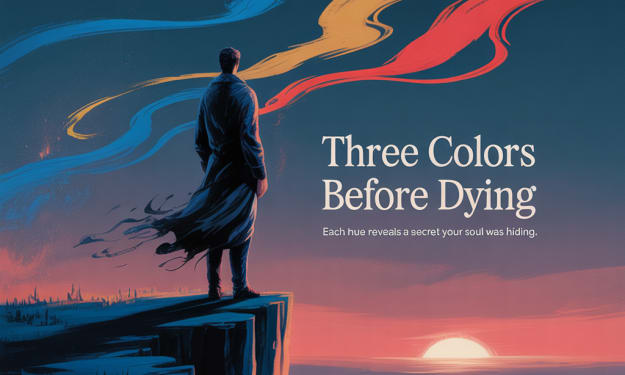
Three Colors Before Dying
In the last days of his life, Elias saw blue, amber, and crimson. No one knows exactly when it started—when humans lost their ability to see the full spectrum of colors. Scientists called it Selective Retinal Suppression. Philosophers claimed it was a curse. But the people of the city called Astraea believed it was fate. In this dystopian world, you were born with the ability to see only three colors—no more, no less—and those three shades determined the trajectory of your life.
By Mehtab Ahmadabout a year ago in Fiction
Timeless Love
The world froze at 2:04 PM. Cars halted mid-intersection. Birds hovered like ornaments in the sky. Conversations turned to statues, caught in half-spoken syllables. Ezra Kane, a quiet bookstore clerk, was the only one who moved through the stillness.
By Salah Uddinabout a year ago in Fiction