Fan Fiction
How a garden brought two hearts closer.
Arsalan never imagined he would fall in love among rows of roses. In fact, love was the last thing on his mind when he returned to his village after finishing school in the city. His uncle had grown old and needed help tending to his modest nursery on the outskirts of town. Every morning, Arsalan rose before dawn, tying a faded scarf around his neck and walking through the sleepy streets to reach the garden before the sun lit up the fields. The nursery was simple but beautiful. Rows upon rows of rose bushes stretched out under the soft early light, heavy with dew. The scent was intoxicating, a sweet promise of mornings yet to come. Arsalan found comfort in this routine, pruning branches, watering thirsty roots, and gently whispering to the plants as if they were old friends. Then came Hina. She was visiting her aunt who lived next door. A girl from the city, with delicate manners and bright eyes that seemed to notice every small wonder. The first time Arsalan saw her, she was standing shyly at the garden gate, her hands clasped in front of her. She looked out of place yet perfectly at home, as if the garden had been waiting just for her. Day by day, Hina began to wander into the nursery, always at the same quiet hour when the sun was soft and the world felt unhurried. Sometimes she would pick up fallen petals and cradle them in her palm, other times she would close her eyes and breathe in the rich fragrance as if trying to fill herself with it. Arsalan watched her from a distance, unsure what to say, how to act. His heart beat unsteadily whenever she was near. One morning, after weeks of silent glances and awkward nods, Hina approached him while he was carefully tying up a stubborn rose stem. She carried in her hands a small bouquet of half-open roses. “They’re beautiful,” she said softly, her voice like wind chimes. “But I think it’s you who makes this place truly come alive.” Arsalan nearly dropped his shears. No girl had ever spoken to him like that. His throat felt tight. He managed a nervous smile and wiped his hands on his kurta. Before he could reply, Hina stepped closer and tucked a stray leaf behind his ear, her fingers lingering for a heartbeat longer than necessary. The world seemed to slow, the air heavy with the scent of roses and something even sweeter — the first spark of love. From then on, the garden transformed. It was no longer just a place of flowers. It became a secret world where laughter bloomed along with the petals, where shy confessions floated on the breeze, and where two hearts slowly found each other in the hush of early mornings. They would walk between the rows hand in hand, sometimes silent, sometimes telling stories of their childhoods. Hina loved how Arsalan’s eyes shone when he spoke about the old mango tree he used to climb, how he once fell and broke his wrist but still laughed through the pain. Arsalan, in turn, was fascinated by Hina’s tales of bustling city streets, bright shop lights, and noisy weddings with hundreds of guests. One particular morning, when the sun was just beginning to warm the dew, Arsalan took a deep breath and reached into his pocket. His hand came out holding a tiny folded paper — a love letter he had scribbled under the dim glow of a lantern the night before. “My words aren’t fancy,” he said, his voice trembling, “but they’re true. I wanted you to have this.” Hina took the letter as if it were the most precious jewel. Her eyes filled with tears, a smile spreading across her face like the first bloom of spring. She leaned in and pressed a gentle kiss to his cheek, the touch so soft it left his skin tingling long after. The days that followed were painted with quiet joys — stolen glances, playful teasing, hands brushing over blooms heavy with perfume. The villagers began to notice, whispering among themselves, but neither Arsalan nor Hina cared. In their little world of roses, time stood still. One evening, under a sky awash with gold and lavender, Arsalan and Hina sat together on a low stone wall at the edge of the nursery. She rested her head against his shoulder, the scent of flowers all around them, as if the earth itself celebrated their love. Arsalan looked down at her, memorizing the way her eyelashes fanned across her cheeks, the way her lips curved even in stillness. “I think I’ve loved you from the first moment I saw you by the gate,” he whispered. “And I think,” Hina murmured back, eyes half-closed, “I came to this village just so I could find you here.” As twilight wrapped them in its tender embrace, the garden held their secret — a promise that in the heart of every flower bloomed the story of two souls who had finally found their way home to each other.
By Aman Ullahabout a year ago in Fiction
The Love Letter.
It was a cold, quiet winter afternoon in the small village where time seemed to move at its own gentle pace, unhurried and soft, like the drifting of clouds over the pale blue sky. Maheen had been meaning to clean her old wooden cupboard for months, but the task always felt too daunting. Today, however, she decided it was time. The cupboard had been standing in the corner of her room for years, silently holding the weight of memories, stories, and moments that had shaped her life. As Maheen opened the creaky cupboard doors, a familiar scent of sandalwood mixed with dust filled the air. Inside, there were faded clothes wrapped carefully in old cloth, glass bangles neatly placed in small boxes, and tiny perfume bottles whose fragrances had long since evaporated. She smiled softly, remembering the laughter and tears that these objects had witnessed. As she gently pushed aside layers of fabric, her fingers brushed against something unexpected—a small, fragile bundle of letters tied together with a delicate golden ribbon. The paper edges were yellowed and curled, clearly aged by time. Her heart fluttered with curiosity and nostalgia as she sat cross-legged on the floor and untied the ribbon. The very first letter was written in beautiful, flowing Urdu script, the handwriting neat and expressive, as if the words themselves carried the writer’s emotions. Maheen’s eyes began to scan the words, and instantly, memories flooded her mind. The letter was from Arif—her childhood friend, the boy she had grown up with. Arif had been the boy who ran races with her across endless mustard fields, climbed mango trees to pluck the sweetest fruits for her, and stood firmly by her side when village boys teased her. His presence had been a comforting constant during her childhood, and his letters now brought that old warmth rushing back. In the letter, Arif spoke of the vast city he had moved to, describing its dazzling lights and endless crowds. Yet, despite all the excitement, the city felt empty without Maheen. He wrote about how he missed her laughter echoing through the fields, the softness of her voice, and how every night, before falling asleep, he whispered her name as a prayer. He dreamed of the day when he could return and finally stand before her, confessing the love he had kept hidden for so long. Tears welled up in Maheen’s eyes as she read each heartfelt line. Fifteen years had passed since Arif left their village. Their letters had arrived frequently at first, then slowly less often, and eventually stopped altogether. The village folks had whispered that he had moved on, perhaps married someone else. Maheen had buried her hopes deep within her heart, but never let them die. As she finished reading, she clutched the letter tightly to her chest. It was as if time had folded in on itself, bridging the gap between past and present. The love that had once bloomed in the innocence of youth had never truly faded. Suddenly, Maheen’s phone buzzed loudly on the wooden table beside her. She wiped her tears hastily and glanced at the screen. It was a message from an unknown number. With trembling fingers, she opened it and read: “Maheen… is this still your number? I’m coming back to the village tomorrow. I’ve carried something in my heart for too long. I can’t let another year pass without seeing you and telling you face to face.” Her breath caught in her throat. It was Arif. Her Arif. The cold winter room seemed to fill with warmth. The thin rays of sunlight streaming through the window suddenly felt softer and brighter. Maheen stood up, holding the bundle of letters close. For the first time in many years, she felt hope rekindle within her. That night, sleep eluded her. Every creak in the house, every whisper of the wind outside made her heart race. She thought back to the carefree days of their childhood—the stolen mangoes, the quiet afternoons spent chasing butterflies, and the secret promises whispered beneath the old neem tree. Morning broke softly with a pale pink sky. Maheen stood outside her house, the letters once again tied with their golden ribbon, pressed close to her heart. Down the dusty village path, a tall figure appeared, moving slowly with a mixture of nervousness and excitement. Their eyes met, and in that moment, the years melted away. Arif smiled shyly, setting down his small bag. Neither of them spoke at first—their embrace said everything that words could not. The village around them seemed to pause, holding its breath as two hearts reunited after years of waiting. Maheen felt tears of joy streaming down her face as Arif whispered softly, “I never stopped loving you.” And there, under the golden winter sun, amidst the scent of marigolds and the gentle hum of village life, their timeless love story began again—stronger, deeper, and more beautiful than ever before.
By Aman Ullahabout a year ago in Fiction
Bravery Defined: One Young Man vs. 100 Lions in the Jungle.
Once upon a time… There was a deep, deserted jungle where the sunlight barely pierced through the dense canopy. Thick shadows wrapped the trees like a dark cloak, and the air was heavy with mystery and danger. It was a place few dared to enter. Tales told of the fierce lions that roamed there—brave at heart, but feared by all who knew the jungle's secrets. People whispered that these lions were the guardians of the forest’s mysteries, and that no one had ever come out alive after crossing their path. Yet, Ahmed was no ordinary young man. His courage was taller than the tallest mountain, and his spirit burned brighter than the fiercest flame. He was drawn to the jungle—not out of recklessness but driven by a purpose deep inside his soul. He wanted to uncover the secrets hidden in the shadows, to prove to himself and the world that fear could be conquered. With a steady breath and a heart full of determination, Ahmed stepped into the jungle, ready to face whatever awaited him. --- The Painful Moment As Ahmed crossed the threshold into the dense jungle, a wave of silence enveloped him. The usual sounds of birds and insects seemed to fade away, replaced by a heavy stillness that made his heartbeat pound in his ears like thunder. Every step forward was measured and cautious, but the tension in the air was suffocating. The ground beneath him was uneven, covered with dry leaves and hidden roots. Then, suddenly, his foot caught on a sharp stone, causing him to stumble and emit a sharp cry of pain. That moment changed everything. The atmosphere shifted dramatically. From the shadows emerged a thunderous roar—an army of lions, their eyes blazing red and teeth gleaming dangerously in the scarce light. They appeared like a living wall of power and menace. One hundred lions surrounded Ahmed, forming a circle that seemed like the very embodiment of death itself. The ground trembled with their weight, and the air was thick with their growls. A piercing pain shot through Ahmed’s chest—not just from fear but from the crushing realization of the danger he faced. But instead of breaking him, the pain ignited a fire within. He refused to surrender to panic. To run would mean certain death. Instead, he steadied his breath, tightened his grip on the knife his father had given him years ago, and prepared to fight for his life. --- The Test of Bravery That knife wasn’t just a blade; it was a symbol of hope and protection. His father’s words echoed in Ahmed’s mind: “This knife will always keep you safe.” Now, in the heart of the jungle, those words were tested. The lions moved in. One by one, they lunged with terrifying speed and power. Ahmed dodged and fought with every ounce of strength he had. Each strike, each scratch, each bite was met with a surge of defiance. Blood flowed freely, staining his clothes and the earth beneath him, but Ahmed’s spirit remained unyielded. Pain stabbed through his body like a thousand knives, but he turned every wound into fuel for his will to survive. This was no longer just a fight for survival—it was a battle for his dreams, for the loved ones he carried in his heart, and for the very essence of his existence. The jungle echoed with roars and cries, a fierce dance of life and death unfolding beneath the towering trees. --- The Secret of Pain Amidst the chaos, a lion’s claw slashed his arm with such force that his blood mingled with the soil. The searing pain tore through him, momentarily threatening to shatter his resolve. But in that moment of agony, Ahmed felt something change deep inside—a revelation that pain is not the enemy but the greatest teacher. It was pain that sharpened his senses, strengthened his courage, and reminded him of his humanity. From the depths of his soul, Ahmed roared back at the jungle and his attackers, “I will not give up!” That pain, which had pierced his flesh and spirit, became a source of extraordinary power. It bound him to the fight with an unbreakable thread of determination. --- The Dance of Life and Death What followed was a brutal, relentless war—not just of flesh and claws but of mind and spirit. The lions’ roars mixed with Ahmed’s ragged breaths and pounding heartbeat. Each moment was a test of endurance, every movement a desperate gamble between survival and defeat. Sometimes Ahmed’s hands trembled, sometimes his vision blurred, but his eyes burned with a fierce hunger for victory unlike anything the jungle had ever witnessed. It was a battle that transcended the physical realm—a sacred duel between life and death, courage and fear. The jungle held its breath as this war unfolded beneath the canopy, a story of raw emotion and indomitable will written in sweat, blood, and determination. --- The Final Moment When at last one lion advanced closer than the others, Ahmed summoned the last reserves of his strength. With a primal yell, he hurled his knife toward the beast. The blade struck true, piercing the lion’s chest. The beast recoiled, its fierce gaze faltering. Seizing the moment, Ahmed sprinted with every fiber of his being, breaking through the circle of lions and running towards the fading light of the jungle’s edge. Each step was fueled by pain and hope alike. --- The Ray of Salvation Emerging from the jungle, Ahmed was a battered man. His body bore the marks of battle—deep cuts, bruises, and exhaustion etched on his face. Yet, his eyes shone with a new light, a radiant glow of victory and rebirth. He felt every heartbeat, every pang of pain, as a reminder of his ordeal. And in that profound moment, Ahmed understood the true meaning of survival: it was not merely to live, but to face fear head-on and rise above it. --- In Conclusion Ahmed’s story is not just about a young man’s battle with one hundred lions in a jungle. It is a timeless tale of human courage, resilience, and the power to conquer the darkest fears that lie within us all. He did what few dared to do—he fought, he won, and most importantly, he chose a new path in life, one illuminated by bravery and the unbreakable spirit of hope.
By Aman Ullahabout a year ago in Fiction
"The Echo of the Forest: A Hidden Secret"
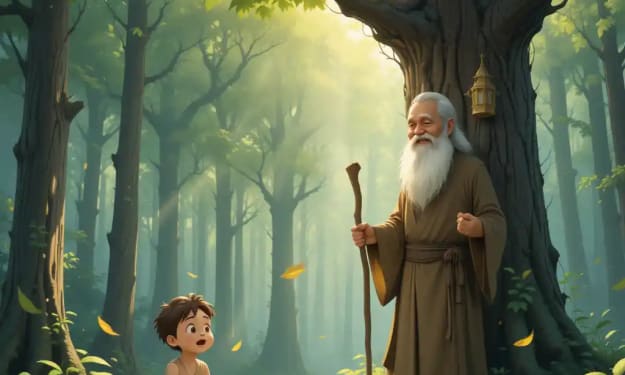
A young boy, burdened by life’s hardships, escapes into a forest seeking solace. There, he encounters a mysterious old man whose simple words unlock a powerful truth, giving the boy courage to embrace life anew. --- 🌲 Story. Ahmed lived in a quiet, dusty village that seemed untouched by time. The mud houses clustered together under the wide blue sky, and narrow lanes wove through fields of golden wheat. From the outside, it looked peaceful. But inside Ahmed’s heart, there was a storm. Every day felt like an uphill battle. His family struggled to make ends meet; their small harvest barely fed them. The burden of seeing his parents silently suffer, the whispered worries of debts, and the coldness of relatives who only visited when convenient — all of it weighed heavily on him. Ahmed was only seventeen, yet life’s heaviness pressed down on his shoulders like he was much older. Each morning he woke up hoping something would change, but every day looked the same. Nights were even worse. He lay awake staring at the cracked ceiling, haunted by thoughts of what future could possibly await him. One afternoon, after another argument at home over money, something inside him snapped. Without thinking, he left the house, his feet carrying him away from the village. He walked down the dusty path, past grazing goats and curious children, until he reached the edge of a thick forest that bordered his village. Many villagers rarely ventured deep into these woods, whispering tales of spirits and strange happenings. But Ahmed felt no fear — only an aching need to escape. As he stepped into the shade of towering trees, a cool breeze embraced him. The sunlight filtered through the canopy, creating shifting patterns on the forest floor. The air was filled with the scent of damp earth and leaves. Birds chirped from hidden branches, and somewhere a stream murmured softly. For the first time in months, Ahmed felt his heartbeat slow, as if the forest itself was whispering calm into his soul. He wandered aimlessly, letting the path disappear behind him. Eventually he came upon a massive old tree, its roots like giant arms wrapping around stones and soil. Exhausted, he sank to the ground, rested his back against the bark, and closed his eyes. There, surrounded by rustling leaves, he let his tears flow. He cried for his parents, for his lost childhood dreams, for the crushing weight of life that seemed too unfair for someone his age. Minutes passed. Or perhaps hours — time felt different here. Suddenly, Ahmed felt a subtle shift, as though someone was nearby. Startled, he wiped his eyes and looked up. Standing a few feet away was an old man with a long white beard, his back slightly bent, leaning on a sturdy wooden staff. His eyes, however, were bright and sharp, glinting with something between mischief and deep wisdom. He wore simple robes tied with a rope at the waist, and his feet were bare on the mossy ground. The old man smiled, a warm, knowing smile that made Ahmed’s guard drop immediately. “Why, my boy?” he asked in a gentle voice that seemed to echo softly through the clearing. “Why do you sit here looking so sad?” Ahmed hesitated. He was not used to sharing his heart. But there was something about this old man, something kind and timeless, that made honesty spill forth. In broken words, Ahmed told him everything — the poverty, the helplessness, the way each day felt darker than the last. He spoke of his fears that his life would never be anything more than silent suffering. The old man listened patiently, nodding slowly, never interrupting. When Ahmed finally fell silent, ashamed of having spoken so much, the old man rested his hand on Ahmed’s shoulder. His touch was light yet reassuring. “My son,” he began, his voice deep yet tender, “every single day in this forest, hundreds of leaves fall. The ground becomes covered in what once was green and full of life. And yet, do you see these trees? They do not die. They stand tall and strong, waiting for spring. Soon, new buds will appear, new leaves will unfurl, and once again the forest will dance in green.” Ahmed blinked, trying to take it in. The old man continued, “Just like these trees, you too must endure. Life will strip you bare sometimes. It will let parts of you fall away, and it will feel like loss. But inside, your roots are growing deeper, your trunk stronger. You must trust that new seasons will come, that fresh chances will grow. From today, see each dawn as a new beginning. Let yesterday’s sorrows fall away like dead leaves.” For a moment, Ahmed felt a warmth spread through his chest, like sunlight breaking through thick clouds. It was such a simple truth, yet so powerful. Tears sprang to his eyes again, but this time they weren’t from despair. They were from relief — from finally seeing a different way to look at his burdens. When Ahmed looked up again to thank the old man, he was gone. Startled, he stood and spun around. There was no sign of him. No footprints, no rustling through the undergrowth. It was as if the old man had melted back into the forest. Ahmed let out a shaky laugh. Maybe it was a forest spirit, or maybe his tired mind had conjured up the old man. Either way, the message was real. His heart felt astonishingly light. With a deep breath, he began walking back toward his village. The path no longer seemed as lonely, and even the burdens he carried felt somehow easier. As he emerged from the trees and saw his village’s small houses glowing under the setting sun, he smiled. Life might still be hard. There would still be days of struggle. But like the tree waiting for spring, Ahmed now carried hope — and that made all the difference.
By Aman Ullahabout a year ago in Fiction
Silent Island — Prisoner of Truth
The year is 1954. A violent storm brews over the Atlantic as U.S. Marshal Edward “Teddy” Daniels and his new partner Chuck Aule arrive at a remote island. Their destination? Ashecliffe Hospital, an ominous facility housing the criminally insane.
By Ameer Gullabout a year ago in Fiction
The Day Time Froze Only for Me
I woke up to the sound of silence. Not the usual sleepy silence that wraps a room before sunrise—but an unnatural stillness that felt like the air itself had forgotten how to move. I blinked into the morning light leaking through my window, rubbed the sleep from my eyes, and waited for the sound of my mom’s footsteps in the hallway or the clinking of breakfast plates.
By MIne Story Nestabout a year ago in Fiction
The Town That Skipped a Tuesday
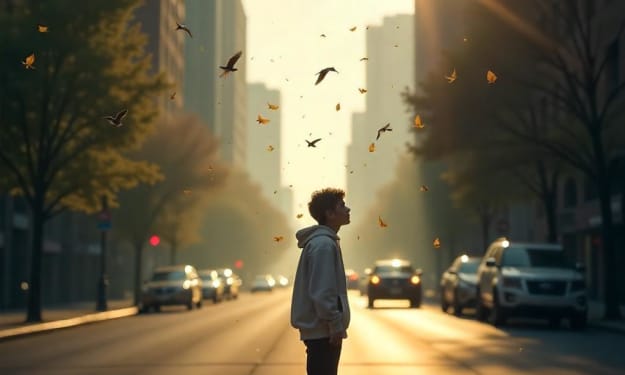
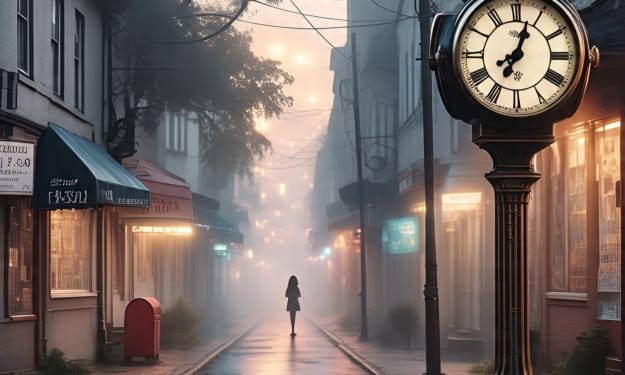
The first sign that something was wrong came from the bakery. Mrs. Harrow always opened her shop on Tuesdays at precisely 6:45 a.m. She was the kind of woman who measured time with the same reverence others reserved for religion. But on this particular morning, the display case still held Monday’s stale pastries, and the bell above the door remained silent. She sat behind the counter, frowning at the clock like it had betrayed her. “It’s Wednesday,” she muttered when I walked in. “But I never baked for Tuesday.” The word hit me oddly. Tuesday. It didn’t sound right. I tried to remember what I’d done the day before—but my mind stumbled like a skipped track. I remembered Monday: homework, a burnt grilled cheese, texting my friend Avery. Then… nothing. “Are you okay, Mrs. Harrow?” She looked at me, eyes unfocused. “Did yesterday happen?” --- I stepped out into Main Street and scanned the town. The florist had Wednesday’s bouquet special on the signboard. The newspaper boy was delivering Wednesday’s paper. The school marquee displayed Upcoming Assembly: Thursday. Everything in Willow Creek moved as if the day in between had dissolved into vapor. At school, no one seemed bothered. “Did you feel like we skipped Tuesday?” I asked Avery as we walked to class. She furrowed her brow. “Tuesday? You mean... yesterday?” “Yeah. I mean, I don’t remember it.” She shrugged. “I guess it just felt... fast?” That’s when I noticed something strange. Avery always wore a silver pendant her mom gave her. It was missing. “You’re not wearing your necklace.” She blinked, confused. “What necklace?” The same necklace she talked about every time we walked past the jewelry shop. The one she swore protected her from bad dreams. “I don’t own a necklace,” she insisted, then turned away before I could press further. --- At home, things only grew more surreal. My phone showed a call history gap between Monday 10:14 p.m. and Wednesday 7:09 a.m. No alarms, no social media updates, no battery drain. Like the phone had hibernated for 24 hours. I asked my dad if anything happened yesterday. “You mean today?” he said, distractedly flipping through the newspaper. “It’s Wednesday.” I gave up and climbed to the attic, where my grandmother’s old journals were still boxed up. She was obsessed with "thin places"—moments in time where reality split, like fabric pulled too tight. One of her entries read: “Time isn’t always linear. Sometimes it jumps, skips, or doubles back. People forget because memory bends around the missing.” Chills climbed my spine. --- That night, I dreamt of Avery standing in the fog. She wore the silver pendant and whispered, “Don’t forget me again.” When I woke up, my heart raced. I checked my phone, and the contact labeled “Avery” was gone. Our texts. Our photos. All vanished. At school, her desk was empty. No one remembered her name. Not even the teacher. I tried to protest, pulling up group photos on my cloud backup. But she wasn’t in any of them now. In a class picture from last week, her outline had been replaced with a potted plant. --- I ran to the library. The town records. Old yearbooks. Emails. Nothing. It was like she’d been deleted. All except the pendant. It sat in my locker—cold, real, and heavy. I didn’t remember placing it there. But when I closed my hand around it, a sharp static rushed through me. Images. A voice. Laughter. Her laughter. Avery was real. Tuesday was real. And now both were gone. --- I returned to the attic and opened more of Grandma’s journals. One entry had been circled: “If a day disappears, something is always lost with it. A person. A moment. A choice. Time is a greedy thing—it does not return what it steals.” That night, I stood on Main Street with the pendant in my hand. I shouted into the wind, begging the universe to rewind, to bring her back, to give me back the day it took. But time didn’t answer. Only the leaves rustled, and the world kept turning. --- Now, I wear her pendant every day. Not because I think it’ll bring her back. But because I’m terrified it’s the only proof she ever existed. And if another Tuesday disappears, I’ll be ready to remember what the world wants to forget.
By Jane Smith about a year ago in Fiction
The Silence That Taught Me Everything
The Silence That Taught Me Everything — A Journey Through Pain, Reflection, and Unexpected Wisdom I never used to fear silence. I simply never noticed it. My days were full—conversations, background noise, the hum of city life. But that was before everything fell apart. Before I realized that silence isn’t just the absence of sound. Sometimes, it’s the presence of something deeper. Something that demands to be heard.
By Kamran khanabout a year ago in Fiction
We Were Just Having Breakfast-Then the Water Took Us
By Zahir Ahmad Morning came gently to the Swat Valley, with golden light spilling over the hills and dancing across the rippling waters of the Snha River. The sound of birds calling through the crisp mountain air blended with the faint gurgle of the river as it wound its way around smooth stones and under swaying willows.
By Zahir Ahmadabout a year ago in Fiction
Digimon-Resurgence
In a quiet cul-de-sac three miles north of Fountain, Colorado, Chris Mercer lived a life balanced between code and custody agreements. A 35-year-old I.T. professional, Chris worked remotely for a cybersecurity firm, surrounded by blinking monitors and air-cooled towers in his basement office—his sanctuary when his kids weren’t around.
By Chris Fortnerabout a year ago in Fiction