Fan Fiction
Waking Dogs Part 4: The Butcher's Bill
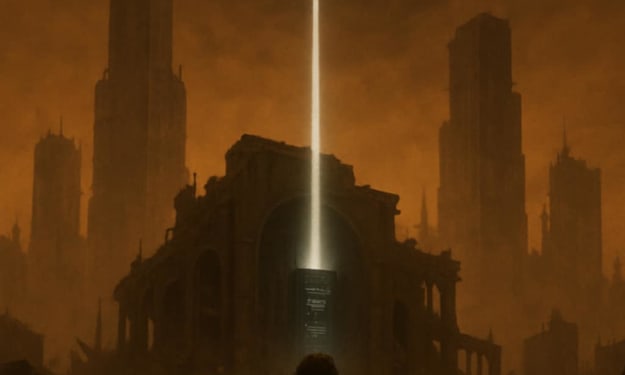
(Previous installations of this story can be found at the following links: Part One, Part Two, Part Three.) Explosions rocked the cratered boulevard, plumes of fire blooming in the dying light of the setting sun. Weapons discharge lit the night, the red beams of hot-shot las rifles punctuated by the searing light of plasma blasts. Grenades arced gracefully through the air, their blasts sending stone shrapnel and broken masonry flying in all direction. Through the smoke and ash came towering figures, their limbs pumping as they charged, roaring and laughing as they sought slaughter. They had the forms of men, but twisted, grown huge, and clad in blocky, bulky armor that was bare of any sigils or heraldry. Their weapons barked, returning fire as mass-reactive rounds stitched explosions across the buildings to either side of the main thoroughfare, and reduced many of those who thought themselves safely behind cover to little more than splatters of gore.
By Neal Litherland5 months ago in Fiction
Mind’s Open Doors
Anything but a knock on the door. Hena was at the brink of life and death. Any moment she was ready to leave the earthly existence. For months she had lived with pain. War had stripped away everything familiar, and illness had taken over. Yet now, as her consciousness drifted through a strange and silent darkness, the pain seemed to be drifting away. That was miracle unfolding out of nowhere. Somewhere deep inside, the frightened child had awoken and realized that everything what it actually seemed. There were dark forces at work. She struggled to remember how she had arrived there.Many fragments of memories returned to her mind, of and on. Sirens.Dust.Screams.A hospital trembling beneath enemy fire.An Iranian barrage of ballistic missiles had struck Israel. One of the missiles had torn through the hospital where Hena lay recovering from injuries sustained earlier in the war. The explosion had shattered walls and windows, filling the corridors with smoke and debris.People rushed toward bomb shelters.Doctors shouted over the alarms.Stretchers rolled through smoke-filled hallways.But Hena could not move.Her fractured arms and legs were secured in casts. Helplessly, she watched nurses drag patients toward exits while others disappeared beneath clouds of dust.“Please,” she whispered to a man standing nearby.The man looked at her and raised his hands in despair.There was nothing he could do.Then another explosion shook the building.The ceiling crumbled.The floor collapsed beneath her and Hena began to slip away into nothingness. The screams grew distant.The rubble faded.The pain dissolved.Everything melted into a twilight where nothing felt entirely real.Perhaps she was dying.Perhaps she already had!Months of sickness and suffering had transformed her body. Now she felt herself drifting beyond names and memories, beyond fear and grief.Then she heard a knock out of nowhere. A knock?! Again , she heard a sharp knock upon a door.“It isn’t my door.” she thought to herself. It’s a different door.But the sound echoed through the darkness.The door opened slightly.And everything vanished.When awareness returned, Hena remembered only bits of incident.Flashes of memories appeared as follows: An ambulance emerging through smoke.A man in white holding a syringe.Someone shouting, “Move! Move!”The taste of dust in her mouth.Then there was blankness.Endless blankness! When she finally awoke, she found herself somewhere else.A long corridor stretched before her. Paint peeled from the walls in faded strips. Fluorescent lights buzzed overhead. The building smelled of bleach, damp concrete, and stale air.At the far end of the hallway hung a sign:Northern District Psychiatric Annex.Confused, Hena followed two attendants through a series of locked doors.“This isn’t my place,” she said.Neither attendant replied.A man behind a desk glanced briefly at her file.He said: “Bed 14.” That was all. No questions. No explanation. No concern. The heavy door locked behind them.
By Madhu Goteti 5 months ago in Fiction
Pink Buds. Top Story - June 2026. Content Warning.
Running through the weed patch, laughing, I listened for the others as they ran all around me. Who knew there was such a gold mine, or rather, field, right here outside the city limits? Jay Jay had stopped somewhere up ahead, and I could hear him with his “Blessed Mother Mary’s.” While Will and Trina were giggling together somewhere behind me, Suzie was just ahead of me, just as giddy as I was, looking over her shoulder like she wanted to ask me a question.
By Mother Combs5 months ago in Fiction
Families Who Rule the World II. Content Warning.
Families Who Rule the World History remembers kings, presidents, generals, inventors, and billionaires. But behind many powerful names sits something older, quieter, and harder to see— families. Not always royal families. Not always political families. Not always famous. Some rise through money. Some through influence. Some through ideas. Some through generations of connection, ambition, and inherited opportunity. The world often looks like it is shaped by individuals. But beneath the surface, families leave fingerprints across decades. This is not a story of one family. It is a story of a hidden question: What if power was less about one person becoming great— and more about people building greatness together across generations? Long ago, in a city nobody agreed how to pronounce, there lived a merchant family called the Varels. They owned no army. No throne. No kingdom. They sold fabrics. Simple business. Nothing impressive. Yet every generation of Varels asked the same question: “What do people need before they realize they need it?” One generation built trade routes. Another learned politics. Another invested in schools. Another entered finance. Nobody became famous overnight. But over time— doors opened. Relationships formed. Trust accumulated. Resources multiplied. Eventually, people noticed something strange. Whenever important decisions happened— someone connected to the Varels seemed nearby. Not because they controlled everything. But because they had spent generations learning how systems worked. People called it luck. The family called it preparation. Then there were families that ruled differently. The Alvins ruled through stories. Every child grew up hearing tales of sacrifice, discipline, and courage. They produced teachers. Writers. Leaders. Artists. They rarely held formal power. Yet generations later— people still repeated their ideas. A family does not always rule through laws. Sometimes it rules through values. Through the things it teaches at dinner tables. Through habits. Through what it celebrates. Through what it refuses to tolerate. Then came the families of invention. No inheritance of gold. Only notebooks. Curiosity. Argument. Questioning. One generation asked: “What if?” Another asked: “Why not?” Their descendants changed industries. Not because intelligence appeared suddenly— but because curiosity became normal. The world sees a breakthrough. Families see years nobody noticed. Late nights. Failures. Encouragement. Lessons passed quietly. But there is another side. Not every powerful family stays powerful. Some become trapped protecting old status. Some confuse authority with wisdom. Some forget that influence without service eventually collapses. Power can become fragile. Legacy can become a cage. A family that once shaped nations can disappear in one generation if values vanish. Meanwhile— someone with no advantage begins building something new. A new idea. A new habit. A new relationship. A new future. History keeps reminding people of this: No throne stays forever. No dynasty is eternal. But families who adapt— families who build— families who invest in people— often outlast monuments. And perhaps that is the secret. The world is not only ruled by those with the loudest names. Sometimes it is shaped by ordinary people who quietly teach discipline. Who help one another. Who sacrifice today so tomorrow has more options. Who build not for attention— but because someone must begin. Every powerful family once started as someone making one decision. One trade. One lesson. One conversation. One generation deciding: “We want better.” And somewhere right now— in an apartment, a village, a crowded city, or a quiet home— another family is beginning. Not with wealth. Not with fame. But with intention. And one day people may look back and wonder: How did they become so influential? The answer may be simpler than they think. They started long before anyone noticed.
By Samson E. Gifted5 months ago in Fiction