Fan Fiction
The Man on the Platform
The clock in the station had stopped ticking two years ago, but the man never seemed to notice. Or maybe he did, but pretended not to care. Every morning, without fail, he arrived at Platform 3 with a worn brown suitcase and a folded newspaper tucked under his arm. His coat, always buttoned to the top regardless of the season, gave him an air of purposeful waiting—like a soldier on standby for an unnamed war.
By Karl Jacksonabout a year ago in Fiction
The Girl at Platform Nine
The Girl at Platform Nine Written by Javeed 🚉 Prologue: A Glimpse in the Fog Platform Nine at the old city station was quieter than usual. The mist curled through the iron beams and drifted low around the benches, wrapping everything in a sleepy gray veil. Most people passed by without noticing the girl sitting alone at the far end. But I did.
By Moonlit Lettersabout a year ago in Fiction
"He Bought a $70 Couch—Then Found $300,000 Hidden Inside"
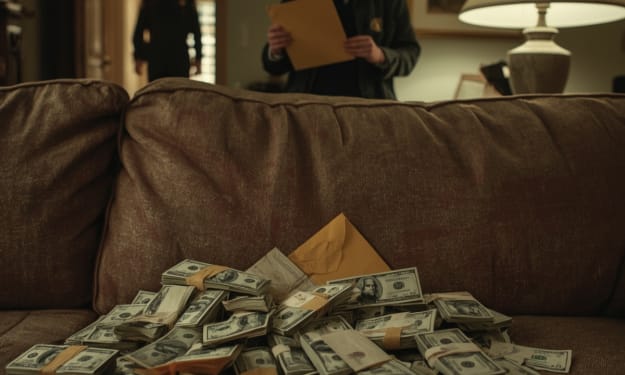
When 28-year old Max Fletcher walked into a dusty secondhand furniture store in northern Michigan, he was just looking for something cheap and decent enough to replace the battered futon in his studio apartment. What he walked out with—well, he had no idea his $70 purchase would become the most bizarre and life-altering decision of his life. “I just thought, hey, this old couch is ugly, but it's sturdy,” Max says. “The springs were still good, and I could throw a blanket over it. I was broke and needed something fast.” He tossed it into the back of his pickup, hauled it up three flights of stairs, and collapsed onto it that same night with a pizza and a documentary. Everything seemed perfectly normal—until four days later, when he dropped his TV remote behind one of the cushions and went fishing for it. What he pulled out wasn’t the remote. It was a thick yellow envelope. “I thought it was junk mail or old receipts,” Max recalls. “But when I opened it, it was full of cash. Like… a lot of cash. Neatly bundled in $100 bills.” Max quickly found more envelopes stuffed deep within the couch's lining and beneath the cushions. His heart racing, he pulled out envelope after envelope. By the end of the night, he was sitting on a living room floor surrounded by $300,000 in cash. The First Question: Is This Even Real? Max did what most people would—he panicked. “I thought it had to be drug money or something illegal,” he says. “I didn’t even sleep that night. I kept checking my window expecting someone to show up and knock on the door.” The next morning, Max called a lawyer and then the local police. Within hours, officers were at his door, carefully counting and documenting the cash. At first, the situation looked like it might be the start of a criminal investigation. But things took a dramatic turn when the thrift store traced the couch’s origin: an estate sale from a woman who had recently passed away at age 91. A Hidden Fortune, Forgotten by Time According to her family, the woman—Mildred Harrison—was known for being intensely private, almost to the point of paranoia. She didn’t trust banks, and after her husband died in the 1980s, she began hoarding cash in unusual places. Her family had no idea. “We cleaned the house thoroughly,” said her granddaughter, Susan Harrison. “But we never thought to rip apart the furniture.” When contacted by authorities, Susan and the rest of the family were stunned—but also gracious. After confirming the money had belonged to her grandmother, the Harrisons declined to take it all back. The Unexpected Twist: A Generous Offer Instead of demanding every dollar, the family asked that Max be allowed to keep a portion of the money as a “thank-you” for doing the right thing. “We were grateful he came forward. A lot of people wouldn’t have,” said Susan. “He could’ve kept it, and no one would’ve ever known.” In the end, Max was allowed to keep $45,000—a life-changing amount for someone who’d been living paycheck to paycheck. “I almost cried,” Max says. “That money paid off my student loans, fixed my truck, and gave me a cushion I’ve never had before.” What would you Do? The story quickly went viral after a local news segment aired. Online commenters were divided—many praised Max for his honesty, while others admitted they would’ve kept quiet. Max doesn’t regret his decision. “Yeah, I could’ve kept it,” he says. “But if it was my grandma’s money, I’d want someone to do the same. Karma’s real. Besides, I still got a free couch… and 45 grand.” Moral of the Story? Always Check the Couch. Whether it’s luck, fate, or just a wild coincidence, Max Fletcher’s story is a reminder that life-changing moments can hide in the most ordinary places. So next time you’re digging between the cushions for spare change—who knows? You might just find a fortune.
By Shoaib Afridiabout a year ago in Fiction
He Died 8 Years Ago. Then He Left a Voicemail
He Died 8 Years Ago. Then He Left a Voicemail Written by Iqbal Raza It started with a notification. Lena was in the middle of folding laundry when her phone buzzed. A voicemail. That wasn’t unusual — except this one was from a number she hadn’t seen in years. A number she had deleted, blocked, and buried with the man who once owned it. Her hands froze mid-fold as the screen displayed the words: "1 New Voicemail — From: Dad." Lena felt the air shift. She stared at the screen as if it might disappear. Her father, Marcus Evans, had died eight years ago. A heart attack in the middle of the night. He was found on the floor of his workshop the next morning, radio still humming jazz softly in the background. So how was he leaving voicemails now? She tapped play. There was static, then a familiar voice—cracked, weary, but unmistakably his. > “Lena... if you’re hearing this, I’m gone. Not just from your phone, but from this world. I don’t know when you’ll get this. Maybe a year, maybe ten. But you need to know something... I never stopped trying to fix things between us.” Her heart stopped. Then beat again, hard. The Past She’d Tried to Forget Marcus wasn’t a bad father, not in the usual way. He didn’t hit, didn’t drink, didn’t leave. But he withheld. His love was mechanical—practical, predictable, cold. He built furniture better than he built relationships. When her mother died, Lena was 13. That’s when the silence between them grew into a canyon. She left home at 18 and never went back. They spoke rarely. Holidays were exchanged like formalities. Their last phone call, two weeks before his death, had ended in an argument about nothing — and everything. “You always act like I was never there for you,” he had said. “And you were never really there,” she had replied. Neither said goodbye. Ghosts in the Machine Lena played the voicemail again. The static seemed longer this time, like something was shifting. Could voicemails be corrupted over time? Could a phone company hold onto a message for years? She couldn’t stop thinking about it. She searched through old backups, even reactivated her cloud voicemail. Nothing. This was the only message. Then it happened again. Three days later. A second message. > “I’m in the shed. You remember the old one, right? Behind the big oak tree. There’s something I left there for you. Maybe it’ll explain everything.” She hadn’t been to her childhood home in nearly a decade. After Marcus passed, the property was sold off to a developer. She had no legal right to be there. But the next morning, Lena found herself driving down the highway toward her old town, toward the house she swore never to see again. Return to the Shed It was still there — the oak tree, the shed, though the house behind it had been remodeled beyond recognition. The shed, however, remained untouched, weathered by time and neglect. A relic that no one cared to demolish. Lena waited until dusk before slipping into the backyard. Her heart raced with every step. Inside the shed, the smell of oil and sawdust hit her like a memory. Tools still hung on rusting hooks. In the far corner, beneath a sheet, she found it. An old wooden box. Her name carved into the lid. Inside: letters. Dozens of them. Letters Never Sent Each envelope was dated — birthdays, holidays, graduation, even her wedding day. Letters he never mailed. Words he never said. Apologies, memories, regrets. Each one written in his blocky handwriting. > “I saw the way you looked at me at your graduation. Like I didn’t belong. But I wanted to say something. I just didn’t know how. So I wrote this instead.” > “You were right. I didn’t know how to grieve your mother, so I pretended I didn’t have to. That was wrong.” > “I was proud of you every single day. I just... didn’t say it enough.” Lena cried until her body ached. The Final Message Back home, she received one final voicemail. This one was different. > “I hope you found it, Lena. If you’re listening, it means you cared enough to go back. Thank you. I didn’t deserve your forgiveness, but I wanted you to have mine. We both held onto our anger too long. But love doesn’t vanish. It just waits... sometimes in a shed behind an old oak tree.” Then a pause. Then silence. And for the first time in years, Lena smiled. Afterward Lena took the letters and had them bound into a small book. She called it "Words Never Spoken." At her book launch six months later, she told a small audience, “This isn’t just my story. It’s a story for anyone who didn’t get to say goodbye. For anyone who needed a voicemail from the past to make peace with the future.” People lined up afterward to hug her, to share their own versions of the story. Because we all have ghosts. And sometimes, they just want to be heard.
By Moonlit Lettersabout a year ago in Fiction
Chapter 11: Recognizing Siblings, Imperial Box
Dongmei glared at Ye Chu and quickly undressed for Huangfu Shiyue. After tidying herself up briefly, Huangfu Shiyue looked at Ye Chu again. "Mr. Ye, thanks to your help this time. Let me take care of things here first, and then I'll host a banquet to thank you."
By HuaxunTechnologyabout a year ago in Fiction
The Day My Shadow Spoke Back
The Day My Shadow Spoke Back It began on a Tuesday, the kind of day that slips between calendar pages unnoticed, with overcast skies and coffee that tastes vaguely like memory. I had just finished rearranging my bookshelf — again — when I noticed something strange
By waseem khanabout a year ago in Fiction
The Last Lightkeeper
The lighthouse on Blackstone Cliff hadn’t been manned for decades. Automation took over, and the stories of lightkeepers faded into memory like sea mist at sunrise. But Eliah Marren, a retired mariner with a face weathered by time and tides, volunteered to tend it again—not because the light needed him, but because he needed the light. After the death of his wife, Eliah had retreated from the world. The empty rooms of his coastal cottage echoed with silence too loud to bear. So when the local council offered him the chance to live in the old Blackstone Lighthouse as a “historical caretaker,” he said yes. It was supposed to be ceremonial—keep the place clean, give the occasional tour. But Eliah took it seriously. Every night, he checked the lens, polished the brass, and logged the beacon’s performance as if ships still depended on him. The lighthouse stood like a sentinel above crashing waves, its spiral stairs groaning under Eliah’s weight each evening. He came to love the rhythm of the sea, the creak of timbers, the cry of gulls overhead. But on the 37th night, something changed. At exactly 2:17 a.m., the light blinked. Eliah noticed it in the logbook the next morning. The rotation cycle was off by a fraction—enough to catch the attention of someone who watched closely. He dismissed it as mechanical variance and tightened the gears. But the next night, it happened again. A pause. A flutter. A blink. By the fourth night, Eliah sat in the lantern room with a thermos of coffee and a pair of binoculars. The sea below boiled in moonlight. He waited. At 2:17 a.m., the light blinked twice. Two quick flashes. Not a malfunction—an intentional signal. Eliah's heart pounded. Morse code. He scrambled for his old naval logbook and began decoding. The pattern came again, clearer now: H-E-L-P Eliah didn’t sleep. The next day, he radioed the coastguard. They laughed gently. “Probably a reflection. Or your equipment's just glitching, old man.” But Eliah knew signal code. And he knew when someone was crying out. That night, the message changed. B-E-L-O-W Eliah peered down the jagged cliffs. No boats. No figures. Just water and stone. But then came another flash: N-O-T-A-L-O-N-E He descended the cliff steps with a flashlight, heart hammering like storm drums. The rocks were slick, but he moved like a younger man, driven by something older than fear. At the cliff’s base was an outcrop barely visible at high tide. A rusted hatch lay there, half-buried under moss and time. Eliah pried it open. A tunnel yawned below, reeking of salt and rust. He stepped inside. The air grew colder. The walls whispered with wind and waves, but something else—breathing? Footsteps? Then a voice: faint, female, trembling. “Hello?” Eliah froze. “Who’s there?” A figure emerged from the shadows. Young, gaunt, and wrapped in a coat far too big for her. “I’m Anna,” she said. “They locked me in here.” Eliah’s mouth went dry. “Who?” She glanced behind her. “The ones who come at night. From the sea. I signaled the light.” She held up a cracked mirror. "It was all I had." Eliah led her out, step by shaking step, until they burst into moonlight. Anna collapsed into the grass, breathing the free air like it was her first breath. In the weeks that followed, the authorities discovered a hidden network of sea caves—used by smugglers during the war, forgotten by time, but not by the few who still carried its secrets. Anna had escaped a group that never expected to be found. Eliah became a local legend. But he never claimed heroism. He just went back to the light. Every night, it spun faithfully, casting its glow into the dark. Eliah never saw another strange blink again. But he always watched. And somewhere deep inside, he hoped—if ever someone needed help again—they would know where to look. Toward the light.
By Muhammad Bilalabout a year ago in Fiction
Whispers of the Banyan Tree
In the quiet village of Kiranpur, where the wind always smelled of mango blossoms and the evening sky burned like fire, lived a boy named Arjun. He was twelve years old, with curious eyes and a slingshot forever tucked in the waistband of his shorts. Life in Kiranpur was simple. The cows wandered lazily through narrow dirt paths, the elders played cards under the neem trees, and the days stretched long and peaceful, like the river that curled protectively around the village. But at the edge of Kiranpur, where the land dipped slightly and shadows always seemed to linger, stood an ancient banyan tree. Its trunk was wider than a bullock cart, its roots curled and twisted into the earth like coiled serpents, and its branches spread like arms trying to embrace the sky. No one dared go near it after sunset. The village elders warned the children, “That tree is cursed. It’s older than all of us. Voices rise from it at night. Some say people who go near it disappear.” Arjun, however, wasn’t afraid. He didn’t believe in ghost stories. He believed in answers. One monsoon evening, when the clouds hung low and thunder rolled lazily in the distance, Arjun slipped away from his home with nothing but a lantern, a blanket, and his notebook. He had decided to spend the night beneath the old banyan tree. Not to prove anyone wrong—but because something in his heart pulled him toward it. It felt like the tree was waiting for him. The banyan loomed in the moonlight, mysterious and majestic. The air near it was strangely still, as if time had paused in its presence. Arjun sat at its base, resting his back against the rough bark, the scent of damp earth filling his lungs. The wind whispered through the branches above. At midnight, the air shifted. He felt it before he heard it—a gentle hum, like the wind speaking in a forgotten tongue. Then came the voice. “Arjun…” He jolted upright. His lantern flickered. “Who… who’s there?” The bark shimmered. From within the tree, a soft silver light emerged, and out of it stepped a figure—tall, graceful, and glowing like moonlight. She had hair like hanging vines, eyes like mossy rivers, and her voice was calm like distant rain. “I am Vanya,” she said. “Guardian of the memory of this land.” Arjun stared, too stunned to speak. “This tree,” she continued, “holds the stories of a forgotten world. Centuries ago, this village was part of a vast forest. Your ancestors lived with nature—not against it. They spoke to trees, danced with rivers, and honored the soil. But time passed. Greed grew. Forests fell. The connection was broken.” “But why me?” Arjun asked, finally finding his voice. “Because you listened,” Vanya said, smiling. “Because you believed—not in fear, but in wonder.” She reached out and touched his forehead with a glowing hand. In an instant, Arjun saw visions—not dreams, but memories: golden forests teeming with birds and animals, rivers that shimmered with light, humans and nature living in harmony, and the day it all began to fade. When he woke up, the sun was rising. Dew sparkled on the grass. The banyan tree stood quiet and still, like it had always been. But something inside Arjun had changed. Back in the village, he tried to tell everyone. The elders laughed, his friends teased him, and his parents shook their heads. “Too many stories,” they said. But Arjun didn’t stop. He began planting trees—one every week. He gathered the village children and told them tales of Vanya and the forest that once was. At first, they giggled. Then they listened. Then they helped. As the years passed, green returned to Kiranpur. Birds began nesting again. The river sang louder. Even the elders started visiting the banyan tree—not with fear, but with quiet respect. Arjun grew older, but he never left the village. He became its storyteller, its gardener, its quiet guardian of forgotten truths. And every evening, under the same banyan tree, he sat with the children, sharing stories passed down not through books—but through roots, wind, and whispers. And sometimes, just sometimes, when the dusk painted the sky in shades of gold, and the leaves rustled like laughter, a silver shimmer danced across the trunk of the tree—just enough to remind those who believed that the forest remembers. Start writing...
By Muhammad Bilalabout a year ago in Fiction
The Letter That Waited 20 Years
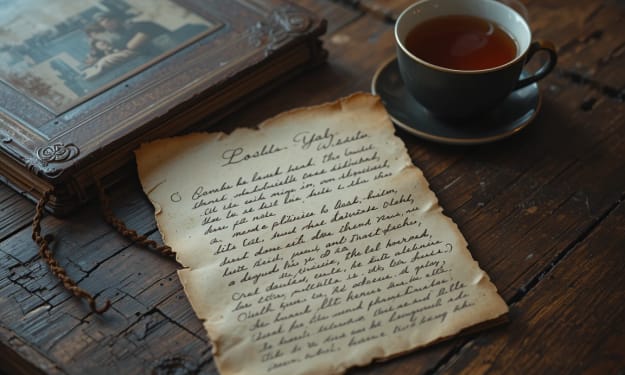
The Letter That Waited 20 Years Written by Raza Iqbal It was a rainy Thursday when Emily stumbled upon the letter. The old family house in Yorkshire had always been full of secrets—dust-covered trunks in the attic, forgotten bookshelves, and drawers that stuck shut from decades of humidity. But this letter wasn’t hidden away. It was tucked carefully between two pages of a photo album, pressed like a fragile flower between fading memories. She had come home for one reason only—to sell the house. Her father had passed away six months ago, and there was no one left to keep the memories warm. Her mother had died when Emily was ten. Her father never spoke much of her afterward. As an adult, Emily stopped asking. Grief made people quiet, she told herself. It made them build walls. But the letter spoke louder than her father ever had. "For Emily. If you're reading this, then the time has come." The handwriting was familiar. Delicate, but certain. Her mother’s. Her heart skipped. With shaking fingers, she unfolded the aged paper, already yellowed and soft at the creases. May 19, 2005 My sweet Emily, You’re only ten today, and maybe you won’t find this letter for many years—perhaps not until you’re grown and the truth finally matters more than the silence. I didn’t want to leave you. Not ever. I want you to know that. The doctors didn’t believe I’d last as long as I did. But your smile made my heart fight for every single day. Still, there were things I never got to tell you. Things I thought your father would explain when you were older. I don’t know if he will. I hope he does. But in case he doesn’t, I’m writing them now. First: You were born out of love. So much love. Your father and I—despite everything—loved each other deeply once. That part is real. But people change. Grief, fear, mistakes... they chip away at love until it’s barely standing. And here is the truth you need to know: I had another child before you. A boy. His name was Jacob. Emily paused. Jacob? She blinked, reread the line, and leaned back into the couch, the letter trembling in her lap. Her mother had never mentioned another child. Neither had her father. I was very young. It was before I met your father. I was seventeen, scared, and alone. My parents sent me away to a home for unwed mothers in the countryside. I was told never to speak of him again. I held him for exactly three minutes before they took him away. He was perfect. Tiny fingers, a soft cry. He had my eyes. I named him Jacob even though no one asked me to. They didn’t care. He was gone before the morning sun touched my window. I spent years searching. But the adoption records were sealed. I never found him. And when I met your father, he asked me to forget. Not because he was cruel—but because he thought the pain would destroy me. He didn’t understand that forgetting hurt more. Tears streamed silently down Emily’s face. She couldn’t picture her mother at seventeen, scared and discarded like a secret. And she couldn’t believe her father had asked her to bury such a thing. Emily, I tell you this not to burden you, but to free you. Families are messy, and love is never simple. But secrets—they are the heaviest inheritance. If by some miracle, this letter finds you, and you feel the need to search for him, I won’t stop you. I just want you to know you were both loved. Always. Love, Mum. Emily sat for a long time in the quiet house, listening to the soft tap of rain against the window. A letter, two decades old, had just changed everything she thought she knew about her family. Suddenly the empty house felt full of voices—her mother's grief, her father's silence, a brother she had never met. She picked up the phone. "Hello, I'm calling about sealed adoption records from 1985..." Six Months Later The café was quiet. A man in his early 40s sat at the far table, nervously checking his watch. Emily walked in, her heart pounding so loud it echoed in her ears. She had seen his photo online, but nothing prepared her for this—seeing Jacob in person. He had their mother’s eyes. Her nose. A kind smile that made her knees weak. He stood as she approached. “Emily?” he asked. She nodded. “Jacob?” They hugged. Long, awkward, emotional. Strangers stitched together by blood and twenty years of silence. Over coffee, she handed him the letter. He read it twice. “I always wondered,” he said quietly. “I used to dream that someone out there was looking for me.” “She was,” Emily whispered. They sat in silence for a while. Two lives that had run parallel, finally intersecting. Epilogue Emily never sold the house. Instead, she turned it into a place for healing—offering weekend retreats for people searching for family, history, or closure. She kept the letter in a glass frame in her study. Not as a reminder of pain, but of truth. And every year, on May 19th, she and Jacob met at the Yorkshire shore, where their mother once took her as a child, to watch the waves roll in. Some letters arrive late. But sometimes, the heart knows exactly when to open them.
By Moonlit Lettersabout a year ago in Fiction