Fan Fiction
The Birthday Gift She Left for Every Year After Her Death
The Birthday Gift She Left for Every Year After Her Death Written by Mirza Written by Mirza My mother passed away on a cold Tuesday morning in November—two days before my 17th birthday. She was 48. It was breast cancer. She fought like hell. And then one day, the fight was over. Grief didn’t hit me all at once. It came in slow, painful waves. At first, I felt like I was walking through a fog, and then came the crashing silence in the kitchen, the empty seat at the table, the sound of my dad crying behind closed doors. But what I didn’t know was that my mother had left something behind—something that would reach across years of silence and fill my birthdays with a love I thought I’d lost forever. The First Birthday I didn't want a cake. I didn’t want to celebrate. But my father came into my room on my birthday morning holding a small, white envelope. His eyes were red, but he smiled the kind of smile you give when you’re trying not to cry. “This was left for you,” he said, and handed me the envelope. In my mother’s handwriting, it said: "For Maddie. Birthday #17." Inside was a letter. Not a long one, but long enough to shatter the wall I’d built around my heart. It was written months before she died. > "Happy 17th, sweetheart. I wish I could see your face today. I know you're hurting, and I know the world feels unfair right now. But I want you to know that even though I won’t be with you physically, I’m with you in every moment. I’m so proud of you. Go do something kind for yourself today—eat your favorite cake. I love you, forever. —Mom" I sobbed. My dad sat beside me, holding my hand like I was five again. That letter brought her back for a moment, and for the first time since she died, I smiled through my tears. A Tradition Beyond the Grave Every year after that, another letter came. On my 18th birthday: > "Happy 18th, my grown-up girl. You’ll make mistakes. It’s okay. Be gentle with yourself." On my 19th birthday: > "I hope college is treating you well. Or whatever you're doing. I’m proud, no matter what path you choose." On my 21st birthday: > "Don’t drink too much! But have fun. Today is about joy, and you deserve all of it." Each letter came with a small gift: a necklace I’d seen in her drawer when I was younger, a favorite scarf she used to wear, a photo of us at the beach with a note that simply read, “My sunshine.” I later learned she’d spent months writing and packaging these gifts with my aunt. There were 30 letters in total. Thirty years of love, sealed in envelopes and stored in a cedar box in my aunt’s attic, ready to be handed over one by one. The Letter That Changed Everything When I turned 25, life was a mess. I’d just gone through a painful breakup. I’d lost my job. I was living back home with my dad, feeling like a failure. That birthday morning, I didn’t want a letter. I didn’t feel like reading anything from a mother who had never seen me as the adult mess I’d become. But I opened it anyway. > “Maddie, I know this year may be hard. I have no idea what you’ll be facing when you read this. But I want to tell you something I wish someone had told me when I was your age: You are allowed to fall apart. You are allowed to not have it all figured out. The world won’t always be kind, but you must be kind to yourself. That is how you survive the storm. You’re stronger than you think. And if today you don’t believe that—believe in me, believing in you.” I cried so hard, I forgot what I was upset about. She didn’t even know what I was going through, but somehow, she did. It felt like she was still guiding me, still reminding me how to stand when all I wanted to do was fall. A Gift That Keeps Giving On my 30th birthday, I found a second note tucked inside the usual envelope. > “If you’re reading this, and if you’ve found happiness—then this is the year I want you to pay it forward. Give someone else a reason to smile on their birthday. A letter. A hug. A cupcake. Anything. And tell them, it’s from someone who knows birthdays can be hard sometimes.” That year, I baked cupcakes and brought them to a local shelter. I slipped little notes into each one: > “You are loved. You matter. Someone is thinking of you today.” It changed something inside me. Her gift was no longer just for me. It was alive in others, too. The Final Letter (But Not Really) On my 31st birthday, the letter felt heavier. The handwriting looked shakier. > “Maddie, This is the last one I wrote. I don’t know where life has taken you, but I hope it’s beautiful. I hope you’re still laughing at things that don’t matter and crying over things that do. I hope you’ve found love—not just romantic, but the kind you find in friendships and quiet mornings and books you don’t want to end. I hope you’ve become the woman you were always meant to be. And if you ever forget who you are— Just close your eyes. And remember this: You were loved so fiercely, by someone who would have carved thirty more letters if she had the time. Happy Birthday, my heart. I’ll always be with you.” I didn’t feel sadness that day. I felt full. I felt seen. The Legacy Now, I write letters too. To my own daughter. She’s five. She loves coloring and asking big questions about the moon and why cats don’t talk. I don’t know how long I’ll be around. None of us do. But I know one thing for sure— Love doesn’t end with the body. It lingers in ink, in paper, in little acts of kindness passed from one hand to the next. And somewhere, in a quiet cedar box at the back of my closet, there are envelopes. Sealed. Stamped. Waiting.
By Moonlit Lettersabout a year ago in Fiction
Beneath the Still Sky. AI-Generated.
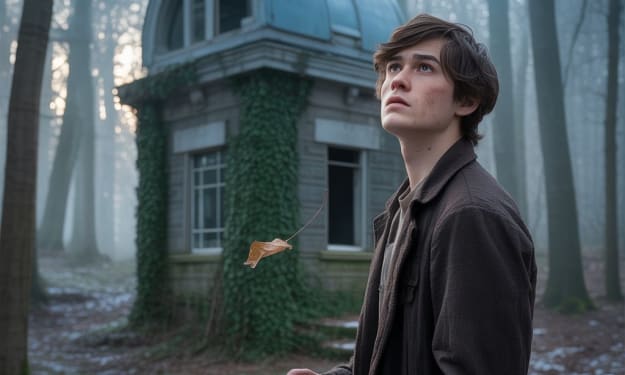
The sky above Elowen was beautiful—perfect, in fact. A sheet of endless blue, motionless for as long as anyone could remember. The villagers called it The Stillness, a gift from the gods, or perhaps the price of peace. But for Aris Vale, it felt like a lie. He stared up at it now, lying on the grass behind the school’s weather-beaten fence, his telescope beside him, untouched. “Still not blinking,” he muttered. “Still not moving. Just... still.”
By Adil Nawazabout a year ago in Fiction
He Carved Her Name Into the Tree Every Year
He Carved Her Name Into the Tree Every Year Written by Mirza Each autumn, when the leaves began toHe Carved Her Name Into the Tree Every fall like fireflakes from the sky, an old man with a slow gait and gentle eyes would walk the narrow path beside Silverlake. He always carried the same worn satchel, a blanket tucked inside, and a rusted pocketknife older than many of the trees lining the path. He walked past the crooked wooden sign reading Lakeview Trail, past the bench where young lovers often sat and whispered dreams, and toward a tall sycamore tree by the water’s edge. Its bark bore many stories — initials, hearts, dates — but his was always the deepest, the most carefully etched. He reached the tree and paused. His hand, trembling from age, brushed across the bark where one name stood out from all the others: “ELENA.” Every year, he came back to this tree. And every year, he carved her name a little deeper. The First Carving It was 1975. He was 19, and she was 17 — a firecracker in a denim skirt with paint on her cheeks and wild dreams in her eyes. They met at a community picnic, and she’d laughed at his serious face as he tried to explain the difference between oaks and sycamores. That same evening, as the sun dipped below the hills, she’d dragged him by the hand to the lake and said: “Let’s carve our names into that tree. That way, even if we forget, it won’t.” He’d hesitated — trees were living things, and cutting into them felt like vandalizing something pure. But she looked at him with those eyes, and he caved. J + E — a simple carving, surrounded by a heart. She smiled and kissed him, her lips tasting like lemonade and certainty. The Middle Years Life, as it does, grew complicated. They got married two years later, moved into a cramped apartment, and eventually found their way into a modest house with peeling paint and a yard full of weeds they never had time to pull. He became a school teacher. She became an artist, though most of her work never left the garage. But they always had Silverlake. Each anniversary, they’d walk the trail, find the tree, and carve the date below their initials. The bark grew thick over the years, but somehow their markings endured. When she had their daughter, Lily, they brought her to the tree and told her, “This is where we started.” The Last Year Together She started forgetting little things — the names of her paints, the route home, even their anniversary. At first, they joked about it. “My brain’s just full of color,” she’d laugh. But then it got worse. Diagnosis: early-onset Alzheimer’s. The years that followed were cruel. Some days she didn’t recognize their daughter. Some days she mistook him for her father. Some days she stood at the sink crying, unsure of why. But one thing remained: the tree. Even when words failed her, she’d look at the carving and whisper, “That’s me.” Their last visit to Silverlake was in the fall of 2010. She clutched his hand tightly and asked, “Will you keep coming here? Even when I’m gone?” He nodded, tears streaming down his cheeks. “Every year. I promise.” She died two months later. The Promise He Kept Since then, he returned every autumn. Alone. He brought a chair now, since standing long became difficult. He’d sit for hours, just staring across the lake, watching the wind stir the water like she used to stir her tea — slowly, with intention. Each year, he’d carve her name again. Not adding anything. Just tracing over the old letters, as if keeping them fresh would somehow keep her memory alive. E-L-E-N-A. Birds nested above. Children played nearby. Young couples passed, not noticing the quiet man who sat with a blade and a heart full of grief. Sometimes, he’d bring their daughter. Sometimes, she brought his grandchildren. They never carved anything. They said the tree belonged to him and her. One Autumn Morning He didn’t come. For the first time in 15 years, the trail remained untouched by his footsteps. The tree stood alone, the bark slowly reclaiming its scars. A week passed. Then two. Locals noticed. Someone left flowers beneath the tree. A note: “We miss you.” Eventually, his daughter returned with her two children. She carried a photo — of her parents sitting beside the sycamore, arms wrapped around each other, the lake behind them glowing like liquid gold. She didn’t cry. She smiled and whispered, “Thank you, Papa. You kept your promise.” That year, she brought a small chisel instead of a knife. And just below the name ELENA, she carved one more word: JAMES. Side by side. Forever. Now the Tree Knows Their Story Years pass. The tree grows. Tourists walk the trail, pointing at the carvings. Some smile. Some wonder. Some take photos. But if you ask the locals, they’ll tell you: “That’s the Love Tree.” “A man came here every year, just for her.” “He never stopped loving her, even after the goodbye.” And if you sit long enough by the lake, on a crisp autumn day, you might just hear the wind whisper her name. Elena. And his. James. Still together. Still growing.
By Moonlit Lettersabout a year ago in Fiction
My Mother’s Last Recipe
My Mother’s Last Recipe Written by Shah Zai Love isn’t always found in words—it can be folded into dough, stirred into sauce, and passed down through generations, one bite at a time. I never expected a recipe to make me cry. The day after my mother’s funeral, I found myself in her kitchen, holding a weathered wooden spoon and staring at a stack of old index cards. Her handwriting—neat, slanted, and unmistakably hers—stared back at me from the top card: > “Zehra’s Sunday Chicken Stew — For when the soul needs warmth.” The ink was smudged near the corner, perhaps from years of being handled with flour-dusted fingers. Or maybe from tears. I wouldn’t know—until then, I’d never dared cook it myself. My mother had been the sun around which our little family orbited. Her kitchen was her kingdom, and her love language was food. She never said “I’m proud of you,” but she always made sure your favorite dish was ready when you came home. She never said “I love you,” but she always packed your lunch with a secret sweet—just enough to remind you someone cared. When I moved away for university, I never learned to cook. “Too busy,” I used to say. “I’ll learn later.” But later kept getting pushed off until it was too late. And now, here I was—home again, motherless, and more lost than I’d ever been—holding her last recipe like it was some kind of sacred map back to her. The Ingredients of Memory I laid out the ingredients carefully, just like I remembered her doing. Chicken thighs, tomatoes, garlic, potatoes, turmeric, salt, pepper, and the one thing I always teased her about—a cinnamon stick. “Cinnamon?” I’d laugh. “Isn’t that for desserts?” “You’ll understand one day,” she’d say, with a smile that meant she wasn’t going to explain. The house was eerily quiet now, the silence pressing against my ears. I half-expected her voice to float in from the hallway: “Did you wash your hands? Don’t bruise the herbs!” But all I had were memories, each one rising with the scent of every chopped clove and seared onion. I browned the chicken in her old cast-iron pot, just like she taught me, letting it crisp at the edges. The sound—sizzling, popping—filled the emptiness of the room. And then came the tomatoes, softened into a deep red paste that smelled like home. Each stir of the spoon felt like a prayer. A Recipe Written in Love As the stew simmered, I sat at the kitchen table, flipping through more of her recipe cards. Each one was a snapshot of a moment. “Fatima’s Wedding Sweets.” “Rainy Day Lentils.” “Cure-for-Broken-Hearts Rice.” She had named dishes not just for taste, but for life’s occasions. For heartbreak. For joy. For ordinary Wednesdays when you needed something warm and soft to remind you that you were still okay. The door creaked open, and my younger brother Amir stepped in. His eyes were red-rimmed. “Is that… mom’s stew?” he asked. I nodded. He sat down silently, watching the steam curl into the ceiling. “She made it for me the day I flunked my final exam,” he said. “Didn’t say a word. Just put the bowl in front of me like it was medicine.” We didn’t talk for a while. We just sat in the stillness, letting the stew speak for her. The Last Bite When the stew was finally ready, I ladled it into the same chipped bowls we’d used growing up. Amir took one, and I took the other. The first bite was like stepping back in time—rich, tender, warm, and just the tiniest bit sweet. And then I understood. The cinnamon. It wasn’t just an ingredient. It was a signature. A whisper of something unexpected. Like my mother herself—soft where you least expected, bold when it mattered most. Tears rolled down my cheeks, not from grief this time, but from something deeper. Connection. Legacy. A reminder that even though she was gone, she’d left behind a language we could still speak.
By Moonlit Lettersabout a year ago in Fiction