Fan Fiction
Memories without closure
It started with a voicemail I didn’t expect. “Hey, it’s me… I know it’s been a while.” That voice — calm, slightly hesitant, still hauntingly familiar — echoed through my kitchen as I stood frozen beside my coffee cup. I hadn’t heard from Rayan in over two years. Not a message. Not a like on social media. Nothing. I thought he had vanished. Or worse — moved on without even telling me why. We weren’t just lovers. We were best friends who fell into something deeper. Something real. At least, I thought it was. Until one day, he was gone. No goodbye. No explanation. Just silence. --- The Disappearance We had our ups and downs, like any relationship. We fought, made up, fought again. But through it all, I believed we were strong. That we had a foundation built not just on romance, but on understanding. Then, one rainy Tuesday, he didn’t show up for dinner. He didn’t call. He didn’t reply to my messages. The first night, I assumed something had come up. The second night, I got worried. By the third, I knew something was wrong. I called his friends. His work. His sister. Everyone gave the same response: “I haven’t heard from him either.” It was like he’d been erased from the world. --- The Months That Followed I wish I could say I moved on gracefully. That I picked myself up and focused on healing. But that’s not what happened. I broke down. Every night. I searched for clues in our conversations. Re-read our texts, looking for signs I missed. I blamed myself — maybe I said something wrong, maybe I didn’t love him hard enough, maybe I expected too much. The hardest part wasn’t the pain. It was the lack of closure. The lack of why. When someone leaves, you can grieve. But when someone disappears, you wait — endlessly. It changes you. You start to question your worth. Your trust in people weakens. Every silence feels threatening. Every goodbye feels final. --- That One Message So when his voicemail came two years later, it shattered something inside me. He didn’t say much. Just that he was “sorry,” that he hoped I was doing okay, and that maybe one day we could talk again. And then… silence again. I didn’t know whether to cry or scream. Part of me wanted to call him back. To demand answers. To ask, “Why did you leave me like that?” But another part of me knew — even if he explained, it wouldn’t undo the sleepless nights, the anxiety, the tears I cried over someone who didn’t even say goodbye. I deleted the voicemail that night. Not out of anger. But because I refused to let that half-apology reopen a wound that had finally started to heal. --- What Closure Really Means We often think closure comes from the other person — from an apology, an explanation, a final conversation. But sometimes, it doesn’t. Sometimes, closure is waking up and realizing the apology may never come. And learning to breathe anyway. It’s deleting the pictures not out of anger, but out of acceptance. It’s seeing his favorite song on a playlist and not flinching. It’s walking past the coffee shop where we used to sit and not needing to pause. And sometimes, it’s telling yourself: “Even without answers, I choose peace.” --- Healing On My Terms I never called him back. I never sent a message. Never asked why. Because I realized I didn’t need his reasons to move forward. I wrote him a letter I’ll never send. I forgave him in silence — not for him, but for me. Because the truth is: people leave in messy, unexplained ways. And not everyone has the courage to give closure. But we can still find peace. --- A Quiet Goodbye, Just for Me Last month, I visited a beach we once dreamed of seeing together. I went alone. I didn’t tell anyone why. I just needed to go — to sit with the memory of him in a place untouched by our past. I brought one of our old photos, the one where we’re laughing, eyes closed. I buried it in the sand and whispered goodbye. Not because he asked for it, not because he deserved it — but because I did. I cried that night, not because I missed him — but because I finally felt free. That was my closure. And it was enough. --- Final Thought Rayan will always be a chapter I didn’t get to finish. But that’s okay. Some stories are meant to end mid-sentence — and still be worth remembering. Because even without closure, I loved. I grew. I survived. And sometimes, that’s enough.
By Hazrat Bilalabout a year ago in Fiction
Wild Tribe
The plane was moving smoothly when it suddenly started to sway in the air. All the passengers were scared. Some started screaming loudly. Some passengers started praying. The pilot was unable to control the plane at all. He could not even communicate with the control room. The plane was falling rapidly towards the ground. All the passengers were crying in fear.
By Echoes of Lifeabout a year ago in Fiction
The Echo of Forgotten Stars
The night sky has always been a storyteller. Every star is a sentence, every constellation a paragraph in the vast, infinite library of the universe. Some stars shine brightly, catching our attention, demanding to be remembered. But most remain silent, distant, and dim—forgotten by the world below.
By Hanif Ullah about a year ago in Fiction
Rain on Tin: A Story Told in Sound
The rain on the old tin roof wasn’t polite. It hammered, clattered, sang a wild and arrhythmic song, sharp as marbles spilled on linoleum. At first, it was just background—a distant, metallic drumming, something you might confuse with static from a bad radio, until it grew bold and insistent, demanding to be heard. You could feel it in your chest, how the drops doubled their pace and weight, as if the whole sky wanted in.
By Karl Jacksonabout a year ago in Fiction
The Man Who Wrote His Goodby
The Man Who Wrote His Goodby Every morning since she turned thirty, Nina Alvarez followed the same quiet ritual — brewed coffee, gentle jazz, and the city paper spread across her small kitchen table, once owned by her mother. It was her way of feeling anchored in a world that often spun too fast.
By Enric Millyabout a year ago in Fiction
The Clockmaker's Paradox
Chapter One: The Silence of Verin Hollow Verin Hollow had no working clocks. Not because they were broken — no, every gear and spring was finely tuned — but because the moment a clock was set and wound in Verin Hollow, it simply… stopped. Not immediately. Not dramatically. It would tick, sometimes for hours, days even, and then—nothing. Silence.
By Waleed Khan about a year ago in Fiction
My Roof Doesn't Leak Anymore, But I Still Miss the Rain
My Roof Doesn't Leak Anymore, But I Still Miss the Rain Written by Raza Iqbal ul, but the kind that makes you search for something you didn’t realize you’d miss. There was no dripping sound in the bucket by the stove. No wet corner in the back bedroom. No mildew scent clinging to the edges of the old floral curtain. Just dry air, new paint, and too much quiet. Maria wrapped her fingers around the mug of tea and walked barefoot across polished wooden floors. It had taken her 12 years to get here. Twelve years of working double shifts at the diner, patching leaks with old tarps, and tucking her children in under quilts she stitched from their baby clothes because she couldn't afford to keep the heating on all night. The old house had been a mess—cracks in the walls, a leaky roof that groaned under every monsoon, and windows that whistled when the wind got mean. But it had been theirs. Scarred, broken, weathered—but theirs. And now? Now the faucet worked without a fight. The lights came on without flickering. And the roof didn’t leak. But something inside her felt hollow. When her daughter Sofia had been ten, she once asked, “Mama, why does it always rain in our house even when it’s not raining outside?” They had laughed. Or tried to. Maria had looked up at the ceiling where the brown stain was starting to widen. “Because our roof loves water too much,” she had said. Sofia didn’t understand back then. Maybe she still didn’t. Now at eighteen, she had her own room with a door that shut properly. No need to stuff socks in the frame to keep the cold wind out. Her laughter echoed in this new house with light walls and clean carpets. She danced to music on Bluetooth speakers and posted videos to apps Maria didn’t understand. She had moved on like young people do. Like they’re supposed to. But Maria couldn’t stop thinking about the rain. She remembered how it used to begin. A soft patter. Then a steady rhythm. Then the drops that breached the roof would begin to fall inside—on the stove, the floor, the worn-out sofa. Buckets would come out. Towels, too. She used to curse it. Curse the rain. Curse the ceiling. But after the kids went to bed, she’d sit near the leaking spot in the living room, the bucket catching each drop like a metronome. Sometimes it soothed her, like a song only she could hear. In that sound was struggle—but also strength. Proof she had survived another day. The roof didn't keep her safe. She kept them safe. In this new house, there were no leaks. But there were also no signs of survival. No cracks that told stories. No floorboards that creaked with age. Everything was perfect. Almost too perfect. Maria walked outside onto the small back porch, where soft rain was beginning to fall. It was different here. The rain didn’t sneak in—it stayed politely outside. It tapped gently on the glass, not angrily on the roof. She missed that angry rain. The kind that demanded attention. The kind that made you hustle, scramble, live. The neighbor, Mrs. Peterson, waved from her own back porch. “Lovely weather, isn’t it?” she called out. Maria nodded politely. “Yes… peaceful.” Peaceful. That was the word everyone used when they visited the new house. “It’s so peaceful here.” “What a peaceful neighborhood.” “You must feel so at peace now.” But Maria didn’t feel peace. She felt absence. That night, she rummaged through one of the moving boxes she hadn’t unpacked yet. It was labeled Misc. She found a torn photo album with peeling pages. Inside, pictures of her kids in worn-out jackets, standing ankle-deep in muddy puddles outside the old house. Smiling. One photo caught her eye—Sofia at age five, in pink rain boots, dancing on the water-drenched patio as the sky cried above her. She remembered Sofia had said that day, “Mama, the rain is hugging me!” Maria had laughed then. She hadn’t done much laughing lately. The next morning, the rain came again. She didn’t make tea. She didn’t turn on the lights. She just stood by the window and watched it pour. Then she did something she hadn’t done in years. She stepped outside. No umbrella. No boots. Just her bare feet and the open sky. She walked to the edge of the porch and stretched her arms wide. The rain soaked her hair, her clothes, her skin. And then it happened. She cried. Not because she was sad. But because she remembered. She remembered what it meant to keep going when the roof leaks and the paycheck doesn’t stretch. She remembered what it meant to dry the floor while humming lullabies. To turn suffering into routine. To turn hardship into hope. She missed that version of herself. Not because she wanted to suffer again—but because that woman was alive in a way this polished, safe, clean version was still learning to be. Sofia came outside, startled. “Mama! Are you okay? You’re—soaked!” Maria looked at her and smiled, water running down her face. “I’m okay, mija. I just needed to feel it one more time.” Sofia looked confused, then slowly stepped into the rain too. “Like old times?” Maria nodded. “Like old times.” They stood together in silence. The rain poured, the earth softened, and the sky didn’t ask for permission to cry. And for the first time in a long while, Maria felt home.
By Moonlit Lettersabout a year ago in Fiction
She Read His Obituary Before He Died
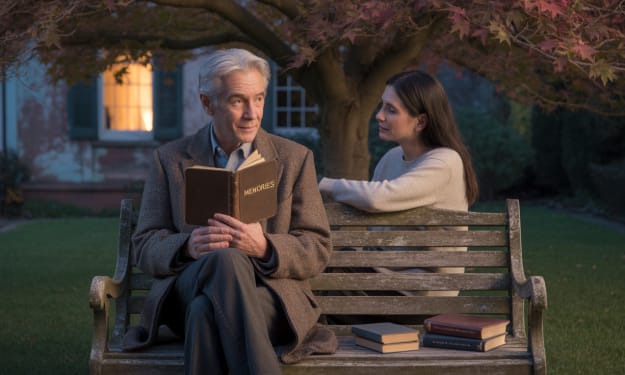
She Read His Obituary Before He Died Written by Muskan Maya had always started her mornings the same way since she turned 30 — strong coffee, soft music, and the local newspaper spread across the small wooden kitchen table her grandmother once owned. It was her ritual, grounding her in a world that sometimes felt too fast, too loud, and too fleeting. But nothing in the pages ever prepared her for what she saw that Wednesday morning. “Dr. Jonathan Hale, 68, passed peacefully on Tuesday evening. A revered linguistics professor and poet, Jonathan spent his final years quietly, often spotted in the garden of his family estate, book in hand…” Maya stopped reading. Her throat tightened. She blinked once. Twice. No. Her heart refused to believe what her eyes read. Jonathan Hale was not dead. He couldn’t be. He was alive just yesterday. She knew this because she had seen him — with her own eyes — walking down the cobbled path near the university’s old fountain. His steps were slow, sure, his coat too large for his frame but familiar. She had almost called out his name. Almost. Instead, she had stood still, silent, as he passed. And now he was dead? She folded the newspaper slowly, like she feared it might scream if handled wrong. Her hands trembled. Her coffee had gone cold. There had always been something mysterious about Jonathan Hale. When she took his poetry class ten years ago, she had been mesmerized by his presence — tall, quiet, eyes like fading ink, and a voice that carried sadness like it was a song. He rarely smiled, but when he did, it was like winter sun—brief, beautiful, and almost apologetic. Maya was one of his favorite students, though he never said it aloud. He showed it in smaller ways — a poem returned with more notes than others, a rare compliment scrawled in the margins, and once, a hand-written letter praising a piece she wrote about time and loss. And then, one day, he vanished. He stopped teaching. His office was emptied without notice. Rumors whispered that his wife had passed and that grief had consumed him whole. Others said he simply decided the world had taught him enough sorrow. No one knew for sure. But Maya never stopped wondering. And now she held his obituary in her hands. The final line read: “He leaves behind no children, but countless students who carry his words.” A tear fell onto the printed page, smearing the ink. That evening, against her better judgment, Maya made her way to the estate listed in the obituary. She didn’t know what she hoped to find. Closure? A final goodbye? Perhaps a glimpse of the garden where he spent his last days? The house stood just as she imagined — regal but tired, its paint faded and windows large and knowing. The front door was slightly ajar. Her heart pounded as she stepped in. “Hello?” she called softly. Silence answered. She walked past the threshold, following the faint scent of old paper and lavender. The living room was lined with books, and in the corner sat a record player, spinning nothing but static. Then, from the garden, she heard a soft cough. Maya froze. She stepped outside slowly. There he was. Jonathan Hale. Alive. Alive. Sitting on a worn bench beneath a cherry blossom tree, a book in hand. He looked older, thinner, but unmistakably himself. She gasped audibly. He looked up. Their eyes met. A pause. Then he smiled — faint, knowing. “Miss Rivera,” he said, voice softer than she remembered, but still laced with poetic rhythm. “You read it, didn’t you?” “The obituary?” she whispered. “I… I don’t understand…” He patted the bench beside him. She sat, breathless, confused, and heart racing. “I wrote it,” he said plainly. “Months ago.” “Why?” “To see who still remembered me. To know if I mattered.” “That’s—crazy. It’s… cruel.” He nodded. “Yes. But solitude does strange things to a man.” She looked at him. “You’re not forgotten. You never were.” He turned to her, and for the first time in a decade, she saw something break in his eyes. Not sadness. Not madness. Just a deep, echoing loneliness. “I just wanted one person to come,” he said. “You got one,” Maya said softly. They sat there for hours, talking about poems and pain, memory and time. The stars came out, unapologetically bright. When she left, he gave her a small notebook — filled with poems he never published. “For when I’m really gone,” he said. Three months later, the real obituary came. This time, there was no mistake. But she wasn’t mourning anymore. She was remembering. And through the ink of his words, he lived.
By Moonlit Lettersabout a year ago in Fiction
Beneath the Iron Sky
The sky above Sector-9 was always the color of old iron, smeared with the exhaust of a thousand factories that never slept. Every day began and ended in the same dull gray, where the sun was more myth than memory. But in a small corner of this choked city, in a crumbling apartment stacked like broken bricks, lived a girl named Lina Mirek, and she was trying—just trying—to survive.
By Waleed Khan about a year ago in Fiction
He Replied to Her Letters—20 Years After She Stopped Writing
He Replied to Her Letters—20 Years After She Stopped Writing Written by Raza Iqbal The first letter arrived on a Tuesday. It was spring in the sleepy coastal town of Whitby, where the sea spoke in hushes and the wind carried secrets through the alleys. Nora Blake, now 47, nearly mistook the letter for junk—until she saw the handwriting. Slanted, familiar. A style etched into her memory like ocean tides into stone. She froze in her doorway, groceries tucked under one arm, the envelope trembling in her hand. Her breath caught. The handwriting belonged to Jacob Bell. Jacob, the boy she had loved as fiercely as the wind and waves of their seaside town. The boy who promised he'd write back every week when he left for university. He did—for a year. Then silence. Still, she wrote. Every Sunday evening for six years, she penned a letter and placed it in a box. Pages filled with the mundane and the meaningful—her father’s illness, her favorite poem that week, the smell of summer storms. She never knew if he read them. Never even knew where he’d gone. She stopped writing after year six. Life moved on, or pretended to. Her mother died. She opened a small bookstore. She adopted a cat. And yet, in the attic, those six years of letters sat bundled by season. Until now. Nora stepped inside, placed the groceries on the floor, and slowly opened the envelope. Dear Nora, I don’t deserve to write to you after all this time. I know that. But today, I found one of your letters. It was buried in a box I never opened—sent to my father’s home after he passed. And I kept reading. One letter became five. Then twenty. Then all of them. I read your entire life through ink. I can’t begin to explain the reasons I never replied. Not yet. But please know—your words saved me more than once. Would you meet me, just once? If only to say goodbye properly. If you still live in Whitby, I’ll be at the old café by the pier, this Sunday at 10 AM. I’ll understand if you don’t come. Always, Jacob Nora didn’t sleep that night. Her thoughts were a tide pool of emotion—rage, heartbreak, aching curiosity. Why now? Why 20 years later? And yet, the next morning she stood at the mirror, brushing out her hair. She chose a simple navy dress and a grey scarf. The same one she wore the day Jacob had kissed her goodbye on the platform. The café hadn’t changed. Same chipped tables, same tang of coffee and sea salt. She walked in and scanned the room. Then she saw him. Jacob Bell, older but unmistakable. His dark hair now peppered with silver, lines etched deep around his eyes. He stood when he saw her. Their eyes locked. For a moment, neither of them moved. “I didn’t think you’d come,” he said softly. “I almost didn’t.” They sat. Silence lingered, but it wasn’t empty. “I don’t know where to begin,” he said. “Why not the truth?” she replied. Jacob’s fingers trembled around his coffee cup. “After I left Whitby… things went wrong. My father fell ill, but worse than that—he began unraveling. He was diagnosed with early-onset dementia. I dropped out. Came home. Took care of him.” Nora’s lips parted, but no words came. “He refused to send or receive letters. He hid things. I didn’t even know you were writing. Not until he passed and I found the box.” Nora’s throat tightened. “So… you didn’t forget me?” “I tried,” he admitted. “But every part of my life had your voice in it.” “Then why wait another year after finding them to reply?” Jacob hesitated. “I was scared. You wrote with such hope. I didn’t want to destroy that.” “You didn’t,” she said quietly. “Time did.” They spoke for hours. About what could’ve been. What never was. He had never married. She hadn’t either. They’d both come close—but something always held them back. Or someone. As the café emptied, Jacob reached into his coat and placed a small box on the table. “What is it?” she asked. “Your letters. All of them. I thought you might want them back.” Nora’s hands shook as she opened it. Her handwriting greeted her like an old friend. Folded pages. Ribbons still tied. She found one on top. A final note—his reply. “I’ve added one,” he said. “For every year I should have written you back.” Two weeks later, they met again. And again the week after that. They walked the beach where they once shared their first kiss. They sat on the library steps, remembering when they'd skipped school to read poetry. But it wasn’t love at first sight—not anymore. It was something deeper. A mending. A recognition. Of what had been lost. Of what still might be found. One year later, they stood in her attic. Nora opened the old letter box and placed Jacob’s replies inside—next to hers. The two timelines finally met. She looked at him. “We wasted so much time.” Jacob smiled. “Or maybe… we just paused.” And outside, the sea whispered its approval.
By Moonlit Lettersabout a year ago in Fiction