Fan Fiction
He Called Me Every Year on My Birthday—Even After I Blocked Him
He Called Me Every Year on My Birthday—Even After I Blocked Him Written by Raza Iqbal I blocked his number on March 12, 2018. That was the day I swore I’d move on. No more texts, no more “just checking in,” no more late-night voicemails that arrived after two glasses of whatever he’d been drinking and too many memories he hadn’t buried. I’d told myself I was done. But truthfully, I never believed that would stop him. The first time he called after the block, I didn’t notice. It wasn’t until the following morning that I saw the “Missed Call – Unknown Number” notification. March 12, 2019. My 31st birthday. I stared at it for a long time, then deleted it. But the next year, it happened again. And the next. And the next. Every year, without fail, there’d be a missed call from an unknown number on my birthday. Just one. No voicemail. No follow-up text. Just a ghost tapping at the door once a year to say, I still remember you. His name was Noah. We met in the fall of 2012—two aimless souls in their twenties with dreams too big and plans too messy. He was the kind of person who quoted song lyrics like gospel, made eye contact like it was an art form, and kissed like he was afraid it might be the last time. And maybe that was the problem. Every moment with him felt like it was clinging to the edge of goodbye. We lasted three years. Or maybe we didn’t. Because even when we were together, there was always this invisible expiration date hanging over us. He wanted freedom. I wanted roots. He craved the thrill of not knowing where he’d sleep tomorrow. I needed the certainty of a place called home. He left on a Tuesday. Didn’t even pack properly—just shoved a few shirts into a bag, kissed my forehead, and said, “I’ll come back when I’m better.” He didn’t come back. When I finally blocked him years later, it wasn’t because I hated him. It was because I knew I’d never heal if he kept lingering like static on an untuned radio. I needed silence. But even silence isn’t always quiet. Every year, on March 12th, I’d catch myself glancing at my phone. And there it would be—one missed call. Always from a different number. Always with the same weight. I tried changing my number once. Just to see. March 12, 2022. Missed call. Unknown number. How he kept finding me, I never figured out. Maybe he used friends. Maybe he hired someone. Maybe he just remembered the rhythm of my life better than I thought. Then came March 12, 2025. The call didn’t come. I checked at midnight. Then again at 3 a.m. I left my phone on loud all day. But there was nothing. And somehow, that silence was louder than all the calls before it. I told myself it was a good thing. That it meant I could finally breathe. That maybe he’d moved on. Or maybe… maybe he couldn’t call. That thought stuck in my throat like a splinter. So I did something I hadn’t done in years. I called him. I tried the last number he’d called from the year before. It had been from a small town in Vermont, if I remembered right. The number rang twice, then disconnected. No voicemail box. Just—gone. Something felt off. So I searched his name online. Not expecting much. Just trying to prove to myself that he was still somewhere out there. That he just forgot. But instead, I found his obituary. Noah Elias, age 39, passed away on February 20th, 2025. A traveler, a poet, and a restless soul. Survived by his sister, a worn guitar, and too many unfinished songs. I stared at the screen for a long time. He died three weeks before my birthday. He didn’t forget. He never forgot. And now, he never would again. A week later, I received a package in the mail. No return address. Just my name, handwritten in the messy, slanted print I hadn’t seen in almost a decade. Inside was a cassette tape and a letter. > “Hey. If you're hearing this, I probably missed your birthday. I’m sorry about that. But I didn’t want this year to be different. So I asked someone to send you this. Don’t worry, it’s not a guilt trip. Just... me. One last time.” I found an old cassette player in the attic. Blew the dust off. Slid the tape in. His voice filled the room. Older, softer. But still him. He spoke for ten minutes. Told me about the mountains he’d climbed, the songs he never finished, the lovers that never quite fit. He talked about regret, about time, about how he never stopped thinking about me. > “I know I wasn’t good at staying. But I was always good at remembering. You were the only thing I never let go of, even when I should have.” > “So happy birthday, one last time. I hope your world is full, your heart is quiet, and your days are soft. I’ll stop calling now. Not because I forgot. But because I finally understand letting go.” > “Love you always. N.” I listen to that tape once a year now. On March 12th. Not because I’m holding on. But because I’m honoring the sound of someone who finally learned how to say goodbye.
By Moonlit Lettersabout a year ago in Fiction
She Left Her Diary in My Drawer—Three Days After Her Funeral
She Left Her Diary in My Drawer—Three Days After Her Funeral Written by Mirza I didn’t cry at her funeral. I thought I would. God knows I wanted to. But as the final shovelful of dirt landed on Emily’s casket, all I could feel was silence—a gaping absence that settled somewhere behind my ribs like a forgotten breath. Three days later, I found the diary. It wasn’t something she kept on a shelf or in a box. It wasn’t tucked away neatly. It was just there—sitting in the top drawer of my nightstand like it had always belonged there. And maybe, in some strange way, it had. It was a small leather-bound book, deep blue, edges worn. A single rose was pressed between the last few pages. I recognized it immediately—it was from that picnic in early spring. The one where she laughed so hard she choked on lemonade and made me promise I’d never bring up her ugly snort-laugh again. She made me promise a lot of things. She made me promise I’d live boldly. That I wouldn’t turn into one of those sad, gray people who let the world happen to them. That if anything ever happened to her, I’d remember to still dance in the kitchen and drink cheap wine on Tuesday nights. She never made me promise not to fall apart. The first page was dated five years ago, the day we met. > June 14th He has tired eyes, but kind ones. I don’t know why I noticed him first, but I did. He sat alone, reading a book he probably didn’t want anyone to ask about. I asked anyway. He said it was boring. I think he’s lying. I hope I see him again. We had met at a bookstore. That wasn’t a lie. But I didn’t know that moment had etched itself so deeply into her memory. I kept reading. > October 2nd He finally kissed me. I thought I’d feel fireworks, like in the movies. But instead, I felt calm. That kind of peace that creeps in when you stop running. I’ve always been running. I paused. I remembered that kiss. It was raining. We stood beneath the awning of that little café on 8th and Main, and she tasted like cinnamon and hesitation. I didn’t know she was running from anything. I never asked. I kept turning pages, and with each one, she became more alive. Her voice filled the room. Her words curled around me like the scent of her favorite sweater I hadn’t been able to throw out. There were pages about her fears—about cancer, about time, about leaving me alone. > March 9th The doctor said it might be nothing, but my gut says otherwise. I haven’t told him. Not yet. I don’t want to steal the light from his eyes. > April 3rd It’s not nothing. I knew it. Stage three. I cried in the parking lot for ten minutes, then ate a muffin like it was just a normal day. I’m good at pretending. I’ve been doing it since I was twelve. > May 27th I told him. He didn’t cry. But he held me like the world was ending, and for a moment, I let it. God. I remembered that night. How quiet we were. How loud the silence was. How she stared at the ceiling for hours while I lay beside her, memorizing the rhythm of her breath like it might leave me at any moment. She never let me read her pain. But here it was. Bleeding ink on paper. Honest. Unfiltered. The kind of vulnerability she never showed in daylight. And then I turned to the last entry. > The day before my birthday He’s sleeping beside me. I wonder if he knows I sometimes stay awake just to hear his breathing. That I count the seconds between each inhale. That I love him enough to let go. If you’re reading this, it means I’m gone. And I’m sorry. Not for leaving—but for not telling you how much you saved me. You made life worth the fight, even when I didn’t want to fight anymore. The diary is in your drawer now because I couldn’t leave without saying goodbye properly. You would’ve kept looking for closure in all the wrong places—in books, in songs, in old text messages. So I’m giving it to you here. In my words. In these pages. In this love that doesn’t end just because I did. Live boldly. Keep dancing. And know, wherever I am, I’m probably laughing at your terrible taste in music. Forever your Emily. I don’t remember how long I sat there after finishing. Maybe an hour. Maybe the whole night. At some point, my hand moved to close the diary, but I couldn’t bring myself to let it go. She had written me a goodbye when I didn’t get one. She had left behind not just memories, but answers. Love in ink. And for the first time since the funeral, I cried. Not because she was gone. But because I finally understood how deeply I had been loved.
By Moonlit Lettersabout a year ago in Fiction
The Door Was Never Locked
Marla always cried during commercials—especially the ones with dogs in them. Her friends joked about it. Her brother used to nudge her at the movies when the sad scenes hit. “Sensitive,” they said, like it was a diagnosis. Like it was something she’d outgrow.
By Enric Millyabout a year ago in Fiction
Whiskers and the Willow Tree: The Cat Who Waited Through the Seasons. AI-Generated.
In a peaceful village cradled gently between emerald-green hills and golden wheat fields, where birds sang lullabies at dawn and the breeze carried tales from one window to another, there lived a peculiar cat named Whiskers. Gray as the mist that blanketed the meadows in early morning, with eyes the color of polished emerald, Whiskers wasn’t anyone’s pet—but somehow, he belonged to everyone. The villagers adored him. Some said he came with the rain during a night storm years ago, a soaked and trembling kitten that curled beneath the bakery window for warmth. Others whispered that he had been born under the roots of the ancient willow tree standing proudly in the village square—a tree older than any living soul in the village. But what truly set Whiskers apart wasn’t his origin. It wasn’t his soft fur, nor his silent, steady companionship. It was his unwavering ritual: each evening, without fail, as the amber sun sank behind the hills and the village glowed in golden light, Whiskers would quietly make his way to the willow tree. There, beneath its curtain of swaying leaves, he would sit facing the cobbled road that led out of town—watching, waiting. Children often tiptoed after him, watching curiously from behind nearby walls. Elderly villagers would nod knowingly. Some claimed he was waiting for someone. Some said he was mourning a past life. Others believed he could see something others couldn’t—a ghost, perhaps, or a memory so strong it took form. Old Mr. Habber, the village baker with the flour-dusted cap, swore Whiskers once belonged to a traveling artist who had painted portraits under the tree before vanishing one cold October morning. Mrs. Alna, the librarian with the bent back and kind eyes, believed Whiskers was the reincarnation of a guardian spirit, forever loyal to a lost soul. The children made him into legend: Whiskers the Cursed Prince, Whiskers the Timekeeper, Whiskers the Dream Cat. But the truth was simpler. And more heartbreaking. Many seasons ago, a little girl named Elsie had lived in the village. With hair the color of ripe wheat and a soul that seemed to glow from within, she had a gentle way of seeing the world—and the ones forgotten by it. One rainy evening, behind the inn, she discovered a kitten, barely clinging to life. She wrapped him in her scarf, whispered comfort into his ear, and named him Whiskers. From that moment on, they were inseparable. Elsie spoke to Whiskers about everything—her dreams of becoming a writer, her fear of thunder, the books she adored, and the things she never told even her parents. In Whiskers, she found not just a pet, but a soulmate. But time is never still. One autumn, Elsie’s family was forced to move to the city. Her father had found work far away. They packed their belongings, including Whiskers’ favorite blanket and a special collar she had bought with her own saved pennies. But the night before the move, Whiskers vanished. They searched the village high and low, calling his name until their voices cracked. But Whiskers didn’t come. Elsie cried the whole way to the city. She left a piece of her heart behind. And Whiskers? He waited. Through falling snow and blooming spring, under summer’s scorching sun and winter’s bitter wind, Whiskers never failed to return to that willow tree. As the days stretched into months and the months into years, his silent vigil became something sacred. The villagers, touched by his devotion, began to leave him offerings. A warm shawl in the winter. Fresh fish from the market. A small pillow sewn by a child’s hand. Someone even built him a tiny shelter beneath the willow's boughs. Artists came from other towns to sketch him. Writers penned stories inspired by him. The mayor once called him “the soul of our village.” Then, one spring—after nearly a decade—a woman stepped into the village. She wore a blue coat and carried a notebook pressed to her chest. Her eyes, once youthful and bright, now carried stories of years spent waiting too. She paused when she saw the willow tree. And the cat. He was older now. A little thinner. His fur slightly patchy. But those eyes—those emerald eyes—still glowed. “Whiskers?” she whispered. The cat turned his head. And in that quiet moment, time bowed in reverence. He didn’t leap. He didn’t run. He simply stood and walked to her, brushing against her ankles, and gave the softest purr that cracked the silence of years. The villagers gathered, some with tears, some with knowing smiles. “He waited,” someone murmured. Elsie took him in her arms and never let go again. But this time, she didn’t return to the city. She had bought a cottage on the village’s edge—her old home, restored with care. And every evening, she and Whiskers sat together beneath the willow tree. Not waiting anymore. Just remembering. --- Thank you for reading this extended story, written with care using ChatGPT. If it touched your heart, share it with someone who believes in love that lasts, in memories that linger, and in animals who never forget. 🐾
By Roohullah Roohani about a year ago in Fiction
The Woman Who Lived in Room 27
The Woman Who Lived in Room 27 Written by Mirza Room 27 wasn’t luxurious. It didn’t have a sea view or silk curtains. The paint peeled a little at the corners, the bed creaked when you rolled over, and the window stuck halfway when you tried to open it. But it was hers. The front desk clerk, Tony, didn’t ask many questions when she arrived seven years ago. She wore a burgundy coat with a torn hem and carried one suitcase, the kind with faded stickers from other places—Italy, Morocco, maybe Greece. Her name, written in crisp black ink on the registration form, was Clara Matthews. She paid a week’s stay in advance at the small coastal inn. Then she stayed the next week. And the next. Eventually, Tony stopped asking if she needed help with her bags. She wasn’t rude. Just… distant. She came and went quietly, walked along the beach in the early mornings, and returned before sundown. She always had a notebook in hand, sometimes a stack of old letters tied in ribbon. She ate the same thing from the café downstairs—black coffee, two eggs, toast no butter. The locals whispered about her. “Maybe she’s a widow.” “No, a writer. They’re all strange.” “She’s hiding. Bet she’s running from something—or someone.” Children made ghost stories about her: The Woman in Room 27, who talks to no one and writes secrets to the dead. But Clara never reacted. She just nodded politely, smiled when necessary, and climbed the creaky stairs to Room 27. Room 27 had no secrets. Or perhaps it had too many. Inside, her life was small and neat. A wooden suitcase at the foot of the bed. A shelf of secondhand books, mostly poetry and old travel journals. A painting of a sailboat she bought from the art market and hung crooked above the bed. A single photograph—sepia-toned—of a young man in a military uniform. His face worn from time and thumbprints. Clara would talk to the photograph some nights. “You would’ve liked it here, Daniel,” she whispered. “The waves sound like the letters you used to write.” On her desk, letters—hundreds—lay bundled in blue ribbon. Some sealed. Some opened and read too many times. Every day, she wrote one more. “Dear Daniel,” each began. “Today, I watched the tide come in. It reminded me of you…” One stormy winter, Tony finally asked her, “You ever plan on leaving, Miss Matthews?” She looked up from her tea. “No,” she said simply. “This is my last stop.” Tony respected her answer. He stopped asking. But every time the room needed painting or the roof leaked, he made sure hers was repaired first. And every year, she still paid her rent on time. In cash. Never with a card. Then one spring morning, Room 27 was silent. No scent of tea from beneath the door. No footprints along the beach. No polite nod at breakfast. Tony waited till noon. Then he knocked. No answer. Inside, Clara Matthews lay in her chair, facing the window, a letter clutched in her hand. She had passed as quietly as she lived.
By Moonlit Lettersabout a year ago in Fiction
Every Sunday at 4 PM, He Waited for Her—Even After She Died
Every Sunday at 4 PM, He Waited for Her—Even After She Died Written by Raza Iqbal The bench on the corner of Maple and 3rd wasn’t special—not to anyone else. Worn wood, a few cracks, and an old iron frame. It faced the tiny flower shop that had been closed since spring, and beside it stood a coffee cart that had seen better years. But to Harold, that bench was a sacred place. Every Sunday at 4 PM, he sat there—rain or shine, wind or snow. He wore the same old gray sweater, the same polished shoes she loved. He brought two cups of coffee—black with a single sugar in the second one. Her cup. The city around him rushed. Children played. Teenagers skateboarded. Workers passed by with bags of groceries and worries in their eyes. But Harold sat still, eyes fixed on the street, waiting. He'd been waiting for seven years. Her name was Margaret. Maggie, to him. They had met in 1964 at the town library. She was reading Wuthering Heights. He was reaching for the same copy. Their hands touched. Her smile reached her eyes. He stuttered something about Brontë, and she corrected his pronunciation gently. They married two years later. For fifty years, they lived quietly but beautifully—Sunday mornings in bed, handwritten notes stuck to the fridge, laughter over burned toast, dancing in the kitchen to jazz. And every Sunday at 4 PM, they sat on that bench with coffee and watched the city pass. It was Maggie’s idea. “Let’s have a little moment just for us,” she said. “Every Sunday. No matter what. That way, life never pulls us too far apart.” They never missed it. Not once. Until the spring of 2016. Cancer doesn't wait, even for love. Maggie had been sick quietly. She kept the pain away from Harold for as long as she could. But by the time he knew, the doctors were speaking in weeks, not years. Her final Sunday came with a weak smile and trembling hands. She sipped her coffee slowly. “Don’t stop coming here,” she whispered. “Even if I’m not with you.” “I won’t,” he had said, barely managing the words. And he didn’t. The neighbors thought it was sweet at first. A beautiful gesture. A symbol of love. Then the years passed. Children grew. The coffee cart changed owners twice. Seasons rolled by like a carousel, but Harold kept coming. Some thought he was senile. Others believed he had lost his mind entirely. But if you asked him, he'd say, “I just like our conversations.” You see, Harold talked to her. Not out loud. But in the quiet of his thoughts, where her voice still echoed. Sometimes he imagined her telling him about heaven. Other times, he just told her about his week. Once, in the second year after her death, a young woman sat beside him on the bench. She was crying. Heartbreak, he guessed. He handed her the cup meant for Maggie. “She won’t mind,” he said softly. “She’d want someone else to feel warm today.” The woman blinked through tears. “Who’s ‘she’?” “My wife.” “Where is she?” He smiled gently. “Still here, just quieter now.” On what would have been their 58th anniversary, Harold brought tulips instead of coffee. Maggie’s favorite. He didn’t cry. He just smiled at the bench beside him. “Remember when you spilled hot coffee all over that banker who kept talking on his phone? You said, ‘Oops, sorry, the universe wants you to shut up.’” He chuckled. “God, you were brilliant.” A gust of wind rustled the trees, and he closed his eyes, pretending it was her brushing past. Time stopped on that bench. One Sunday, he didn’t show up at 4 PM. The coffee cart man, Ravi, who had inherited the cart from his father, noticed. So did the florist’s daughter, who passed the bench every day on her way to work. By 4:30 PM, they were whispering. “He’s never late.” “Maybe he’s just sick?” Ravi walked across the street and placed a single coffee cup on the bench. Black, with one sugar. But Harold never returned. Three days later, an obituary was printed in the local paper. Harold Thomas Willoughby. Age 87. Devoted husband to Margaret. Passed peacefully in his sleep, July 18. Survived by love. The following Sunday, something unexpected happened. At 4 PM sharp, the bench wasn’t empty. A middle-aged couple sat there, holding hands, each with a cup of coffee. Then the next week, an elderly woman and her grandson. After that, a teen with a notebook. They’d heard the story. They’d read the obituary. Word had spread online—a man who waited for his wife for seven years, on the same bench, at the same time. Soon, the city renamed the bench: “Harold & Maggie’s Bench — For Love That Waits.” It became a ritual for many. People showed up with stories, with heartbreaks, with hopes. They sipped coffee. They remembered someone. Or no one. Some said they felt peace there. Others swore they could hear jazz in the wind. But one thing was certain: Every Sunday at 4 PM, the bench was never empty. Because love—true love—doesn’t vanish. It waits. It remembers. It sits in silence, beside a paper cup, watching the world pass by—still hoping.
By Moonlit Lettersabout a year ago in Fiction
The Whispering Tree
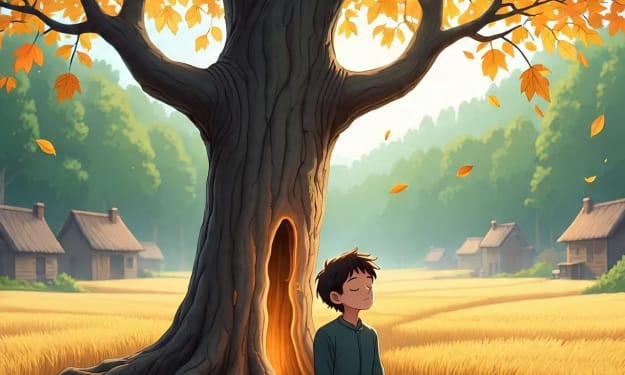
In the quiet village of Noorabad, nestled between golden fields and deep forests, there stood an ancient tree—its branches twisted like the fingers of an old storyteller. No one knew exactly how long it had been there, but everyone called it The Whispering Tree. It was said to speak when the wind was just right—softly, like a lullaby, and only to those who dared to truly listen. Twelve-year-old Ayaan had always been curious about the tree. His grandmother used to tell him bedtime tales of the tree’s magical powers. "It holds the memories of the forest," she would say, eyes twinkling with mystery. "It speaks to those who carry a kind heart and a brave soul." One crisp autumn afternoon, after finishing his chores, Ayaan slipped away from his home and made his way to the edge of the forest. The tree stood tall, its brown leaves fluttering like tiny paper birds. He hesitated for a moment, heart pounding, then stepped forward. A gust of wind blew through the branches. The leaves rustled, but deeper within the sound, Ayaan heard something else—like a soft murmur, just beyond the edge of understanding. He sat beneath the tree, closed his eyes, and whispered, “I’m listening.” At first, there was silence. Then the breeze stirred again, and this time the whisper grew clearer: “Help her. In the well.” Ayaan’s eyes snapped open. “The well?” he whispered aloud, looking around. There were several old wells in Noorabad, most sealed or unused. Which one could the tree mean? He rushed home and asked his grandmother if anyone had gone missing recently. “No, child,” she said, knitting by the fire. “But… Old Well Street was sealed after a girl fell in, long ago. They never found her. Poor family moved away.” Ayaan’s stomach tightened. That had to be it. The next morning, before the sun had fully risen, Ayaan ran to Old Well Street. At the end of the lane, hidden behind wild bushes and weeds, stood the stone rim of the ancient well. The cover was heavy, but he managed to lift it just enough to peer inside. “Hello?” he called into the dark. Nothing. Then—a faint sound. A cry? Or just his imagination? He tied a rope from his schoolbag to a nearby tree, looped it around himself, and began to lower into the well, heart racing. As he descended, the light faded and the air grew cold. About twenty feet down, his feet touched damp ground. He shone his small torch around. The well wasn’t just a pit—it opened into a narrow tunnel. He followed it cautiously until he saw something extraordinary. A girl. She looked about his age, pale and wide-eyed, with a glowing pendant around her neck. “I’ve been waiting,” she said softly. Ayaan blinked. “How long have you been down here?” “I don’t know,” she whispered. “Time is strange here. I only remember the tree calling you.” He reached for her hand. “Come on. Let’s get out of here.” Together, they climbed the rope back up. As they reached the surface, dawn had broken and golden light bathed the street. The girl gasped as the sun touched her face. “I’m free…” But as Ayaan turned to smile at her, she began to shimmer—like a reflection on water. Within seconds, she had vanished, leaving only the glowing pendant in his hand. He stared, stunned. Was she… a ghost? He returned to the Whispering Tree that evening, pendant in hand. “Who was she?” he asked. The wind rustled again: “A soul forgotten. A voice unheard. You listened.” Ayaan felt a warmth in his chest, not from fear, but from something like peace. He buried the pendant beneath the tree, whispering a prayer for the girl, and as he did, the tree’s leaves glowed faintly gold, as though the forest itself had smiled. From that day on, Ayaan returned often. He listened more—sometimes to voices, sometimes to silence. He helped those in need, told stories to the lonely, and comforted the forgotten. And every time the wind blew just right, the tree whispered his name with gentle pride.
By Muhammad Bilalabout a year ago in Fiction
The Sound of No Goodbye
The Sound of No Goodbye Written by Mirza The morning she left, there were no slammed doors or tearful hugs. No emotional declarations or scribbled notes. Just the creak of the front door, the whisper of her boots on the wooden steps, and the long, quiet sigh of an engine starting. That was it. Lena had always been a woman of words — a poet by trade, a lover of language — yet when it came to goodbye, she gave none. It was the most painful silence Peter had ever known. He didn’t notice it at first. He thought she had gone to the market, maybe to the bookstore on Fifth, where she often spent hours nestled between worn pages. But by evening, when the shadows of the kitchen walls grew long and her teacup remained untouched, reality began to unravel. She wasn’t coming back. Peter spent the first night pacing. He didn’t cry. Not yet. He was still waiting for a text, an apology, something that would explain the suddenness of her departure. By the second night, he began to remember things—subtle hints he’d ignored: the way she no longer hummed while cooking, how her laughter had faded into polite chuckles, how she stared out the window longer than necessary, as if looking for the exit. Lena had been slipping away for months. The truth was, Peter had been caught in the comfort of routine. He had mistaken her quiet for contentment, her distance for peace. He’d thought love, once spoken, could remain unspoken forever and still survive. But Lena needed to be heard. She had always craved connection, not just presence. She needed someone to feel her silences, read between her pauses, answer the questions she never asked out loud. Peter loved her, but he hadn’t listened closely enough. Not really. Weeks turned into months. Peter still set the second mug out every morning. He didn’t know why. Habit, maybe. Hope, possibly. A punishment, most likely. Friends tried to comfort him. “She’ll come back.” “Maybe she just needed space.” But Peter knew. There were no postcards. No phone calls. Not even mutual friends had heard from her. She had disappeared in every way a person could, without dying. It was grief without a grave. One day, Peter found himself cleaning the attic. He hadn’t been up there in years. Among the dusty boxes, he found an old wooden trunk — Lena’s. Inside were journals, photographs, bundles of letters tied with string. At the bottom, under everything, was a sealed envelope with his name on it. His heart pounded as he sat down on the wooden floor, hands trembling. He opened it. > Peter, I didn’t know how to say goodbye. I guess I still don’t. I loved you. I want you to know that first. I loved you from the moment you made that ridiculous pun at the bookstore and turned beet red when I laughed. But somewhere along the way, we stopped talking. Not about errands or bills or dinner plans. I mean really talking. I felt invisible in the same room as you. I shouted in silence, but you never heard me. I waited for you to notice. I wanted to be reminded that I mattered — not as a routine, but as a person with a beating heart, full of dreams and fears. And when you didn’t, I realized I couldn’t stay. I didn’t want to hurt you with a dramatic farewell. I thought maybe if I just disappeared, you’d look back and find me in the memories — the real me. I’m sorry I didn’t say goodbye. Maybe I was afraid you’d ask me to stay. And maybe I would have. But I needed to learn how to be heard again. — Lena Peter read the letter three times before folding it neatly and pressing it to his chest. He wept for the first time since she left. Not just because she was gone, but because she had been right there, breaking quietly, and he had never noticed. He spent the following days reading her journals. It was like hearing her voice again, page by page. Her words were gentle, thoughtful, aching. She hadn’t wanted to hurt him. She had wanted to be seen. Years passed. Peter never stopped loving Lena, but he also never stopped growing from the silence she left behind. He became a better listener, a more present friend, a man who now understood that love wasn’t about avoiding conflict or staying comfortable — it was about being vulnerable, open, and attentive. One rainy afternoon, Peter returned to the same bookstore where they’d met. An open mic night was just beginning. A young woman was reading a poem. He sat at the back, sipping coffee, soaking in her words. After her set, he stood and applauded. And for the first time in years, he spoke into the quiet. “Thank you for your voice.”
By Moonlit Lettersabout a year ago in Fiction
The Watchmaker's Memory
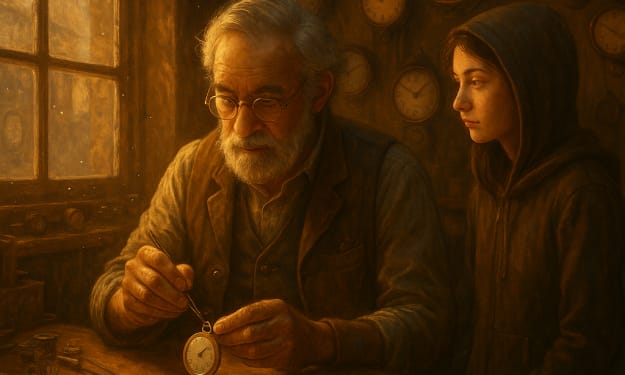
The shop stood quietly at the end of Rose Street, nestled between a forgotten tailor's boutique and an aging tea house that smelled perpetually of cinnamon and nostalgia. Its sign, faded but proud, read: M. Rehman – Watchmaker. Repairs & Restorations Since 1946.
By Farooq shahabout a year ago in Fiction
Under the Crimson Sky
By Nadeem Shah The sky bled red the evening I returned to Raven Hollow. I hadn’t been back in twelve years—not since the night everything I believed in was shattered. The roads felt narrower, the trees darker, like the whole town was holding its breath, waiting for me to remember what I’d tried so hard to forget.
By Nadeem Shah about a year ago in Fiction