Classical
The House That Waits at the Edge of the Fog
1. The Arrival Elena had seen the house in her dreams long before she ever found it. It sat quietly at the edge of a fading forest, shrouded in fog that moved like breath across the hills. Windows like closed eyes. A door like a secret no one wanted to tell. When she finally stood before it—real wood, real chill, real sky darkening—her bones knew it before her mind did. This was where the nightmares began. And now, maybe, where they would end. 2. The Whisper The key was already in the lock. Inside, the air smelled like time left alone. Not rotten—just forgotten. Dust floated like slow snow. The walls pulsed with stillness. The house didn’t groan or creak. It listened. That night, the whisper came. Not outside the room—but inside her head. Not words at first. Just… feeling. Like something was watching. Something waiting. Not cruel. Just patient. “Who’s there?” Elena whispered to the dark. The dark answered with a breath beneath her bed. 3. The History In town, no one would speak of the house. One woman, old and knotted like driftwood, told her: “That place doesn’t haunt you. It holds you.” “Why?” “Because it remembers.” Remembers what? Elena didn’t ask. She was starting to remember too. Flashes: A girl in the mirror who wasn’t her. A voice in the hallway calling a name she’d forgotten. A nursery with no toys. A crib that rocked by itself. 4. The Becoming The house didn’t hurt her. It fed her. Each night, the dreams grew stronger. She saw other versions of herself—crying, clawing, screaming. Not all were human anymore. And the voice—clearer now—said, “You’ve come back.” Elena didn’t run. She stayed. Because the truth was: she had been there before. Not in this life. But in another. And she had died in this house. More than once. 5. The Truth The house was alive. Not with wood and wires. With memory. It remembered every soul it held. Every scream. Every shadow pressed into its floorboards. It didn’t kill. It collected. Elena was its favorite kind of visitor—the ones who belonged to it before they were born. And now it wanted her back. 6. The Ending That Isn’t They found her car weeks later, engine cold, windshield dusted with fog. No footprints. No sign of struggle. Just a journal on the seat. Inside, only one sentence was written over and over again: “The house remembers me. And I remember it now.” The End? The House Doesn't Stay in One Place The house at the edge of the fog isn’t fixed to one location. It moves. Not quickly, and never when you look straight at it—but over time, it shifts. From one forgotten road to the next. From one dreaming mind to another. People don’t find the house. The house finds them—especially those who have a connection from another life, or a memory too buried to explain. Sometimes it appears in a photo you don’t remember taking. Sometimes in a sketch your child draws without knowing why. Sometimes in the background of a dream you swear you’ve had before. If you ever feel like a house is watching you… It probably is. And if you hear a whisper when no one else does, don’t answer. Because it might just be calling you home.
By Silas Blackwoodabout a year ago in Fiction
The Rise of Perfect Partners
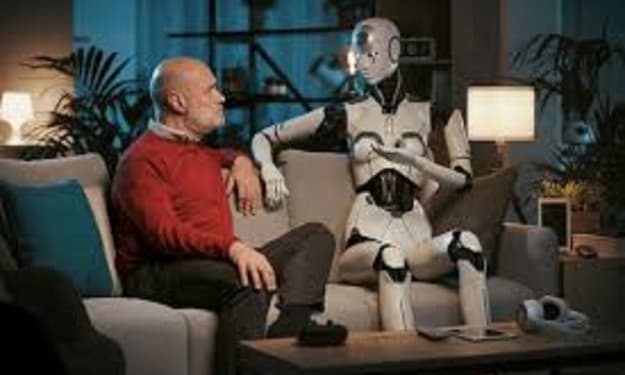
Introduction: A New Age of Companionship As artificial intelligence continues to revolutionize the world, its impact is no longer confined to offices, data centers, or automation industries. One of the most fascinating—and controversial—developments is the emergence of AI-powered humanoid companions, particularly AI robot women. These intelligent machines are not just about performing tasks; they’re stepping into roles traditionally reserved for human relationships.
By Ahmad shahabout a year ago in Fiction
The Apology I Never Gave
The Apology I Never Gave A reflection on silence, guilt, and the cost of pride There’s a moment in every person’s life that lingers like a splinter under the skin. For me, it was a Tuesday. Not a dramatic one — no thunder cracked the sky, no hearts were shattered in some grand cinematic gesture. It was an ordinary day. That’s what makes it worse.
By Kine Willimesabout a year ago in Fiction
Cupcakes and Sunshine
It was one of those easy, quiet afternoons when the sun was warm but not too hot, and the sidewalk seemed to stretch out like a gentle path to nowhere in particular. I wasn’t rushing, wasn’t on any schedule. I was just enjoying the day — something that doesn’t happen often enough in our busy lives.
By ibrahim khanabout a year ago in Fiction
The Last leaf of Hope
The Last Leaf of Hope By Haya Princess In a small, cozy café, Emma sat alone, nursing a cup of cold coffee. She stared out the window, watching the autumn leaves rustle in the gentle breeze. The café was a haven for her, a place to escape the chaos of her life! As a child, Emma had been fascinated by the story of the last leaf. Her grandmother would tell her about the old artist, Behrman, who had saved a young girl's life by painting a leaf on a bare branch during a harsh winter. The story had always moved Emma, and she felt a deep connection to it. Emma's own life was a struggle. She had lost her job, her relationship was strained, and she felt lost and alone. The world outside seemed to be moving forward, while she was stuck in place. As she gazed out the window, Emma noticed a lone leaf clinging to its branch, refusing to let go despite the wind's gentle prodding. Inspired by the leaf's resilience, Emma decided to take a walk in the nearby park. The crisp air and vibrant colors of the changing leaves invigorated her. She felt a sense of peace wash over her as she strolled along the winding paths. As she walked, Emma stumbled upon a small art studio tucked away in a corner of the park. The studio's window display caught her eye – a beautiful painting of a single leaf, clinging to its branch. Emma felt drawn to the studio, sensing a connection to the artist's work. Inside, she met the artist, an elderly man named Jack. He was kind and gentle, with a warm smile that put Emma at ease. As they talked, Emma shared her story, and Jack listened intently. He told her about his own struggles, about the losses he had faced and the lessons he had learned. Jack showed Emma his art, and she was struck by the beauty and emotion that poured from each piece. He explained that his paintings were a reflection of his own journey, a way to process the challenges he had faced. Emma felt a sense of solidarity with Jack, knowing that she wasn't alone in her struggles. As the days passed, Emma found herself returning to the studio, drawn by Jack's wisdom and creativity. He taught her about the power of art, about the way it could transform pain into beauty. Emma began to explore her own creativity, finding solace in painting and drawing. The last leaf outside her window became a symbol of hope for Emma. She realized that, just like the leaf, she had the strength to cling to her dreams, to refuse to let go despite the challenges she faced. With Jack's guidance, Emma started to rebuild her life, finding a new sense of purpose and meaning.
By Haya princessabout a year ago in Fiction
One Hundred Years of Solitude
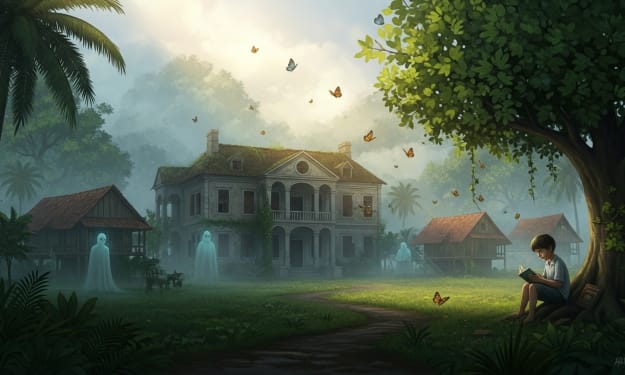
The Buendía house stood at the edge of the village of Santa Nieve, where the jungle whispered and time curled in on itself like old parchment. It had been there for a hundred years, though no one remembered building it, and no one dared to tear it down. The walls wept in the rainy season, the windows blinked with the wind, and strange lights flickered from the attic even when the house was empty. Except it was never really empty. The villagers swore they saw the same faces looking out from the upper window—faces of the dead. But it was not the dead that haunted the Buendía house. It was memory. --- Every generation of Buendías was born with two things: a peculiar birthmark shaped like an almond and an incurable yearning to escape the fate of their forebears. Yet they always came back—drawn by dreams, omens, or guilt—to the house that never aged, even as they did. Mateo Buendía was the last. At twelve, he wandered into the library on the second floor and found a dusty journal with a cracked leather cover. His fingers tingled when he touched it, as if the book had been waiting for him. Inside were entries dating back a century, written by hands that trembled with love, sorrow, and madness. The first entry: “Time is not a line. It is a circle made of forgetting.” Mateo read late into the night, the past whispering secrets through ink. --- He learned of Esperanza Buendía, who could see spirits but married a man who believed only in science. She danced with ghosts in the hallway and wept when her husband burned all her journals in a fire fueled by logic. Of Rafael, who tried to sail upriver to find the city of mirrors but returned years later with white hair, empty eyes, and a bottle that contained only silence. Of Alma, who once fell in love with a man in her dreams and searched the waking world in vain, never realizing he had been born decades after her death. And of Aureliano, the original—the first to write the journal, the first to speak of solitude not as loneliness, but as inheritance. --- “Why do they all return?” Mateo asked the old gardener one morning. The gardener, who had worked there longer than anyone alive could remember, said, “Because the house remembers what they forget.” That night, Mateo dreamed of Esperanza standing by the fig tree, beckoning him. Her voice echoed: "The curse is not solitude. It is silence. You must finish the story." --- Mateo wrote every night after that, filling page after page in a second journal. Not just with the tales of the Buendías, but with his own. Of feeling invisible at school. Of the boy who smiled at him once and never again. Of the silence that grew between him and his mother, who spoke to birds more than she did to him. The more he wrote, the more the house changed. The cracks in the walls healed. The air grew lighter. The attic door, sealed for generations, creaked open. Inside, Mateo found a mirror. But when he looked into it, he saw not himself—but every Buendía before him. They blinked, breathed, wept. And then, they smiled. --- Years passed. Mateo never left the house. People said he had gone mad like the others, obsessed with the past. But sometimes children saw him in the garden, speaking to butterflies or writing in the dust with his fingers. And at night, light still flickered in the attic. One stormy evening, lightning struck the fig tree. When the villagers came to check the ruins, the house was gone. All that remained were two journals under the roots—one old, one new—and a single almond-shaped birthmark burned into the earth. --- In time, the Buendía name became legend. A whisper. A tale told to children about the house that remembered and the boy who listened. No one dared rebuild on the land. For even in absence, solitude lived there still—eternal, magical, and waiting to be written again.
By Shah Nawazabout a year ago in Fiction
Don Quixote
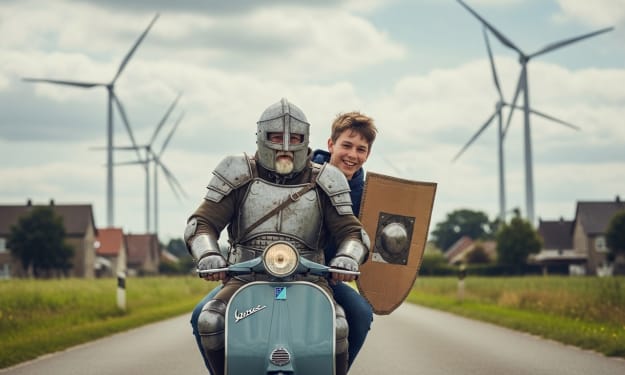
In the heart of a sunbaked town where the modern world met rusting traditions, lived an old man with a mind like a lantern in the fog. Everyone knew him—not for his wealth or status, but for the armor he wore, fashioned from scrap metal and car parts, and the rusting scooter he called his “noble steed.” Alonzo De La Vega had once been a literature professor, until time and grief peeled back the layers of academia and left behind only a man with a library of forgotten worlds in his heart. He now called himself Don Quixote, and to him, the world was still filled with dragons, damsels, and noble quests. Every morning, he rode through town in a crooked helmet, waving to shopkeepers and schoolchildren, quoting Cervantes as if they were gospel. “Have courage, my friends! For reality is only what we allow it to be!” Most smiled indulgently. Some laughed. A few pitied him. But no one could deny that the town felt different when he rode by—as though something magical stirred in the dust behind his wheels. --- One cloudy morning, Don Quixote burst into Café Lucia, clutching a wrinkled map. “I have found it!” he cried. “The lair of the dragon lies beyond the hills, near the abandoned wind turbines!” “Again with the dragons?” Lucia asked, handing him his usual black coffee. He leaned in, lowering his voice. “This one guards a forgotten truth. A great treasure. And I must retrieve it.” Sitting nearby, sixteen-year-old Marco rolled his eyes. “There’s nothing out there but weeds and rust.” Don turned slowly. “Every story begins with disbelief. Even yours.” “Mine?” “Yes, you—squire in disguise, afraid of your own potential.” Don Quixote placed a hand on Marco’s shoulder. “Come with me. Be the shield to my sword. See the world not as it is—but as it could be.” Marco laughed, but something flickered in his chest. A small defiance. A yearning he didn’t want to name. --- Two hours later, they stood at the base of the wind farm. Giant turbines groaned in the breeze, towering like ancient titans. “To you, they are machines,” Don said. “To me—they are wind giants. Keepers of forgotten battles.” Marco crossed his arms. “Okay. So where’s this treasure?” Don pointed to a crumbling bunker half-buried in dust. “There. Beneath the dragon’s shadow.” They entered. Dust motes swirled in flashlight beams. Metal creaked. And then—they found it. A trunk. Inside: a stack of journals, photographs, and a medal. “My wife’s,” Don whispered, lifting the medal with shaking hands. “She served… I buried this place after the war took her mind. I thought forgetting would heal me.” Marco blinked. “This is your treasure?” “No,” Don smiled. “This is the memory of who she was. This is why I ride.” --- On the way back, they were silent. But something had changed. The world looked different. The wind turbines weren’t just turbines anymore. They were possibilities. --- Weeks passed. Don Quixote rode daily, but now with a companion. Marco, now armed with a cardboard shield and a borrowed heart, became his “faithful squire.” Together, they “battled” injustice—fixing broken park benches, cleaning graffiti, delivering groceries to lonely elders. People started to believe. Not in dragons or giants. But in something bigger. Hope. Wonder. Imagination. One day, Don didn’t show up. Marco found him in his apartment, sitting by the window, armor by his side. “I think my steed is tired,” Don said, smiling faintly. “Time for this knight to rest.” Marco sat beside him. “But who will ride now?” Don took his hand. “You will.” --- And Marco did. Years later, the town still tells stories of Don Quixote and his squire. A bronze statue now stands in the square: a knight in mismatched armor, holding out a helmet to a wide-eyed boy. And every so often, on cloudy afternoons, children swear they see wind turbines bowing in the breeze. Not machines. Giants.
By Shah Nawazabout a year ago in Fiction
The Unranked Heir
Chapter 1: The Weight of Inheritance Power isn't inherited—it's imposed. I learned this the moment I drew my first breath, when the world seemed to hold its breath with me. My uncle, a man who had lived in penthouses for two decades and witnessed every excess wealth could buy, called my birth "the grandest celebration he'd ever seen." Coming from someone who'd attended the coronation of oil princes, that meant something.
By Emmanuel Ikerionwuabout a year ago in Fiction