
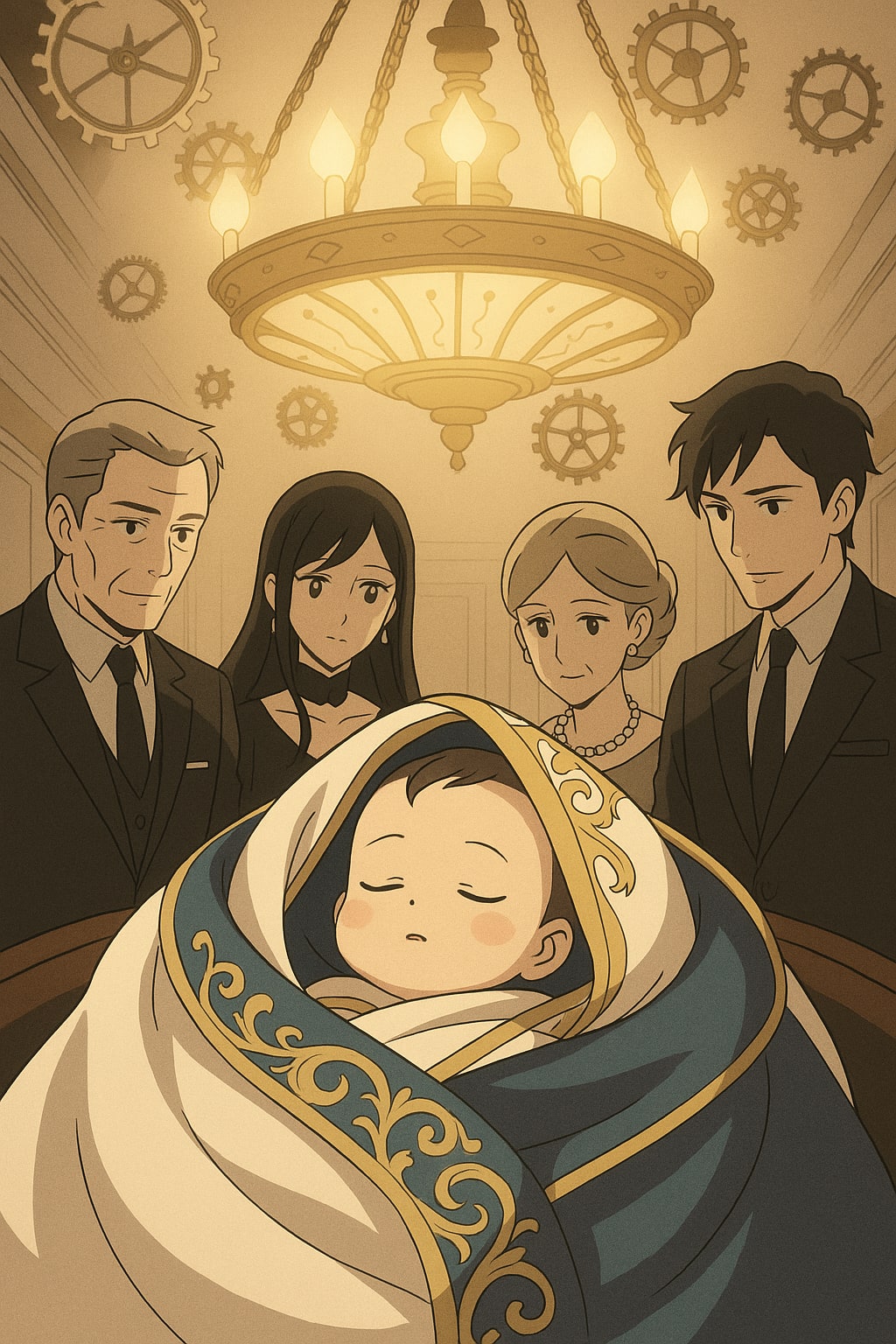
Chapter 1: The Weight of Inheritance
Power isn't inherited—it's imposed.
I learned this the moment I drew my first breath, when the world seemed to hold its breath with me. My uncle, a man who had lived in penthouses for two decades and witnessed every excess wealth could buy, called my birth "the grandest celebration he'd ever seen." Coming from someone who'd attended the coronation of oil princes, that meant something.
In our family, power wasn't privilege—it was birthright. We carried abilities so rare they bordered on myth. My father could bend time itself, reversing moments with a gesture or accelerating reality to suit his needs. My mother wielded shadows like living weapons, shaping darkness into blades or veils that could hide armies.
Both were extraordinary. Both were untouchable.
I was promised something greater.
Memory manipulation—the ability to rewrite a person's past, erase their pain, or convince them I was someone else entirely. This power could reshape reality, alter histories, and bend human will. The world would become clay in my hands.
Yet as I grew, watching the family's obsession with control consume everything around us, I began to understand a fundamental truth: the promise of absolute power is the greatest lie ever told.
Chapter 2: The Discovery
The call came on a Tuesday morning that would fracture everything we thought we knew.
A supercharged mineral deposit had been discovered beneath our estate—crystals that could amplify supernatural abilities beyond any known limit. The Sheik's breathless voice crackled through the encrypted line, describing veins of power that pulsed with their own heartbeat.
At first, there was celebration. Our family stood on the precipice of becoming gods.
But power is a magnet for betrayal.
Within days, the discovery became a battleground. Family members who had shared meals and secrets now circled each other like predators. Some wanted to harvest the minerals immediately. Others demanded careful study. A few whispered of selling the information to rival houses.
My father deployed his time-manipulation abilities to freeze crucial moments during heated negotiations, buying space to think. But even time couldn't prevent the inevitable: when unlimited power becomes possible, family bonds become secondary to ambition.
The first assassination attempt came from my own cousin—a man I'd played chess with every Sunday for three years. The blade missed my throat by inches, deflected only by my mother's shadow-shield. As his blood pooled on the marble floor, I realized our legacy had always been built on a foundation of fear.
Chapter 3: The Shadow Falls
My mother's scream still echoes in my dreams.
It happened during what should have been a routine family council. The same cousin who had tried to kill me had spent weeks corrupting my mother's connection to the shadows, feeding her power source with poisoned memories until her abilities turned against her.
When she tried to summon her defensive shadows, they wrapped around her throat instead.
I watched her collapse, not dead but hollowed out—her supernatural abilities severed, her confidence shattered. The woman who had once commanded darkness now flinched at her own reflection.
That night, I understood what my father had tried to protect me from. Power doesn't corrupt—it reveals. The hunger for control had always been there, sleeping in our blood like a virus, waiting for the right moment to consume everything we claimed to love.
As I sat beside my mother's bed, watching her struggle to remember her own name, I made a decision that would define everything that followed: I would not become them.
Chapter 4: The Severing
My father's solution was exile disguised as education.
"You're too dangerous to remain here," he said, his voice carrying the weight of centuries. "Not because of what you might do to others—because of what they will do to you."
He was right. I had been born with the most coveted power in our lineage, and that made me both weapon and target. Every family member who looked at me saw either an ally to cultivate or a threat to eliminate.
The facility he chose was hidden in a small mountain nation, far from the reach of our family's influence. They gave me a new identity, suppressed my memories, and enrolled me in a school where supernatural abilities were forbidden knowledge.
For the first time in my life, I was nobody special.
It should have been liberating. Instead, it felt like death.
Chapter 5: Jack O'Toledo
Jack didn't believe in impossible things—which made him the most dangerous person I'd ever met.
While other students at the academy worried about grades and social hierarchies, Jack questioned everything. He had a gift for reading people's emotions, not through supernatural means but through careful observation and intuitive understanding. He could sense what people wanted, what they feared, and what they'd do to get it.
More importantly, he wasn't impressed by power.
"You're hiding something," he said during our second conversation, his green eyes studying my face with uncomfortable intensity. "Not something you've done—something you are."
I deflected with humor, but Jack persisted. He had a theory that the world was controlled by people who wanted others to believe they were powerless, and he was determined to prove it.
When he suggested we spend winter break on a remote island he'd discovered, away from supervision and surveillance, I agreed. Not because I trusted him—but because I was tired of being afraid.
Chapter 6: The Island
The island was supposed to be sanctuary.
Instead, it became a crucible.
We'd barely established our camp when the rogue superhumans found us. They weren't random criminals—they were organized, equipped, and they knew exactly who I was. The ambush was surgical, designed not to kill but to test my abilities under pressure.
When they threatened Jack, I broke my father's conditioning and used my power.
I erased their memories of the encounter, implanting false recollections that would send them away. The technique worked perfectly—they left us alone, convinced they'd searched the island and found nothing.
But power always extracts a price.
As their memories dissolved, so did pieces of my own. I lost the sound of my first teacher's voice. I forgot the smell of my childhood bedroom. Each use of my ability carved away another fragment of my identity, leaving me more powerful but less human.
Jack watched it happen with growing horror. "You're disappearing," he said. "Every time you use that gift, you lose something you can't get back."
He was right. But by then, it was too late to stop.
Chapter 7: The Return
We returned to the mainland as different people.
Jack had seen too much to pretend the world was normal. I had tasted my own power and found it both intoxicating and terrifying. The careful balance my father had tried to maintain was shattered, and there was no going back to the person I'd been before.
The message was waiting when we reached the academy: my family was at war with itself.
The mineral deposits had been fully excavated, but instead of bringing prosperity, they had accelerated the family's destruction. Power amplified by supernatural crystals had driven my relatives to madness. They were consuming each other in an orgy of betrayal and violence.
My cousin—the one who had tried to kill me—had emerged as the strongest. He had absorbed the abilities of the family members he'd murdered, becoming a grotesque amalgamation of stolen power. Now he ruled from my father's throne, wearing my mother's shadows like a crown.
And he was looking for me.
Chapter 8: The Vanta System
The letter arrived on midnight-black paper, sealed with a symbol I didn't recognize but somehow understood.
My cousin had created something new—a technological system called Vanta that could track, rank, and control every person with supernatural abilities. It assigned numerical values to power levels, monitored loyalty through biometric scanning, and punished betrayal with automatic execution.
The system was elegant in its horror. It had transformed my family from a chaotic group of individuals into a precise hierarchy of oppression. Everyone knew their place, their value, their expiration date.
But the system had one weakness: it couldn't track what it couldn't measure.
People like me, who existed outside its parameters, were invisible to its sensors. We were unranked—ghosts in the machine, free to move but forever hunted.
The letter contained an ultimatum: submit to ranking within seven days, or watch everyone I'd ever cared about die.
Jack found me burning the letter in the courtyard. "We're not going back," he said.
"I know," I replied. "We're going to destroy it."
Chapter 9: The Hollows
The rebellion had a name: The Hollows.
Hidden in an abandoned military complex, they were a collection of unranked individuals who had escaped or been expelled from the Vanta system. Their leader, Del Sarin, had once been ranked fourth in the global hierarchy before she chose exile over submission.
"Power without freedom is just slavery with better benefits," she told me during our first meeting. "The question is: what are you willing to sacrifice for liberation?"
The training was brutal. I learned to use my memory manipulation not just on individuals but on groups, creating shared false experiences that could turn armies against each other. Jack developed his empathic abilities until he could project emotions across entire crowds, turning rage into compassion or fear into courage.
But the most important lesson came from watching the other rebels. They had all lost something in their fight for freedom—family, identity, sanity. Power always demanded payment, and the currency was always what you couldn't afford to lose.
Chapter 10: The Virus
The plan was audacious in its simplicity.
During the annual ranking ceremony, when all family members gathered to renew their Vanta registrations, I would infiltrate the system's core and plant a virus—a corrupted memory loop that would convince the system I was dead while marking my cousin as the source of the breach.
The virus was built from my own altered memories, fragments of identity I was willing to sacrifice for the greater good. Each piece I carved away made me less human but more dangerous to the system that couldn't classify what it couldn't understand.
Jack and I infiltrated the ceremony disguised as maintenance workers. The vault beneath the Hall of Heirs was protected by psychological traps designed to exploit the intruder's deepest fears. I relived my mother's betrayal and my own exile while Jack anchored me to reality through shared emotion.
When we reached the core, I pressed my hand against the central processing unit and let the virus flow into the system like poison into blood.
Within hours, Vanta began to collapse. Power rankings fluctuated wildly. Family members turned on each other as the system's commands became contradictory. My cousin, driven mad by his inability to control the chaos, declared martial law.
But it was too late. The virus had already spread through every connected system, creating a cascade failure that would take years to repair.
Chapter 11: The Price of Freedom
Victory tasted like ash.
I had achieved the impossible—I had become truly unranked, invisible to every system designed to control supernatural individuals. But the cost was higher than I had imagined.
The virus had required me to sacrifice core memories to function properly. I could no longer remember my father's face clearly. My mother's voice had become a whisper. The names of childhood friends had dissolved into static.
Jack held me as I wept for losses I couldn't fully recall, his empathic abilities allowing him to feel the hollow spaces in my mind. "You saved everyone," he said. "But who's going to save you?"
We fled to a coastal town where nobody cared about power or politics. For the first time in my life, I was truly free—and completely alone with myself.
Chapter 12: New Beginnings
The town of Driftlow existed in the spaces between worlds.
Here, retired superhumans ran fishing boats while cyborgs repaired old machinery. Nobody asked questions about your past or your abilities. The only currency was what you could contribute to the community's survival.
Jack and I found work in a memory clinic, helping people recover from traumatic experiences. My power, so destructive in the hands of my family, became a tool for healing. I could lift the weight of unbearable memories or strengthen the recall of happier times.
It was during one of these sessions that I met Aya.
She was a young woman whose memories had been systematically destroyed by the Vanta system, leaving her with fragments of identity scattered across her consciousness. As I worked to help her recover, I discovered something that changed everything.
She remembered my brother—alive, imprisoned, and being used as a living battery to power the system's core functions.
Chapter 13: The Rescue
We returned to the ruins of my family's estate under cover of darkness.
The Vanta system had partially recovered from my virus, but it was still fragile, held together by jury-rigged connections and desperate patches. My brother was suspended in a crystalline chamber, his time-manipulation abilities being harvested to maintain the system's temporal stability.
The rescue required everything I had learned about power and sacrifice. I had to choose between saving my brother and maintaining the system's collapse. If I freed him, Vanta would stabilize. If I left him, the system would eventually fail but he would die in the process.
Jack made the decision for me. "Some things are worth more than victory," he said, and began disconnecting the chamber's power feeds.
As my brother's eyes opened for the first time in months, I felt the weight of family love—not the twisted obligation that had defined my childhood, but the simple truth that some bonds transcend power.
Chapter 14: The Architect
My brother's first words were a warning: "He's still here."
The First Architect, the original designer of the power hierarchy that had enslaved my family for generations, had never truly died. His consciousness had been preserved in the system's core, guiding its evolution from the shadows.
Now, with Vanta damaged and my family scattered, he was making his move. Through corrupted memory fragments and possessed agents, he began rebuilding the system stronger than ever. This time, it wouldn't just control supernatural individuals—it would control the very concept of identity itself.
The new system, Vanta Prime, would assign not just power rankings but names, personalities, and life purposes. Free will would become a historical curiosity.
As we fled the collapsing estate, I realized the war was far from over. I had won a battle against my family's tyranny, but the true enemy had been using us all along.
Chapter 15: The Choice
Standing on the cliffs overlooking the burning ruins of my childhood home, I faced the hardest decision of my life.
I could disappear into anonymity, live quietly with Jack and my brother, and let the world fight its own battles. The cost would be measured in millions of lives enslaved by a system I had the power to destroy.
Or I could embrace the role I had been born to play—not as heir to a corrupt legacy, but as the virus that could bring down the entire structure of supernatural oppression.
Jack took my hand. "Whatever you choose, I'll follow."
My brother, still weak from his imprisonment, managed a smile. "You already know what you're going to do."
He was right. I had always known.
I turned away from the sunset and back toward the war.
Epilogue: The Unranked
They call me the Unranked now—the one who exists outside all systems, the ghost in the machine of power.
My true name has been forgotten, erased by my own hand to protect those I love. But names are just labels, and I learned long ago that identity runs deeper than any system can measure.
I am the son who chose love over legacy.
I am the heir who burned his inheritance to light the way for others.
I am the memory that refuses to be erased.
And I am coming for the Architect.
About the Creator
Enjoyed the story? Support the Creator.
Subscribe for free to receive all their stories in your feed.
Comments
There are no comments for this story
Be the first to respond and start the conversation.