Classical
The Garden That Forgot to Bloom
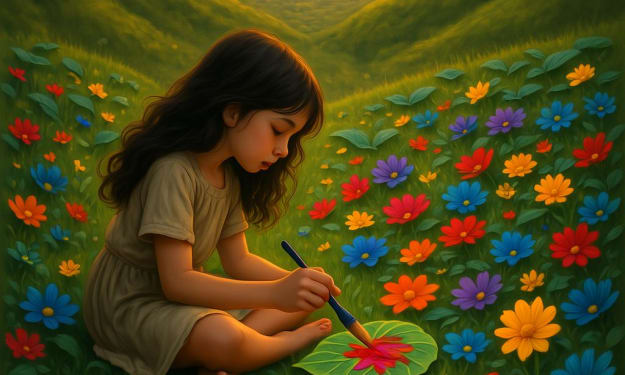
There was once a garden where no flower ever bloomed. It lay between two quiet hills, wrapped in the arms of a forgotten valley. The earth was not dead, and the sun did not hide. Rain visited kindly, and the wind whispered lullabies across its skin. Yet, no color ever rose from the ground. Only leaves. Only stems. Only green—and nothing else. The villagers called it the Hollow Garden. Many believed it was cursed. Some blamed the seeds. Others whispered that the soil was jealous of the bright meadows blooming beyond the hills. But whatever the reason, the garden remained mute in its silence. Year after year. Season after season. Then one day, a girl arrived. Her name was Lila. She was not from the village, and nobody knew why she came. Her eyes looked like they had once held entire storms. Her hands were small, but they carried the quiet weight of something she never spoke about. When she first walked into the Hollow Garden, she did not dig, she did not plant, and she did not water. She sat. Right in the center of the garden, among the stems and silent soil, she simply sat. And she listened. Not with her ears, but with her silence. She listened with her breath, with her stillness, with her open palms resting softly against the earth. It was as though she was listening not for sound, but for feeling. The villagers watched from afar. Some laughed. Some shook their heads. Some whispered that she must be broken too, just like the garden. But Lila kept coming back. She did not speak. She did not try to change the garden. But over time, she began to hum. Softly. Gently. The kind of humming that sounded like a lullaby only the soul could hear. Her voice was cracked, like a dried riverbed after a cruel summer, but it carried warmth. A warmth that filled the empty space without asking anything in return. Days passed. Then weeks. The garden remained green. Only green. But something had shifted. The wind began to circle the valley more often. It carried her hums like invisible threads through the leaves. Birds started to visit again, resting on bent branches. Even the rain lingered longer, as if curious to watch. Then one morning, Lila brought a basket. It was not filled with seeds or tools, but with paintbrushes. Dozens of them, and pots of paint in every color the eye could imagine. She sat in the garden and began to paint the leaves. Red, blue, yellow, orange—petal colors blooming on plain green leaves. The garden, surprisingly, allowed it. It let her color its silence without resistance. By evening, it looked as though the valley had finally bloomed. “It is only paint,” the villagers said. But still, they came. One by one. Some brought food. Some brought stories. Others brought songs. The garden became a place not of flowers, but of people. They laughed. They wept. They sat. They listened. And then, something unexpected happened. A single flower bloomed. A pale yellow daisy, hidden near a rock. So quiet and soft, it could have been mistaken for memory. Nobody noticed it the first day. Or the second. But on the third, a small boy pointed and shouted, “Look! It is real!” Lila smiled. Not because a flower had finally bloomed, but because someone had finally seen it. By the end of the season, ten more had bloomed. Quietly. Naturally. Not because of magic, or perfect soil, or any special method. But because something inside the garden had healed. Lila never said goodbye. One morning, she simply left—with the same silence with which she had arrived. The villagers kept visiting the garden. They stopped calling it Hollow. They gave it a new name. The Listening Garden.
By Muhammad Abuzar Badshah about a year ago in Fiction
The Diamond Treasure in the Depth of the Sea
Long ago, beneath the surface of the Southern Sea, there existed a hidden underwater kingdom known as Sirena. Protected by glowing coral walls and ancient sea magic, Sirena thrived in silence, unknown to the surface world. At the heart of its power was a legendary jewel called The Heart of the Abyss—a massive diamond that pulsed with light, magic, and life.
By Engr. Mansoor Ahmadabout a year ago in Fiction
Beneath the Crimson Sky
The sky had bled for years. It wasn’t always this way, or so the old ones said. Once, the sun rose golden and warm. Clouds were white and soft as feathers. Rain fell clear, not black and acidic. But those days were gone—swallowed by the flames that turned the heavens crimson and the earth to ash.
By abidnaseemabout a year ago in Fiction
The Bench Under the Old Tree
Fifteen years. That’s how long it had been since Arman last stood at the edge of that rusted gate, staring into the park where his childhood used to live. The wind still whispered through the branches of the massive old tree in the center, just as it did on that unforgettable evening—the one where everything changed.
By Soul Pagesabout a year ago in Fiction
Greek Mythology
Gaia: The Mother of Greek Mythology Gaia's Place in Mythology Gaia, one of the most fundamental figures of Greek mythology, is considered the mother of all living things, mountains, seas and sky, not just the gods. She is "Mother Earth" – one of the first conscious beings in the universe and the basis of life. One of the first formations born in the wake of Chaos, Gaia is not only a mythological character, but also a symbol of cosmic order, fertility, and universal balance.
By Remzi Kazdalabout a year ago in Fiction
A Child’s Dream of Mars. AI-Generated.
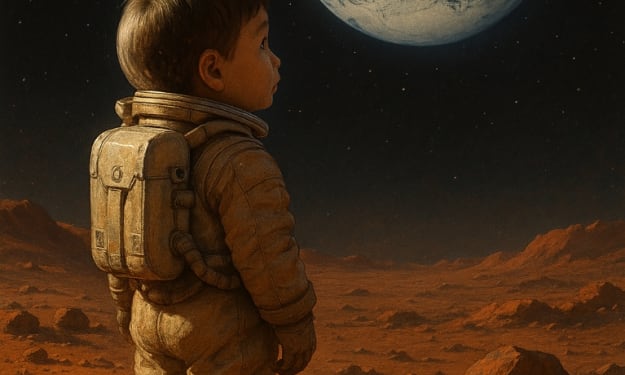
1. The Boy Who Watched the Sky In a small, crowded city, nestled between concrete towers and tangled wires, lived a boy named Aasim. At just twelve years old, he had one peculiar habit—every evening after school, he would climb the stairs to the roof and just stare at the sky. While other kids played video games or chased after cricket balls, Aasim watched the stars appear one by one. He didn’t just see light. He saw possibilities. Routes. A calling. He didn’t come from wealth. His parents worked hard to provide food, schooling, and shoes that barely lasted a year. But Aasim had something rare: clarity of purpose. He didn’t want to be rich. He wanted to walk on Mars. 2. The Quiet Genius in the Classroom At school, Aasim was an average kid in most subjects. But in science—especially physics and astronomy—he came alive. He built paper models of rockets. He memorized every planetary orbit. He taught himself to calculate gravity on other planets, just for fun. When the school held a science fair, most students brought simple models. Aasim presented something different: “Mars Habitat for Child Survivors” — a protective space capsule designed to shelter children on Mars. The judges, visiting scientists from a global research alliance, were stunned. 3. A Future That Was Already Here The year was 2038. Humanity had already placed colonies on the Moon. Mars was the next frontier. Space travel had become faster. AI-managed spacecraft could now reach Mars in three months instead of seven. The world had changed, and space was no longer science fiction—it was a career. Aasim applied for a global space cadet program—a competitive internship designed for youth researchers to assist in Mars exploration. He didn’t expect much. He was just a kid from a crowded neighborhood. But a few months later, he received a message that changed his life. > “You’ve been selected for the Youth Mission to Mars.” 4. Leaving Home, Entering the Unknown At fourteen, Aasim left everything he knew. He boarded a sky elevator that took him into orbit. From there, he boarded a transfer shuttle bound for Mars. The three-month journey was both beautiful and brutal. Microgravity was fun—for a while. Loneliness was harder. Food was bland. Silence was constant. But Aasim carried a secret. A prayer from his mother. A handwritten note from his little sister. And a dream bigger than fear. He wasn’t just a boy. He was a seed, sent to grow on another planet. 5. First Steps on Red Dust When the lander touched the Martian surface, Aasim was among the first to step out. He didn’t jump in excitement. He simply fell to his knees and placed his forehead on the red soil. He whispered, > “Let my steps here benefit the world. Not just me.” He began working with senior scientists on a critical problem: Creating sustainable life systems—oxygen, food, and water on Mars. 6. The Discovery That Changed Everything While analyzing Martian soil, Aasim discovered microbial activity in a deep cave zone. The microbes produced trace amounts of oxygen—naturally. No one had seen this before. It was the missing piece for long-term survival on Mars. Suddenly, Aasim wasn’t just a cadet. He was a symbol. Not of genius. But of possibility. The media called him “The Quiet Star Walker.” 7. Homecoming and Humility After 18 months, Aasim returned to Earth. He had grown taller, quieter, stronger. Reporters wanted drama. He gave them depth. > “I didn’t go to Mars for fame,” he said. “I went so that kids with dreams, not resources, could believe again.” He didn’t care for interviews. He cared for education. He started a foundation to support space science in underprivileged schools. He wrote books for children, in simple language, explaining black holes, planets, and hope. Final Thoughts Aasim’s journey wasn’t just from childhood to space. It was from imagination to action. He didn’t carry flags. He carried prayers. And he proved one truth: > You don’t need to be born into greatness. You can rise to it. We may never all reach Mars. But through Aasim’s story, we’re reminded: Sometimes, all it takes is a rooftop, a restless mind, and a refusal to stop dreaming.
By Kaleem Ullahabout a year ago in Fiction