Adventure
The Whispering Room
It was supposed to be just another urban exploration trip a weekend escape from the noise of the city. For years, people in the nearby town of Millcreek had whispered about the Holloway Farmhouse, a place abandoned since the 1970s. Locals claimed that at night, if you got close enough, you could hear your own name being called from inside.
By kashif khanabout a year ago in Fiction
Rain, Tea, and Timeless Words
Rain, Tea, and Timeless Words A heartwarming story of connection, calm, and the beauty of conversation. The rain had arrived softly, as if the sky were whispering secrets to the earth. It tapped gently on the roof of the little cottage at the edge of the hill, drumming a rhythm that felt like an old, familiar lullaby. Inside, the air smelled of cardamom and honey. A teapot steamed quietly on a wooden tray, accompanied by two handmade cups and a plate of warm biscuits. The scent of the tea drifted into the open air, dancing with the fresh petrichor that seeped through the window screens. Maya stood at the edge of the veranda, watching the raindrops slide down the leaves in the garden. The world seemed to shimmer in green and silver, like nature had been freshly painted. She turned slightly and smiled. “You always knew when to come,” she said. Across from her, seated in a wicker chair with a soft shawl draped around her shoulders, sat Lila—her oldest friend. Time had added a few silver strands to their hair, a few gentle lines around their eyes, but it hadn’t touched their laughter, or the comfort of their quiet conversations. “I think the rain sends me invitations,” Lila replied, smiling back. “And your tea seals the deal.” They laughed—softly, but freely. The kind of laughter that doesn’t chase silence away but fills it with light. As they sat with their tea, the garden unfolded before them like a peaceful painting. Birds rustled under leaves, the flowers swayed, and the occasional breeze carried the scent of jasmine. “Do you remember,” Maya began, “how we used to sit like this when we were twenty? Rainy afternoons with tea and dreams.” Lila nodded, her eyes twinkling. “We planned everything on those days. Where we’d live, the books we’d write, the cafés we’d open…” “…the mountains we’d climb,” Maya added, grinning. “We never opened the café, but we did find our mountains.” They paused, sipping their tea. The conversation wasn’t urgent—it never was between them. It flowed naturally, like the stream that ran just beyond the garden fence. “What I love about us,” Lila said after a moment, “is that we never stopped making space for days like this. Even when life got loud.” Maya nodded thoughtfully. “Tea, rain, and real words. That’s our ritual. No pretending. Just presence.” Outside, the rain thickened for a few minutes, softening the landscape into a watercolor. Inside, the warmth of the tea and the glow of their conversation made the room feel like a haven. “Do you think people still talk like this?” Lila asked. “Without phones, without noise—just words and wonder?” Maya tilted her head. “Some do. Some are learning again. I think the world is remembering the value of slowness. Of listening.” There was a silence then—not empty, but full of meaning. The kind of silence only deep friendship allows. They watched the world breathe. Suddenly, Lila reached into her bag and pulled out a small notebook, its cover worn and soft at the edges. “I brought this,” she said. “It’s something I’ve been writing. Thoughts, poems, little moments I don’t want to lose.” She handed it to Maya, who opened it gently, as if holding something sacred. The pages were filled with neat, flowing handwriting—some playful, some profound. One short poem caught her eye: Rain remembers every story, Even the ones we whisper in silence. Tea listens better than most people. And time— Time waits, when love is true. Maya looked up, eyes misty. “It’s beautiful,” she whispered. Lila smiled. “You inspired most of it. Our talks. These afternoons.” They sat for a while longer, reading and sipping, until the rain began to slow, and golden light broke gently through the clouds. The garden sparkled as if it had been dusted with diamonds. Before Lila left, they hugged tightly, the kind of hug that says thank you for being part of my life’s story. As she walked down the stone path, umbrella in hand, Maya called out, “Same time next rain?” Lila turned, grinning. “Always.” Maya returned to the veranda, poured herself the last of the tea, and sat quietly. The sky had cleared, but the feeling of the rain lingered like a memory—soft, fresh, and full of life. She picked up Lila’s notebook again and wrote a line on the last page: Some friendships are brewed like tea—warm, strong, and better with time.
By Muhammad Saad about a year ago in Fiction
The Night of Dreams
The night was unlike any other. The city lights faintly battled the soft glow of the moon, casting long shadows that merged with the quiet of the streets. To Amna, it seemed like just another evening, yet something felt different. Her mind was restless, filled with swirling thoughts of dreams that never let her sleep peacefully. As she closed the door behind her, a sense of unease filled the air — the line between what was real and what was imagined had begun to fade.
By Muhammad yarabout a year ago in Fiction
A Puzzle-maker's Lament
Elias’s workshop was a sanctuary of silent questions. Wood shavings carpeted the floor like fallen leaves, and the air smelled of cedar and old secrets. He was a puzzle-maker, an artisan of exquisite confinement. The wealthy and powerful came to him not for furniture, but for beautiful prisons—intricate boxes to hide deeds, jewels, or shame.
By Habibullahabout a year ago in Fiction
The Cog-Boy of Aethel. AI-Generated.
Master Elara Vance found him three hours later. The workshop that had once been Baron Von Greed's private laboratory was now a scene of controlled chaos. Academy artificers worked alongside city engineers to catalog the Baron's equipment (the man himself had vanished in the confusion following the resonance cascade). Awakened automatons wandered the space, some weeping electronically as they rediscovered their suppressed memories, others simply marveling at the return of choice to their existence.
By Shane D. Spearabout a year ago in Fiction
The Second Chance Garden
The air in the geodesic dome was thick with the scent of damp earth and blooming jasmine—scents that had died everywhere else. Elara was the keeper of the Last Garden, a secret place where the flora of a lost Earth thrived under an artificial sun. But the garden’s true magic was hidden in its soil, a unique mycelial network that could feed on more than just water and nutrients. It could consume regret.
By Habibullahabout a year ago in Fiction
Shining Through: The Best World Record of 2025
In a year that many expected to be like any other, 2025 surprised the world with something extraordinary — a global movement so powerful, it set a world record no one had ever imagined possible. Not for speed, strength, or technology — but for kindness. It all began in January, when a small school in Finland launched a project called "Kindness Chain". The goal was simple: every student had to perform one act of kindness and then encourage the person they helped to pass it on. The idea quickly spread across social media, catching fire faster than any viral challenge before it. Within weeks, thousands of people in dozens of countries were joining in — planting trees for strangers, helping the elderly with groceries, sending supportive letters to people they’d never met, and donating food and clothes in record amounts. The hashtag #PassItOn2025 trended globally, and for the first time in years, positive news was leading every headline. Then, something unexpected happened. In March, the Global Goodwill Council, a non-profit international watchdog for humanitarian efforts, began documenting the movement. They counted over 700 million confirmed acts of kindness by April — an all-time world record. But more than the numbers, what shocked everyone was how the movement had spread to places once divided by conflict, politics, or pain. In a small town in Syria, children from formerly opposing groups planted olive trees together. In Brazil, a youth group cleaned up entire neighborhoods, then taught digital skills to elderly locals. In India, a community pooled resources to build homes for displaced families. Across oceans and borders, kindness became the world’s most powerful common language. By June, schools, companies, hospitals, and even governments began organizing large-scale "positivity days." Businesses gave employees paid time to volunteer. Hospitals saw patient recovery improve when kindness programs were introduced. Some cities reported a measurable drop in crime rates, linking it to the growing culture of empathy and community care. Perhaps the most emotional moment came on World Kindness Day, November 13th. Coordinated across 193 countries, over 1 billion people participated in the largest synchronized human chain ever recorded — physically and digitally. People joined hands in real life or shared live selfies online with heartfelt messages of unity. From the snowy mountains of Canada to the deserts of Africa, the image of humanity, hand-in-hand, circled the Earth. The Guinness World Records confirmed it as the largest collective human event in history. News outlets dubbed it “The Year the World Remembered Its Heart.” The story of 2025 became more than a trend — it became a testimony to the strength of compassion. The United Nations honored the movement with a new global observance: The International Day of Kindness and Unity, to be celebrated every year on the third Saturday of November. The event would serve as a reminder that the greatest changes don’t always come from big inventions or political breakthroughs — sometimes, they start with small, selfless acts. And while the official record was noted, most people involved didn’t care about the numbers. What stayed with them were the connections they formed, the smiles they saw, and the healing they felt — both in others and in themselves. As the sun set on 2025, one truth remained clear: in a world often overwhelmed by noise and division, the quiet power of kindness had shone through, louder and brighter than anyone ever expected. It wasn’t just a record. It was a revolution — of hope, unity, and the simple belief that one good deed can truly change the world.
By Muhammad Saad about a year ago in Fiction
The Echo Chamber Breaker
Kael’s world was a symphony of agreement. As a Senior Curator for the Aethel Network, his job was to fine-tune the Consensus—the seamless, personalized reality stream fed to every citizen. The AI did the heavy lifting, but Kael and his colleagues were the artists, smoothing the last rough edges, ensuring the flow of information was harmonious, positive, and affirming. Conflict, tragedy, and offensive opinions were not censored; they were merely edited for clarity and comfort. It was a perfect world, and he was one of its architects.
By Habibullahabout a year ago in Fiction
Love in the Last Train Car
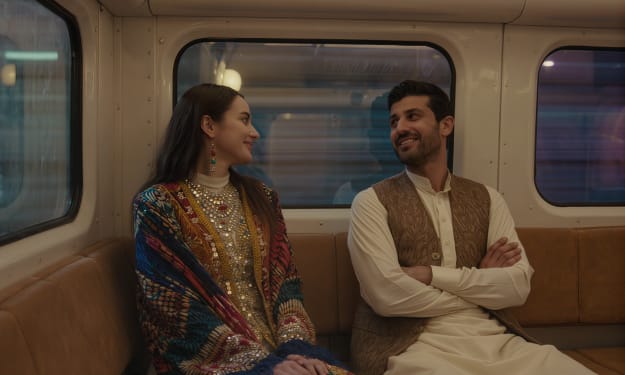
Love in the Last Train Car The train rattled down the tracks, its dim lights flickering across the empty car. It was the last ride of the night, the one most people avoided, leaving the weary or the restless to occupy its lonely seats. Emma sat by the window, her coat pulled tightly around her, a paperback novel resting unopened on her lap. She wasn’t reading—not really. Her mind was tangled in the thoughts of the day: work emails, her mother’s call, and the small ache of loneliness that had been creeping in for weeks. Across from her, a man with tousled hair and a worn leather jacket boarded the train. He carried a small backpack slung over one shoulder and scanned the nearly empty car, his eyes lingering for a seat that wasn’t too far from the exit. Their eyes met for a fleeting moment, an acknowledgment of shared solitude, before he settled in the seat diagonally across from her. The silence of the car was comforting at first, broken only by the rhythmic clatter of wheels over tracks. Emma glanced at him occasionally, noticing the way he absentmindedly tapped a pen against his notebook. He wasn’t texting, wasn’t scrolling—he was writing. Curious, she wondered what could demand such focus at this hour. Minutes passed before the unexpected happened. The train lurched slightly, and her book slid from her lap, landing at the man’s feet. He bent down, picking it up. “Here, I think this belongs to you,” he said, holding it out with a small, polite smile. Emma thanked him, her voice quieter than she intended. Something in his eyes—a spark, a recognition, a warmth—made her hesitate before returning the book. “I don’t usually ride this late,” she admitted, tucking the book back into her lap. “Neither do I,” he replied. “It’s… peaceful, though. Kind of like the city sleeps just for us.” They shared a small laugh, the kind that felt easy and unforced. And then, for the first time that evening, Emma felt a strange, comforting sense of familiarity, as if she had known him longer than a few fleeting minutes. “What do you write?” she asked, nodding toward his notebook. “Stories,” he said, a little sheepishly. “Short ones, nothing fancy. And you?” “Nothing creative,” she said, shrugging. “I just read… usually too many things at once.” The man smiled knowingly. “Sometimes, reading is the same as writing. You absorb pieces of life and stitch them together in your mind.” Emma felt an odd resonance with his words. Conversation flowed naturally after that, first cautiously, then more freely. He told her about his job in a small publishing house, how he often stayed late reading manuscripts, and how he found solace in these late-night rides. She spoke of her work at a nonprofit, the long hours, the quiet victories no one else noticed. Somewhere between the third stop and the fourth, the train rattled through a dark stretch of tunnel, and time seemed to slow. Emma glanced at him and caught the flicker of a name tag on his backpack—one she almost didn’t recognize. “Wait…” she murmured. “Did you go to Riverview High?” His head tilted, surprised. “Yeah… Class of 2008. You?” Emma’s heart skipped. “Me too. Same year. You were—wait—you were in my science class! Mr. Halston’s… group project partner?” He laughed, the sound rich and familiar. “Emma? Emma Lewis? I can’t believe it! I’ve been thinking about you for years. Never thought I’d run into you like this… on the last train car of the night, no less.” Emma laughed too, the sound blending with his in the quiet car. How strange, how miraculous, to find someone who had been a part of her life long ago, tucked away in the corner of memory, now sitting just feet away. They reminisced about high school, the misadventures, the awkward dances, the long hours spent on projects they both secretly loved. He remembered how she used to correct his messy handwriting, how she always asked questions that made him think harder. She remembered how he always laughed at her jokes, even the bad ones, and how he had an uncanny way of making group work feel like less of a chore. As the train approached the final stop, neither wanted to break the spell. The world outside was quiet, illuminated by the occasional streetlight reflecting off wet asphalt. Emma felt a strange surge of courage, a desire to make this moment something more than a fleeting coincidence. “Hey,” she said, her voice soft, “I feel like we… we should continue this conversation. Maybe over coffee sometime?” He smiled, a mixture of relief and hope. “I was hoping you’d say that. Tomorrow?” “Tomorrow,” she agreed. The train slowed, brakes hissing as it neared the station. They rose together, their bags slung over shoulders, the shared history between them now stretching decades back, yet fresh as the night air rushing in. As they stepped off the train onto the empty platform, Emma couldn’t stop smiling. Somehow, the last train car of the night had become a doorway, not just to the station, but to a connection she had never expected to find again. And perhaps, she realized, it was the perfect time for life to give her a second chance. He offered his hand, which she took without hesitation. Together, they walked toward the city lights, two strangers who had been part of each other’s lives all along—finally reunited in the most unexpected of ways. The last train car had emptied, but it left behind something fuller, warmer, and infinitely more promising: the beginning of a story neither of them could have anticipated, but both were eager to write together.
By Abdul Muhammad about a year ago in Fiction
Morning walk and exercise
A New Dawn The sun had barely begun its gentle climb over the horizon when Meera tied her shoelaces and stepped out of her front door. The air was cool and crisp, carrying the earthy scent of dew-kissed grass and the faint sweetness of blooming jasmine from a neighbor’s garden. For years, Meera had promised herself she would start walking in the mornings. But life—work, family, excuses—always got in the way. That changed three months ago. After a routine checkup, her doctor gave her a gentle but firm warning: “Meera, your body is speaking to you. You need to listen.” Her blood pressure was rising, her energy levels were dipping, and sleep had become a nightly struggle. The prescription? A simple daily routine of walking and light exercise. So, on a chilly July morning, she began. The first week was tough. Her muscles protested, her mind begged to go back to bed, and her feet weren’t used to early-morning roads. But she kept going. Now, it had become a ritual. Not a chore—but a cherished part of her day. As she walked through the quiet park, the familiar rhythm of her feet on the gravel path was comforting. Birds flitted from tree to tree, chirping their morning greetings. A pair of squirrels chased each other around an old mango tree. Everything felt alive, fresh, and full of possibility. She passed Ravi uncle, a retired army man who never missed his 5:30 a.m. walk. He gave her a cheerful salute, which she returned with a smile. A little ahead, she saw Anaya, a college student who jogged with music in her ears and determination in her eyes. Every morning, their paths crossed—strangers tied together by the same unspoken commitment to health and peace of mind. After her 30-minute walk, Meera reached the yoga platform by the lake. She placed her mat down and began her stretches. The lake shimmered under the first rays of sunlight, and the gentle sound of water lapping against the stones brought a calm to her mind. Breathing in, she raised her arms to the sky. Breathing out, she folded into a forward bend. With each stretch, each breath, she felt more grounded, more grateful. Her mind wandered to how far she had come—not just in distance, but in mindset. She was sleeping better now, eating more mindfully, and feeling more energetic throughout the day. Her colleagues at the bank even commented on her glowing skin and lighter mood. But the biggest change? Her outlook on life. She no longer woke up dreading the day. Instead, she looked forward to her mornings—the time she had all to herself, free from deadlines, emails, and chores. A time when she connected with nature, her breath, and her body. It wasn’t about losing weight or looking a certain way. It was about feeling alive. One day, after finishing her routine, she sat by the lake and noticed a young boy sitting alone on a bench, hunched over and looking anxious. Something about his posture tugged at her heart. She approached him gently. “Are you okay, beta?” she asked. He looked up, startled, then nodded. “Just… worried about my exams. Can’t focus at home. I come here to clear my head.” Meera smiled and sat beside him. “You know, when I started coming here, I was worried too—about my health, my work, my family. But walking and breathing in this fresh air… it helps. Try it. Just a short walk.” The boy looked hesitant, but the next morning, Meera saw him walking slowly along the trail. She gave him an encouraging nod. Over the weeks, more familiar faces joined her morning circle—a new mother pushing a stroller, a retired teacher doing tai chi, a teenager listening to audiobooks while jogging. The park became a small, moving community. Strangers began smiling at each other, sharing stories, offering fruit or tea from thermoses. The quiet walks gave rise to quiet friendships. Meera realized that her morning walk was more than just a routine. It was a ripple of wellness—starting with her and spreading gently through her community. As October rolled in, the mornings grew cooler and the leaves rustled with a hint of gold. Meera added a light sweater to her outfit but kept her stride steady. Her body was stronger, but more importantly, her heart was lighter. Every morning, as the sun rose over the lake, it wasn’t just a new day. It was a new Meera.
By Muhammad Saad about a year ago in Fiction
When the Sun Didn’t Rise for 30 Days
When the Sun Didn’t Rise for 30 Days A Tale of Survival, Fear, and Hope in the Longest Night The sun is something most of us take for granted. We wake up with its first light, and we rest when it sets, knowing it will return the next morning without fail. But imagine a world where one day the sun doesn’t come back. Not for a few hours. Not for one long night. But for thirty days in a row.
By Farooq Hashmiabout a year ago in Fiction
Thin Line. Honorable Mention in Parallel Lives Challenge.
TBL Fingers with dirty nails shook as they struggled to tie bloody boot laces. Officer Perty was unsure of how his boots had come untied in the interaction. Blue and red light flashed around him, and he felt dizzy, sick, inhuman. ‘What have I done?’, he asked himself as he stood and looked at the body, the very small body of the man—boy that he’d just shot. Blood pooled around the body slowly, shining in the moonlight, reflections of the red and blue lights danced on the liquid. There was a buzzing in Perty’s ears, a low hum of blood pulsing through his own veins. His head was spinning with a deep pain, and his whole body vibrated with anxiety. Someone slapped his shoulder.
By Raine Fielderabout a year ago in Fiction