
Plainer in a Plane Land
Rise of the Spheres!


Poly lived happily in a 2-D world, her plane of life determined by three points: herself; her husband, Quad; and her little boy polygon, Trap. They were plain people living the plane life.
Quad was quite ordinary, all of his angles adding up to 360º. His were all righteous angles, but the ones that Trap had, although adding up to 360º, were skewed — two acute and two obtuse, and too dissimilar. So it goes with youth and naïvité.
When Trap grew older, he would sweep their plane for girls, and he often intersected with them. One day, however, he met "the 1," a lovely quadrilateral named Rhomba.
Rhomba liked Poly and Quad, but as her tangents with Trap increased in frequency, Poly felt she was being distanced from him. She knew what the shortest distance was, between the two of them, and she couldn't help but notice that intermediate points were beginning to define newly angled departures from the straight line. She began to see Rhomba as a strange attractor, leading Trap into fractal non-Euclidean indiscretions.
Quad, having such righteous angles, felt lines should not only be straight, but by the straight-and-narrow.
Perhaps Poly was too overbearing, a weightiness distorting their planar world. Such dents in the planar fabric caused each of them to circumnavigate, drawn to a strange Newtonian two-dimensional gravity. When Poly derived this coherency in her 2-D sensibility, she was pleased, as her family began to circle each other, approaching true intersections of mind.
But Rhomba added another dimension to the world — for Trap, anyway.
As their love deepened, they began to rise, that is, develop depth. Both Rhomba and Trap grew sides.
Rhomba did it first, since her angles were malleable. She experimented wildly with her body, pushing past 360º. She titillated her vertices. Her sides throbbed.
SHe also tried different religions. She joined the Parallelograms; she served at the altar of the Square. She even researched the very strange cult of Circles, which even Trap couldn't abide. In fact, when Romba massaged her vertices into her sides and became well-rounded, Trap could no longer follow her. His angles were what he felt made him, him.
Trap returned to the plane, descending into the common-sense reality determined by three points, yet was haunted by the possibilities. Could extensions of height and width determine self-actualization?
Poly regarded her son warily. Quad fretted. They knew such inclinations were a slippery slope (i.e., hazardous rise-over-run). She had known several friends, so tempted, who had vanished along what were theorized to be asymptotes.
Still, Trap wondered. How would his functions alter with other variables introduced--like ones of depth?
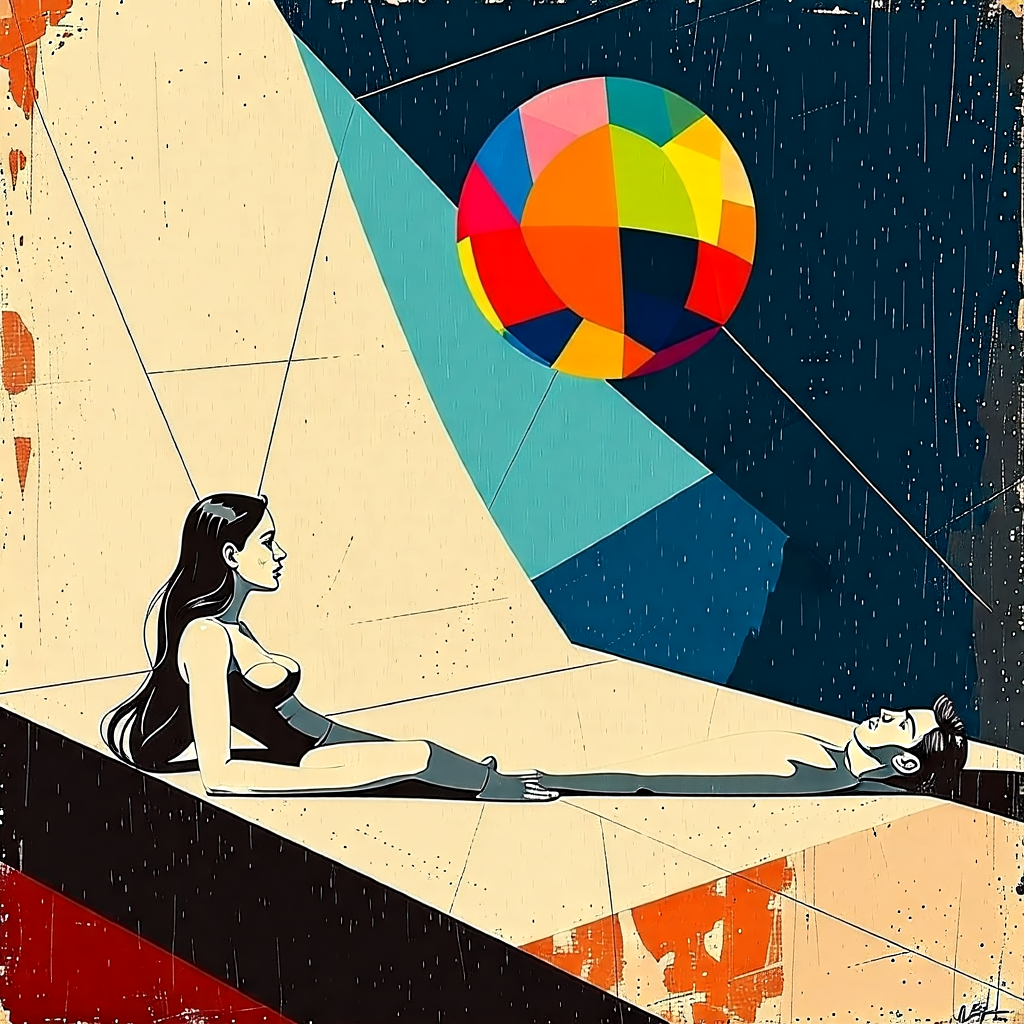
One day, a mysterious feature appeared on Poly's, Quad's, and Trap's plane. It began as a dot--a mere point. It began to grow. It widened. Radius and circumference enlarged exponentially, becoming an ever-widening circle changing colors.
Their plane scintillated in a variegated, hypnotic, stroboscopic display. Poly, Quad, and Trap were mesmerized.
Trap, however, having been exposed to spatial ambiance determined by three dimensions, recognized the truth. It was Romba! His love! How he had missed her.
But where Poly and Quad could only appreciate her surface features — a simple obscene circle--he saw the whole person.
For she was a sphere! A globe of multicolored enhancements of space, texture, and global existentialism. She was glorious.
He felt foolish. How could he continue living in only two-thirds of a world? He needed more dimension.
And so while he remained a simple trapezoid on Poly's and Quad's plain plane, he lived a secret, unseen life, in global ecstasy with his lover. They could look down on Poly and Quad, but Poly and Quad were unable to look up. Yet, they knew that their son was more than than just the 360º of his four angles; more than just four straight and narrow sides. More than just a simple quadrilateral. They suspected he was on an asymptote.
Poly lamented to Quad. "My tears need a minute to find the edges of my face. If you'll please excuse me." And with that, she was tempted to collapse into a line, albeit a straight and narrow one. But Quad had seen such collapse before and knew that there was a single endpoint that would surely follow.
Quad did not want singularity; he wanted dimensions to his love with Poly. And that's when he experienced a true epiphany:
Love is boundless. It really should be asymptotic. Multidimensional and growing. Cartesionally challenged, exponential, and unbound by geometry, planar or otherwise.
For Rhomba and Trap, they were now boundlessly in love, fractally recursive in their devotions to each other. But they still left--on that plane--a simple presence each, lined shadows that limited myopic, possessive beings could not fully appreciate, blind to the possibilities of space and time.
____________
WORD COUNT 799
Above is my homage to Flatland: A Romance of Many Dimensions, a satirical novella by the English schoolmaster Edwin Abbott Abbott, "a Square," first published in 1884.
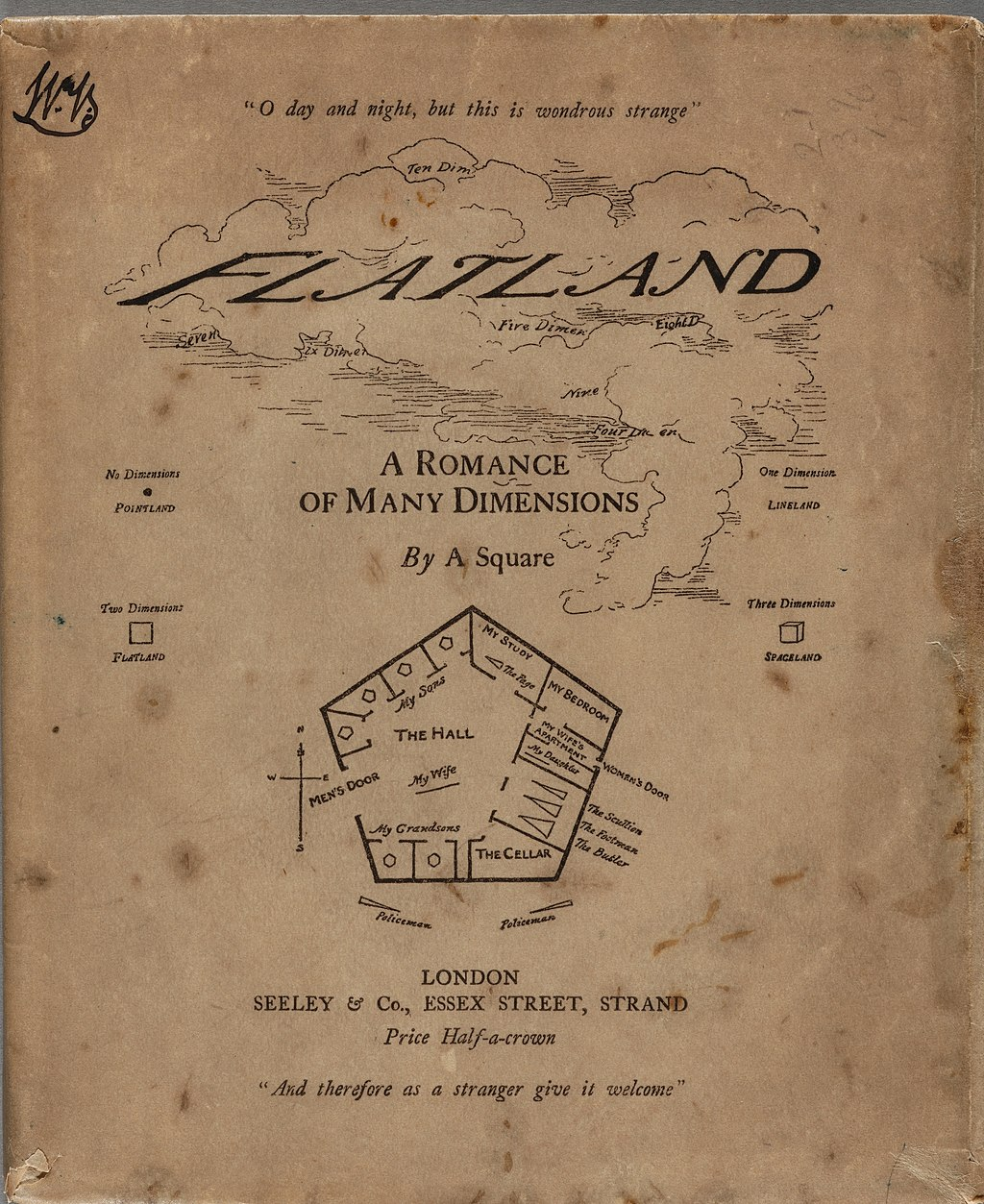
In 1957, a sequel came out, by Dionys Burger, Bolland : een roman van gekromde ruimten en uitdijend heelal, later translated in 1965 into Sphereland: A Fantasy About Curved Spaces and an Expanding Universe.

Subsequently to both, Flatterland, 2001, was written by mathematician and science popularizer Ian Stewart about non-Euclidean geometry.

THIS WAS A SUBMISSION TO CHRISTY MUNSON'S CHALLENGE: Munson's Microfiction: My Tears Need A Minute
About the Creator
Gerard DiLeo
Retired, not tired. Hippocampus, behave!
Make me rich! https://www.amazon.com/Gerard-DiLeo/e/B00JE6LL2W/
My substrack at https://substack.com/@drdileo
Enjoyed the story? Support the Creator.
Subscribe for free to receive all their stories in your feed. You could also become a paid subscriber, letting them know you appreciate their work.
Comments
There are no comments for this story
Be the first to respond and start the conversation.