
The Son Who Signed and Never Went In
In a dialysis unit, a father’s lifelong need to control left behind a son who would pay the bills and refuse the visit.
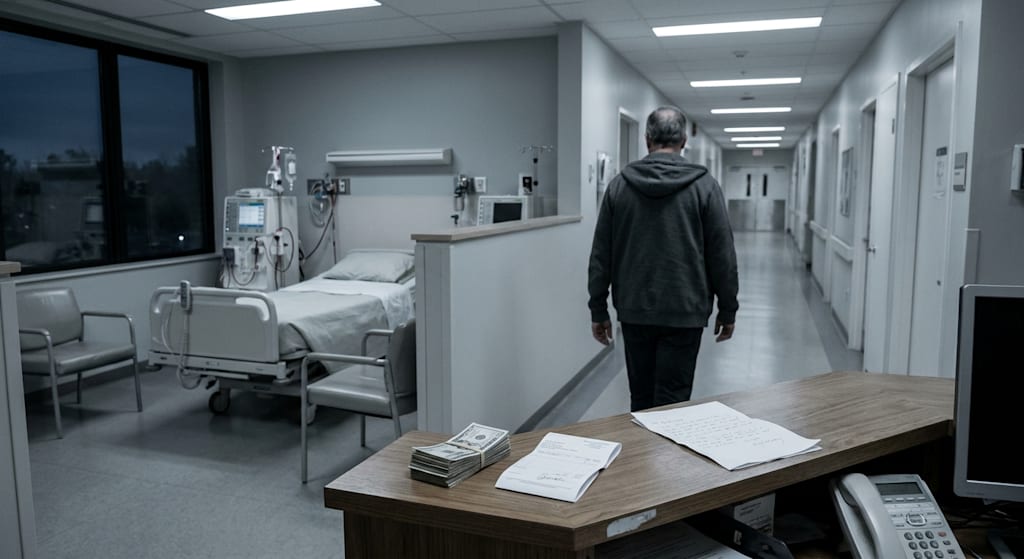
The dialysis unit’s shift schedule was posted on the back of the changing-room door. Lao Zhou’s name was fixed to the third shift on Tuesdays, Thursdays, and Saturdays. He had used the bed by the window for three years, and the nurses privately called it “the minefield.” He complained that the blood-pressure cuff was too tight, that fluid removal was too slow, and if the patient in the next bed so much as coughed, he would glare at them. Over time, everyone learned to say less when needling him: get the needle in, get out, don’t linger.
When he cursed, his voice still had plenty of force. You would not have guessed he had been on dialysis for years. He cursed health insurance, the cafeteria, and the old woman in the next bed for going to the toilet too often. One day he stopped mid-curse and said he did not have enough money this month.
The head nurse’s surname was Fang. She was in her forties and had run the dialysis unit for more than a decade. She did not interrupt him. First she recalculated his dialysis fee slip, then asked whether he had any family left. Lao Zhou lay there, eyes on the water stain on the ceiling, and said he had a son. The son had stayed with his mother after the divorce, and they had barely been in touch since. He should be doing well now. Nurse Fang asked for a name and a phone number. He mumbled them out, then added, Don’t call. Even if you call, he won’t answer.
Nurse Fang called anyway. The first call was hung up after three rings. The second time someone answered and said he was in a meeting. The third time Nurse Fang said, This is the dialysis unit at XX Hospital. Your father is on dialysis here. The fees are a problem. We need a family member to come in. The line was silent for a few seconds, then the man said, I’m very busy, and hung up.
Later the neighborhood committee stepped in. Nurse Fang never went into detail about what was said, but about a week later a man in a dark gray jacket came. He did not enter the ward. He stood outside the nurses’ station, took two stacks of cash out of his bag, and put them on the counter. He said, This is twenty thousand. It can only go toward dialysis. The money cannot be given to him, or who knows what he’ll spend it on.
When Nurse Fang later told us this part, she acted out how he put the money down: two stacks squared off neatly, face up, as if he were at a bank counter.
Nurse Fang asked, You won’t even see your father?
He said, I don’t want to see him. Not one look.
Nurse Fang tried once: He is your father, after all. With this illness, he could go at any time.
He did not argue. He did not even redden around the eyes. He just said, very evenly: Do you know what he was like when I was young?
Then he told her. Smoking and heavy drinking. Everything in the house had to go his way. He had to control everything and own everything. It made the house hard to breathe in. When his mother could not take it and asked for a divorce, he got worse. He threw things, sat in the living room smoking in the middle of the night, hid her salary card. At work he had enough ability to become a low-level manager, but he offended everyone above and below him. He always felt his talents were unrecognized, changed jobs, and because of his personality turned department against department until he was pushed to the margins. Then he quit and ran off to Shenzhen. Early on he did well there. Women threw themselves at him. That was when he agreed to the divorce. He had plenty of money, but he did not pay a cent of child support.
The son was raised by his mother, his maternal grandparents, his uncle, and his father’s mother. In his senior year of college, he found his father once through one of his father’s classmates. He hoped that when he started work he could have a computer to make things easier. His father said, You’re wrecking my family.
Later, the father lost his job, lost his family, the woman ran off, and he did not even have social insurance. Then he remembered he had a son.
After saying all this, the son folded the receipt, put it in his jacket’s inner pocket, and left. Nurse Fang followed him out and asked, Next time we call about a critical condition, this is the number, right? He did not turn his head. He said, Call it. I’ll come.
Lao Zhou did not know his son had come. Nurse Fang did not tell him about the money. She only said that part of it had been coordinated through health insurance and critical-illness assistance. He went on cursing as usual. He called his son ungrateful and young people nowadays heartless, until the old woman in the next bed asked to change beds. Once, in the middle of a curse, he asked Nurse Fang, Did you get in touch with him? Nurse Fang said, Don’t worry about the money. Just focus on dialysis. He turned his face to the window and said, That ungrateful wretch. If it weren’t for me back then…
He did not finish. Nurse Fang did not ask.
Later Lao Zhou had two cardiovascular complications, one heart failure and one hyperkalemia. Both times he was given a critical-condition notice. Nurse Fang called, and the son came. The first time he sat all night on a chair outside the ICU. He signed, swiped his card, and discussed the treatment plan with the doctors. He did not go into the ward. The second time was three in the morning. He came in slippers, signed, and bought a bottle of water from the vending machine at the end of the corridor. He took two sips and left.
Nurse Zhao once ran into him on night shift and said, Go in and take a look. He’s asleep. He won’t know you’re here. He said, No need. I don’t want him to know I came even when he’s awake.
When Zhao came back and told us, someone said the son had a hard heart. Someone else said he was already good enough to come sign and pay. Nurse Fang did not join in. She was sorting Lao Zhou’s unpaid bills and his son’s payment records, matching them one by one.
Lao Zhou’s third critical condition came in winter. When the son came to sign, Nurse Fang asked one more question: How long are you going to keep doing this? He said, Until he’s gone, I suppose. Nurse Fang said, You hate him. He watched the pen scratch across the paper and said, It’s not exactly hate. I just don’t want to see him. The moment I see him, I think of my mother sitting on the kitchen floor crying in the middle of the night. I think of my grandfather in his seventies still watching a warehouse to save money for my tuition. He paused, then said one more thing: A man who has been self-important and domineering his whole life is going to get it back. Look at him now. He is alive in a way he would have called pathetic.
When Nurse Fang later repeated this to us, she added: He said it with no expression on his face at all.
Lao Zhou is still on dialysis, three times a week, kept going by the money his son pays and by health insurance. He still curses, but his voice is a little softer now, maybe because his body is failing. The son still does not come into the ward. When there is a critical condition, he comes to sign and leaves. Once Nurse Fang said to him, Your father has been asking about you lately. He said, Asking what? Nurse Fang said, Just whether you’re still in Shenzhen. He said, What did you say? Nurse Fang said, I said you’re pretty busy. He nodded and left.
At lunch we still occasionally talk about it. A new young nurse asked, So is the son filial or not? Nurse Fang took a bite of rice and said, Don’t worry about whether he’s filial. Remember two things. First, when Lao Zhou curses, stop him when you need to. He’s a patient, not the boss. Second, when his son comes, he signs and pays. Don’t add your own advice and tell him to go in and see his father. The young nurse said, But what if Lao Zhou doesn’t make it? Nurse Fang said, If he doesn’t make it, his son will come and sign. We do the procedures that need to be done. The rest is not ours to manage.
Once I was on night shift and went in at two in the morning to change Lao Zhou’s dialysate. He was awake, staring at the ceiling. He said, Xiao Liu, have you ever seen my son? I said I hadn’t. He said, He looks like me. His temper is like mine too. Stubborn. Then he turned over and said he was sleepy.
I adjusted the machine and came out. The light at the nurses’ station was still on. Nurse Fang had left a note on the counter: Put next week’s fee slip for Lao Zhou in my drawer. Don’t show it to him.
I folded the note and put it with the payment records. The top sheet was the one the son had left behind the last time he signed. Pen strokes, neat and deliberate, his signature beside his father’s name, about three centimeters apart.
About the Creator
Jin
Writer of reamstories
https://reamstories.com/jin
Enjoyed the story? Support the Creator.
Subscribe for free to receive all their stories in your feed. You could also become a paid subscriber, letting them know you appreciate their work.
Comments
There are no comments for this story
Be the first to respond and start the conversation.