
The “Good Son” Who Turned a Family Fight Into a Criminal Case
A father was convicted but spared punishment. The harder question is why the court never fully answered his self-defense claim.
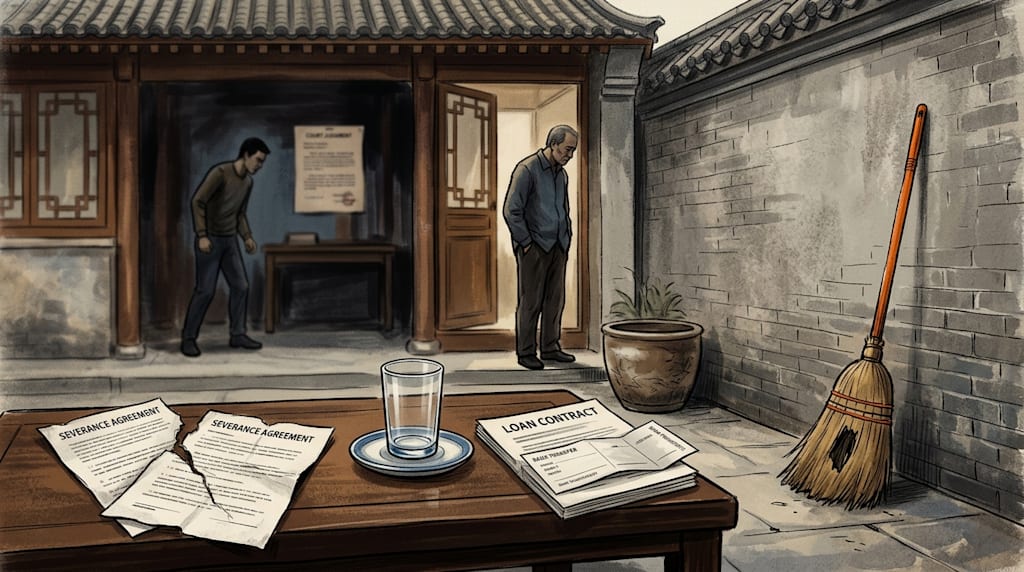
When the two copies of the “Agreement to Sever the Father-Son Relationship” landed on the table, their paper edges pressed on the coaster. Xiao Liu wanted his father, Lao Liu, to sign. Lao Liu tore them up. The fight moved from the house to the courtyard. The two exchanged punches and kicks. Lao Liu picked up a broom and struck Xiao Liu, breaking a metacarpal bone. The injury was minor, Grade II.
Afterward, Lao Liu went to the police and confessed. He raised 250,000 yuan through a bank loan and borrowing from relatives and friends, then transferred it to Xiao Liu. Xiao Liu disputed the nature of the payment and refused to write a criminal letter of forgiveness.
The court found Lao Liu guilty of intentional injury and exempted him from punishment. Legal Daily summarized three disputes: whether a father and son fighting constituted intentional injury; whether the victim’s refusal to forgive blocked exemption; and whether exemption meant innocence. The court got the three basic legal points right.
Kinship does not shield violence. Article 234 of the Criminal Law protects personal health and does not treat family members differently. Lao Liu struck with a broom and caused a minor injury, Grade II. He intended injury and caused it. That is intentional injury. A family dispute can affect sentencing. It does not turn a criminal case into a household matter.
A victim’s refusal to forgive is also not the only condition for exemption. In minor injury cases, forgiveness matters for leniency. The court also weighs the origin of the conflict, who escalated it, voluntary surrender, guilty plea, compensation, and social harm. Here Xiao Liu demanded that his parents borrow 250,000 yuan for his business debts. They refused. He then used an invalid severance agreement to pressure them. Lao Liu surrendered, pleaded guilty, and raised money to compensate. The case grew out of a family dispute. Article 37 of the Criminal Law allows exemption when the circumstances are minor and punishment is unnecessary. The court had a legal basis.
Exemption is not innocence. The judgment still says “guilty of intentional injury” before it says “exempted from criminal punishment.” The court still condemned Lao Liu’s violence. It did not find that he committed no crime.
The weak point is the self-defense review. The Guiding Opinions of the Supreme People’s Court, the Supreme People’s Procuratorate, and the Ministry of Public Security on the Lawful Application of the Self-Defense System require courts to weigh the origin of the case, who was mainly at fault, who struck first, whether a weapon was used, and whether the violence was proportionate. Courts must separate self-defense from mutual assault. Supreme People’s Court Guiding Case No. 225 says a person does not lose a self-defense claim just because he fought back instead of backing down. Fighting back is not automatically mutual assault. Mutual assault does not automatically rule out self-defense.
This case had room for that review. Xiao Liu demanded that his parents borrow 250,000 yuan for his own debts. That demand had no legal basis. After they refused, he brought two invalid agreements and slammed them on the table to force a signature. A natural blood relationship cannot be ended by agreement. The agreements had no legal effect. But slamming them down and demanding a signature was coercive. Lao Liu tore them up. The conflict became physical. Self-defense does not require the unlawful infringement to be a crime. An unlawful infringement is enough.
The timing matters. The fight moved from the house to the courtyard. The two exchanged punches and kicks. Lao Liu picked up the broom during that fight. The broom was an everyday tool in the courtyard, not a weapon prepared in advance. The strike came during the physical conflict, not after a chase. The target was Xiao Liu, who was still in the fight. The intent was to stop the attack. All four dimensions left room for a self-defense finding.
The force also matters. The result was a broken metacarpal bone, a minor injury, Grade II. There was no serious injury or death. Even if hitting the hand with a broom could be criticized, the case should enter the excessive self-defense framework. The court should ask whether Lao Liu “clearly exceeded the necessary limit and caused major harm.” It should not deny self-defense at the outset. A minor injury, Grade II, is usually hard to call “major harm” for excessive self-defense. If the court found self-defense, the likely result would be acquittal, not excessive self-defense with exemption.
But the key facts cannot be skipped. Who struck first? Did Lao Liu’s tearing up the agreements escalate the fight? Was Xiao Liu still attacking when the broom came up? Had Xiao Liu stopped or stepped back? Where did the blows land, and how many were there? If the evidence showed both men agreed to fight from the start, or that Lao Liu chased Xiao Liu after he stopped, then denying self-defense would have support. If the evidence showed Xiao Liu shoved first and kept punching, and Lao Liu picked up a nearby broom to fight back, the court should answer the self-defense claim directly.
That is where this judgment is too cautious. It resolved the conflict at sentencing without fully explaining the self-defense review at the guilt stage. Conviction with exemption can stand. A desire for stability is understandable. But if the judgment used “mutual assault” to cover the self-defense defense, the reasoning is thin. A better judgment would answer three questions: Why was self-defense not established? Was the force excessive self-defense? If not, why not? A bolder judgment would address the statutory ground favorable to the defendant instead of avoiding it because the case is sensitive or the family relationship is unusual.
Three issues need separate treatment: the 250,000 yuan, the letter of forgiveness, and the duty of support. Xiao Liu took the money, disputed its nature, and refused to write a letter of forgiveness. That looks bad morally. It is not illegal. Forgiveness is the victim’s right. It cannot be forced. Whether the 250,000 yuan was a loan, a gift, or compensation must be settled with civil evidence. It is not money to buy exoneration. Lao Liu folded the transfer receipt and put it inside a copy of the loan contract. The nature of the money can be argued later in civil proceedings.
The severance agreement is invalid. It does not cancel the duty of support. An adult child’s duty to support his parents is a statutory obligation. A father-son conflict or a criminal case does not automatically end it. The amount would depend on both sides’ finances, the parents’ fault, and other factors. “I signed the severance agreement, so I do not have to support them” does not hold up in law.
The last line of the judgment was “exempted from criminal punishment.” Lao Liu leaned the broom against the courtyard wall. It was missing a tuft of bristles. The transfer receipt was still folded inside the loan contract, its paper corner pressing on the bank receipt. There was no wind in the courtyard. The coaster was still on the tea table.
About the Creator
Jin
Writer of reamstories
https://reamstories.com/jin
Enjoyed the story? Support the Creator.
Subscribe for free to receive all their stories in your feed. You could also become a paid subscriber, letting them know you appreciate their work.
Comments
There are no comments for this story
Be the first to respond and start the conversation.