
The Backpack Behind the Door: When Your Seventh Grader Refuses to Go to School
Carrot and stick won’t work. Here’s what to do instead.
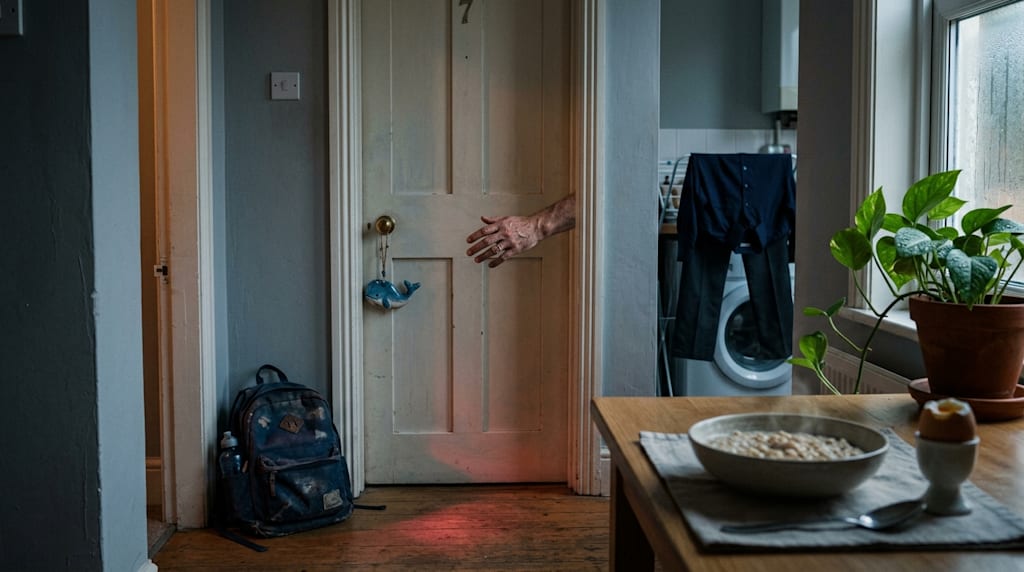
At 6:30 in the morning, the alarm rang for the third time. You stood outside your child’s door. Your hand went up. You lowered it. On the doorknob hung a charm from last year’s autumn field trip. A blue whale with chipped paint. Inside, nothing. You knew he was awake. You also knew that if you pulled off the blanket again, the day would turn into silence, arguments, slammed doors, or something worse.
You had tried coaxing. You had tried scolding. You had cut the internet. You had called teachers and relatives. None of it worked. He said one sentence: “I’m not going.” If you asked more, he locked himself in.
Stop first.
1. Put school aside for now
Change methods. Do not give up.
When a child refuses school, school has become tied to pain. Maybe fear. Maybe shame. Maybe suffocation. Maybe exclusion. Maybe a knot he cannot name. The more you push, the more he believes you are not helping him. You are escorting him.
For one or two weeks, take school off the dinner table. Do not ask if he is going today. Do not ask when he will go. Do not ask what will happen if this continues. Those questions hit like hammers. Each one makes the door thicker.
Say this:
“You do not have to go to school right now. We will not force you today. We still need to keep you safe and keep some rhythm at home.”
That clears the battlefield. If the relationship survives, you can talk again.
2. The bottom line is life, not the desk
Not going to school does not mean no rules. The rules change.
No self-harm. No hurting others.
Eat and sleep, at least basically.
Phone use is allowed with limits.
Do one small activity each day: walk, take out trash, wash dishes, pick up a package.
Do not disappear completely. Keep some contact with parents.
How does this look? Use objects, not speeches.
Put the charger in the living room. At 11 p.m., turn off the router. You are moving charging out of the bedroom.
Put breakfast by the door. Knock once. Say, “Porridge is by the door. Egg is still hot.” Do not ask if he will eat.
If he gets up at 3 p.m., do not yell. Open the curtains. Say, “Sun is nice. The pothos is almost dry. Water it if you can.”
If he says he is not going, say, “Okay.” Then go wash dishes. Running water works better than a lecture.
Accept feelings. Do not accept every behavior. You can feel awful. You cannot smash things. You can rest. You cannot flip day and night. You can stay quiet. You cannot vanish.
3. Seventh grade is a weak point
Elementary school was fine. Then seventh grade started, and everything changed. Why?
Seventh grade is not just one grade higher. New school. New class. New classmates. Old friends may be in other classes. Subjects go from three to seven. More homework. More tests. Rankings go up on the wall. Teachers stop holding your hand. Class moves faster. The body changes. Moods swing. Some children board. The bed is hard. The cafeteria is crowded. After lights out, someone cries.
For sensitive children, these things stack. For children who need to be perfect, one bad test can collapse everything. For children who cannot speak up, one laugh can stay for months.
School refusal is not laziness. It is a red light on the dashboard. You cannot smash the bulb and keep driving.
4. Check three lines: school, family, child
Do not only ask the child. He may not know how to explain. He may fear that talking makes it worse. Trace three lines at once.
School
Message the homeroom teacher. Do not start with “How do we get him back to class?” Ask about details:
“Hello, Teacher. My child is in a bad state and refuses to go to school. We are worried and trying to understand why. I am not here to make trouble. I want to know how he is at school and ask the counselor to help. Who does he sit with? Where does he stand in PE? Who does he eat with? Has any teacher criticized him lately? Is anyone isolating him, laughing at him, or pushing him?”
Watch for bullying. Many children do not say, “I am being bullied.” They say, “I do not want to go to school.” If bullying is real, ask the school to investigate and protect him. Do not go to fight. Go to ask for a plan.
Family
Look at the last three months. Was there a move, a school transfer, a death, bad fighting, divorce, a new baby, money trouble? Have you said, “If you do not get into high school, you are finished,” or “We sacrificed so much for you”? Do the parents agree on discipline? Is one very strict and the other very protective? Has there been door slamming, cold silence, or talk of divorce in front of the child?
Sometimes a child refuses school to shield the family from gunfire.
Child’s body and mind
Sleep: What time does he sleep? What time does he wake? How long does he nap?
Appetite: How much does he eat? Has he lost weight?
Mood: Irritable, low, crying, numb?
Interests: Does he still touch games, basketball, comics?
Friends: Does he still contact anyone, or has he cut everyone off?
Phone: Is it fun, or his only shelter?
Self-harm: Any marks on arms, legs, or things in the drawer that should not be there?
You can observe. If you spy and then confront him, it will explode. Say, “I notice you seem very tired. I am worried. I am not trying to spy.”
5. Replace “Why won’t you go?” with “I know this is hard”
Many parents start with, “Why won’t you go?” “What do you have to feel bad about?” “Do you know what will happen to you?”
The child hears judgment.
Change the script. Describe facts. Express worry. Acknowledge difficulty. Offer a choice that does not force him.
“I see you have not come out much. You are not eating much. I am worried. I know school may be very hard for you. Hard enough that you do not want to go. We will not force you today. Your safety matters most. When you want to talk, we will figure it out together. If you do not want to talk to me, talk to the counselor or someone you trust.”
If he says, “You do not understand,” “Talking is useless,” or “It is all my fault,” do not argue. Say:
“Maybe I do not fully understand. I am willing to listen. If talking makes it worse, we can wait. I am here.”
Let him know you are helping, not escorting. Safety comes first. Cooperation comes after.
If he trusts someone, an older cousin, an aunt, a former teacher, a counselor, ask that person to spend time with him. Do not build a persuasion team. Do not take turns telling him to go back. Just listen.
6. When to get professional help
If he has not gone to school for one or two weeks and has any of these signs, see a child and adolescent psychiatrist or psychologist:
Long low mood, irritability, hopelessness.
Insomnia, early waking, day-night reversal.
Big appetite changes, weight loss.
Saying “Life is meaningless” or “I do not want to live.”
Self-harm or repeated dangerous acts.
Hallucinations, delusions, disordered speech or behavior.
Severe social fear, cannot leave home.
Internet addiction, completely cut off from reality.
Headaches, stomachaches, heart palpitations, nausea, with no physical cause after checks.
This is not drama. It may be depression, anxiety, OCD, social phobia, trauma, ADHD, or a learning disorder. An evaluation is not a label. It finds the right help. Sometimes therapy. Sometimes medication.
If there is self-harm or suicide risk, go to the emergency room. Remove dangerous objects. Stay with him. Call the National Psychological Assistance Hotline 12356. In an emergency, call 120 or 110.
7. Talk with the school about flexible options
The school is not the enemy. Make it an ally.
You can discuss:
A temporary leave, with local paperwork.
Regular sessions with the school counselor.
A half-day schedule first, or going first to the counseling room or library.
Delayed homework and exams.
Changing seating, dorm, or class.
If bullying is involved, asking for an investigation and protection.
If a teacher conflict is severe, considering a class change or transfer, but not as the only option.
The point is to help him feel safe again, not to force the school to take him back.
Returning to school should be step by step. Today, to the gate. Tomorrow, ten minutes in the counseling room. The next day, half an hour in the library. Then one class, half a day, a full day. Acknowledge every step. Do not punish failure. If he reaches the gate but does not go in, he still reached the gate.
8. Parents need support too
When a child refuses school, parents carry a heavy load. You will feel anxious, angry, guilty, ashamed, out of control. These feelings are normal. If you pour them all onto the child, he will feel weaker.
Stop blaming each other. Do not play good cop and bad cop. Do not argue in front of the child about who spoiled him. Divide tasks. One person handles daily care. One handles outside communication. One listens. One records. Take ten minutes at night. Do not talk about the child. Talk about yourselves. Drink water. Turn off the lights. Sleep.
When parents are steady, the child has room to steady himself.
9. Do not do these things
Do not cut off internet, food, or allowance to force him.
Do not send relatives to bombard him with calls.
Do not humiliate him in public or bring up old mistakes.
Do not pretend everything is fine. Do not cry every day about your sacrifice.
Do not rush a formal leave or transfer without an evaluation and a plan.
Do not promise, “Once you go, everything will be fine.” School may really hurt him.
Do not secretly check his phone and then confront him. The relationship will break.
10. You can do these things
Make sure he sleeps, eats three meals, and gets outside.
Lower academic talk. Rebuild the relationship first.
Do small things together: cook, walk, do a puzzle, watch a movie.
Ask someone he trusts to talk with him.
Record what you see: sleep, mood, food, phone, self-harm, friends.
Keep talking with the school, without pressure.
Book a professional evaluation. Sooner is better.
Find support for yourself. Do not carry this alone.
11. The backpack behind the door
When a seventh grader refuses school, it is not a parenting failure or the end of his life.
It is a red light. There is danger ahead. Stop and check.
Carrot and stick do not work because the problem is his condition. The child does not refuse to get better. He cannot get better.
Do not push him back to school first. Walk to his side. Find where he is stuck.
Returning to school comes last. Build the road first. Then let the car through. Relationship is the road. Safety is the roadbed. Cause is the map. Professionals are the navigation. When the road is repaired, the car can start again.
One morning, you notice the backpack behind the door has moved. The zipper is open. The blue whale charm has turned. You do not ask. You put breakfast on the table. You add one egg. The pothos drips water. The school uniform hangs by the washing machine. It is not dry.
He comes out. He sits. He bites the egg. Neither of you mentions school. A car passes outside. The horn honks once. He pushes the bowl toward you. “Is there more?”
You say, “Yes.”
The porridge in the pot is still warm.
About the Creator
Jin
Writer of reamstories
https://reamstories.com/jin
Enjoyed the story? Support the Creator.
Subscribe for free to receive all their stories in your feed. You could also become a paid subscriber, letting them know you appreciate their work.
Comments
There are no comments for this story
Be the first to respond and start the conversation.