grief
Losing a family member is one of the most traumatic life events; Families must support one another to endure the five stages of grief and get through it together.
From the Heart of Chaos to the Awareness of the Survivor.
There are families not made of love, but of performance, where the bonds of affection are replaced by roles in a psychological theater. These families don’t raise children, they cast roles. The mother becomes the director of emotional manipulation, the father fades into the shadows of absence, and the children are assigned parts that suffocate their individuality.
By Sayed Zewayedabout a year ago in Families
Here’s The Real Reason Why Men Stay With Women They Hate
Does anyone else remember watching TV from yesteryear? As someone who grew up with mostly retro television, I sure do. I remember watching Married with Children with my parents, as well as The Honeymooners.
By Olivia Chastityabout a year ago in Families
A Horrible Accident Of My Grandma's
It was a rainy afternoon in April, the kind of day when the sky can't seem to decide whether to cry or rest. My grandmother, Lillian, had just left the community center where she volunteered every Tuesday, helping children with their reading. She loved those kids like they were her own, even at 72, and insisted on walking to the center daily, no matter the weather.
By Muhammad Ahmar about a year ago in Families
The Silent Strength of Sara(A loyal lady)
In a quiet village tucked between hills and olive trees, lived a woman named Sara. She wasn’t known for her beauty, though her dark eyes spoke of depth and devotion. Nor was she famous for wealth or words. What made Sara unforgettable was her loyalty — a quiet, fierce flame that never wavered. She met Amir when she was only seventeen, and he had returned from the city with dreams in his eyes and poetry on his lips. He loved to speak of stars, of the way the sea hummed secrets at night. Sara, shy and soft-spoken, fell in love with his dreams before she realized she was falling for the man himself. Their courtship was simple. Walks by the riverbank, letters written on yellowed paper, a red scarf she once gave him that he wore for years. When he asked her to marry him, she said yes without hesitation, though everyone in the village said Amir would never stay. “He’s a city bird,” they warned. “He’ll fly off someday.” And he did. Two years into their marriage, with a baby on the way, Amir got a job offer in the city — a promising one, the kind he had always dreamed of. "It’s just for a while," he said. "I’ll set things up, then bring you and the baby." Sara nodded, trusting him with the whole of her heart. She kissed him goodbye, pressed the red scarf into his hands, and never once let tears betray her courage. Days turned into months. The baby — a daughter, Leena — was born. Sara wrote letters every week. Sometimes Amir replied. Sometimes he didn’t. The village women whispered. "He’s forgotten you." "He won’t come back." But Sara would only smile gently, humming lullabies to Leena in the same voice she once used to read Amir’s poems. Years passed. Leena grew, asking questions: “Why doesn’t Papa come?” Sara never spoke bitterly. “He’s working hard, far away. But he loves us.” She made sure her daughter’s heart never knew resentment, only longing and belief. Then, one winter evening — twelve years after he left — Amir returned. Time had carved lines on his face and guilt in his eyes. He came without riches, without the dreams he once chased, holding only that faded red scarf and a tired soul. Sara didn’t scold or cry. She simply opened the door, looked into his eyes, and said, “We’ve been waiting.” Amir fell to his knees, broken by the weight of her kindness. “I failed you,” he whispered. She placed her hand gently on his shoulder. “No. You just got lost for a while.” In the years that followed, their home echoed with laughter, forgiveness, and stories. Sara never glorified her patience nor demanded anything in return. Her love had never been a contract; it was a gift, given freely and fully. People still speak of her in the village — not just as Amir’s wife or Leena’s mother, but as a woman who taught them that love isn’t just found in passion or poetry, but in the quiet power of staying. Sara’s story was never about grand gestures or perfect endings. It was about love in its rawest form — patient, steady, and enduring.
By Dr Gabriel about a year ago in Families
7 Ways to Turn Heartbreak into Power
Heartbreak is a highly personal experience. No matter whether it has been brought on by a sudden break-up, betrayal, or failed engagement, the emotional hurt can be debilitating. In most cultures—Nigeria not being an exception—there is often pressure to "get over it" quickly or to hide your pain for the sake of appearances. But the truth is, you don’t have to stay broken. With the right mindset and steps, heartbreak can become a stepping stone to personal power. Here are seven real, research-backed ways to turn your pain into purpose, drawing from experiences familiar to people both in Nigeria and beyond. 1. Allow Yourself to Feel and Heal In cultures where strength is mistaken for silence, it's easy to suppress emotions. But healing starts with honesty. Let yourself cry, journal, pray, or reflect. Whether you’re in Lagos, Nairobi, London, or Atlanta—emotions are universal. Don’t let society rush your process. As the Yoruba proverb says, “ọjọ́ kan kò mọ'gbón ṣe” (wisdom doesn't come in one day). Take your time. Healing is strength. 2. Cut Off Contact and Cleanse Your Space Delete that number. Unfollow them. Remove shared photos or gifts. Your environment has power over your emotions. Many people—whether in Enugu or Edmonton—find peace through spiritual or emotional cleansing. This could mean prayer, therapy, a solo trip, or simply rearranging your room. Create a new atmosphere that reflects your future, not your past. 3. Reconnect with Your Identity Heartbreak has the ability to erase your sense of self. Go back to your origins—whatever that may be for you, whether that's time with your family, getting lost in your culture, or grounding yourself spiritually. In many African cultures, it was said by the elders: "What happens to a man also happens to a woman." Heartbreak is not a lack—it's human. Retake your sense of self. 4. Channel Pain into Purpose Heartbreak has inspired music, businesses, books, and careers. Turn that pain into fuel. A woman in Port Harcourt used her canceled wedding funds to launch a catering business. Today, she runs a thriving restaurant. Whether it’s launching a side hustle, returning to school, or writing your story—create something meaningful from your experience. 5. Give Attention to Your Physical and Mental Health This is your cue to prioritize self-care. Get to the gym, walk far distances, eat healthily, hydrate, sleep more. Mental well-being is no different—talk to a therapist, counselor, or trusted friend. In cities such as Abuja, Nairobi, or New York, mental wellness support groups are becoming increasingly popular. Healing isn't just emotional—it's holistic. 6. Build a Support Network Pain grows louder in isolation. Reach out to friends, family, or support communities. From WhatsApp groups in Lagos to healing circles in Johannesburg or online forums in Canada—people everywhere are choosing to heal together. Find your tribe. Talk. Share. Listen. Let others remind you that you’re not alone. 7. Reinvent Yourself Let this be the chapter where you reintroduce yourself to the world. Switch careers. Learn a skill. Relocate. Change your wardrobe. Start a new routine. Glow up on your terms. One woman said, “This pain birthed my power.” Let your heartbreak shape a newer, stronger version of you—one who rises, not despite the pain, but because of it. Final Thoughts Heartbreak doesn’t have to be the end of your story—it can be the beginning of your evolution. Whether you're in Nigeria or anywhere else in the world, your pain is valid, but it doesn’t define you. With each step you take toward healing, you reclaim your power. You are not weak. You are not broken. You are rising. Let your heartbreak be the spark that ignites your greatest comeback.
By Chinonso Kingsleyabout a year ago in Families
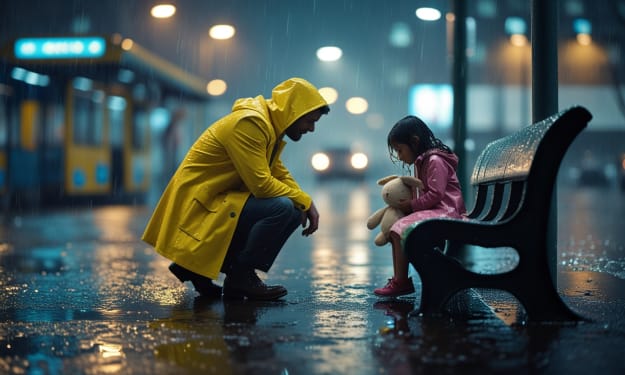
🌧️ Kindness in the Rain
The rain didn’t just fall that night—it attacked. It slammed against the pavement with a fury, turning streets into rivers and umbrellas into crumpled messes. People rushed by, heads down, eyes averted, chasing warmth and dry shelter. No one noticed the little girl on the bench at the bus stop. Soaked to the bone. Shivering. Silent.
By Ahmad Malikabout a year ago in Families