
I Planned to Kill My Father. Then I Learned What His Life Had Done to Him.
A story about inherited violence, the people who never escaped, and why understanding someone isn’t the same as forgiving them.
I
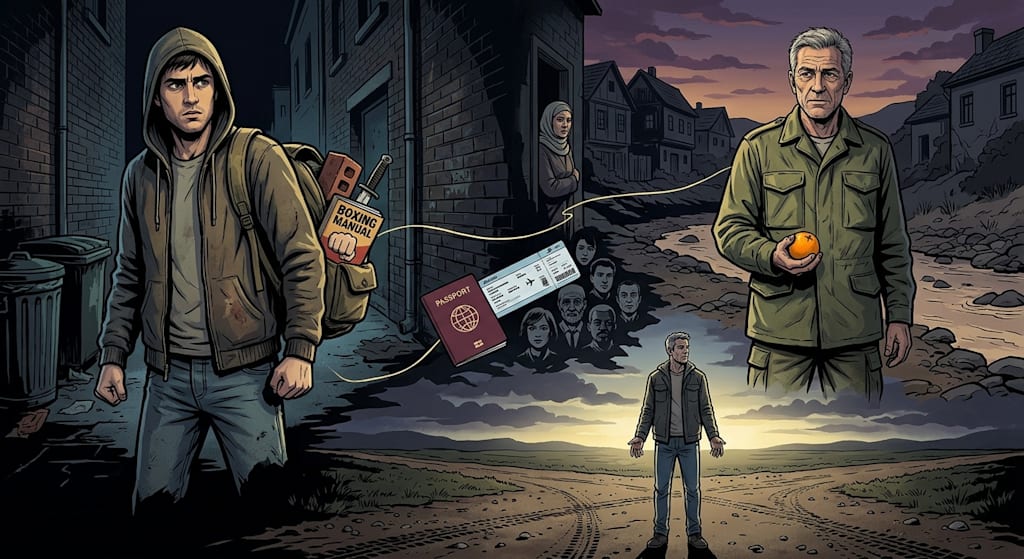
Other kids had textbooks in their schoolbags. Mine had Boxing Practical Techniques, The Tao of Jeet Kune Do, and sometimes bricks and iron rods.
Later, when mobile phones became popular, young men and women carried phones with flashy ringtones in their pockets. I carried knives: folding daggers, military spikes, Yengisar knives, triangular scrapers. I didn’t like these things. I just never wanted to go back to the days of being surrounded, shoved around, and treated as a joke.
By then I already had stress reactions. When there were more of them, my first instinct was to draw a knife, not to run.
I hated my father. I hated him in a concrete way.
At my most hateful, I made a special trip to scout the area near a friend’s home. His hometown was by the Yellow River. He said that in winter, during the dry season, the river channel narrows and some of the riverbed near the bank is exposed. I went to see the conditions. I was calculating: beat my father to death, bury him in the riverbed during the dry season, and the probability of discovery would be low.
This isn’t a boast. When a child is pushed to a certain point, the exits in his head become narrow. So narrow that only violence is left. So narrow that only “you die or I die” is left.
II
From 2014 to 2025, I didn’t say a single word to my father for eleven years.
At the end of 2014, the last time I spoke to him, I used him as a punching bag. I threw combination after combination at his body and broke his ribs. Later he went to my relatives to complain, pitifully. No one supported him. They only tried to persuade me: “He is your father after all. It doesn’t look good for you to beat him like this.”
My sister knew too. She didn’t intervene. Over dinner she chatted and asked me why I hadn’t beaten him to death.
I shot back at the relatives who tried to educate me: “You mocked my father again and again in front of my mother, my sister, and me. Our family became the negative example in your mouths. From the time I can remember, it was your repeated scolding and mockery. Every holiday family gathering had to bring him up, saying he wasn’t human, saying he was useless. You passed your contempt for him on to us, but not one of you helped us. Now that I can’t stand it anymore and want to settle things with him, you turn around and try to persuade me. You’ve said all the good words and all the bad words.”
After that, I stopped going to family gatherings.
For a time I was also sick of my mother. I despised her weakness, her hesitation, her obsession with face, and her double standards. When my father beat her, I stood in front of her. When my father beat my sister, I stood in front of my sister. But when I was beaten, my mother hid to one side. She later admitted that she was afraid of being beaten, so she didn’t dare interfere.
Later, when I grew taller and stronger and was able to fight back against my father, my mother would desperately hold me back every time. She’d grab my arm, pull my clothes, and affect my ability to fight. My father would take advantage of her pulling me to attack me wildly. I often wished I could beat my mother too, or beat her first, but seeing how small and thin she was, I couldn’t bring myself to do it.
I asked her why she only stopped me and not my father. She said she was afraid my father would beat her, so she didn’t stop him; and she knew I wouldn’t beat her, so she stopped me. The reason she stopped me was that I was the son, and in her values, a son cannot beat his father.
After hearing that, I couldn’t speak for a long time.
Poverty, violence, mockery, bullying, double standards, PUA: these things ran through my childhood and youth. They weren’t a few isolated incidents. They were a whole environment. When you live inside it, you think the world is just like that.
III
No one supported me when I went abroad. Only one friend gave me his salary card and told me to take as much as I needed. He was from Gansu and working in Zhengzhou at the time, earning 3,500 yuan a month. There was more than 10,000 yuan in the card. I took 10,000 RMB and went abroad.
When I first arrived abroad, I planned to learn English, get familiar with firearms, earn some money to pay back my friend’s loan, and then go fight in Afghanistan and Iraq. ISIS was making a lot of noise at the time. I contacted the Iraqi and Afghan embassies in Southeast Asia and asked how to join their government forces.
Because I felt life was painful. I might as well go to the battlefield and fight the most brutal people, and that would be the end of this life. As for family and parents, I didn’t want to forgive them, and I didn’t want to discuss anything with them.
Later, I gradually established myself abroad. I had my own team and business, savings, people and things I cared about. Only then did my mindset slowly change.
Southeast Asia is a dye vat and also an amplifier of human nature. Good people still insist on being good, but people who aren’t good are easily corroded. I saw many people with miserable fates there, and many tragic cases.
In China, my background and experiences were the worst among my peers. None of my classmates or colleagues had it worse than I did. But abroad, I met quite a few Chinese who were just as miserable. Like me, they had chosen to go abroad to escape their original families and terrible growing environments.
As the old saying goes: “When a clan thrives, stay in the hometown; when a family is poor, leave for another land.” Happy families rarely let their children go to dangerous and chaotic places to survive. Many of the Chinese I met in Southeast Asia indeed had their own bitter stories.
IV
A friend from the north. When she was young, she was raped by her own brother and suffered from long-term depression afterward. Her parents were extremely partial to her brother, indulging him when he caused trouble outside and using the family’s savings again and again to clean up his messes. Her brother is now over forty and still a good-for-nothing local thug. Her parents no longer have the ability to compensate for him, so they morally blackmail her and make her pay again and again.
The partner she had been with for ten years thought her family had too much trouble, couldn’t bear it, left her, and married someone else. Her depression worsened. She self-harmed and attempted suicide, but was rescued each time.
Her parents got old, her brother was still causing trouble, and there was no one to care for her parents. They forced her to return to China. She couldn’t get past the psychological barrier of abandoning her parents, so she went back, opened a small restaurant, and now supports herself, takes care of her parents, and drinks heavily.
I once thought about using evil to fight evil: have her bring her brother to Southeast Asia, wait for him to cause trouble, then arrange for the police to arrest him. She said her brother was alert. People like him who cause trouble everywhere seem to have an instinct for danger, and he absolutely refused to come to Southeast Asia.
I also gave her an extreme plan. After hearing it, she thought for a long time and said she couldn’t do it. Just like I couldn’t bring myself to harm my mother.
Last year, when I returned to China, I passed through her city. She warmly hosted me, called friends to drink with me, and got me dead drunk every day. One late night, drunk and bleary-eyed, I saw her on a video call with her mother, crying and speaking in dialect. I couldn’t understand much, only phrases like “living is painful” and “when will this end.” Her mother’s aged face on the phone was full of pain, her hair completely white. It was two in the morning. I took the phone, said a few words to her mother, and told her to go to sleep early.
Later I asked her, “Is this your daily life?” She said usually there weren’t so many people drinking with her, but yes, she drank every day. If she didn’t drink, she couldn’t sleep.
I drank for three days in that city and went nowhere. Just drank every day, every meal. While drinking, I learned her restaurant business wasn’t good either. Before I left, I transferred her 10,000 yuan, saying it was a loan, and told her to pull herself together and find a way to change this life, or she would drink herself to death. She saw me off at the high-speed rail station and nodded and agreed nicely, but she looked distracted, not like someone who could quit drinking. Later it proved true: she still drinks at least twice a day, barely kept alive by alcohol.
A woman from the northwest. Her parents divorced. Her mother had little sense of responsibility and ignored her after the divorce. Her father had some sense of responsibility but not much. He remarried and had a son, and her stepmother didn’t like her, so she was left to live with her grandmother for a long time. Because she lacked a safe environment and adult attention, she was raped. Later she went abroad and spent every day in acquaintances’ circles cursing China’s social system and legal system. Whoever said China was good, she would chase and argue with them. Whoever said foreign countries were bad, she would also grab onto them and not let go. She believed that as long as it was abroad, even a backward country with a bad economy and high crime rate, the legal and human environment was better than China’s.
Her extreme and contradictory views made her relationships bad. Almost no one was willing to be her friend, and she was lonely. When I first met her at a friend’s dinner abroad, I thought I had met a low-end public intellectual, a self-funded pro-American. Later, after learning her story, I understood: she was using extremism to protect herself.
A woman from Sichuan-Chongqing. She was raped when young, which had a big impact on her personality. Later she worked in bar marketing in Southeast Asia. She changed boyfriends faster and faster, each one handsomer than the last. She sighed that all men were bastards while immersing herself in bars and nightclubs looking for men. Later she got pregnant with some handsome guy’s child. She knew the nightclub pretty boy was unreliable, so she gave birth and raised the child alone. Then she felt bar marketing was too tiring and the pressure of raising a child was too great, so she planned to become a prostitute or a mistress. She asked me if I knew any bosses looking for a kept woman, and asked me to introduce her to a relatively reliable one so she could sell her body for money.
I had helped her handle several disputes abroad and knew her nature wasn’t bad. After learning she had this idea, I tried to persuade her: before having a child, she could indulge and have fun, but after having a child she had to restrain herself. Some things definitely cannot be done. If she did them, they would be a stain on her life, and her child would look down on her if they found out.
A Huawei guy. He was the eldest in his family, from a place in the south where son preference is strong. His parents were extremely partial to his younger brother. Since childhood, they made him give the good food and good toys to his brother. His brother developed the habit of taking advantage of him. Now his brother is married, but neither he nor his wife works. They lie flat at home and live off his transfer payments. Whenever he refuses, his parents pressure him: your salary at Huawei is high; if you don’t help your brother, we won’t recognize you as our son.
Being loved produces confidence; being abused produces loyalty. This guy had been abused so much that his parents had him under control. Huawei’s overtime is brutal. Because of long-term overtime, he was in the prime of life but his hair was already white. I advised him to take care of his health and not have an accident, because he had a wife and child too. But his parents didn’t care much about his wife and child; their eyes were full of his brother’s family. I said, if something happens to you, your wife and child will have no one to take care of them, and given your parents’ and brother’s character, they won’t easily let go of your assets. They won’t show mercy to your wife and child.
A guy from the south. He was long oppressed, squeezed, and PUA’d by his parents and original family. He also came from a southern place with strong traditional values. On the surface, son preference seemed to benefit him, but in a poor family, he carried his parents’ vanity and desires: he had to be successful, make money, build a big house in his hometown, and provide his parents with a dignified old age. Even abroad, he was not let off. His parents forced him to send money on time. If he didn’t send it or sent less, they humiliated him.
He had severe depression from an early age. Later he went to Southeast Asia and met a Chinese woman who looked sunny and sweet. He thought he had found true love. But the woman was only sweet on the outside; in essence she was a demanding overgrown child. She also loved going to nightclubs. I knew her because years ago she got into a fight at a nightclub over an emotional dispute. Security restrained them and called the police. Someone contacted me to bail her out at the police station, so I remembered her.
Getting involved with this demanding overgrown child did no good for his depression; it accelerated its deterioration. Coupled with the pressure from his original family, later he couldn’t think straight and committed suicide. After he died, his overgrown-child girlfriend contacted us for help, because his uncle had brought people from China to Southeast Asia to handle his affairs. Southern families are usually large and powerful, especially when handling weddings and funerals, they are united. Although their influence abroad was limited, his girlfriend was worried about being made difficult by his uncle and relatives, so she wanted us to step forward and deal with them.
We arranged for a Chinese friend to appear on her behalf and deal with his uncle and relatives, but the friend didn’t give them a good face the whole time. If these idiot relatives hadn’t pressured him, he wouldn’t have collapsed to the point of suicide.
V
Take my father as an example.
In the past two years, when I returned to China, I occasionally beat him up, but I held back. I was afraid his old arms and legs couldn’t take it. When I saw he was restless, I’d whip him a couple of times. Now I no longer hate him, and I no longer have the desire to kill him. He even proactively sends me videos and messages.
The change in my attitude came because I realized my father’s life was also miserable, and he had no path of escape.
My grandmother was a famous shrew in our hometown. She was arrogant and domineering, so much so that no one in ten miles dared provoke her. She was domineering to outsiders, and even more domineering at home. Anyone in the family who disobeyed her would be made to turn the house upside down. My father had many siblings. In difficult times, this kind of family often didn’t have enough to eat. The family’s few resources and food were controlled by my grandmother. Whoever disobeyed went hungry. My father and the others often went hungry. To avoid hunger, they could only obey and submit. This further solidified my grandmother’s power in the family.
When my mother was pregnant with me, she lived at my grandmother’s house. Worried she wasn’t getting enough nutrition during pregnancy, she wanted to eat some eggs. But every day the fresh eggs at home were collected by my grandmother’s orders to my aunt, who counted and marked them. Only eggs that had been left too long and were slightly spoiled were allowed for my mother. Two of them. I was born in the 1990s, but my grandmother still maintained the habit of controlling food. My father was born in the 1960s, so his memories of hunger were certainly deeper.
My mother once secretly took a few fresh eggs. My aunt discovered it when checking the count. My grandmother quietly watched as my aunt cursed at my mother’s door for days. Every time my aunt cursed, my grandmother stared coldly at my mother. This incident was one of my mother’s psychological shadows. Now my mother is over sixty, and when she brings it up she still can’t forgive my aunt. Although after my grandmother died, my aunt escaped her control and now always tries to get close to my mother, my mother still doesn’t want to talk to her much, at most a few polite words, never inviting her to stay for a meal.
Apart from these small episodes, my father and several uncles were controlled by my grandmother for years. She didn’t arrange for them to start families, didn’t arrange blind dates, and didn’t allow them to get too close to partners. If my father said a few good words about my mother in front of my grandmother, he would be reprimanded. When my mother wasn’t around, my grandmother often spoke ill of her and incited my father to oppose her.
One uncle found a partner and lived with her for a long time, but my grandmother wouldn’t arrange for them to marry and controlled all the family property. Eventually the woman gave up, broke off the relationship, and married someone else. One uncle couldn’t bear the torment of the original family and died early. The uncles still alive are all single, old bachelors at their age.
My father was handsome when young, smart, and did well in school. When the local area recruited pilots, he passed all the physical exams and interviews and ranked second in the whole county. But the pilot qualification that had been decided was replaced by someone else. Families with power and resources could easily do such things in those days. My grandmother’s domineering abilities were useless in this matter; she couldn’t give my father any help. After this blow, my father was depressed for a long time and was often gossiped about in the village and town.
Then he went to join the army. His comrades all had family to see them off, but no one came for my father. He got on the train with the new recruits like a fool. The comrade next to him gave him an orange. That was when he was almost twenty, the first orange of his life.
My father later mentioned this orange many times.
Not long after joining the army, his unit received orders to participate in the Sino-Vietnamese War. I don’t remember how old my father was when he first went to the battlefield, but it should have been about the same as college students now. Young and green, pushed onto the battlefield, he must have received a lot of stimulation. I always felt that his later emotional instability, irritability, and tendency to hit people were related to this battlefield experience. He probably had PTSD, but he refused to go to the hospital and insisted there was nothing wrong. When I asked him about the battlefield, he didn’t want to talk in detail.
After my father transferred from the army, the comrades and relatives around him were all muddled. Those who followed the rules did proper work; those who didn’t were desperadoes. I later looked it up: the most chaotic period before Hong Kong’s return happened to be the active period of that batch of people after the Sino-Vietnamese War. The prototype of the movie Long Arm of the Law was them.
My father was among the rule-following ones in that batch of veterans. But his original family determined his horizons. It was not the same as officials’ or businessmen’s families where someone could guide you. In those days there were no mature information channels, not even many bookstores. It was difficult for muddled people to open their minds. He was swept along by the times. Before he understood the ways of the world, he met my mother. My grandmother didn’t allow them to marry, but my mother insisted on marrying him, and my grandfather helped arrange the wedding. Before he was mature, he became a father.
My grandfather was the village party secretary. When my grandfather was alive, my father listened to him. My grandfather treated him well, respected him, and taught him how to conduct himself. When I was just three, my grandfather died. My father completely lost the person who could guide him.
Because my grandparents were irresponsible and strongly controlling, my father’s personality and emotional intelligence were shaped in a terrible way. He was also tortured into a people-pleasing personality in an extreme environment. These weaknesses made him suffer endlessly later in life: used by colleagues, used by fellow townsmen, used by relatives, used by my grandmother, used by some comrades, used as a gun by others. He exhausted himself but couldn’t save money. He couldn’t find the reason. His family, background, circle, and information channels determined that he couldn’t break out of the circle.
In those days there were no psychologists, no AI, no self-media. He was repressed and angry, unable to find an outlet. His psychological problems, his stress disorder, ultimately could only be vented through violence when his emotions collapsed.
His environment determined that no one in his life taught him how to be a normal child, a normal husband, a normal father. Apart from my mother and my grandfather, he never met anyone who cared about him. After my grandfather died, my mother’s horizons and abilities alone were not enough to guide my father through the difficulties he encountered, nor did she have the wisdom to confront my grandmother. From then on, our family was constantly in chaos.
VI
In my father’s era, the pain of his peers, and of people older and younger, cannot be described in detail.
The Cultural Revolution, the rustication movement, the nationwide “blind flow” of migrants, the terrifying detention centers for blind migrants in the south.
In the course of history, some people did become winners, standing on the wind. These people were the lucky ones.
One of our dangers today is being tricked to Cambodia, Myanmar, or Thailand and locked in compounds as slaves. In their era, danger wasn’t abroad; it was right beside them. Apart from the lucky ones, apart from those in the system with secure wages, there were large numbers of ordinary people with no income. Many of them, while looking for income, died at the hands of highway robbers of that era, died in black brick kilns, died in black coal mines, died at the hands of human traffickers, died in unknown small mountain villages, died in Zhangmutou, died in detention centers. Some employees of enterprises who originally had a way to live died in certain people’s operations during the reform of state-owned enterprises.
When we look at their era, it’s like they looked at the Age of Discovery. Explorers who went to sea might bring back gold coins and become winners in life, or they might bring back news of the death of an entire ship, leaving widows and orphans to be bullied ever after. The bold wanted to go out and try their luck, but they had no capital and no skills. After dodging black brick kilns, black coal mines, and highway robbers, they blindly flowed to big cities, and most still ended up as laborers. Women workers with some looks became playthings for foreign businessmen, mistresses in “mistress villages” for Hong Kong taxi drivers. Male workers with some ideas had their wages withheld and no place to complain; they might be taken to detention centers, or tricked into crime. Those who stayed in their hometowns faced a repressive and conservative environment: village gossip, the pressure of filial piety, relatives’ scrutiny, parents’ PUA, harassment by local thugs, the corrupt environment of the time, and the demands of social relations.
After I understood these things, I stopped hating my father. Of course, I didn’t forgive him either. The harm he did to our family was real.
I just stopped hating the boy who had to go hungry if he disobeyed, stopped hating the poor family’s child whose place was taken, stopped hating the man who didn’t eat his first orange until he was almost twenty, stopped hating the PTSD patient pushed onto the battlefield while still green, stopped hating the people-pleasing personality constantly used by others, stopped hating the man trapped by psychological problems with no cure in sight.
I also stopped looking down on those people in an era of blocked information and weak rule of law, when one step forward might mean making money or dying violently, and one step back might mean being bullied or living a mediocre life. Their era did have dividends, but ordinary people were trapped by horizons, courage, family, education, and information channels. It was hard for them to grasp them.
VII
People ask me how I escaped the pain of my original family. I haven’t completely escaped. Sometimes I still have nightmares. When someone provokes me, I still get stress reactions. Sometimes I still fall into low moods without realizing it.
But later I did a few things.
I stopped whipping my father, even with restraint. Boundaries are more useful than punishment: no private one-on-one time in enclosed spaces, no meeting when drinking, short meetings, public places, a third person present, only discuss practical matters. If he gets physical, I leave, call the police, keep evidence.
I set rules with my mother: “When you two conflict, I won’t be present. If you block me, I’ll leave.” This isn’t unfilial; it’s stopping triangulation.
With relatives: no explaining, no arguing, less contact. That retort already made the double standards clear. There’s no need to prove it again.
When stress reactions come, first leave the scene, delay reaction, ground myself. Keep boxing, but put it back into rules and sport. Don’t carry knives.
Find trauma-informed mental health professionals. Trauma-focused CBT, EMDR, and DBT skills are all worth considering. If alcohol affects sleep, get a psychiatric evaluation.
Mourn for the child and young person I was, whose childhood and youth were run through by poverty, violence, mockery, and bullying. Write a timeline and mark clearly where responsibility lies: it wasn’t that I wasn’t strong enough; it was that many people passed their failures on to me.
Have boundaries when helping others. Don’t participate in extreme plans. Refer people to professional help, local social workers, police, crisis hotlines; give limited money and companionship.
“No one can understand anyone else’s despair” is true. But there’s a second half: not being fully understood doesn’t mean you can’t be accompanied.
I’m still on the road. The old alarm still goes off sometimes. Now I know I don’t have to draw a knife.
About the Creator
Jin
Writer of reamstories
https://reamstories.com/jin
Enjoyed the story? Support the Creator.
Subscribe for free to receive all their stories in your feed. You could also become a paid subscriber, letting them know you appreciate their work.
Comments
There are no comments for this story
Be the first to respond and start the conversation.