
I Never Thought I’d Pay Someone to Teach My Kid How to Jump Rope
The rope isn’t the problem. The empty playground is.
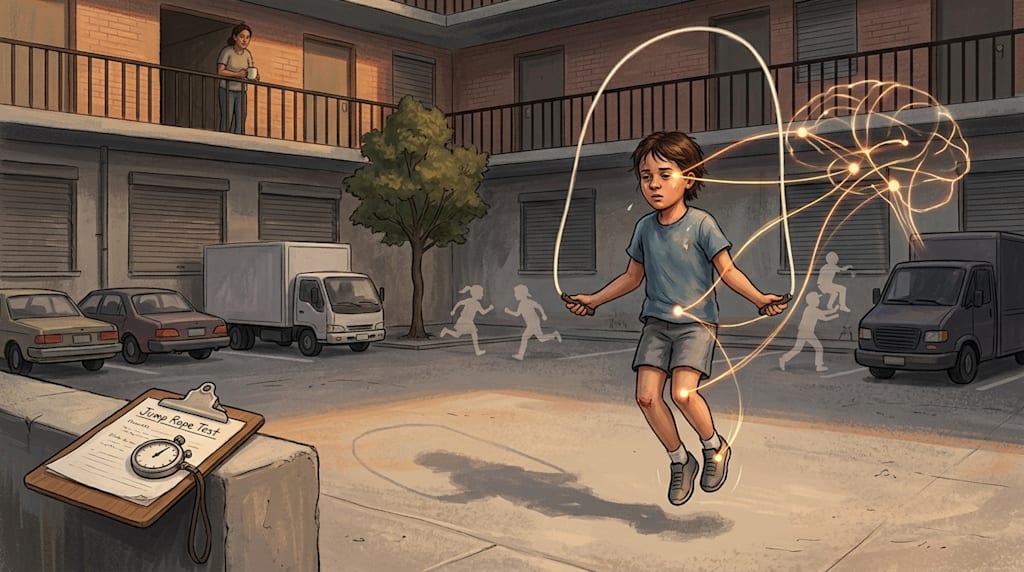
Why do so many kids take classes to learn how to jump rope?
I never imagined that one day I would pay for my child to learn how to jump rope.
Not piano. Not coding. Not English. Jump rope.
When my child was about to graduate from the senior kindergarten class, the parent group chat suddenly started discussing elementary school jump-rope tests: how many jumps per minute, what to do if the child still could not do it, whether to sign up for a class. I stared at the phone screen and remembered being a child on the concrete downstairs, swinging the rope, lifting my feet, missing, and trying again. No one taught me. No one tested me.
Jump rope had become a paid course for this generation.
Later I understood: jump rope itself is not hard. What is hard is having to know how by a certain deadline.
At some point, schools require children of different ages, talents, and movement experience to meet the same standard. But children differ. Some are naturally athletic and learn after watching someone jump twice. Some are younger, and their hand-foot coordination has not caught up. Some are cautious and afraid the rope will hit them. Some do not have enough space and time to practice.
To align with the schedule, those who cannot yet do it have to be pulled up by human effort. That human effort can be a parent, a teacher, or a fitness coach.
So jump-rope classes, fitness classes, basketball classes, roller-skating classes, and swimming classes have become standard for many urban families.
It sounds absurd, but it makes sense.
1. The child is not sick. The environment where you learn while playing is gone.
When we learned jump rope as children, it was not because jump rope was easy. The environment gave us enough opportunities.
There was open space downstairs. The neighborhood did not have so many cars. After school there was a crowd of kids. Parents did not have to watch every second. If you could not jump today, tomorrow you watched others. The day after, you tried swinging the rope yourself. The day after that, you could string three jumps together. No one specially taught you. No one tested you. And no one was anxious because you could not jump.
Now?
For an urban child to learn jump rope while just playing, at least four conditions are needed:
A safe place. Plenty of time. A guardian who can watch the child. Playmates.
Each condition, on its own, is not hard. Having all of them at the same time is difficult for many families.
The place may not be safe: too many cars, too many people, too little space. Time may be chopped up by homework, commuting, and extracurricular classes. The guardian may get off work late or not have enough energy. Playmates are even scarcer. By second grade, children whose parents let them out to play together are already a rare resource.
So sports classes, fitness classes, and jump-rope classes are essentially paying for these things: space, equipment, instruction, supervision, and most important, other kids to play with.
This is like hiring a tutor, an electrician, or a cleaner. You pay a third party with both skill and service to solve a practical problem quickly.
I am not saying every sports class is worth it. But if you ask me, in kindergarten and the lower grades of elementary school, if you must sign up for a class, which is the best value? I would say sports. Fitness, roller skating, swimming, basketball, soccer, jump rope. All fine.
For young children, running, jumping, crawling, climbing, chasing, throwing, and balancing are not just exercise. They are not just burning energy. They are building the underlying foundation of the nervous system.
2. Not being able to jump down stairs is not the same as sensory integration disorder.
Many parents see a clumsy child and immediately think: sensory integration disorder.
Can’t jump rope: sensory integration disorder. Can’t jump down stairs: sensory integration disorder. Writes crookedly: sensory integration disorder. Can’t concentrate: sensory integration disorder. Sensory integration disorder becomes a catch-all basket.
Not being able to jump down stairs may be related to sensory integration, but it is far from equivalent to sensory integration disorder.
Jumping down stairs requires many abilities to work together: vision judging depth and distance, the vestibular system sensing body position and speed, proprioception telling the brain where the feet are, lower-limb strength providing support, the cerebellum and cerebral cortex making movement plans, and enough inhibitory control and safety judgment.
If a child is clearly clumsy, falls frequently, has poor motor planning, lags far behind peers in coordination, and it affects daily life, then a professional evaluation is needed. It may involve developmental coordination disorder, sensory processing difficulties, muscle tone issues, attention problems, and so on.
But “can’t jump down stairs” is itself specific.
Jumping down stairs is not a standard developmental milestone. No authoritative guideline says that by a certain age a child must be able to jump down stairs. Many children cannot do it not because they lack the ability, but because they have been taught “you must not jump down stairs.” Jumping down stairs is dangerous. Parents forbid it from early on, so the child has no chance to practice. Caution, fear, lack of practice, and insufficient strength can all lead to not being able to do it.
Sensory integration difficulties that need clinical attention require professional assessment. You cannot slap on a label just because a child cannot jump rope or jump down stairs. If you are worried, go to a professional institution, such as child health, pediatric rehabilitation, or occupational therapy, for evaluation. Do not sign up for a commercial sensory integration class and use “sensory integration disorder” as a catch-all explanation.
The concept of sensory integration has value, but it has been used far too broadly. Sometimes a child who has not played enough, practiced enough, or had the chance is described as “disordered.”
3. Less play, running, and jumping affects development.
Yes.
And it does not affect only the body.
For young children, running, jumping, crawling, climbing, chasing, throwing, and balancing look like play. They are laying the foundation for the brain and nervous system.
When a child runs and jumps, the brain is not just controlling the legs. It processes a huge amount of information at once: the eyes judge distance and direction, the vestibular system senses speed and body position, proprioception tells the brain where the hands and feet are, the cerebellum constantly corrects movement, and the cerebral cortex predicts the next step, watches others, avoids obstacles, and adjusts force.
The brain is constantly running a high-speed perception, judgment, action, and feedback loop.
This kind of loop is especially important for young children because their brains are still building and strengthening neural networks. The richer the movement, the richer the sensory input the brain receives, and the more systems need to coordinate. Running, jumping, climbing, standing on one foot, and catching a ball are not isolated skills. They train vision, vestibular sense, proprioception, spatial judgment, left-right coordination, rhythm control, and motor planning.
Later, when a child controls the tip of a pen while writing, tracks text while reading, learns new movements in PE, organizes a backpack, or ties shoelaces, all of it builds on these foundational abilities.
The relationship between movement and attention matters too.
Many people think that if a child needs to study, they should move less and sit down. Young children are often the opposite: only after moving enough can they settle down more easily. Moderate-intensity physical activity can raise the brain’s arousal level and blood flow, bringing the prefrontal system, responsible for attention, inhibition, and working memory, into a more suitable working state. Many children find it easier to concentrate for a while after exercise.
Playful running and jumping also train an ability that seems unrelated to sports but is closely related to academic performance: executive function.
Executive function can be understood as the brain’s commander-in-chief. It mainly includes three things: remembering the current rules, controlling impulses, and changing strategies according to the situation.
For example, playing red light, green light: the child must remember the rules; when hearing “red light,” inhibit the impulse to keep running; when the rule suddenly changes to “yellow light, walk only,” adjust quickly. This trains working memory, inhibitory control, and cognitive flexibility at the same time.
These abilities are exactly what classroom learning demands later: remembering step one while the teacher is on step three; not blurting out an answer the moment you see a question; switching to another method after the first solution does not work; resisting the urge to go play while doing homework.
Complex play involving running and jumping is sometimes closer to executive-function training than making a child sit and do ten so-called attention-training worksheets.
This does not mean that running for half an hour every day will make a child better at math. It is not such a direct causal chain.
More accurately, exercise improves some of the underlying conditions that learning depends on: attention regulation, emotional state, sleep, executive function, bodily arousal level, and neuroplasticity. It therefore indirectly helps learning.
When playful running and jumping decrease, it does affect a child’s development. But children are highly plastic. It is not over just because something was missed. The key is to restore opportunities for activity as soon as possible.
4. Free play has value that PE class cannot replace.
When I sign up for sports classes, I am not thinking about the result. I am thinking about the process.
How much progress is made, how good the technique is, whether the teacher is the best: none of that matters much to me. Even if the teacher is average, an hour and a half to two hours of movement does a child no harm.
Money can solve space, equipment, supervision, instruction, and most important, other kids to play with.
But sports classes cannot completely replace free play.
PE class is often the teacher specifying movements and completing tasks. In free play, the child has to decide: Where do I want to go? How do I get past this obstacle? How do I catch someone? Is this safe?
This involves risk judgment, problem-solving, physical confidence, and social negotiation. Reality gives feedback too.
My child is now in fourth grade. The only paid tutoring class he takes is basketball. There is a basketball court nearby, and he could play and run around by himself, but it is hard to gather enough people to play basketball together. After school, he also sometimes plays in the neighborhood with classmates, supervised by another parent, running around playing tag or war games. In summer he often comes back drenched in sweat, and sometimes limping after a fall.
But I still believe children need this kind of playful running and jumping. Getting hurt is part of learning too.
There need to be safety boundaries. Children need room to experience risk within a controllable range, judge risk, and bear small consequences. This kind of learning is hard to do sitting in a classroom.
5. What to do instead.
If you ask me, what is the most realistic strategy for urban families now?
I think it can be:
Simple daily outdoor activity, one or two sports classes a week, and a big family outdoor outing on weekends.
Daily outdoor activity, even just walking to and from school, running for twenty minutes in the neighborhood, jumping rope for ten minutes, biking, or climbing on playground equipment, all counts. Fragmented time adds up. The World Health Organization recommends that children and adolescents aged five to seventeen get at least sixty minutes of moderate-to-vigorous physical activity every day. Preschoolers need more. In reality it is hard to fully meet that, but the direction has to be right.
For sports classes, for younger children prioritize variety of movement, fun, and no early specialization. Fitness, swimming, roller skating, basketball, soccer, and jump rope are all fine. Do not chase technical precision too early, and do not squeeze the child’s interest in movement dry for competition results.
Weekend outdoor time is a good chance to make up for weekday shortages. Hiking, biking, walking trails, running wild in the park, and camping all work. My child is now in fourth grade, sits in the last row by height, has a strong constitution, rarely gets sick, and so far is not nearsighted. He is still not good at complex physical coordination, but he can win prizes in running at school sports day, has great endurance, can hike all day, and can ride fifty kilometers outdoors.
This does not mean every child has to be like this. But it shows one thing: the underlying benefits of movement are far more important than learning any single skill.
As for jump rope, if your child is the cautious, timid type, not especially gifted athletically, maybe try this:
First practice jumping in place with feet together, without a rope. Then practice swinging the rope with one hand, feeling the rhythm. Then put the rope behind you, swing it to the front of your feet, and jump over. Then try one, two, three. Rope length: step on the middle, handles should reach about your armpits. Swing with the wrists, not the upper arms. Land on the balls of the feet, knees slightly bent. Short, frequent practice every day, five to ten minutes, is more effective than one half-hour session. Gamify it: races, counting, music. All are more effective than forcing.
If you cannot teach it, a short-term class is nothing to be ashamed of. Spending money to buy time, peace of mind, and a third party to solve a problem is a normal adult choice.
6. The space downstairs is empty again.
A few afternoons ago, I stood on the balcony and looked down.
The open space in the neighborhood was empty. A few delivery vehicles were parked by the road. Not a single child. After a while, my child ran out from the stairwell, sweating, a small scrape on his knee, a jump rope clutched in his hand. He stood in the open space for a moment, swung the rope twice, jumped over once, then again. The rope hit his calf. He bent down, rubbed it, and kept jumping.
Downstairs was still empty.
But he was still jumping.
About the Creator
Jin
Writer of reamstories
https://reamstories.com/jin
Enjoyed the story? Support the Creator.
Subscribe for free to receive all their stories in your feed. You could also become a paid subscriber, letting them know you appreciate their work.
Comments
There are no comments for this story
Be the first to respond and start the conversation.